
Part 1. Principles of Growth. The Foundation and the Psychology of a Leader (insights №1–17) — https://docs.google.com/document/d/1tXmeqUt6xTjzaB3JPY0XZQQDdZoE4kHmyB6PjdwUgmQ/edit?tab=t.0
Part 2. Principles of Growth. All About the Team (insights №18–33) — https://docs.google.com/document/d/1EblG9uDxHhpF-yavz_jRCNNd2Eld1NXuDiptsEHepOI/edit?tab=t.0
I've settled on four things that make a business or a product genuinely interesting to me:
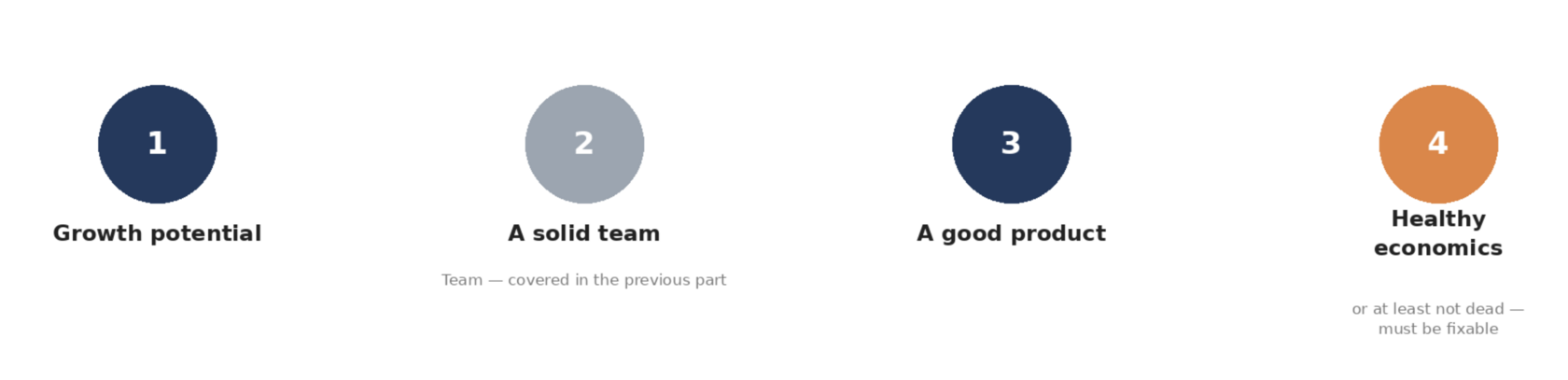
Team is covered. What's left is the other three.
Insight №34. The market has to grow
When we started Ed.Partners, an agency niched into EdTech that offered clients influencer and CPA marketing, everything around us was growing at once — EdTech itself, influencer marketing, CPA. EdTech had strong growth drivers and a low barrier to entry. Then the war began, some channels disappeared overnight, and everyone rushed into influencer and CPA — it felt like we were on top of the world. But two or three years later the market found its ceiling, and growing on a stagnant market stopped being interesting.
The market you're entering has to grow in the future — ideally both now and in the future at once. Even a strong founder in a small, narrow market will never be hugely successful — you need either a massive market or a genuinely unique platform. There are a few rules about markets that I either ignored or only learned years too late (a breakdown of one of the international studies on this).
Insight №35. Narrow means more
Sometimes the right answer to "which market should I take" isn't "all of it" — it's a deliberately small one. Don't try to please everyone at once — pick a group narrow and specific enough that you can make something for it that it actually wants to share. Expanding later is fine, even necessary. Starting out spread thin, aiming "for everyone," almost always means reaching no one.
Peter Thiel puts it bluntly in Zero to One: don't compete, build a local monopoly instead — start in a niche so narrow that you're automatically the only player in it, then expand from a position of strength rather than a fight. Amazon started with books not because books were an attractive market, but because books were the easiest place to become a monopoly, and from there it could grow step by step into everything else — including the cloud infrastructure that today generates more profit than the rest of Amazon combined. Linktree solved one narrow but common problem (social platforms only let you list a single link in your bio), gave away a generous free tier — and every user's public page became an ad for the service itself. Once creators with millions of followers piled in, the company started building new layers on top of that narrow niche — analytics, direct sales from the page. Own a small, real problem completely first, and only then expand.
Insight №36. Build the product from the customer, and only the customer
For about three years I stared at the Lean Canvas and never managed to understand it. Here it is:
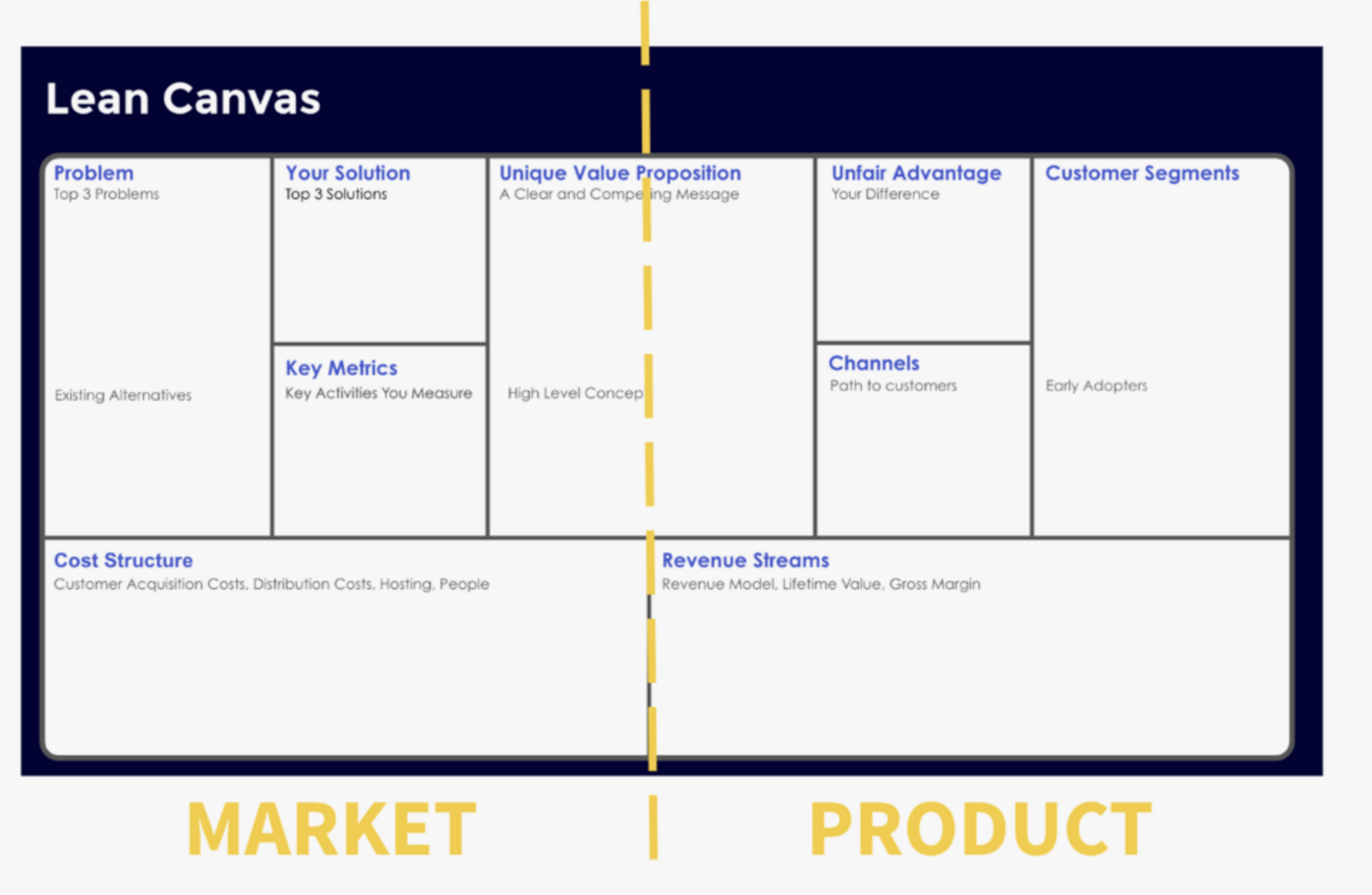
I figured the problem was me: everyone around me raved about this framework, and all I saw was a grid of boxes, so clearly I was missing something. Turns out I just needed a simpler explanation.
You need to understand what the user actually wants — their task, their pain, their expectation, their desired outcome. Build a feature that hits that need precisely. Package it well — sometimes even dress it up a little. And show its value in the customer's own language, not the language of your investor deck. The real skill here isn't inventing — it's digging into the audience, catching demand as it's forming, and turning it into solutions. Do that, and you stop chasing the market — the market starts copying you. I wrote a whole guide on how to know everything about your customer.
When we became co-founders of Vetworkshop, a veterinary school, we grew their revenue fivefold in a single month. We barely touched the product itself — didn't put a single extra ruble into it. We did two things: pinpointed exactly whose pain, tasks, and desires the product addresses, in the audience's own words, and rebuilt the entire communication — landing pages, the customer journey — around those exact words instead of however the company was used to describing itself. That's it.
The same principle shows up at companies like Weber, the grill maker. They know literally every task a customer solves around open-fire cooking, and at every step they have exactly the right accessory ready — which, of course, costs 5 to 10 times more than the generic kitchen equivalent. To be fair, it's often genuinely better. The whole secret isn't inventing sixty new features — it's finding the one need nobody's built a feature for yet, building it, and communicating its value beautifully in the buyer's own language.
Elad Gil makes the same point even more bluntly in High Growth Handbook: until you have a tight fit with real market demand, everything else — growing the team, advertising, a polished brand — isn't just useless, it's dangerous, because it creates a false sense of progress. Hyper-focus on that fit comes first: without it, someone more focused will eventually copy you and overtake you on the exact same idea.
So the right question about a product isn't "what else should we add" — it's this: what would the product have to be for a customer to forgive a broken website and a clunky order form, and still hunt down my personal Telegram just to buy? The best product is the one people buy on their own.
PS: most of those target-audience tables listing "pains, fears, and desires" are useless, because they're obvious to everyone already. A fitness trainer doesn't need a table to know the audience wants to lose weight and is afraid of losing control and getting no results. What you need isn't the pain or the desire in the abstract — it's the specific situation where it shows up. Not "afraid of not losing weight," but "won't go to the beach this summer because I'm self-conscious about my body, and it's already affecting my relationship."
Insight №37. Just raise your prices
Raising prices scares almost everyone who's never done it — and almost always for nothing. Competing on price is a slow death: there's always someone willing to work even cheaper.
The best decision I made at both Ed.Partners and Vetworkshop was the simplest one: raise prices and carefully justify it to customers, instead of chasing more leads at the old price. That money — not a loan, not investment — is what funded marketing at both companies. Raising the price turned out to be no harder than finding a way to justify it. It was only scary the first time.
The logic is simple: if you take 15% of revenue as profit and put another 15% back into the product and service, the customer doesn't experience it as "got 15% more expensive" — they experience it as "got twice as good." Discomfort about the price lives in someone's head for a couple of weeks, tops. The product you put that extra 15% into stays with the customer for the rest of the relationship.
It's worth knowing which model you're actually in: a high-volume business lives on speed, traffic, and a team built for scale, while a high-margin business lives on trust, authority, and a premium team that can afford not to rush. These are two different rulebooks, and trying to play by one model's rules while sitting in the other is usually exactly why raising the price feels so scary.
One simple rule worth keeping in mind in any conversation about price: a customer doesn't buy when the price is low — they buy when the pleasure of the purchase outweighs the pain of paying. You can move either side of that scale, not just the price — but for some reason most people only ever try to move the price.
Hermann Simon, who's studied pricing for decades, calls price the most underrated lever on profit — unlike acquiring new customers, the effect of price doesn't get diluted across CAC, LTV, and a dozen intermediate metrics. It either shows up the very next day, or it doesn't. Simon goes further and shows that for some products the logic flips entirely: the more expensive it is, the more desirable it becomes.
PS: it's better to downsell from an expensive offer than to upsell from a cheap one — the entry point sets the ceiling on expectations for the rest of the conversation.
Insight №38. The one rule that matters for your landing page and positioning
Nine times out of ten, it's not that a competitor is objectively better — it's positioning: you simply haven't articulated what makes you different clearly enough for a customer to remember it in the eight seconds they spend on your landing page — that's about all the time you get before they leave. I broke down exactly how those eight seconds work here.
For years I'd look at competitors' landing pages and think I could never pull that off — it looked too polished. Years later I understood: ninety percent of that is just positioning, not product superiority. Online schools promise "money back if you don't land a job" and bury a condition in the contract that almost nobody actually meets. Some sell "four courses for the price of one," when two of them are standard pre-recorded lessons the company spends nothing on. Some call an installment plan a "subscription" because it sounds more modern. Once you see that, other people's slick landing pages stop being intimidating.
But that doesn't mean positioning shouldn't have teeth. DHL doesn't try to look cheaper or friendlier than competitors — they say outright that they're more expensive, and explain exactly why: speed and reliability where the cost of a mistake is high. That's not defensive positioning, it's aggressive positioning — the company doesn't hide its most vulnerable trait, the high price, it makes that the whole story.
The point isn't to be both cheaper and better than everyone at once — that's usually a trap — it's to deliberately sacrifice something expected in exchange for something competitors don't offer at all. Al Ries and Jack Trout wrote about this before the internet even existed: the winner isn't whoever entered the market first, it's whoever first claimed a word in the customer's head. Being the second or third to actually launch isn't scary. What's scary is not owning a single word at all.
Insight №39. What I learned about sales
— I'll admit it: calling myself a marketer, I was sure I understood sales reasonably well too — after all, I kept insisting marketing and sales should share the same KPIs. Turns out I barely understood them at all, until I had to personally sell Ed.Partners' services myself. The first thing I learned: sales are counted several months ahead, not after the fact. What's the conversion from inquiry to response? From response to a conversation with the decision-maker? From conversation to contract? From contract to payment? And how much time passes, on average, at each step? Once that's measured, sales becomes a simple answer to one question: how many calls and leads do you need this month to hit the revenue number you need three months from now?
— "Why did you even reach out to us?" is one of the most underrated questions in sales, and it's not about the product at all. In the answer, the customer states their own expectations for you — all that's left is to package it back as a clear "you're in the right place." The same principle shows up in the classic "sell me this pen" exercise: the right move isn't to pitch, it's to ask — what do you need the pen for, how often do you write, does it matter if it looks good to other people or is it just for you. And once the customer is qualified as a good fit, a useful follow-up is: "on a scale of one to ten, how would you rate the product? And be honest — why not a ten?"
— You don't need a presentation at all. Talk to the person — they need to see you as the key to their own solution, and after that, they'll buy.
— The single most important thing in sales is not being afraid to say "no." The moment someone tells you "no," the sale is only just beginning — but that works both ways, and the other direction actually matters more. A salesperson also needs to be able to say "no": you wouldn't walk into a budget airline and dictate your own baggage terms. If a salesperson can't say no and grabs at every client regardless of budget, they end up trying to please everyone — and get no financial results at all. The one thing to avoid is confusing this with dodging responsibility for the outcome: promising "give us a hundred thousand, we'll give you a million" is the riskiest sales model there is, because the client leans back, does nothing themselves, and then comes back with complaints. The honest formula is "we're accountable for our part, the result is built by both sides" — it slightly lowers conversion, but it raises average order value and retention, and the client stops terrorizing your team with unreasonable complaints.
Insight №40. A broad, adaptive customer journey map solves everything
For years I considered myself a marketer — I was a CMO, I wrote an article about what a CMO actually should do that dozens of schools ended up citing and putting into their curricula, I gave lectures on managing a 40-million-ruble-a-month ad budget. Not bad, on paper. But once I became a business owner myself, I had to rethink a lot of it.
It used to be simple: on a growing market you run ads, people click through and buy right away. In my experience, in b2c today it takes 7 to 12 touches before someone buys, and in b2b — which I had to figure out separately — it's 10 to 15. That's exactly why I built Partners Digest back in the day, a newsletter that delivered those extra touches through useful content instead of a hard sell. And channels work in combination, not in isolation: retargeting people who came from one channel, a blog that warms up the funnel, a newsletter to your best CRM clients — the effect where channels overlap is bigger than the sum of each one alone.
And no funnel lasts forever — it's a serious mistake to think a setup that works once will keep converting at the same rate forever. That's exactly why I eventually shut down Partners Digest: what used to work stopped working, and that's normal. Flexibility is the key skill of strong specialists: the ability to doubt your own methods and try something new, even when it's uncomfortable. Weak people cling to what's familiar. Strong people are constantly testing approaches, breaking and rebuilding systems that already work. Yes, not everything sticks — but some of what you try does, and it delivers compounding gains.
Insight №41. Marketing has a line, and manipulation crosses it
Any audience can be roughly split into two groups. The aware group understands that easy results don't exist, pays for real value, gets disappointed less often, and brings in new customers on its own. The unaware group loves promises of "fast, easy, guaranteed" and responds more readily to a countdown timer. Manipulative tactics systematically attract that second group — and those are bad customers in the long run: more complaints, more refunds, worse real outcomes that end up dragging down your own product metrics. So this is an honest choice, not a moral lecture: you can squeeze out quick money at the cost of your reputation, you can carefully balance both for the sake of long-term growth, or you can work only with the aware audience — in which case you'll have to give up on speed.
Insight №42. Growth is the work of dealing with constraints
Revenue is falling. The first instinct is to immediately come up with something to do: a new promo, a new channel, a new feature. That's a mistake. The right move is to first understand why it happened. Usually there isn't one reason revenue is stuck — there are several constraints at once, and the job isn't to look at each one separately, it's to find the root cause behind each. Only after that do you pick a hypothesis. In the end, building a good product and driving growth both come down to exactly this: working with constraints.
Everything that can be said about the importance of hypothesis speed has probably already been said: the number of experiments per week determines how fast a company grows, growth is really the speed of learning from data, a hundred imperfect tests beat one perfect one. All true, but with one correction people usually miss. Hypotheses need to come from an actual constraint you've found, not out of thin air or out of some grandly named "hypothesis factory" with zero connection to a real bottleneck. Speed only starts to matter once a hypothesis has a clear answer to "why would this even work" and a forecast for exactly how the metrics and the economics would change.
In practice, specialists love "shipping features," polishing landing pages, and studying competitors, but compounding growth is actually made of something else entirely: finding bottlenecks in the funnel and endlessly fixing them by testing dozens of small hypotheses; finding segments with unmet demand and building for them; digging into raw data exports to explain anomalies; building communication and product from the customer's side instead of inventing "creative ideas"; and knowing every metric by heart well enough to run the economics in your head.
Insight №43. Focus on the one metric that matters
If a leader wants compounding growth, they have to actively focus the team on what matters and explain why — not just cut tasks without an explanation. Overall, the single most important thing in managing a growth team is relentless focus on the main thing, because compounding growth almost always looks boring day to day. And there's a separate discipline, without which growth turns into a pile of disconnected hypotheses: finding the one metric that matters among the thousands you could technically track. Not revenue, not sign-ups — the metric that most precisely captures the value the product delivers to the customer right now. Finding it is the hardest part, and there are usually dozens of candidate metrics floating around, almost all of them sounding reasonable. But finding the metric is only half the job.
The other half is decomposing it into secondary metrics that specific people and specific steps are actually accountable for. Airbnb's growth formula breaks down into three independently growing variables: number of users, frequency of use, and average spend per use.
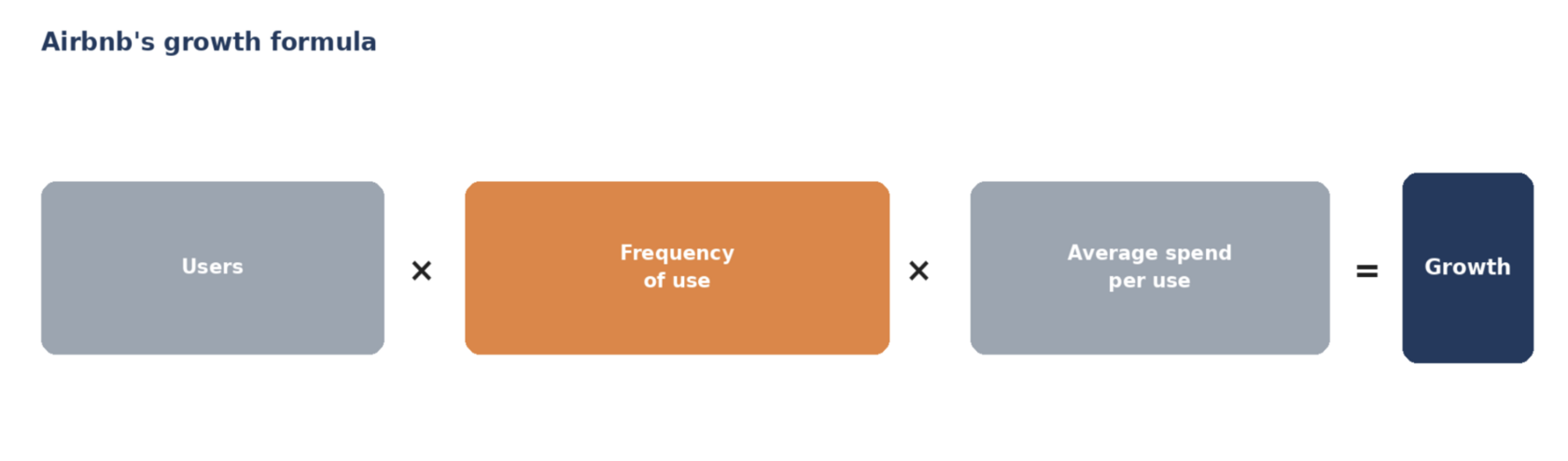
Airbnb's growth formula: breaking one metric down into factors
At Spotify it's daily active listeners multiplied by average listening time — a metric designed so the business simply can't game it: users who bounce right away don't move the number. For any online school, it isn't the number of people who bought the course, it's the number who reached their first real result — that's the number that pulls repeat purchases and referrals along with it, while the number of buyers on its own is just a vanity metric.
And this is where growth genuinely starts compounding. Once a metric is broken down into several factors, each one has its own current gap — the distance between where it is and where it could physically be. Closing any single one of those gaps by 10–15% is a quarter's work for one small team, not a heroic feat. But because the factors multiply rather than add, three modest 10–15% improvements don't add up to 30–45% — they multiply into a several-fold increase. Compounding growth almost never comes from one brilliant idea — it's born in the gaps, in the space between decomposed metrics, when a few modest wins multiply against each other.
Insight №44. I've come to love growth managers
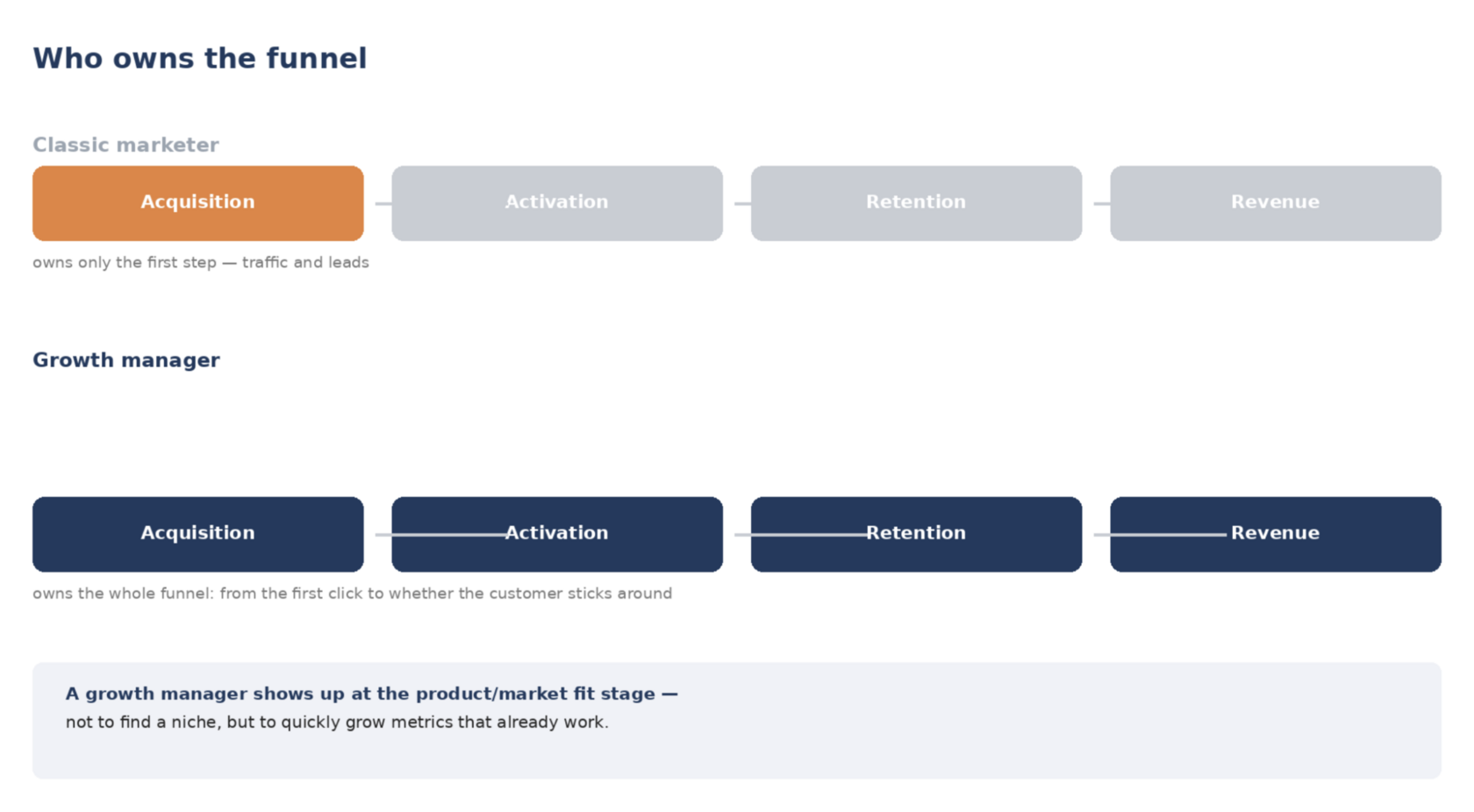
A classic marketer or product manager is responsible for one thing. A growth manager is responsible for the entire funnel — from the first click to whether the customer is still around in six months and buys again. This kind of person doesn't show up at the start, when it's still unclear who even needs the product — they show up exactly when there's product/market fit and the job is to rapidly grow metrics that already work, not search for a niche all over again.
On the team side, a growth manager needs to deliberately invest time in delegating, making sure every engineer owns their own feature and the key decisions around it — and it's exactly that, not personal heroics, that increases the speed and engagement of the whole team. A growth team also needs to be given goals without micromanagement.
Insight №45. The right KPIs in commerce
When I teach this in MBA lectures, I usually open with one question: who's ever seen marketing and sales pulling the blanket in opposite directions? Every hand goes up. The reason is almost never personalities or toxic individuals — it's that the two departments have different KPIs from day one. Marketing gets measured on lead volume and CPL, sales on conversion and revenue. With metrics like that, the two departments physically can't avoid fighting: it's in the marketer's interest to bring in more leads, even cheap, weak ones, while sales drowns in that flow.
The mechanics are simple and counterintuitive at the same time: the more leads there are, the lower the conversion. The more time sales spends processing bad leads, the worse they handle the good ones. Flooding sales with leads isn't a gift — it's the single most common way to kill the department from the inside, especially with free traffic from a grant or a cheap channel. Bad leads are almost always cheap, good leads almost always cost more, and trying to lower acquisition cost and grow revenue at the same time is trying to sit on two incompatible chairs at once.
The purpose of marketing isn't to find inquiries — it's to find buyers, and the KPIs need to reflect that. Time-tested KPIs: measure marketing not by lead count and CPL, but by profit and ROMI. Measure inbound sales not by conversion alone or revenue alone, but by conversion and average revenue per lead together — either number on its own is easy to be misled by. Measure outbound sales by number of contacts and revenue together, for the same reason.
PS: any report is a goldmine of ways to manipulate you, and I've trained myself to distrust it by default. If you simply ask a department why something failed, even people you trust will lie to you — not out of malice, but because the honest reason often sounds like "we didn't figure it out," and admitting that is uncomfortable. I have a golden rule about this: you're a bad manager if you can't get down to the level of a specialist yourself and understand the real cause — or better yet, down to the level of the customer.
Insight №46. Growth is tied to how fast you test hypotheses
An expensive lesson from my own experience: preparing a new direction for launch means it's already outdated by the time it ships. And the whole time, there were literally thousands of connections around us who could have given honest feedback in a week instead of six months. A fast hypothesis test isn't about asking one person and calling it done — it's about the habit of going after feedback before everything is perfectly ready, and the market won't wait. I once came across a similar point in someone else's post: a VP at Twitter openly admitted that real growth didn't start with a brilliant new idea — it started when the team began testing ten hypotheses a week instead of one every two weeks. Quantity converted into quality on its own, simply because the same amount of time now fit in far more tested solutions instead of imagined ones.
Insight №47. Healthy economics is clean economics
I made one of the worst mistakes of my working life: I brushed off inconsistencies in the P&L, and it cost me control over the unit economics. Turned out that at high volume, we were barely profitable.
It didn't help that we were running gray-zone schemes to shield the profit from taxes. Healthy economics doesn't start with a polished report for an investor — it starts with going clean. As long as part of the revenue moves off the books, split across several legal entities for tax reasons, the business has no real numbers to stand on — only rough impressions that are easy to dress up as strategy. Clean that up, pay everything you actually owe, and you often find out the growth was fictional, and there was never any real profit behind it.
The real sign of healthy economics is a growing technology component inside the business, even when the business itself doesn't look like a tech company. According to research from SaaS Capital, the median early-stage company puts up to 40% of revenue into R&D and technology, while mature public companies put in an average of 17–22%. The difference isn't young companies being wasteful — it's a deliberate strategy: while the market is still open, every dollar invested in technology is worth more than the same dollar invested three years later, when what you're chasing is no longer the market but your own competitors.
Insight №48. The closer to the sun, the fewer the guardrails
No civilization that eventually collapsed ever thought of itself as fragile. It built to last centuries, pushed its borders outward, layered on more and more complexity of governance — and believed order could be maintained forever. The problem almost never began at the moment of the blow: it accumulated earlier, while the center kept absorbing more control and the system grew used to stability, no longer noticing the tension building underneath. Resilience isn't scale, it isn't a safety margin, and it isn't headcount. It's the ability to notice overload before it becomes irreversible.
WeWork and Theranos weren't companies without a brilliant idea — they were companies where growth became more important than the question of what conditions it was happening under.
We fell into that same trap ourselves once — pouring money into growth and not looking at the thousand risks stacking up around it. Companies that start scaling aggressively in their first 6 to 12 months fail almost one and a half times more often than companies that first find a model that actually works and only then scale it. What I've concluded for myself is that a company that stops listening to anyone outside itself — the market, customers, consultants, research firms — gradually turns into a system that only sees confirmation of its own correctness. Refusing to live in a bubble and regularly checking yourself against the outside world is the only way to notice the crack in time, instead of explaining afterward why everything collapsed "out of nowhere."