
Reach ≠ memory. Awareness ≠ a reason to choose. Growth in brand search ≠ proof.
Sunday, the fridge has just died. Nobody is going to read your positioning. The person grabs a phone and recalls two or three names: the store they bought from before, the repairman a neighbor praised, a service they saw in an ad. If your name is not among them, your website, your price and your discount don't matter, because the person will never see them. The scene is made up, the mechanism is real: choice happens at a specific minute, and at that minute you are either in the person's head or you are not.
In 2019, in my blog about brand marketing, I defined a brand as a set of ideas and associations in a person's head, and brand marketing as managed work on them. The definition works. It was missing two things: a tie to the moment of choice, and a way to check that the work does anything. This guide is about those two things.
What's inside: a chain of seven links, three "weak → stronger" pairs, four layers of measurement with the limits of what they prove, a running example on an imaginary company, and a quarterly plan template. Let's go in order.
Stop: skip this guide if your product doesn't hold on to customers yet. Fix that first. A brand will only increase the number of unhappy people.
1What brand marketing is, and what it is not
Brand marketing is work on what people know about you, remember, and associate with you in situations of choice, so that they choose you more often and demand fewer discounts. There are three things it is most often confused with.
Logo and visual identity. That is branding in the narrow sense: giving a company, product or space recognizable elements. A necessary part of the job, but not all of it.
Reach. Showing an ad to many people does not mean they remembered it and connected it to you. Section 5 has an example of how an ad without recognizable signals works for the whole category.
"Image" advertising with no link to sales. A beautiful video after which nobody knows what you sell, to whom, and in which situation.
It is easier to separate neighboring functions by the question each one answers. Strategy decides who you are for and why you are better than the alternatives (that is the topic of a separate guide on brand strategy and positioning). The product decides what the person actually gets. Performance channels collect people who are ready to buy right now. Brand marketing answers "will they remember you when it is time to choose" and makes sure you are considered without a discount. These roles don't compete: performance almost never creates demand from nothing, and a brand without a product and sales sells nothing.
One more distinction from my 2019 notes that turned out to be useful: brand identity is what the company wants people to think, brand image is what people actually think. Brand marketing works with the gap between them, and the first job is to see the gap.
Insight: brand marketing is the part of selling that happens before the person writes to you.
2Seven links instead of the single word "brand"
When brand marketing doesn't work, it is usually not one tool at fault but a missing link. A beautiful message with no choice situation hangs in the air. Reach without recognizable signals works for the whole category. Recognition without a good product experience leads to disappointment.
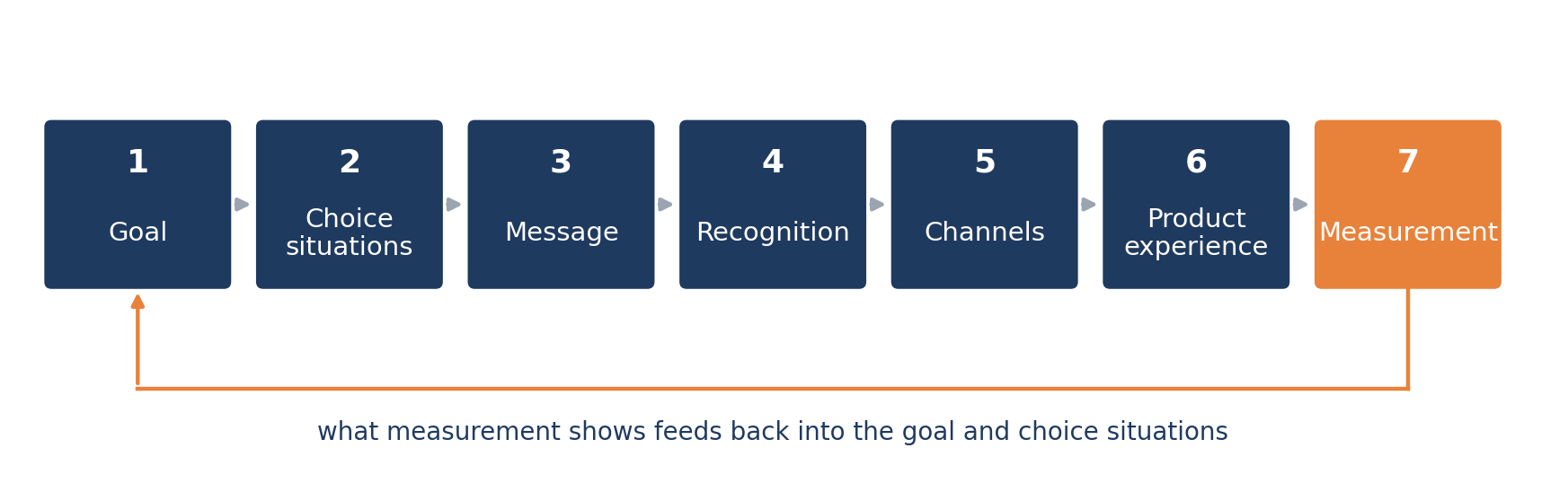
| Link | Question | What you should end up with |
|---|---|---|
| 1. Goal | Which business constraint are we removing, and which behavior will show it? | A goal with a group of people, a baseline and a deadline |
| 2. Choice situations | When and where does a person decide whom to buy from? | 1–3 situations in which you want to be first in the person's head |
| 3. Message | What should the person know, remember and associate with you? | One idea and one proof |
| 4. Recognition | By which signals do they recognize us without a label? | No more than three recurring signals |
| 5. Channels | Where and how regularly do we meet the person in those situations? | One or two channels and a rhythm |
| 6. Product experience | Does the promise match what the person gets? | Verified touchpoints |
| 7. Measurement | What changed: delivery, perception, behavior, business? | Four metrics and an honest note on what they prove |
Next, in order. The running example is an imaginary company, "Pepper", that delivers corporate lunches to offices of 20–150 people. It is fictional; all numbers and answers in the examples are made up for illustration.
3Link 1. Goal: which business constraint you are removing
Starting with the brand is not always right. First ask yourself a boring question: what is stopping the business right now?
If few people consider you at all, that is a brand marketing task. If they consider you but only buy with a discount, that is both the brand and the offer. If they reach the site and don't buy, the offer, the price, the page or sales are usually to blame, and a logo won't fix it. If they buy once and leave, that is the product. I would not start with the brand until I had checked that the funnel after the word "considering" doesn't leak: otherwise you just bring more people to a leaky bucket.
A goal is formulated as a change in behavior or perception in a specific group, with a starting point and a deadline.
| Weak | Stronger | What changed |
|---|---|---|
| "Increase brand awareness" | "In 12 months, raise the share of office managers in our city who name us among their first three corporate lunch suppliers, unprompted, from [X]% to [Y]%" | A group, a question, a baseline and a deadline are named |
X comes from a measurement before the work starts, not from a "market norm": there are no universal norms here, every category has its own.
Example, Pepper. Constraint: people order from us only when their previous supplier lets them down, and the rest of the time they don't think of us. Goal: office managers at target companies name Pepper among their first three options when they need to organize a lunch.
4Link 2. Choice situations
One of the most useful ideas in brand marketing is the category entry point. Jenni Romaniuk of the Ehrenberg-Bass Institute uses it for the cue that makes a buyer pull suitable brands out of memory when facing a purchase task (her take on B2B). Mental availability is how easily a brand comes to mind in such a situation. Not "do they know you at all", but "will they think of you exactly then".
The practical step: list the situations in which people choose, and decide in which of them you want to be first. You can only find them by talking about the last time: when the person last chose, what happened right before, what they compared. How to run such conversations and how many you need, I covered in the guide to understanding consumers. The most visible choice situation is a store shelf; that guide also describes how to watch it live.
It is convenient to write a situation with the Job Story formula that Alan Klement proposed in 2013: "When [situation], I want [motivation], so I can [outcome]", plus what might get in the way.
Example, Pepper. After five conversations with office managers the picture was this (imaginary):
| Situation | Who chooses | What matters at that minute |
|---|---|---|
| A client is coming, we need lunch for a meeting | Office manager or executive assistant | Don't embarrass yourself, arrive on time |
| The team is staying late | Head of department | Fast and with no approvals |
| Tired of collecting orders in a spreadsheet once a week | Office manager | One payment instead of forty transfers |
| The previous supplier let us down | Any of the above | Reliability, not price |
We pick two: "a client is coming" and "the previous supplier let us down". The first happens regularly and tolerates no risk; the second is the moment when people look for a replacement themselves. The other two wait.
Tip: there will be many situations. Pick those where you have a real advantage and where people choose often or pay a lot. One or two, not ten.
5Links 3 and 4. What the person should know, remember, associate, and what recognizes you
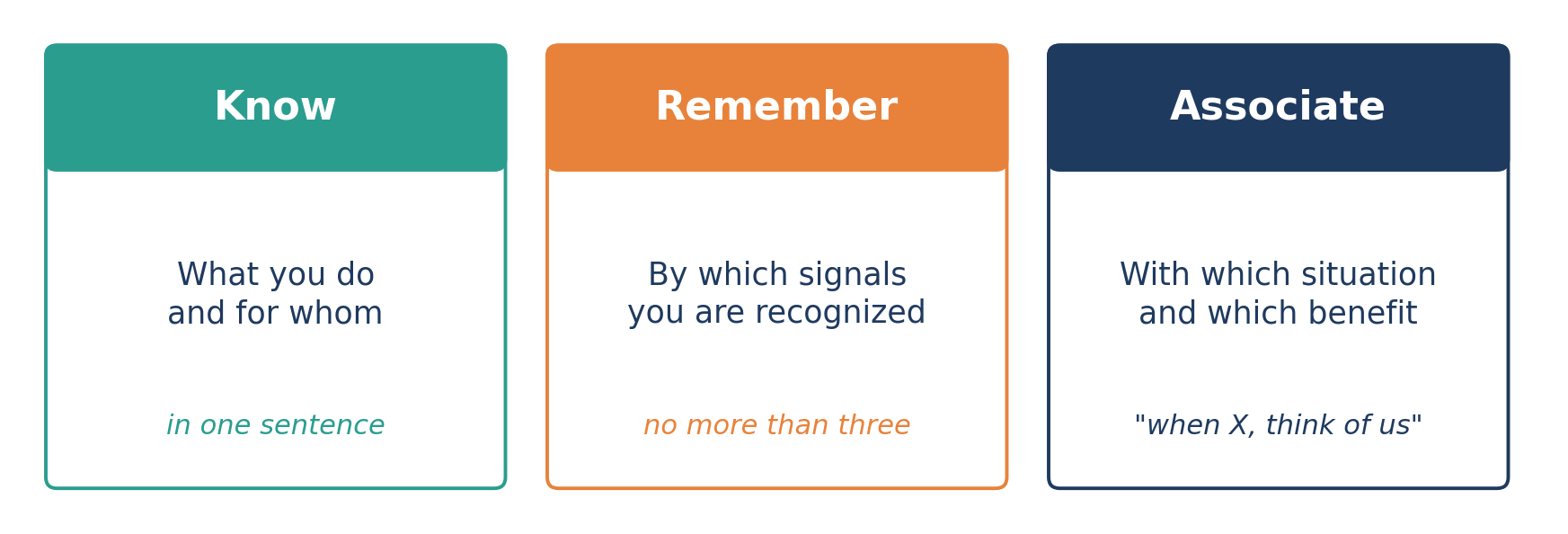
The message answers three questions about a person in a specific situation.
- What they should know. What you do and for whom, in one sentence.
- What they should associate you with. Which situation and which benefit: "when X, think of us".
- By which signals they recognize you. A name, a color, a shape, a sound, a character, a repeated phrase. No more than three.
The message is one idea and one proof. How to test wording with money, I covered in the guide to ad creatives.
Recognition and meaning are different jobs. Recognition decides whether you get found. Meaning decides whether you get chosen. The dispute over which matters more is not closed: for Byron Sharp, brands grow mainly through reach, mental and physical availability and recognizable signals, while critics answer that meaning and differences also affect choice. For practice the simple conclusion is enough: without recognition nobody finds the meaning, without meaning recognition sells nothing.
An example of what happens without recognition. In a Facebook IQ meta-analysis of 35 brand lift studies with 34 advertisers, in 57% of cases not only the advertiser's own awareness rose but also the awareness of competitors: when a creative has no recognizable brand signals, the most visible brand in the category wins. This is the platform's own data measured by the platform itself, so take it as an illustration, not a norm (report).
How to choose recognizable signals. Romaniuk suggests rating each signal on two questions: how well known it is among category buyers (fame) and whether it belongs only to you (uniqueness). An important detail from Ehrenberg-Bass research: marketers who judge their own signals "by feel" on average overestimate fame and underestimate uniqueness (summary in Marketing Week). So ask ten people from your audience, not your colleagues.
The meaning test. Remove the brand device from the material (the character, the color, the font). If it is still clear what you offer and to whom, you have a message. If not, you have recognition without meaning.
| Weak | Stronger | What changed |
|---|---|---|
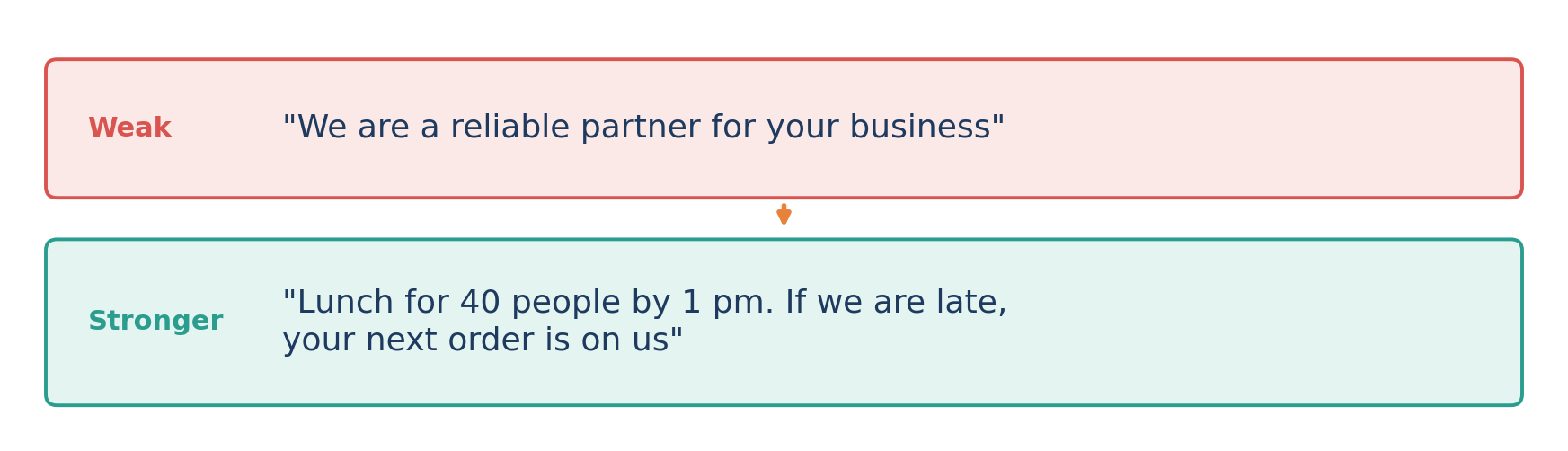
| "We are a reliable partner for your business" | "Lunch for 40 people by 1 pm. If we're late, your next order is on us" | Instead of general quality: a deadline, a volume and a consequence of failure |
| "Tasty, fast, with care" | "For lunch when a client has arrived: looks good, no surprises, delivered before the start" | Instead of three properties: the situation in which the person chooses us |
The second pair is about the link to a choice situation. If a message names neither the situation nor the benefit, it won't attach to the situation in memory.
6Link 5. Channels, frequency and budget
Choose channels with two questions. Where does my segment meet the category before and during the choice? And can I show up there regularly, with the same signals? "Where is it cheaper" comes third.
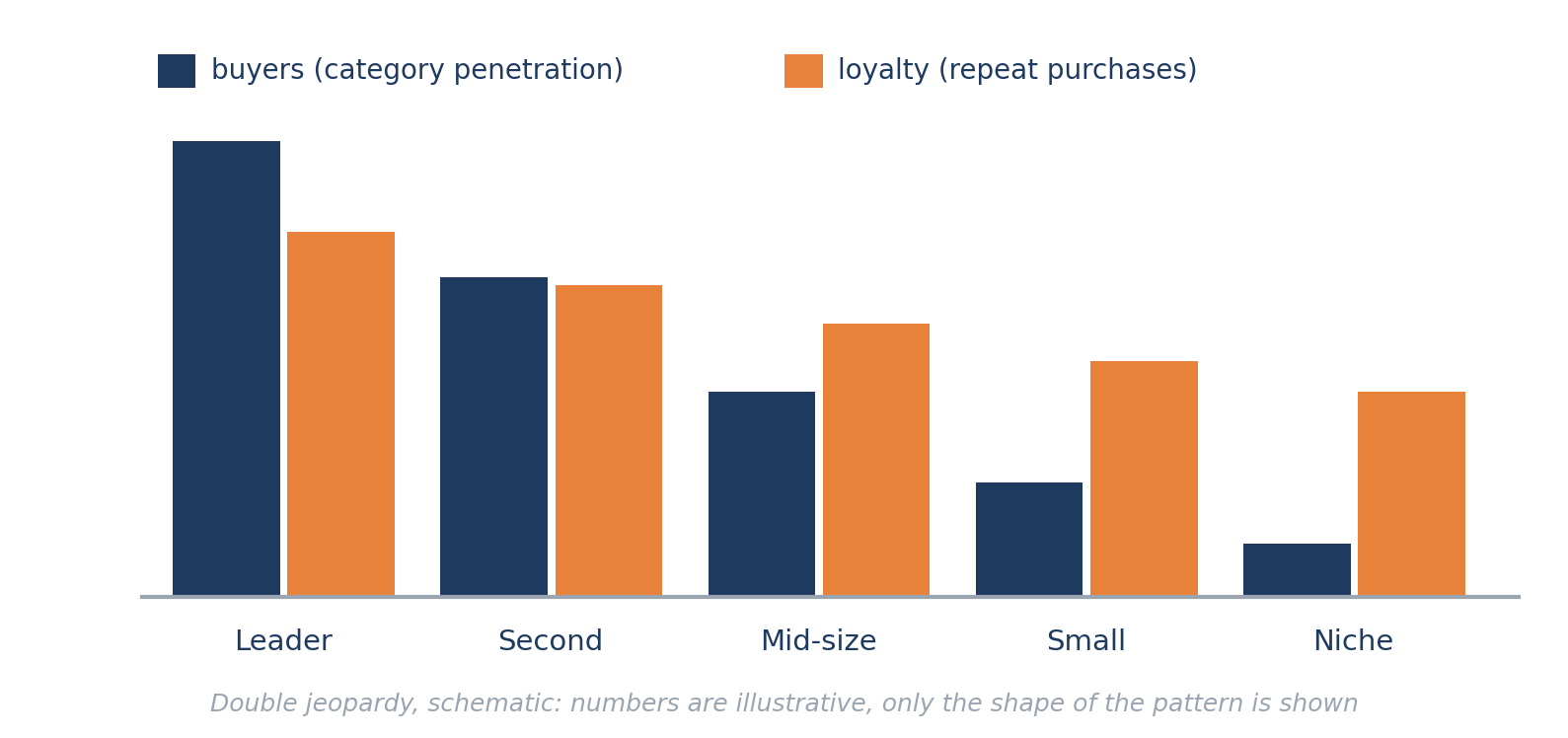
Reach and frequency. In Sharp's work a brand's growth is tied first of all to the number of buyers (penetration), not to the loyalty of those it already has. The law of double jeopardy (Ehrenberg, Goodhardt, Barwise, 1990): brands with a smaller market share have fewer buyers, and those buyers are slightly less loyal. I wrote about this in my blog in 2019. The practical consequence: the plan "raise loyalty and the company will grow" usually doesn't work for a small brand; first you need new people who consider you. A caveat: the pattern is described mostly for frequently repurchased consumer categories; for B2B, rare expensive purchases and subscriptions there is less evidence.
There are no universal proportions. The 60:40 rule from Binet and Field is often quoted (60% of budget on long-term brand building, 40% on activation). The authors themselves described it as an average observation from the IPA database, not a rule: the proportion varies by category. Critics add that the database leans toward big consumer brands, and Sharp called the methodology misleading. Don't borrow someone else's proportion. Take the constraint from link 1 and decide what it points to.
If the budget is small. This is the most common case, so I'll treat it separately. A workable set:
- one segment and one or two choice situations, not the whole market;
- one or two channels where these people already gather (niche chats, partners, offline spots, newsletters, reviews), and regularity matters more than one-off bursts;
- one name, one main signal and one repeated phrase that you don't change for years;
- physical availability: if you are hard to buy, all the work on memory goes to waste.
Example, Pepper. Channels: two chats of office managers in the city (being present with useful answers, not advertising), a partnership with two business centers (a leaflet in the elevator with one phrase and a phone number), reviews, and the question "how did you hear about us" at ordering. Rhythm: the same format once a month.
7Link 6. Product experience
Brand marketing promises, the product delivers. The gap between them kills a brand faster than advertising helps: the more people you bring in, the more unhappy ones there are.
The check is simple. In my notes it sounds like "look at everything through the user's eyes" and "what do you think the person believes?". Walk through five touchpoints as a person who has just seen the promise: the site's first screen, the price page, the first order, the support reply, the message after purchase. Does it sound the same everywhere? Does it match what the ads promised?
Example, Pepper. Promise: "by 1 pm or your next order is on us". Check: if the courier service's delivery window is 12:30–1:30 pm, the promise is false, and it is better to change the promise than the ad. Brand marketing starts where words and behavior match.
A costly signal. Words about quality are cheap, so people believe them little. In Who Gets What and Why, Nobel laureate Alvin Roth describes an experiment by Soohyung Lee and Muriel Niederle on a Korean dating site. Every participant got two virtual roses to attach to two of their proposals as a mark of special interest. A randomly chosen group received six extra roses and gained a clear edge: proposals with a rose were accepted 20% more often. The signal worked because it was scarce: a rose spent on one person is not available for another.
Roth shows the same principle in the queue outside a restaurant: a long line sends a signal that the empty place next door cannot easily copy. The practical point for a brand: a promise becomes a signal when there is something behind it that is costly to fake: a guarantee you will have to honor, a refund, a public number anyone can check. Pepper's "by 1 pm or your next order is on us" works exactly this way: the words get a price.
Caveat: the experiment ran on a dating site; carrying it over to selling light bulbs or a B2B subscription is my reasoning, not a research result.
How price and discounts shape a buyer's expectations, I covered in the guide to price and sales.
8Link 7. Measurement: four layers and the limits of proof
One metric does not show brand marketing. Look at four layers, each answering its own question.
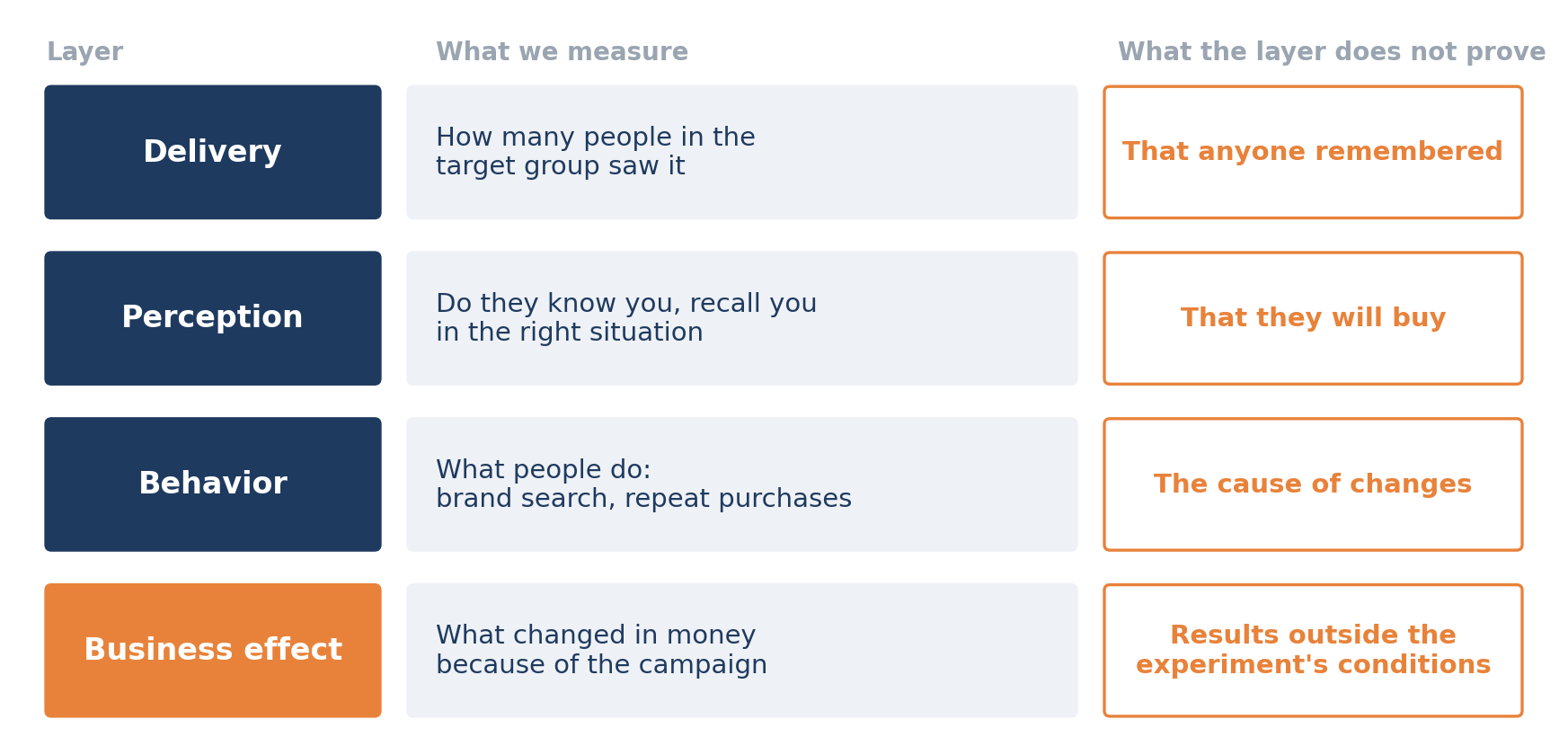
| Layer | What we measure | Tools | What the layer does not prove |
|---|---|---|---|
| Delivery | How many people from the target group saw it | Reach, frequency, impressions in the target audience | That anyone remembered |
| Perception | Whether they know you, recall you in the right situation, and what they associate with you | Audience survey (unaided and aided awareness, consideration, associations with situations), platform brand lift | That they will buy. Answers are self-reported, and the result depends on the sample |
| Behavior | What people do | Brand search and its share in the category, direct visits, "how did you hear about us", share of repeat and referred customers, share of purchases without a discount | The cause: brand search also grows from seasonality, PR, promotions, competitors' actions |
| Business effect | What changed in money because of the campaign | Geo experiments, control groups, media mix modeling | Results outside the conditions of the experiment; needs volume and time |
What to know about the limits.
Survey. To estimate a share ("what percent name us") with ±5 percentage points of error you need about 385 answers from a random sample of the right group; for ±3 points, about 1,070. If the survey went to your own base and only the most active answered, these numbers don't work. For a small brand with a tiny audience it is reasonable to treat a survey not as an estimate but as a way to hear wording.
Brand search. Les Binet proposed the share of search metric: the share of queries for your brand among queries for the brands in the category. In his analysis of new cars, home energy and mobile phones it moved ahead of market share (IPA). He himself called it a fast, cheap, predictive metric, not a full assessment, and the conclusions about causality are disputed. Use it as a signal: watch the dynamics, don't build proof on it.
Ads on brand queries. In an eBay experiment (Blake, Nosko, Tadelis, Econometrica, 2015) the company stopped paid ads on queries containing "eBay" on Yahoo! and Microsoft: almost all the lost traffic and sales moved to free results. The lesson for measurement is wider than eBay: last click and brand-query conversions easily credit advertising for what the brand did by itself. The reverse also holds: part of the "brand effect" in your reports is really search by people who would have come anyway.
By the way, about experiments. In a study of 15 Facebook experiments (Gordon, Zettelmeyer, Bhargava, Chapsky, Marketing Science, 2019), methods based on the observational data that advertisers usually have did not reproduce the true effect shown by randomized tests. The authors' conclusion: where you can, set up a control group. For ads in different regions there are geo experiments (Google's method, Vaver and Koehler, 2011). To estimate the contribution of several channels from your historical data there are open media mix models: Robyn from Meta and Meridian from Google (generally available since January 2025). They need a long enough history, variation in spend and careful validation; you can't plug their numbers into a budget unchecked.
What not to promise. There is no universal payback period for brand marketing. There is no automatic CAC reduction either. A more honest hypothesis: if you are considered more often without a paid click in the path, the share of customers who didn't come from paid ads should grow, and acquisition cost on average should fall. Check it on your own data, and write down before you start which value would disappoint you.
If you are a small company. You can't run a geo experiment: not enough volume. That is normal; it means your evidence is weaker, and you should say so. What remains: a before-and-after measurement on the same survey question, a similar region where no work was done, a monthly open-ended "how did you hear about us", brand search dynamics, the share of customers by referral.
Example, Pepper. Once a quarter: a survey of 40–50 office managers at target companies (as a way to hear wording, not as a share estimate); monthly: queries by name, the number of orders with the answer "recommended", the share of orders with a repeat within 60 days. These metrics give a signal but don't prove that the cause is the chats and leaflets.
9How to organize the work
Brand marketing rarely breaks on the idea. It breaks when the "brand" has no owner and every department has its own.
- Owner. One person is responsible for the chain "situations → message → signals". In a small company that is the founder or the head of marketing.
- Interfaces. With product: promise and experience. With sales: the same words on calls as in ads. With support: the same tone. With the performance team: the same message and the same signals.
- Rhythm. Weekly: reviews and tickets for gaps between promise and experience. Monthly: are the signals used the same everywhere. Quarterly: the survey and a review of the metrics.
- One document. Not an 80-slide deck but one page: situations, message, signals, tone, good and bad examples. Such templates exist so that any new person (or contractor) doesn't invent the brand from their head.
- Shared goals with performance. The common war of "brand versus performance" ends when both sides have a shared funnel and a shared quarterly review. How to count marketing and sales as one result, I covered in the guide on marketing and sales.
10AI: where it helps and where it blurs the brand
It helps. Analyzing reviews and support tickets: in which words customers describe choice situations and breakdowns. Drafts of message variants to test. Transcription and first grouping of interviews. Mention monitoring. Adapting materials to formats.
It blurs. Any text generated without constraints sounds like everyone else's: tone and specifics disappear. Visuals become similar to category neighbors. Ten variants of one idea create an illusion of variety. "Synthetic customers" instead of live conversations look like research but are not: in a study by Bisbee and coauthors (Political Analysis, 2024), ChatGPT's answers matched a real survey on averages, but about 48% of regression coefficients differed significantly, and the spread of answers was smaller.
What to set up as guardrails. A page with tone and "ours / not ours" examples. Recognizable signals are locked: the neural network doesn't "improve" the logo, the color and the phrase. A person reads everything before it goes out. Facts and promises are checked separately from generation.
A new channel worth knowing about. People increasingly ask assistants whom to choose. Once a month, ask two or three assistants the ten questions your buyer asks, and record the date, the answer, whether you are mentioned and how you are described. Assistants' behavior changes fast, so record the date and the wording. If you are described wrongly, look for the cause in the sources: your site, reviews, directories.
11Template: a brand marketing plan for the quarter
Fill it in within an hour. A field you can't fill shows a gap, not a flaw of the template.
| Field | What to write | Example (Pepper) |
|---|---|---|
| Business constraint | What is stopping us now | We are ordered only when the previous supplier fails |
| Goal | Group, question, baseline, deadline | Office managers at target companies name us among their first three: [X]% → [Y]% in 12 months |
| Segment | Who exactly | Office managers at companies of 20–150 people |
| Choice situations (1–3) | Job Story: when → I want → so I can | When a client arrives, I want lunch without risk, so I don't embarrass myself |
| Message | Know / remember / associate | "Lunch for 40 by 1 pm; if we're late, your next order is on us" |
| Signals (up to 3) | What repeats everywhere | The name, pepper red, the phrase about the deadline |
| Channels and rhythm | Where, how often | Two chats, two business centers, once a month |
| Product experience | Where we check the promise | Delivery window, support reply, post-order message |
| Measurement | One indicator per layer | Reach in chats; survey; queries by name and "recommended"; repeat orders |
| What we don't do | A refusal frees resources | No social media or general-query search ads |
| Decision on results | In advance: what we do at different values | If referrals are below [Z] by quarter end, we change the channel, not the message |
Typical mistakes
- Starting with a logo and a slogan without naming the choice situation.
- Setting the goal "raise awareness" without a group, baseline and deadline.
- Treating growth in brand search as proof without checking other causes.
- Borrowing someone else's "brand / performance" proportion.
- Promising in ads what the product doesn't promise.
- Changing the signals every quarter.
- Using a neural network as a respondent.
PS: the cheapest test of the whole system: ask ten recent buyers which three suppliers they would name if they had to choose again tomorrow. If you are not among them, everything else in this guide is about how to get there.