
Positioning ≠ slogan. Strategy ≠ document. Promise ≠ proof.
What will you say to a customer who asks: "Why are you better than what I already have?" Look at the question: not "why are you better than your competitors", but "than what I already have". What the customer has may be an Excel table, a messenger, an employee who remembers everything, or the habit of changing nothing. These options beat you more often than the competitor named in your presentation.
Positioning is a choice: who you are for, what you are really compared with, why you are better in that comparison, and what proves it. Brand strategy is wider: which position you take, what you refuse, and what changes in product, price, sales and advertising because of it. The beautiful wording comes at the end, not at the start.
Stop: if you haven't yet talked to customers about their last choice, do that first. Positioning built on guesses falls apart fast.
What's inside: a comparison of six terms that people constantly mix up, a running example on an imaginary company, "weak → stronger" pairs, four checks and a one-page brief. Let's go in order.
1Six terms that get mixed up
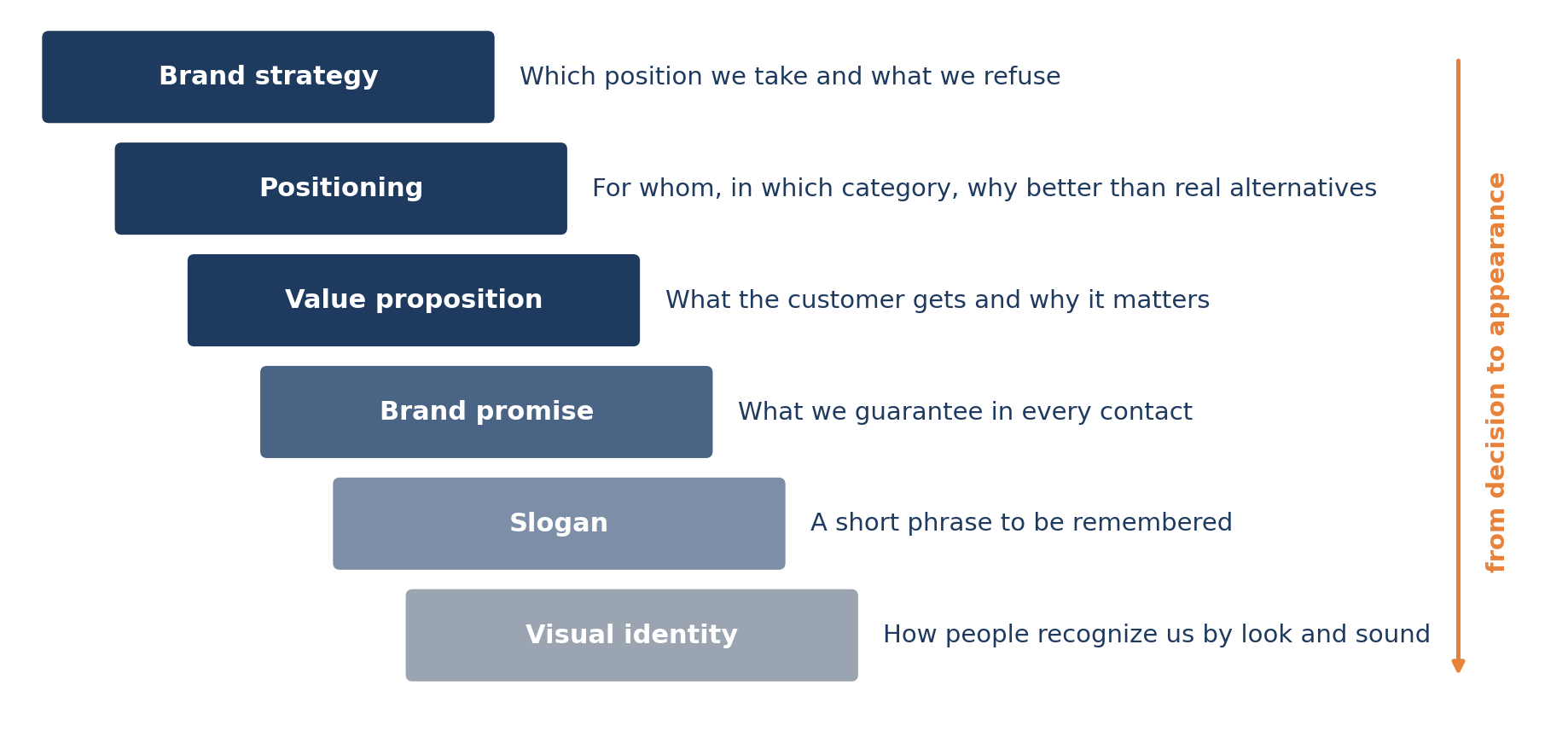
In meetings about positioning it is easy to get stuck on the slogan when you need to decide something else. Each term answers its own question.
| Term | Which decision it records | Form | Changes |
|---|---|---|---|
| Brand strategy | Which position we take, what we refuse, what we change in product and sales | A short document of decisions and refusals | When the market or the business changes |
| Positioning | For whom, in which category, why better than real alternatives, what proves it | An internal statement from a template | Rarely |
| Value proposition | What the customer gets and why it matters to them | 1–2 sentences for the site and sales | Per segment |
| Brand promise | What you guarantee in every contact | A phrase and the condition under which it is kept | Almost never |
| Slogan | A short phrase to be remembered | 2–7 words | Rarely and carefully |
| Visual identity | How you are recognized by look and sound | Name, colors, fonts, sound, style | Evolution, not revolutions |
The upper rows can't be replaced by the lower ones. A slogan without positioning is decoration. Positioning without strategy is wording that nobody is obliged to follow. Agency "brand pyramids", where the layers run from attributes and rational benefits through emotional benefits and character up to values and essence, are handy as a checklist. But you can fill in every layer without making a single decision.
2Start with the business task and a diagnosis
Positioning "to grow" is empty, believe me. First you need to see where the business loses money or chances: they don't consider you; they consider you and choose others; they choose you only with a discount; they buy and leave. Each case needs a different position.
Richard Rumelt described what this looks like in "Good Strategy / Bad Strategy": a real strategy has a kernel of three parts. A diagnosis (what exactly the problem is), a guiding policy (a general approach that rules out options), and coherent actions. A list of goals and slogans is not a kernel. The order matters: first find out what exactly limits the result, and only then talk about actions.
| Weak | Stronger | What changed |
|---|---|---|
| "We want to stand out in the market" | "We win deals only with a free period and a discount. We need a position where we are chosen without a discount in a specific customer situation" | The problem and a measurable sign are named |
Running example. An imaginary company, "Styk" ("Joint"), is an order-tracking service for small furniture workshops (3–15 people): measurements, estimates, statuses, payments. The company is fictional, like everything in the example: the answers, numbers and wording are made up for illustration. Styk's diagnosis: many sign-ups, but workshop owners drop off in the first week, and the company wins only with the free period.
3Market and category
A category is a set of expectations: what is compared, what counts as mandatory, what price seems normal. The name of the category chooses your alternatives for you. Call yourself a "CRM" and you will be compared to general CRMs by number of features. Call yourself "order tracking for a furniture workshop" and you will be compared to how the workshop tracks orders today. April Dunford, the author of "Obviously Awesome", defines a market category as the context in which a product's value is obvious to target customers, and puts it at the end of the positioning work: first alternatives, differentiators, value and segment (her quick guide). The same order applies here: you name the category after it is clear what you are compared with and for whom.
There are two options. Enter a known category: people understand you quickly, but compare you by its rules. Or name yourself in a new way: you have to explain the problem, but you set the rules. A small company is more often better off taking a known category and narrowing it than creating a new one.
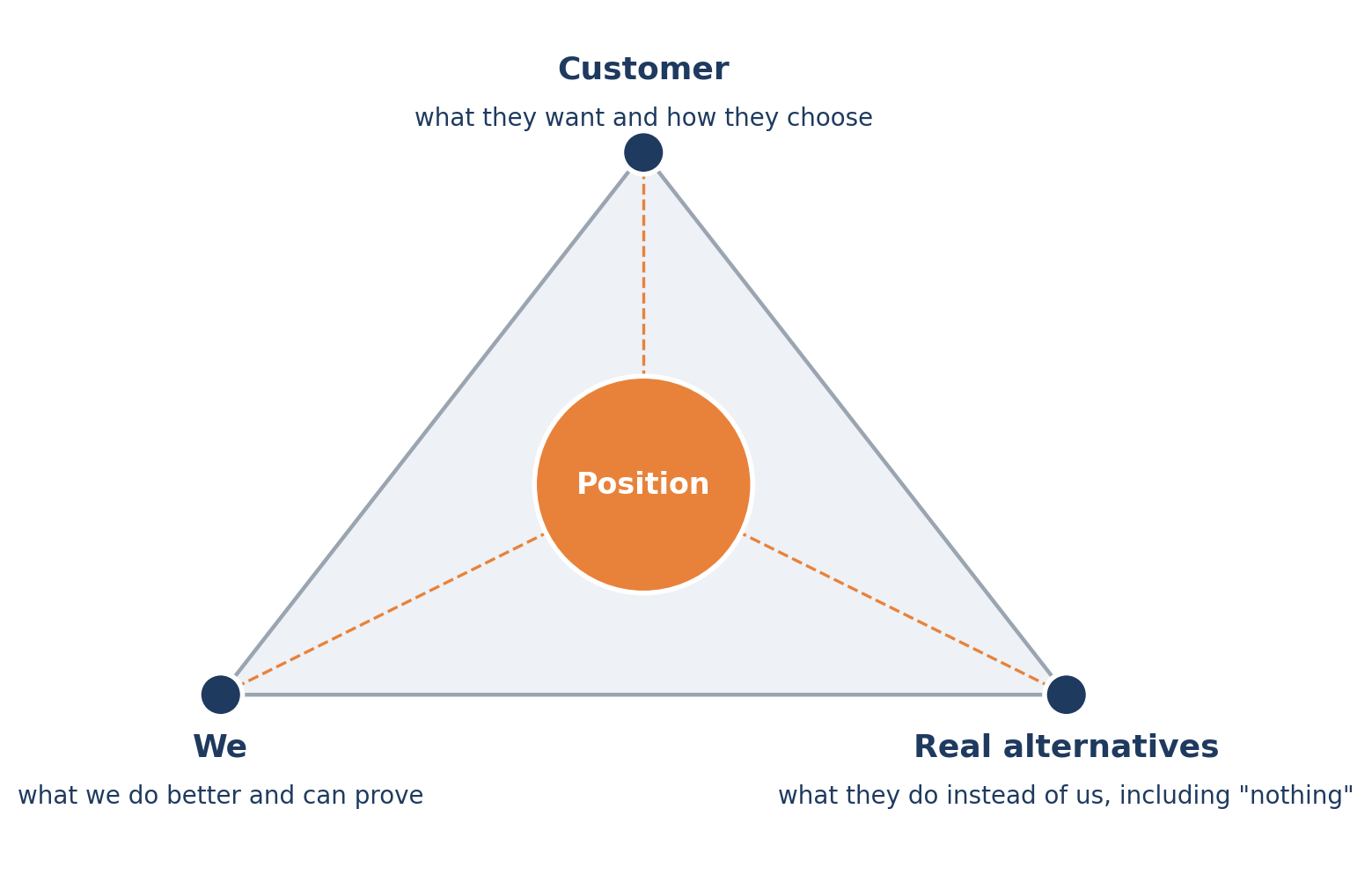
Kenichi Ohmae's "strategic triangle" (the three Cs: customer, company, competitors) is handy for a check. A position is to be found at the intersection of three questions: what the customer wants, what you can do that the alternatives can't, and what the alternatives do. Below is an adaptation: instead of "competitors" it says "real alternatives", including "change nothing".
4Audience and situations
Segment by the logic of choice, not by age and gender. How to do it and how many conversations it takes, I covered in the guide to understanding consumers. What matters here is the result: one main segment and one main situation. If there are three, you haven't chosen yet.
Evidence has different weight for a decision. The weakest is the team's own conviction. Stronger is what people told you about their last case. Strongest is what you saw in their behavior: purchases, refusals, correspondence.
Styk. Main segment: owners of workshops with 3–15 people who handle correspondence with clients themselves and lose orders between the messenger and the spreadsheet. Situation: a week after the measurement the client is silent, and the table has nothing about them.
5Real alternatives, including "change nothing"
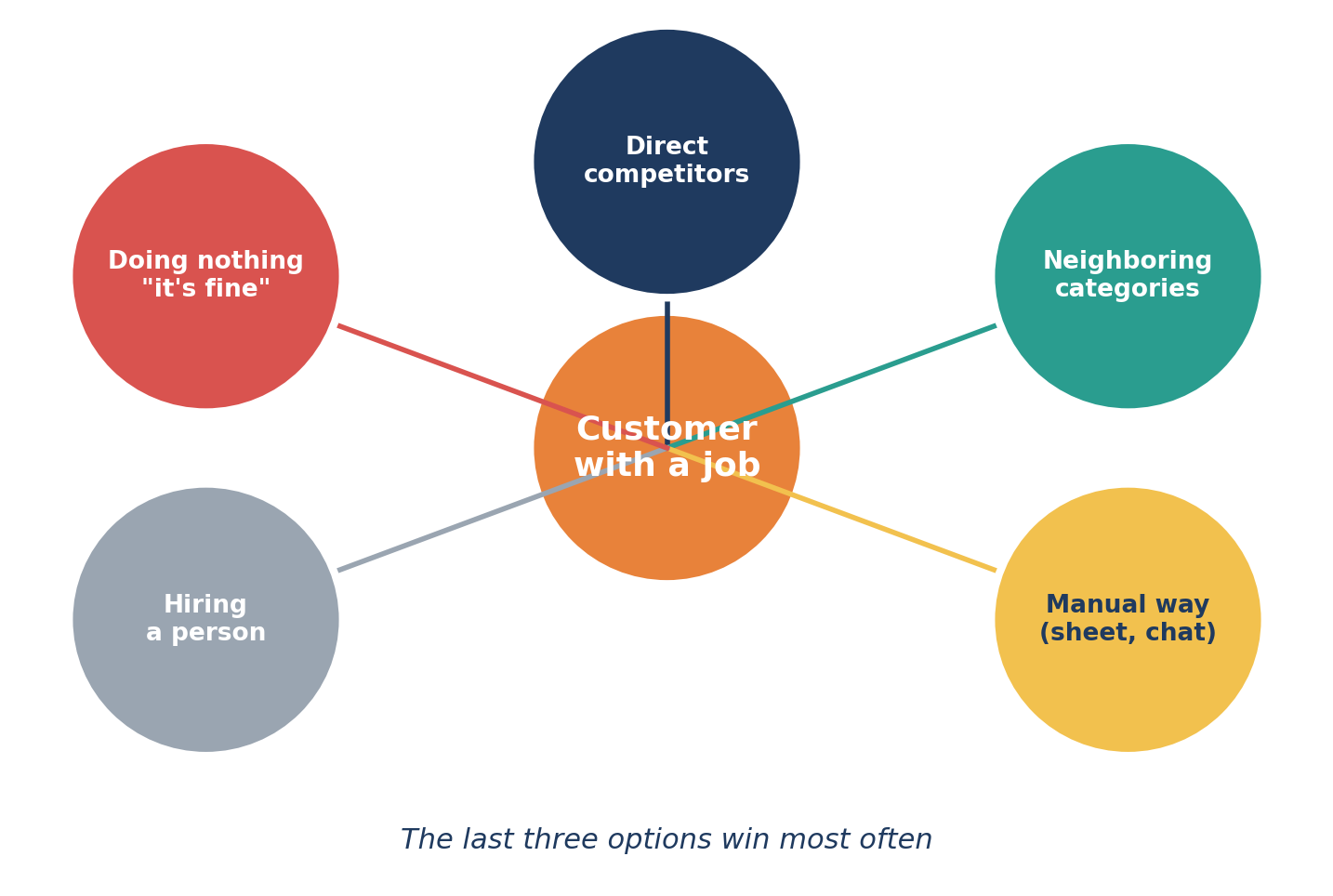
Alternatives come in five kinds:
- direct competitors;
- solutions from neighboring categories that do the same job;
- a manual way (a spreadsheet, a messenger, a notebook, a master's notebook);
- hiring a person;
- doing nothing.
The last three win most often. The switching model described by Bob Moesta and Chris Spiek explains this by two forces against you: anxiety ("what if it doesn't work") and habit ("it's fine as it is"). So don't ask "whom did you consider", ask "what did you do before us" and "what would you do if we didn't exist".
How to pick competitors when data is scarce. If you have market data, take the category leader, the fastest-growing brand, the one people know more often than others, the one you take share from and the one that takes share from you. If you have no data, ask consumers which companies perform the same function and who comes to mind first. Remove "phantom competitors": companies you think about but never meet in real deals.
Styk (imaginary, after interviews).
| Alternative | Why people choose it | Where it is weak |
|---|---|---|
| Spreadsheet and messenger | Free, familiar, everything "in the head" | Orders get lost when the workshop grows |
| General CRM | Many features, a familiar category | Long setup for a workshop, you pay for the extras |
| An administrator | A person does everything | Expensive, dependent on one person |
| Change nothing | Fear of moving | The same losses, but "at least familiar" |
6Value and proof
Value exists only relative to an alternative. "Better than what?" is the question without which the wording hangs in the air. A person chooses the option where perceived value minus price is higher; a brand affects both.
A promise is what you say. Proof is what a person can check. Positioning must be true and confirmed by actions, not only by words.
| Type of proof | When it convinces | What is missing without it |
|---|---|---|
| A number from your data with its method | If people can see how it was counted | Numbers without a method read like advertising |
| A case with the name and situation of a client | If the client resembles the reader | An anonymous "client from services" doesn't convince |
| A demo on the client's data | When confidence that it will work matters | Words about simplicity without a showing |
| A guarantee with a consequence | When risk stops people from deciding | A guarantee that costs you nothing is empty |
| Process transparency | When the client fears the unknown | "We care" |
Here is how it looks in wording:
| Weak | Stronger | What changed |
|---|---|---|
| "We care about our customers" | "We move your first 10 orders ourselves" | Care became an action you can check |
| "The most convenient service" | "A new order is entered in 40 seconds from a phone at the measurement" | A comparison was replaced with a checkable detail (the number is imaginary) |
7Choice and refusals
Strategy is what you refuse. Michael Porter, in "What Is Strategy?" (HBR, 1996), writes that a position rests on trade-offs: you can't be the best for everyone at once without losing an advantage with someone. His analysis of IKEA is built on this: the company chooses customers who want style and low price and who are ready to trade part of the service for price.
To choose what to lean on, a short list of typical supports helps. It is shortened and not exhaustive; for each support there are two questions: under what condition it works and what you pay for it.
| Support | Works if | Price |
|---|---|---|
| Specialization | The segment is big enough and pays; you are better in its situation | Refusing all other customers |
| Simplicity and convenience | It really is simpler and faster, and this is visible | Easy to copy unless built into the product |
| Novelty | The new thing is useful to the customer; you are ready to explain it | Expensive to maintain, you must create something new again and again |
| Price | Costs are lower, not just a discount | A fight over price; vulnerability to cheaper rivals |
| Lifestyle and values | The values are confirmed by actions over years | Takes time and money; irrelevant to a casual buyer |
| Scale and leadership | Size turns into convenience or trust | Takes money; whoever has more wins |
A digression on focus. "Narrow" doesn't mean "small". Check four things. Can you name the places where the segment gathers? Will the revenue from it pay for the next step? Are there neighboring segments with the same task that you can enter later? Can you say "this is not for you" without losing the core?
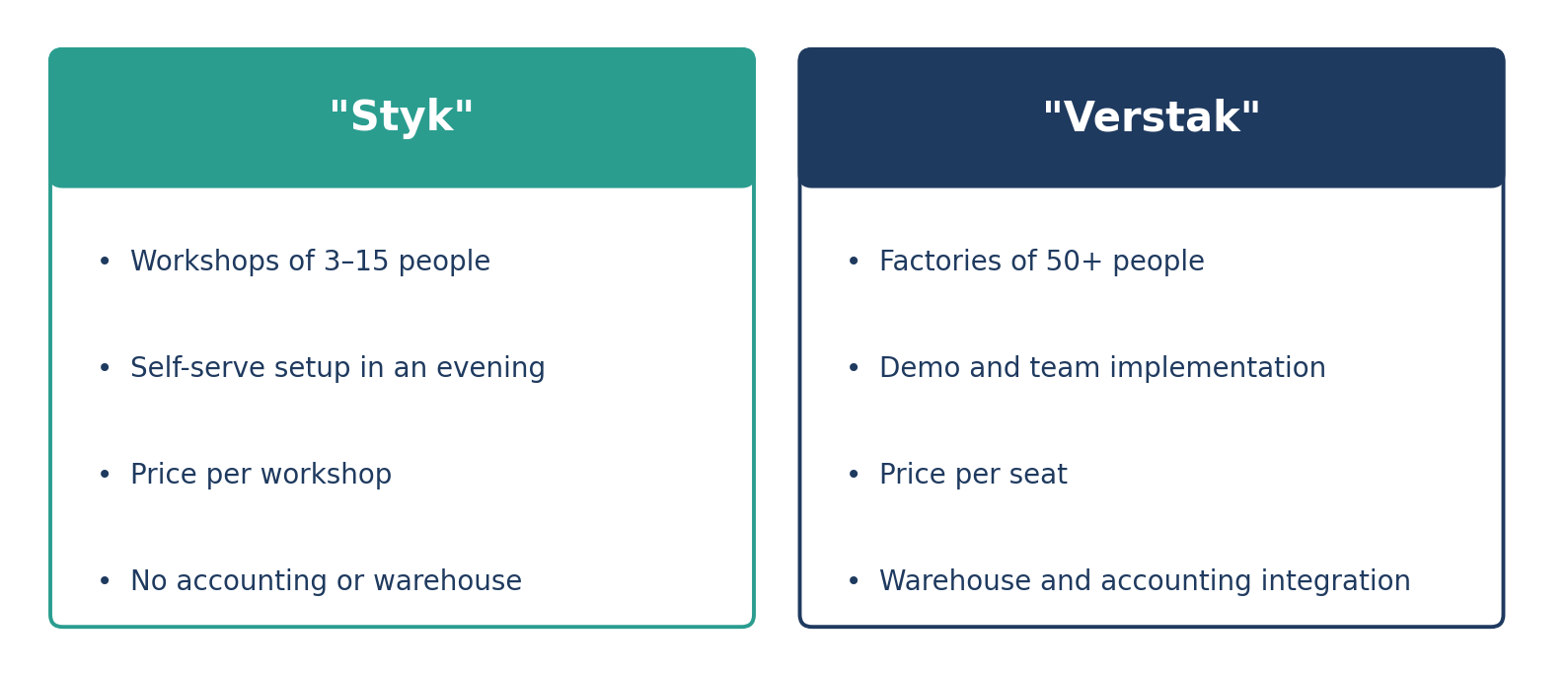
Styk. We choose specialization plus simplicity. We refuse: accounting and warehouse management, factories of 50+ people, a universal "for everything" product and a free plan that attracts the wrong people. Every refusal is written down with a reason.
One category, two positions. To see how a choice changes everything else, imagine a second imaginary player, "Verstak" ("Workbench"): tracking for furniture factories of 50+ people with integration into the warehouse and accounting. Same category, but Verstak has long sales through demos and implementation, a per-seat price and a team of implementers. Styk, with its self-serve setup in an evening, doesn't fit any of that, and Styk's pricing plan wouldn't suit Verstak. Both can be right if each sticks to its choice. Trouble starts when Styk a year later begins selling to factories: without changing the product and the price it gets long deals and clients who lack features.
8Wording: positioning, value proposition, messages
Positioning is written with a template in the spirit of Geoffrey Moore: "For [segment in a situation] who [need], [name] is a [category] that [key benefit]. Unlike [real alternative], [main difference and proof]". This is an internal statement, not site copy.
Styk. For owners of furniture workshops of 3–15 people whose orders get lost between a messenger and a spreadsheet, Styk is an order-tracking service from measurement to payment. Unlike a spreadsheet and a general CRM, it is set up for a workshop's stages from day one, and we move the first 10 orders ourselves.
| Weak | Stronger | What changed |
|---|---|---|
| "Styk is a modern platform for effective business management" | "Order tracking for a furniture workshop: not a single measurement gets lost" | The category, segment and situation are named |
| "We are better than the competitors" | "No need to set up a CRM: we move your first 10 orders ourselves" | The competitor was replaced with the customer's real barrier |
Messages are built top-down: one main thought, three supports, a proof for each, then answers to the three most frequent objections. The slogan comes last. A practical check: if you can't assemble the site's first screen or an ad from the positioning, the wording isn't ready. It also helps to show it to people outside your team: almost always the first version has to be redone.
9What changes in product, price, site, advertising and sales
Positioning that doesn't change the product and the price is a slogan.
| Area | What should change | Styk | How to check |
|---|---|---|---|
| Product | The order of features and what is absent | The order card with the date of the next step comes first; no accounting | What people really use in the first week |
| Price | Structure and tone | A fixed price per workshop, no free plan | Share of customers who came from the target segment |
| Site | The first screen names the segment and situation | "Order tracking for a furniture workshop" instead of "platform" | People from the segment retell the first screen |
| Advertising | The message fits the situation, not everyone | Creatives about clients who go silent after the measurement | Cost of the target action, not clicks |
| Sales | Call questions and objections | The question "what did you do when the client went silent?" | Review of call recordings |
| Support | Tone and speed | Answers in the workshop's language, not in terms | Repeat contacts |
How to test messages with money, I covered in the guide to creatives; how price and discounts change expectations, in the guide to price and sales; how to align the words of marketing and sales, in the guide on marketing and sales. How to make the chosen positioning come to mind at the moment of choice, I covered in the guide to brand marketing.
10How to check: clarity, relevance, trust, choice
One check is not enough: they catch different mistakes.
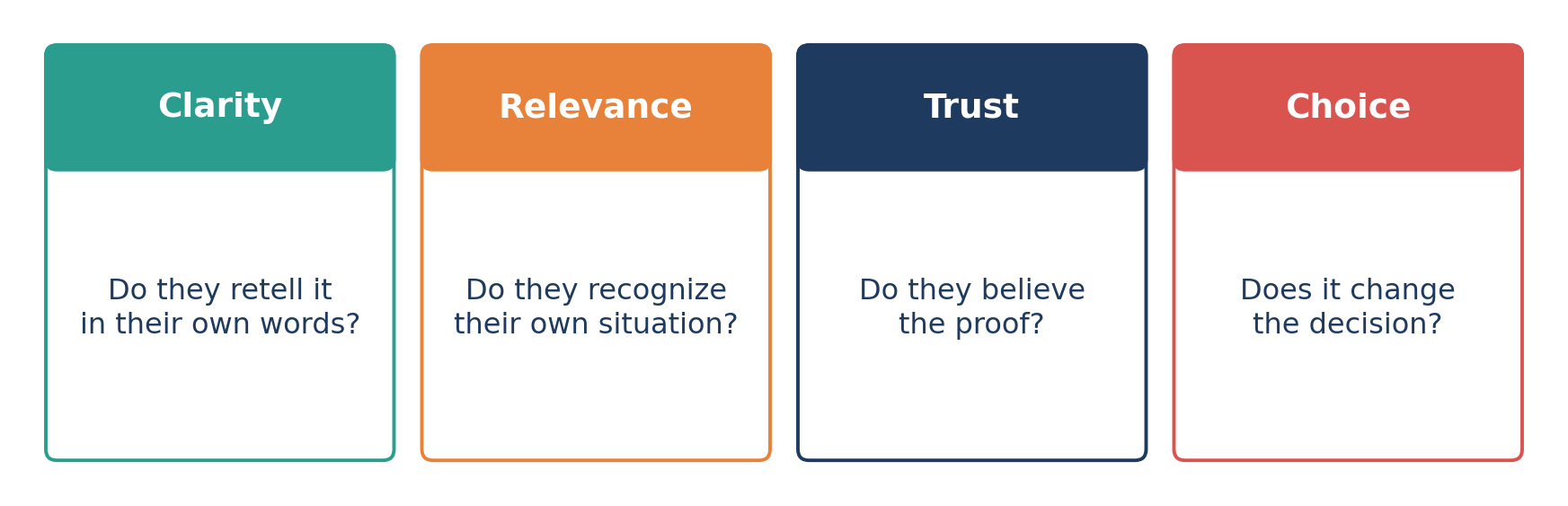
Clarity. Show the wording or the first screen to a person from the segment for a few seconds and ask them to retell it in their own words: what it is, who it is for, how it differs. A mismatch with your intent shows the gap.
Relevance. Does the person recognize their own situation in the wording? Ask: "Was it like this the last time you did this?"
Trust. Which proofs does the person find convincing, and which do they not believe? A conversation helps here, not a survey.
Choice. Does the position change the decision? Go through the latest deals: why you won, why you lost, against whom or what (including cases where the client stayed with the spreadsheet). Behavior, such as a demo request, a purchase or a repeat order, is stronger than opinion.
What is not a check. An A/B test of a headline measures the reaction to wording among those who saw it. It does not show whether you picked the segment, category, alternative or proof correctly. It checks execution, not strategy. A perceptual map needs care too: a real one is built from respondents' ratings (for example, with multidimensional scaling), and one drawn by hand by the team should be labeled a hypothesis.
Hypotheses with decision thresholds. Write the thresholds down before the test; the numbers in the example are illustrative.
| Hypothesis (Styk) | How we check | Decision threshold |
|---|---|---|
| Owners recognize their situation in "after the measurement the client is silent for a week" | 8 interviews about the last order | Fewer than half recognize it: change the situation |
| "We move the first 10 orders ourselves" removes the fear of switching | Two first screens for one segment, compare demo requests | A difference smaller than chance: decide by other signs |
| We win against "spreadsheet and messenger" more often than against a general CRM | Review of the last 10 deals | If it's the other way round: change the emphasis in sales |
11When repositioning is justified
It is justified when the category or the expectations in it have changed, the product has become different, you are entering a new segment, a review of deals shows a systematic mismatch, or companies are merging. It is not justified when you are "tired of it", a new director arrived, or you had one bad quarter. Change has a price: you lose recognition, retrain the team and explain again to the market who you are. Distinguish three scales: repositioning (what you say and to whom), rebranding (name and identity) and a refresh (appearance). Choose the smallest change that solves the problem.
A public example is Miro: the company, formerly called RealtimeBoard, explained the rename by saying the product had outgrown the "board" and it needed a short, memorable name. This is a retelling from secondary sources: I did not open the company's own article and did not check the reasons in detail. The lesson is in the order of reasoning: first the product and the range of tasks changed, then the name.
12AI in strategy work
It helps. Collecting and grouping reviews and conversations. Preparing ten wording options. Playing the opponent: "find the weak spots in the position". Checking that the site, emails and presentations say the same thing.
It limits. It doesn't know how your customers actually choose; facts about competitors must be verified against primary sources; wording drifts toward the clichés of the category. "Synthetic respondents" don't replace people: in a study by Bisbee and coauthors (Political Analysis, 2024), ChatGPT's answers matched a live survey on averages, but about 48% of regression coefficients differed significantly. Decisions about refusals are made by a person.
13Template: a brand strategy and positioning brief
| Field | Question | Styk |
|---|---|---|
| Business task and diagnosis | Where we lose money or chances | Many sign-ups, drop-off within a week, we win only with the free period |
| Category | What we are called | Order tracking for a furniture workshop |
| Segment and situation | Who chooses and when | Workshop owner, 3–15 people; after the measurement the client is silent |
| Real alternatives | Including the manual way and doing nothing | Spreadsheet and messenger, general CRM, administrator, nothing |
| Value relative to alternatives | Better than what, and how | Orders don't get lost, with no CRM setup |
| Proof | What we have, what we'll collect | Moving the first 10 orders; cases after the pilot |
| Choice and refusals | What we do and don't do | Specialization and simplicity; no accounting, no factories, no free plan |
| Positioning | One sentence from the template | See section 8 |
| What changes | Product, price, site, sales | See section 9 |
| Hypotheses and thresholds | What and how we check | See section 10 |
| Review | When we come back | In a quarter, based on the checks |
PS: if everything you said in your positioning would suit your closest competitor too, you haven't chosen anything yet.