
The company works. There is revenue, the team is busy, the calendar is full. Yet every month takes more effort, money disappears somewhere, and new opportunities fight over the same people.
At that moment it is tempting to book a strategy session. Sometimes that is right. But first, answer four uncomfortable questions. What does the business actually earn money on? Which kind of growth is hurting it? What limits the result? What will you have to give up so the chosen direction gets resources?
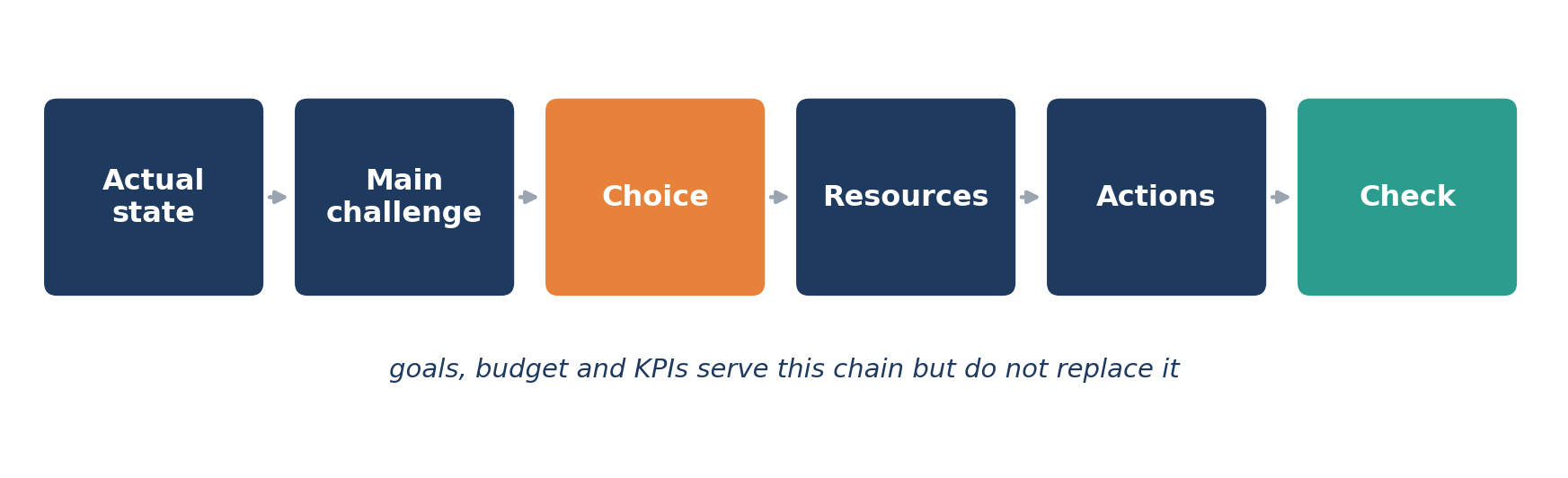
I see strategy as a chain: actual state → main challenge → choice → resources → actions → check. Goals, budget and KPIs serve this chain, but they do not replace it. "Grow by 30%" does not explain why customers will buy more, how the company will fulfil orders, or who will fund the growth.
This guide is for founders and CEOs of operating companies: money is limited, and you have to choose before uncertainty goes away. All numbers in the example are illustrative, not a client case.
1First, agree on what you call strategy
A goal describes the desired result. A budget shows how money is allocated. A plan is a sequence of actions. KPIs show state and movement. You need all of them. The trouble starts when one replaces another.
Richard Rumelt names three elements of good strategy: a diagnosis, a guiding policy for overcoming the challenge, and coherent actions. It is his framework, not a law of management. But as a test it works: do we understand the obstacle, and do our actions really address it? (The perils of bad strategy, McKinsey Quarterly, 2011)
Michael Porter puts the emphasis elsewhere: position, trade-offs and fit between activities. Choosing what the company does not do matters more than trying to do everything better. The two views are compatible, but they are not one model. (Creating a Successful Strategy, Institute for Strategy & Competitiveness, HBS)
And not every deterioration calls for a strategy. A payment failure, a routing error or an unfilled vacancy is operations. A strategic question appears when you need to change the logic of competition, the offer, the economics or the configuration of resources.
2AS-IS: describe the business that actually exists
AS-IS is not an optimistic version of the company and not a process diagram. It is how customers, product, revenue, costs, operations, people and obligations connect. The depth depends on the decision: for choosing a geography you need demand and payments, for rebuilding a tariff you need usage and cost to serve. There is no need to research everything equally deeply.
For every important statement in the brief, note the source, the period, the data owner and your confidence. If a number is an estimate, label it as one. A neat table does not make the underlying data accurate.
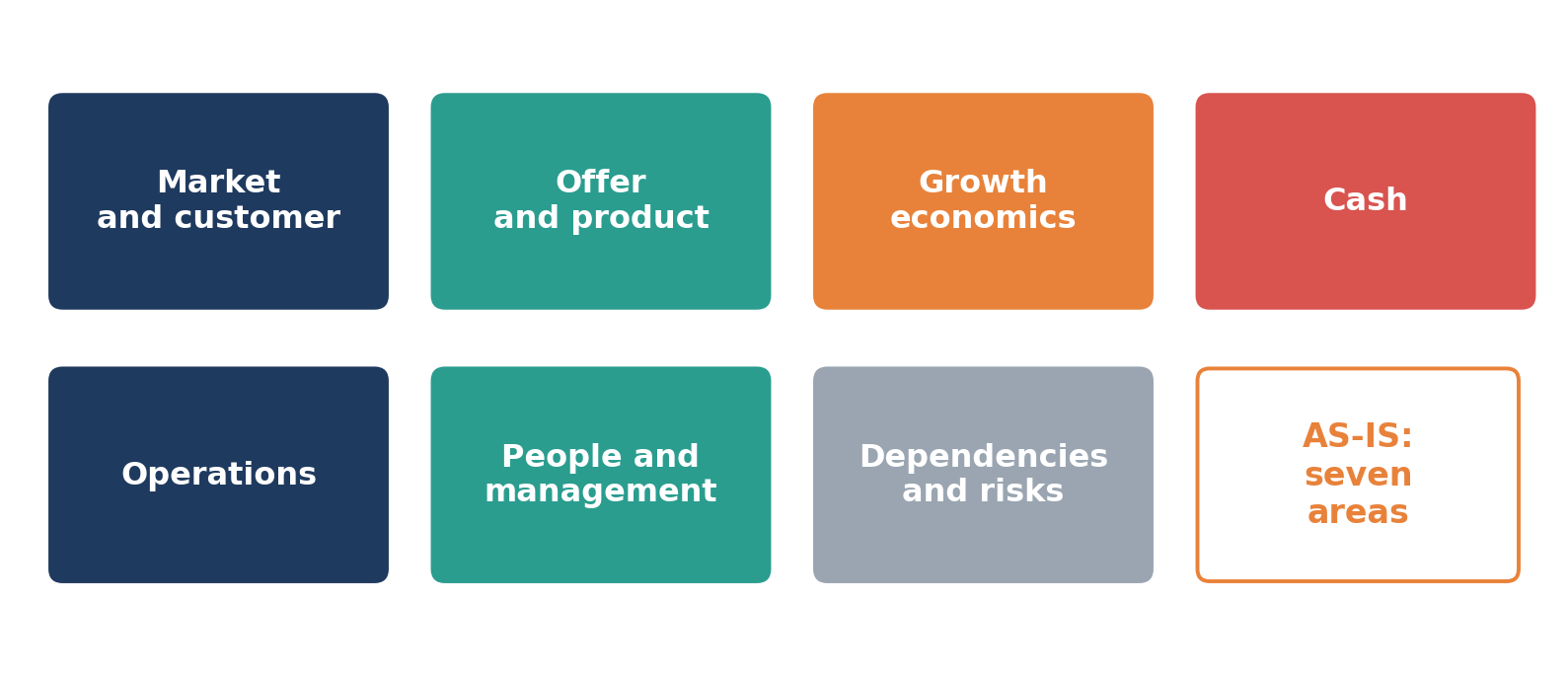
Market and customer. Who buys, in what circumstances, what they use instead of you, why they stay. Compare segments not only by revenue but also by cost of acquisition, service and retention. Study people who left or declined separately: active buyers explain part of the value, not the whole market. I covered how to keep observation, interpretation and decision apart in the guide to understanding audiences.
Offer and product. What recurring value do people pay for? Which items bring contribution and which bring complexity? Low direct margin does not automatically mean "remove": some links need checking. Look for the gap between promise and experience. Marketing sells predictability while the product needs manual coordination. Sales promise a personal approach while operations are built for a standard flow. That is no longer a question of effort but of how the business is configured.
Economics. Contribution per customer, variable costs, CAC, cohorts. Do not use LTV until you have data for several cohorts: forecast LTV easily justifies any spending.
Cash. At least three pictures: economic result, cash movement and obligations. Revenue, profit and bank balance answer different questions. Cash from an annual subscription sits in the account while the service still has to be delivered for six months. A loan raises the balance but does not prove the business earns money. IAS 7 splits cash flows into operating, investing and financing for a reason. (IAS 7, IFRS Foundation)
Operations. Where the promised result is created and where it breaks: lead times, rework, returns, queues. Average utilization hides the point. Monday is quiet, Thursday has a queue. "20% capacity left" with no link to time and type of work may be a reserve that does not exist.
People and management. Who makes decisions, which questions still go through the founder, where people own a result without authority. And the conflict of goals: sales want any contract, operations want the standard one, marketing wants the cheap lead, finance wants fast payment. Each team hits its KPI and worsens the system.
Dependencies and risks. Do not write "market risk". Write: "if we lose partner X, we will not fulfil part of the orders for Y; the backup route is untested". If Y is unknown, the next task is to estimate it, not to invent a comfortable number.
How to assemble this without a three-month project
Start with existing data and a specific decision. Pick a comparable period, check definitions, break the result down by meaningful segments. Where the numbers do not explain the mechanism, add customer conversations and observation of fulfilment.
| Block | What we record | Decision it serves |
|---|---|---|
| Market and customer | Jobs, alternatives, reasons to choose and to decline | Where to look for value and growth |
| Offer | Usage, promises, contribution, complexity | What to develop, what to limit |
| Economics | Revenue, variable costs, acquisition, cohorts | Which growth is profitable |
| Cash | Receipts, payments, obligations, buffer | What can be financed |
| Operations | Bottlenecks, quality, capacity by time and segment | What can be delivered |
| Team | Skills, authority, decisions | Who can carry out the choice |
| Dependencies | Disruption scenarios and alternatives | What to protect before expanding |
This is not a mandatory "diagnostic week". If management accounting does not show contribution, restore the basic picture first. But do not wait for perfect data: an obviously dangerous decision can be stopped now while you keep checking.
The result is a few pages: facts, disputed points, and questions that really change the choice. Let the long archive be an appendix. A CEO needs not one more catalogue of data but a sense of where the company stands and what it does not yet know.
3A running example: revenue grows, complexity grows faster
Take an illustrative service, "Clean Circle": a laundry subscription with pickup and delivery. The company is fictional, amounts are in euros, taxes are ignored, and the calculation is a simplified management model.
Two active tariffs:
| Segment | Active per month | Revenue per customer | Variable cost | Contribution |
|---|---|---|---|---|
| Standard schedule | 600 | 90 | 50 | 40 |
| Flexible windows | 400 | 115 | 75 | 40 |
| Total | 1,000 | 100 avg | 60 avg | 40 avg |
Monthly revenue is 100,000, variable costs are 60,000, contribution before acquisition and overhead is 40,000.
Suppose 90% of standard and 80% of flexible customers stay into the next month. This is an assumed month-to-month transition, not a proven customer lifetime model. To hold the base you need roughly 60 and 80 new customers, 140 in total. At a CAC of 70 that is 9,800. Other operating costs are 22,200. After everything, 8,000 remains before taxes, financing and investment payments. This is not free cash flow and not EBITDA.
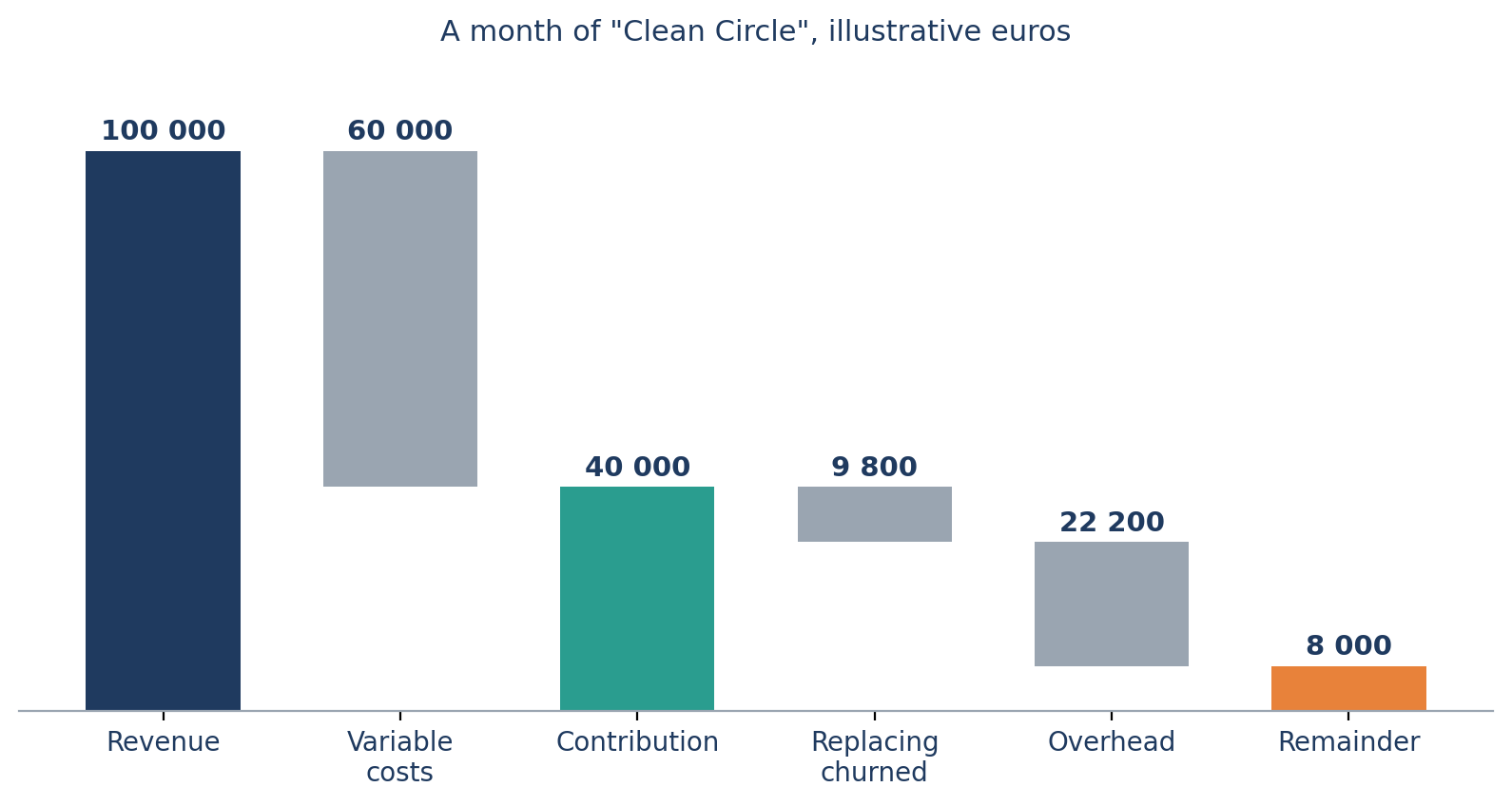
What does the CEO see in the averages? A positive result. What is in the detail? The flexible customer brings more revenue but the same contribution, is retained worse and needs a more complicated route. That is not enough to close the tariff. But it is enough to stop treating its growth as automatically better.
4From symptom to diagnosis
Say the CEO hears: "Sales are missing plan, we need more advertising." At the same time requests to reschedule are rising, and the operations director asks to expand headcount.
There are many explanations: demand weakened, the price is high, the leads are wrong, the promise of flexibility attracts complicated orders, fulfilment hurts retention, the bonus scheme rewards revenue regardless of complexity. Each has to be separated using data.
| Symptom | What to check | Competing explanations | Implication |
|---|---|---|---|
| Flexible customers churn more | Cancellation reasons, delays, cohorts, districts | Price, quality, changed need | Do not cut the price before checking |
| Delivery costs more | Density, windows, repeat trips | Carrier rate, routing, the promise | Check the configuration of the offer |
| More people needed | Tasks, peaks, rework | Lack of capacity or excess complexity | Do not hire "in general" |
| Weak growth result | CAC, contribution, retention, cash | Expensive channel or weak model | Separate the sources of the problem |
If data converge, a working diagnosis might read: "We are increasing the share of orders with inconvenient windows and low route density. They complicate fulfilment and retention. Revenue growth does not turn into comparable growth of contribution."
That is an explanation, not the truth. Check whether the effect holds inside comparable districts and cohorts. Perhaps the flexible tariff is sold more often where the service recently launched. A difference between groups is not a proven cause.
A company can have several constraints. Choosing the main challenge is a management priority, not a claim that the other problems vanish. For this stage the challenge is: find growth that uses the existing operating system more densely, instead of expanding complexity.
5Goal and TO-BE: what business do we want
The ambition may sound like "become a noticeable city service". For the next stage you need a verifiable goal: improve contribution and retention of the chosen segment without losing quality and without breaching the liquidity limit.
TO-BE is how the business is built: which customers, which offer, how delivery works, what authority the team has, what limits apply to sales. The financial figure is part of the picture, not the whole of it.
Separate the result from the constraint. "Contribution grew" is a result. "Delivery did not get worse" is a protective condition. "Cash never falls below the agreed level" is a financial boundary. Without boundaries a beautiful goal can be reached in a destructive way.
Horizons differ too: the nearest cycle is to test demand and operations; a few quarters is to learn to reproduce the profitable configuration; beyond that, to decide whether you need your own infrastructure. A five-year plan is a hypothesis, not a forecast. And there is no need to rewrite the direction every week either.
6Look at different routes before choosing
Options must differ in the mechanism of the result. Three different ad accounts are not three strategies.
| Option | Mechanism | What it requires | Main trade-off |
|---|---|---|---|
| Grow in dense districts with standard windows | Load the existing route better | Local demand, limited windows, customer selection | Giving up some options customers like |
| Expand flexible premium | Monetise willingness to pay for convenience | Pricing, routing, spare capacity | More complex, costlier fulfilment |
| Hand part of operations to partners | Less own capacity | Contracts, quality control | Less control, dependence on a partner |
| Slow acquisition for a while | Fix retention and fulfilment | Changed incentives, work with the base | Lower short-term revenue growth |
| Buy equipment | Create or cheapen capacity | Capital, premises, utilization | Irreversibility and fixed costs |
Compare evidence, resources, timing, dependence on external money, reversibility and opportunity cost. Equipment can be sensible, but not because "it will come in handy anyway".
A 4 instead of a 3 in a scoring table does not measure the future probability of success. If the conclusion depends on arbitrary weights, go back to the key assumptions and thresholds.
7The choice: where and how we win
The assumed choice for the next stage: test growth of the standard subscription in a few dense districts on existing routes. We do not widen arbitrary windows and do not buy equipment until demand and utilization are confirmed.
Customer value is clear regularity. The possible economic advantage is lower cost and fewer failures per unit of fulfilment. It is supported by routing, stable quality, a simple tariff and discipline around exceptions.
This is not a proven moat. A competitor will copy a tariff. Protection, if it appears, will sit in the system: density, quality, customer habit, coherence of operations. Porter treats fit between activities as an essential part of strategy, but that is a framework for checking, not a guarantee of lasting protection.
And write the refusal down plainly: we do not promise everyone an individual time; we do not pay bonuses on revenue alone; we do not open a district until the route meets the conditions. The refusal must show up in real rules, not only in a presentation.
8Growth needs money before it becomes profitable
Let us test a tempting option: acquire 200 new customers at revenue of 100 and variable cost of 65 in the first fully served month. We assume all 200 are active for the whole month. This is a simplification, not a forecast of calendar intake.
Extra revenue is 20,000, variable costs are 13,000, contribution is 7,000. At a CAC of 70, acquisition costs 14,000. The first month gives −7,000 even before any new overhead.
Repeat payments may change the economics, but they must be shown over time, not declared with "it will pay back later". If payments arrive later than costs, or equipment is needed, cash exposure grows even with promising cohort profitability.
One more thing. In steady state you constantly need to replace leaving customers. You cannot show an attractive LTV for one customer and forget that the base needs acquisition every month.
Before approving a strategy, build a simple cash calendar: obligations, receipts, scenarios. EBITDA does not replace it: it does not show the need for working capital, investment payments, taxes and debt service.
9The pilot: test the configuration, do not fund a dream
For the chosen route, design a pilot: 30 new customers at 90 for the first fully served month, variable cost 50, CAC no higher than 70. We assume they fit into existing windows without new permanent hires. That is exactly what the pilot tests.
| Item | Value, illustrative |
|---|---|
| Customers × monthly price | 30 × 90 = 2,700 |
| Variable costs | 30 × 50 = 1,500 |
| Contribution before acquisition | 1,200 |
| Acquisition | 30 × 70 = 2,100 |
| One-off changes to ordering and routing | 6,000 |
| Operations preparation and training | 3,000 |
| Total pilot costs | 12,600 |
| First-month result | −9,900 |
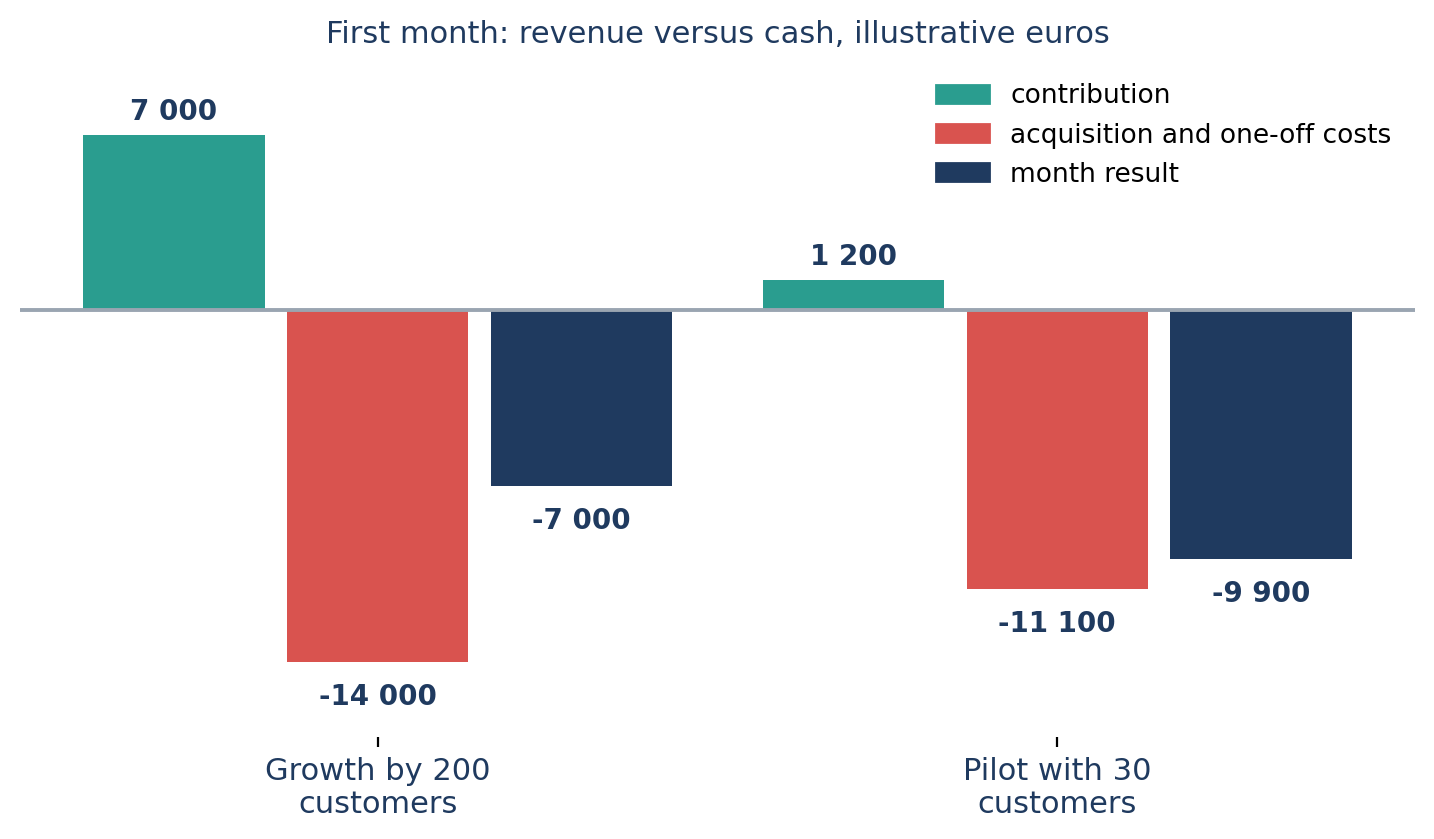
This is the price of a test, not a profitable launch. It is justified only if the question is important, the answer changes the decision and the risk is acceptable. The peak cash need is up to 12,600 if all costs fall before receipts. The real peak will be set by the calendar.
An example of affordability: 80,000 in the account. Of that, 25,000 is reserved for near-term obligations and 30,000 as a minimum balance for a stress scenario. That leaves 25,000, which is only preliminary room for a decision. The cash forecast must confirm that reserves are not counted twice. You cannot approve a pilot just because "there is eighty thousand in the account".
10What has to turn out true
First contribution of a standard customer is 40, CAC is 70, so the first month does not repay acquisition. The mechanical 70 / 40 = 1.75 months ignores churn and the calendar. If 90% of customers stay, the contribution of a new customer over three months is 40 × (1 + 0.9 + 0.81) = 108.40. After CAC, 38.40 remains before overhead and one-off costs. This is a scenario assuming current-base retention applies to a new cohort, not a measured LTV.
Build a downside: higher CAC, costlier fulfilment, worse retention, a delayed launch. Change levers one at a time first, then together. You do not need a hundred combinations. You need answers to four questions: what CAC the model withstands, what fulfilment costs, how many months of cash the test needs, and when the investment could return.
A threshold does not prove achievability. "Cut costs by 20%" is a condition, not a strategy. Name the mechanism: density, fewer repeat trips, a different service. And check that the value to the customer does not disappear along with the costs.
11The next 90 days
90 days is a horizon for organising execution, not the whole strategy.
| Period | Action and owner | Result | Gate |
|---|---|---|---|
| Days 1–15 | Finance and operations check segments and routes | Agreed economics and capacity reserve | Continue only if data are usable and cash is available |
| 16–30 | Product and operations prepare a limited tariff | Working design and exception rules | Execution test without promising any availability |
| 31–60 | Growth recruits the pilot, operations deliver | Demand, CAC, cost, quality of the first cohort | Stop or revise if budget and quality are breached |
| 61–90 | Joint review, owner is the CEO | Early retention and a proposal for the next stage | Expand only the confirmed configuration |
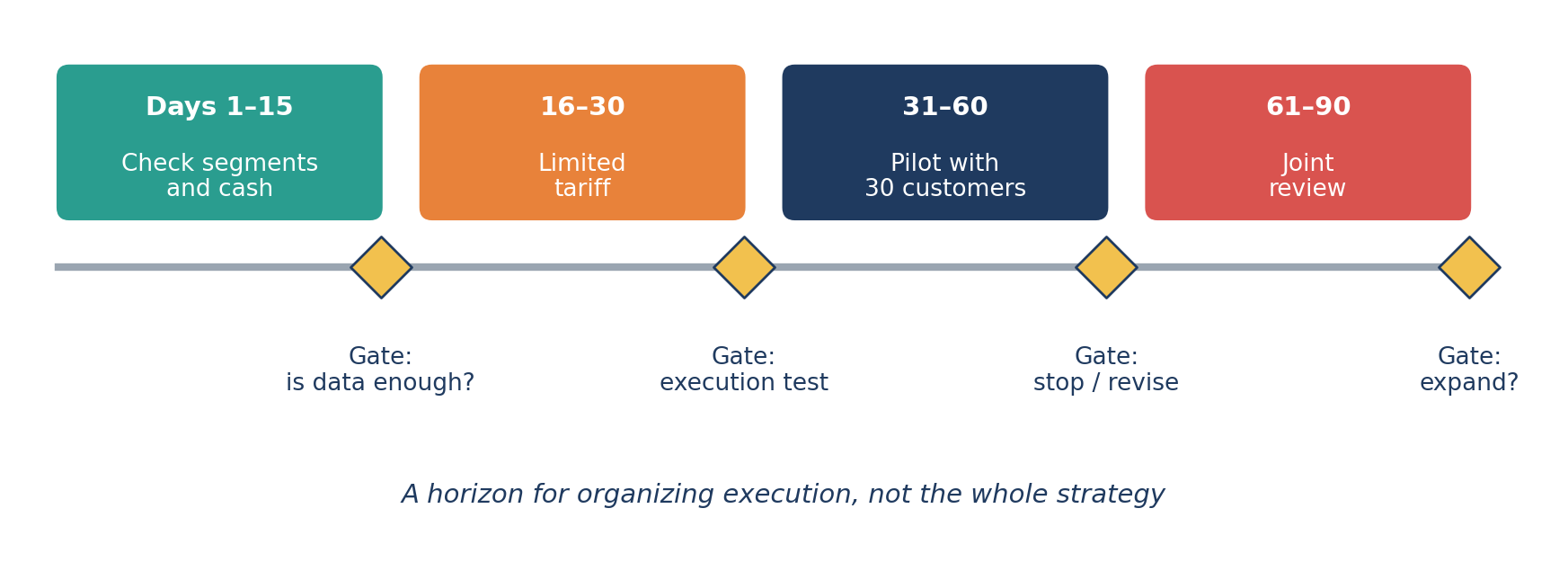
There is no annual LTV on this horizon yet, and a small pilot does not guarantee the same costs at scale. The next stage should close a specific gap in knowledge, not automatically multiply the budget.
Each initiative has an owner, a result, resources, dependencies and a decision rule. If product has to set up the tariff and finance has not yet agreed the acceptable price, the deadline sits on the wrong task.
Split the work into four types: BAU maintains existing commitments; improvements make the current system better; a bet changes an important part of the model; an experiment buys knowledge. A project can move between types, but its goals and budget must change explicitly.
12Why strategy does not get executed
Strategy breaks not only at the choice. The change-management model by Knoster, Villa and Thousand says the result is made of five parts: vision, skills, incentives, resources and an action plan. Remove one and you get a predictable failure: without vision, chaos; without skills, fear and anxiety; without incentives, resistance; without resources, frustration; without a plan, a false start.
Two practical conclusions for the CEO.
First: an initiative has one owner. There can be many participants, but collective responsibility without decision rights quickly turns into a queue of approvals. Fix the boundaries: operations change the schedule inside agreed windows, growth reallocates the test budget within a limit, finance stops extra spending if the cash boundary is breached. Changes to the offer and anything beyond the overall risk return to the CEO.
Second: incentives must support the choice. If a manager is paid for revenue while the strategy requires limiting complex orders, the contradiction will not disappear after the document is circulated. You need clear criteria for an acceptable sale.
OKRs can help align the team's attention. They do not replace choosing a strategy. "Increase contribution" without a diagnosis, a mechanism and resources remains a goal, however nicely formatted.
13Manage assumptions, not only risks
A fact is an observation with a definition and a period. An estimate is a calculation on incomplete data. An assumption is what we accept for now in order to decide. A risk is a possible event with consequences. An unknown is a question with no answer yet.
| Assumption or risk | Why it matters | Check | When we revisit |
|---|---|---|---|
| A new standard customer costs 70 or less | Sets payback | Limited purchase, full costs | Sustained price above the model threshold |
| The route takes customers without new fixed cost | Basis of operating leverage | Time, windows, repeat trips | A new permanent shift became necessary |
| Retention of current customers applies to new ones | Basis of three-month contribution | A new cohort | Behaviour clearly worse than the scenario |
| The tariff is understandable and wanted | Basis of demand | Real applications and choice episodes | People choose only the exceptions |
| Quality does not deteriorate unacceptably | Protects the existing base | Lead times, rework, complaints | The agreed boundary is breached |
Take numeric quality boundaries from your current level, your promise and acceptable damage, not from someone else's business. And do not treat an early signal as a proven predictor. Reschedules in week one may warn of trouble but do not prove future churn. Its usefulness has to be checked as well.
When a result is bad, separate execution from the idea. Traffic was not gathered: the conclusion about demand is weak. The tariff is clear and available, yet customers systematically choose something else: now it is value that is being tested. A supplier changed terms: recalculate the environment, the team is not to blame.
14Management rhythm: discuss changes, do not read the table aloud
An example rhythm for this business: a short review of quality and cash signals; a regular pilot review; monthly reading of economics and cohorts; a strategic check at a gate or on a significant event. It is an example, not a standard for everyone.
An operational meeting should not choose the market again, and a strategic one should not drown in individual delays. Before a review, one version of the figures is updated. At the meeting you discuss discrepancies: what changed, why, how sure we are, what decision is needed. The outcome is to continue, change, stop, reallocate or re-check the explanation. "Noted" is not a decision.
Leading indicators are route readiness, completion of the first order, share of exceptions. Lagging ones are contribution, retention, payback. If the first grow and the second do not, you cannot keep blaming a delay indefinitely: check whether the link exists. And record the reason for a decision and its expected effect. A month later the decision log tells a bad hypothesis from bad execution.
15Where AI helps a CEO and where it is dangerous
AI is good at finding discrepancies between documents, listing assumptions, offering alternative explanations and checking whether initiatives contradict the chosen approach. It does not know the internal reality without good data.
A workable order: prepare the minimum permitted data set → give a dictionary of metrics → ask it to separate facts, interpretations and unknowns → check links and calculations by hand → decide → look at the result.
In "Clean Circle" a model could notice that some reports count orders and others count customers, and suggest checking repeat trips. It must not invent retention or declare routing the only cause.
A useful prompt: "Find the strongest explanation that contradicts our diagnosis. Say which data would tell the versions apart. Do not add facts that are not in the attachments." That makes AI an opponent, not a factory of confirmations.
NIST AI 600-1 describes, among other things, confabulation, data privacy and human–AI configuration risks. A confident answer does not confirm a fact, and the ability to upload a file does not mean it is acceptable to process customer data. (NIST AI Risk Management Framework) Check calculations by computing them, documents against the original. You can delegate preparation, not responsibility for the choice.
16What to keep on one page
- Situation: what is happening and what data it rests on.
- Main challenge: what limits the desired result.
- Choice: where and how we act.
- Mechanism of winning: why this should work.
- Refusal: what we are not doing for now.
- Resources: money, people, time, cash boundaries.
- Initiatives: agreed actions and owners.
- Checks: assumptions, metrics, gates.
- Review: which events will change the decision.
For "Clean Circle" it sounds like this: "We test the standard subscription in dense districts on existing routes. We do not widen arbitrary windows and do not invest in equipment until demand, fulfilment and cohort economics are confirmed. First a limited pilot, then a separate decision on the next volume."
There is no guarantee of a good result here. But it is a construction you can execute, check and challenge.
Strategy becomes a tool when it changes real decisions: which sale to accept, which project to stop, where to send capital, whom to hire, what to check next. If after the session everyone keeps doing the same thing under a new name, the document has not started working.
Related reading: how to build demand and measure results is in the guide to brand marketing; how to choose what people pick you for is in the guide to brand strategy and positioning.