

Let me start with the uncomfortable part: zero-budget marketing does not exist. What exists is marketing without buying impressions. It costs as much as your hours, your expertise, your product and other people’s willingness to recommend you cost. Counted honestly, it is sometimes more expensive than ads.
Why do it, then? Because the cost has a different structure. You buy ads again every time: stop paying and the traffic stops. A good organic asset keeps working after you have finished making it: a page with a calculator, an article on someone else’s audience, a partner who mails out your promo codes, a customer who brings a colleague. The only question is which asset to build with your resources and how to check that it works at all.
I collected 30 mechanisms in one place and went through them with numbers wherever numbers can be checked. For the strong cases I found the primary source. For the weak ones I wrote it plainly: this is a founder’s story, this is a third-party service estimate, this is an illustrative example. Every figure carries a label saying what exactly was measured and by whom. In this genre the difference between a “self-report” and an “experiment” decides almost everything.
The material comes from three layers: open sources (Ahrefs, Pew Research, Spotify, TechCrunch, Contently and others), the practice of Roman Kumar Viyas (Forbes, a webinar, an interview; he is the founder of the agency Qmarketing and a co-owner of Qlean), and working partner spreadsheets that became the basis for the partner-pipeline schemes. I do not invent numbers I could not find in sources.
How to read the labels
Every case gets one of five labels. Remember them; it saves time later.
- Experiment: measured under controlled conditions, or a method is published that you can check.
- Self-report: the company or founder publishes the numbers. Useful, but not proof of causality.
- Service estimate: the figure comes from an external tool (for example Ahrefs Site Explorer) and shows search visibility, not revenue.
- Practice: people do it, no numeric result.
- Illustrative: an example with invented inputs. It shows the logic of a calculation, not the market.
1. What “no budget” actually means
If a company doesn’t pay Meta or Google for impressions, it pays with something else. I split the mechanisms into five groups by the “currency” you pay with.
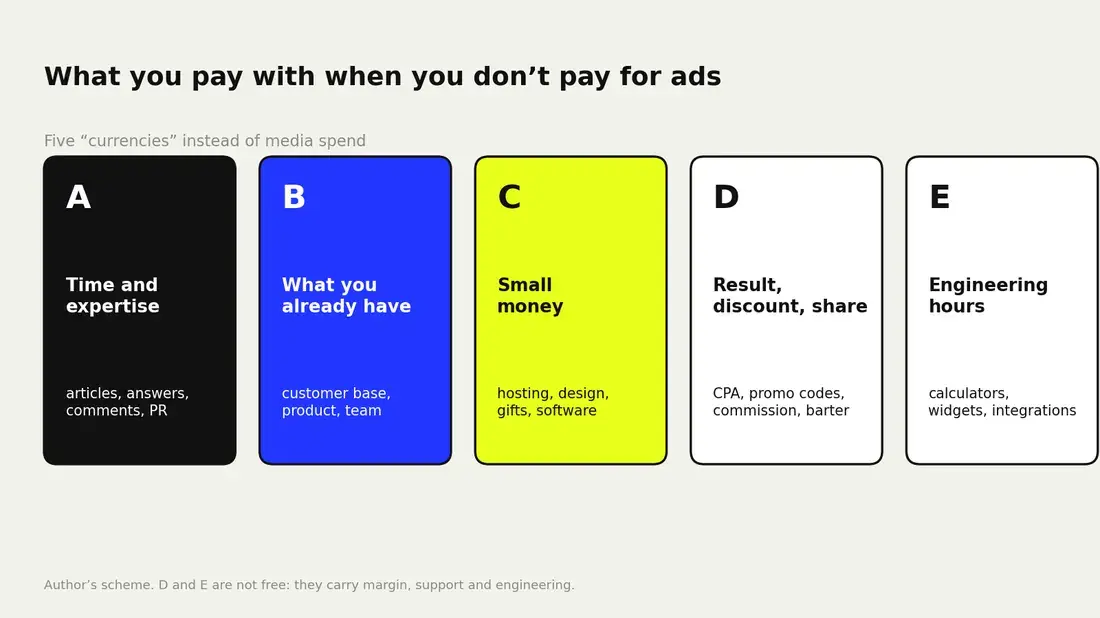
A. Time and expertise. Articles, answers to questions, comments for journalists. Almost no money, but you need someone who knows the subject.
B. What you already have. A customer base, a product, a team, data. You don’t buy anything new, you turn what you have into a channel.
C. Small money. Hosting, design, gifts to partners, software subscriptions.
D. Result, discount or share. You pay not for an impression but for a confirmed action: commission, promo code, barter. This is not an ad budget, but it is an acquisition cost.
E. Engineering hours. Free tools, widgets, integrations. No money goes on placement, but it goes on engineers.
Groups D and E can’t be called free. I include them for one reason: they let you replace buying media with a different way of paying. That is why they must be counted.
Spike, process, asset, loop
A second distinction you need before going on. Not everything that brought customers is a “channel”.
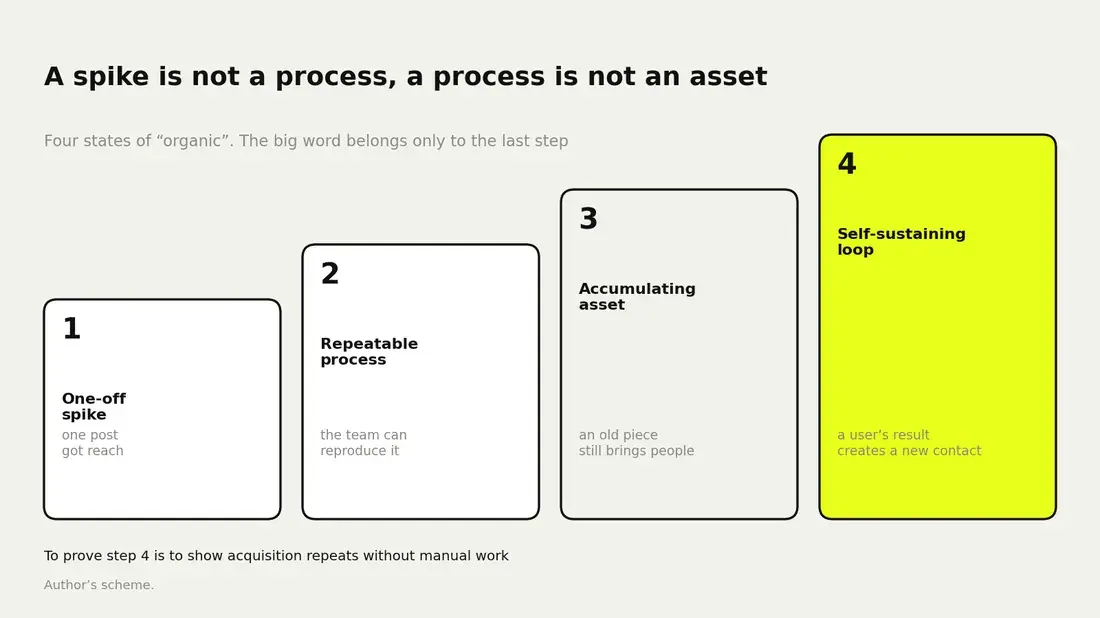
A good post gives a spike. Weekly answers in a niche community give a process. A calculator that people find through search adds up to an accumulating asset. And “growth loop” should only be used for something where a user’s result itself creates the next contact: a signature in an email, a year-in-review card, a public link to a result. If you can’t show that acquisition repeats without manual work, it is not a loop, it is a process.
“Organic” is not zero CAC
If you spent 40 hours and brought 10 customers, your CAC is not zero. It equals the cost of 40 hours divided by 10. We will get to the calculations below; for now one rule: when someone says “we got customers with no ad budget”, ask how many people and how many hours it took. The answer is often more interesting than the figure itself.
2. How to choose a mechanism: five questions
Before choosing a tactic, answer five questions.
- What result do you need: new users, activation, repeat purchase or cheaper acquisition? Subscribers and views are not a business result.
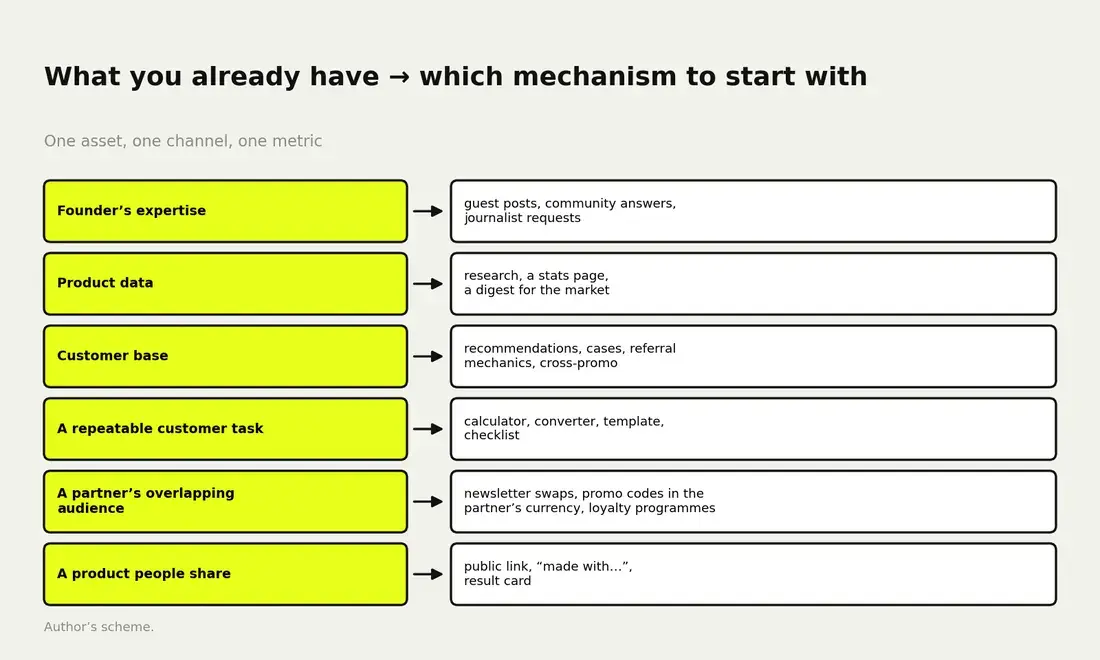
- What advantage do you already have? Expertise, product data, a customer base, an integration with someone else’s product, a result users want to share.
- Who will be the first distribution channel? Material without a distribution plan is not marketing, it is content production.
- What is the full cost? Not only production but distribution, support, updates, rewards.
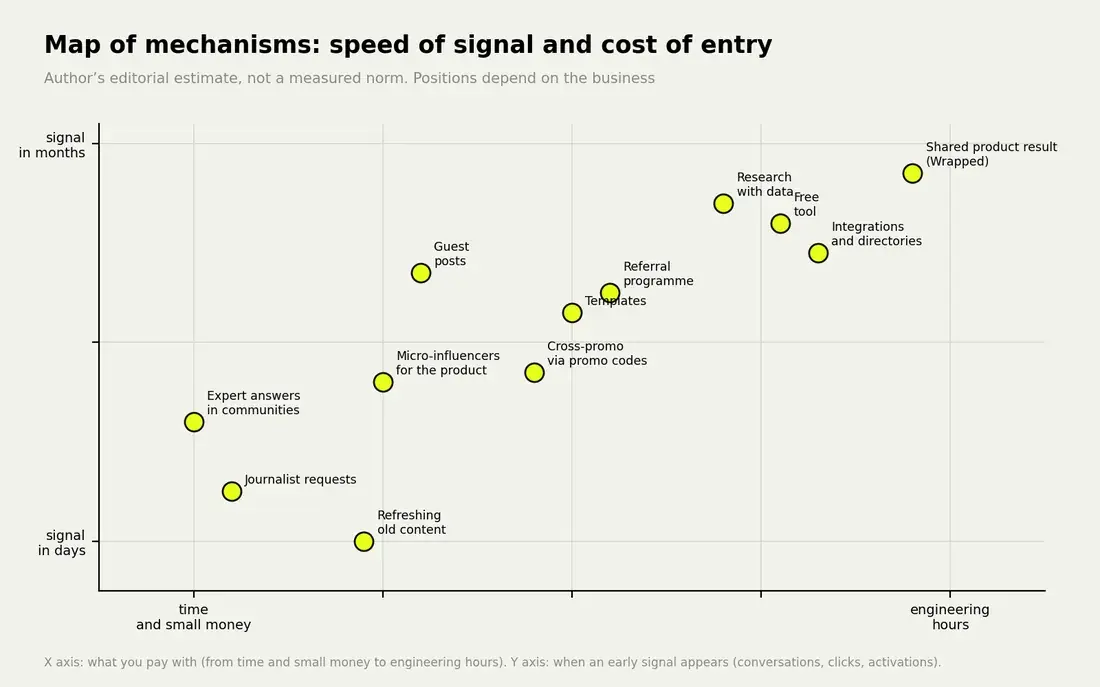
- Which early signal will you consider enough? For personal outreach it is dozens of conversations; for a tool it is months of search ranking.
And here is a map of mechanisms on two axes: what you pay with and how fast a signal appears. It is an editorial estimate, not a measured norm. But it helps you avoid looking for a quick signal where there won’t be one.
Block I. The product works instead of ads
In this block the product, or a part of it, brings new people by itself. It is the most expensive group in hours, but it has the highest ceiling. And it has the most good numbers that are easy to mistake for a universal law.
1. Free tools: calculators, converters, generators
The idea is simple. A person doesn’t search for an article on how to calculate margin; they search for the calculator. They want to do, not to read. You give the result in seconds, and the next step, your product, sits right beside it.
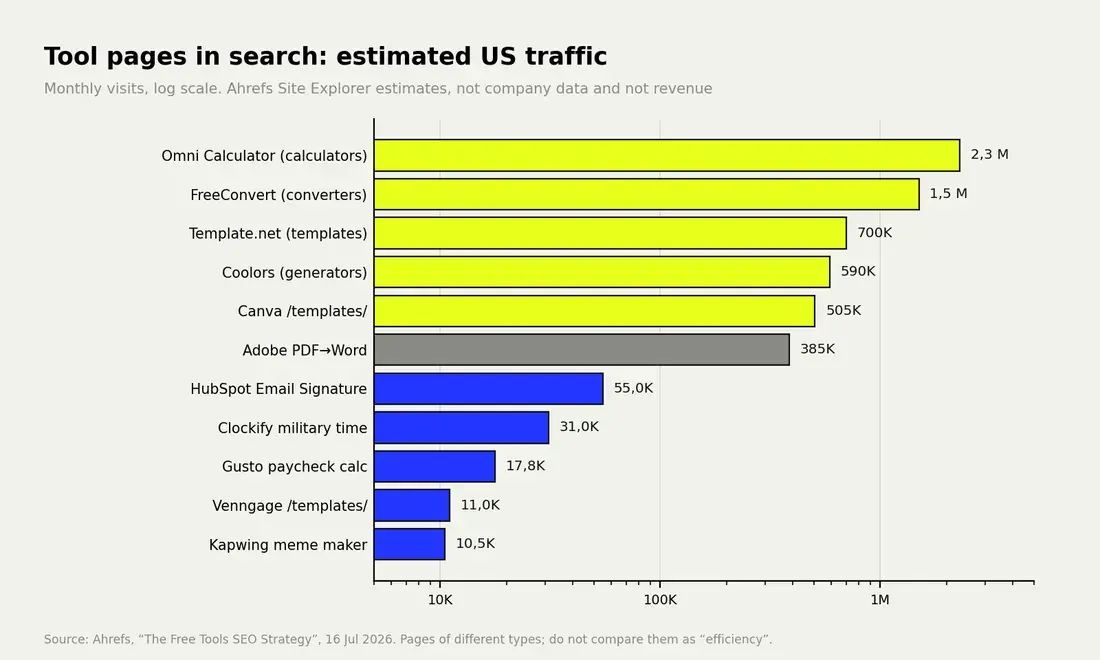
Case. Ahrefs (Singapore, a mature company, an SEO tool) reports that the /writing-tools/ subfolder was launched from zero in mid-2023, peaked at almost a million US visits a month by Ahrefs’ own estimate and now holds at hundreds of thousands. The same article analyses others’ examples: at Omni Calculator the calculator library brings about 2.3M visits a month, FreeConvert’s traffic grew over five years from roughly 380K to over 1.5M, Coolors has about 590K. It is important that small numbers are there too: Gusto’s calculator gets about 17.8K visits a month, Clockify’s time converter about 31K, Kapwing’s meme generator about 10.5K (it had over 150K at its peak).
What is proven and what is not. It is proven that such pages rank and bring people from search. It is not proven how many of those people became customers: Ahrefs shows only a traffic estimate. HubSpot’s email signature generator gets about 55K US visits a month by the same estimate, but sales from it are not shown in open sources. Also, the article was published by a company that sells keyword-research software and an AI platform for building such tools. That doesn’t make the figures false, but the author has an interest.
How it works. Value is created not in text but in work done for the user. The first touch happens in search. The page spreads through links and repeat visits. The next step is a contact, a sign-up, a trial. Scale is limited by demand for the specific query and by competition: Ahrefs itself says generic queries like “QR code generator” are taken by giants, and winners are narrow professional niches.
What transfers. List 10–20 tasks your customers do by hand. For an online school it can be an exam-prep calculator or a check of whether a programme fits requirements. For a delivery service, a cost and time estimate. For a consumer app, a converter or a compatibility check.
What is pointless to copy. A universal “AI generator of everything” with no concrete task. And benchmarking against big brands’ traffic: they have a different domain, maintenance budget and tolerance for low conversion.
Fits: a product with a repeating customer task where the result can be computed. Doesn’t fit: a business whose value is entirely in personal consultation. Needed before starting: 10 real wordings of customer tasks and an answer to “what will the person do after the result”. First steps: collect queries from sales and support; check search suggestions and wording in communities; build a minimal version with no sign-up; add a methodology note and a short FAQ; fix the metric before launch. Metric: the share of people who got a result and took the next step. Reason to continue: repeat visits and clicks into the product. Reason to stop: traffic exists, but no clicks into the product.
2. Templates
A template is cheaper than a tool; the logic is the same: a person came for a ready result. By Ahrefs’ estimate, Canva’s templates section gets about 505K US visits a month, Template.net about 700K, Venngage’s template hub about 11K. That is traffic estimated, not conversion. A template works where you have a repeatable artifact: a contract, a checklist, a study plan, a sales script, a brief. It doesn’t work where value hides in personal expertise and can’t be packaged without losing quality.
Label: service estimate. Metric: downloads, usage, leads. Stop: if people download but nobody returns or signs up.
3. “Made with…” signature: the Hotmail loop
A classic retold at every conference, so let’s take what is actually written.
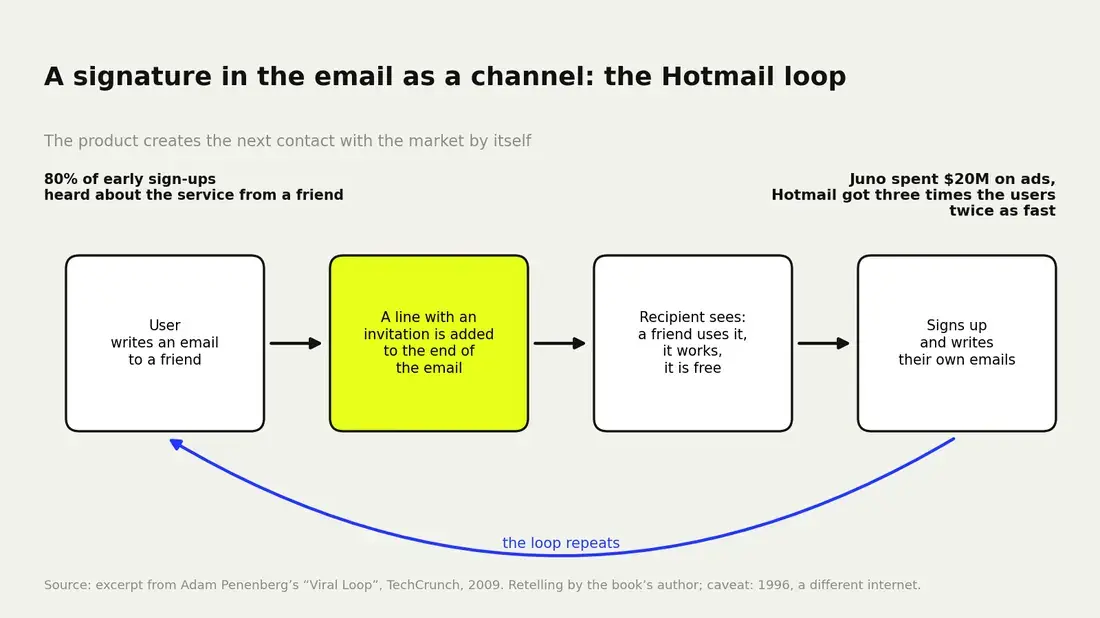
Case. Hotmail, USA, launched 4 July 1996, early stage. According to Penenberg, investor Tim Draper repeatedly insisted on adding an invitation line to the end of every user’s email; the founders resisted, then agreed, but without the phrase “P.S. I love you”. After that, growth, as the author writes, looked like a hockey stick: about 3,000 sign-ups a day, a million users in six months, two million five weeks later at over 20,000 sign-ups a day. In the early days 80% of people who signed up said they heard about the service from a friend. For comparison the author cites competitor Juno: it spent $20M on ads, while Hotmail got three times the users twice as fast.
What is less clear here. It is a retelling in a popular book, not a company report. The text also contains an internal inconsistency: “750,000 by Labor Day” fits badly with “a million in six months”, so I don’t use that figure. Also 1996: email was a new product, not a crowded market. The channel wasn’t “free” either: the project had $300K of seed funding, and the servers regularly went down under load.
Mechanism. User value: free email. First touch: the recipient of a friend’s email. Reason to share: the user doesn’t have to do anything, the line is added automatically. Next step: sign-up. Scale limit: if the user has no one to write to, the loop doesn’t start.
What transfers. The principle. If your product creates a public result (a document, a design, a booking page, a certificate), add a modest “made with…” mark with a clear next step. What is pointless to copy: the exact signature text in 2026, and hoping it works without a product scenario.
Fits: products whose results are seen by third parties. Doesn’t fit: closed tools. Metric: clicks on the mark, sign-ups, activations, the share of new users who came by link. Stop: if the mark annoys paying customers more than it helps.
4. A result people want to share
A good loop needs a very precise gift to the user: beautiful, personal, and something they aren’t embarrassed to show.
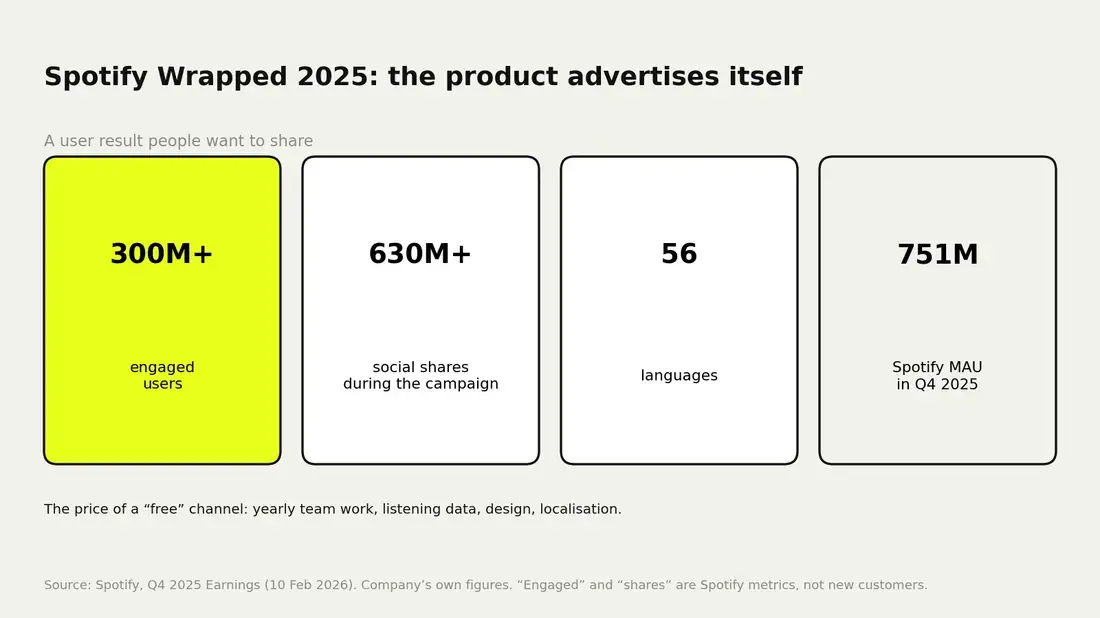
Case. Spotify (Sweden, global market, mature company). The eleventh Wrapped, according to the company, reached more than 300M engaged users by the end of the campaign and more than 630M social shares in 56 languages; in Q4 2025 the service had 751M monthly active users.
What is proven. Only that the product creates a huge amount of content users share. It is not proven how many new paying customers Wrapped specifically brought. An “engaged user” and a “share” are not a new customer, and Spotify doesn’t interpret these metrics that way.
Cost. Yearly development, data, design and localisation. It is the most expensive “ad-free” channel in this article and only affordable for those who already have a large base. For a small product the lesson is different: look for your own small Wrapped. A year-end report for a customer, a ranking by results, a certificate of completion, “your year in numbers”. Anything a person will want to show colleagues.
Label: self-report. Metric: shares with a click-through, sign-ups from links, activation of invitees. Stop: if many share but few arrive.
5. Referrals, recommendations and waitlists
A referral programme is often described as “ask friends”. In reality it is a bundle of a product, a reason to recommend and the economics of a bonus.
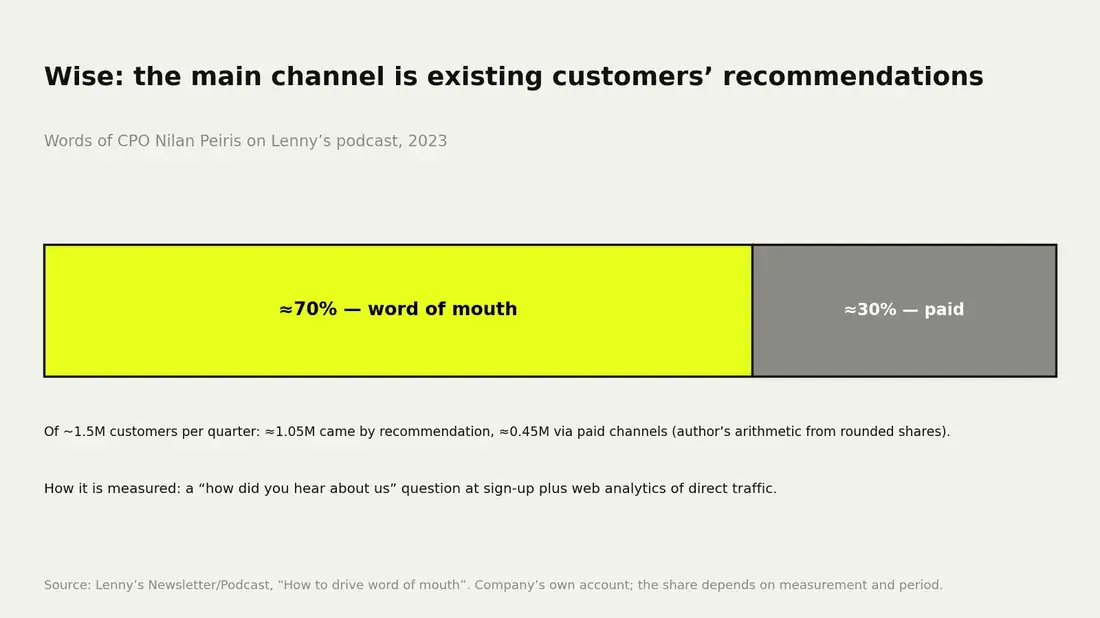
Case 1: Wise (UK, international transfers, mature company). Chief product officer Nilan Peiris said on a podcast that of roughly 1.5M customers a quarter, about 70% came by recommendation and about 30% through paid channels. The share is estimated by a “how did you hear about us” survey plus direct-traffic analytics, so it is an estimate, not a hard measurement. Importantly, recommendations arise not from a programme but from the product: the company openly builds the service around what customers want to tell others.
Case 2: Robinhood (USA, a stock-trading app). Founder Vlad Tenev said in an interview that the waitlist got 10,000 sign-ups on day one, more than 50,000 in a week and almost a million in a year; the mechanic was that invited friends moved you up the queue. This is a retelling found in search; the primary source was not checked in this work. It is a self-description and doesn’t prove the queue grew the business: people were waiting for access to a regulated product that hadn’t launched yet.
Case 3: Roman Kumar Viyas writes in Forbes (2017) that at the start the referral channel can give up to 50% of customers, and that spend on acquiring one social user turns into two or more customers. It is a practitioner’s claim without a method; treat it as a hypothesis.
Dropbox with a two-sided storage bonus is described so often that I leave it to one sentence: its growth figures (“from 100,000 to 4M in 15 months”) circulate in dozens of blogs, and in the sources I could check there were no links to a primary source.
How to test the mechanic before launch. Define the event that is truly valuable: payment, renewal, a first successful deal. Decide who gets the benefit. Count the funnel, not the number of invitations.
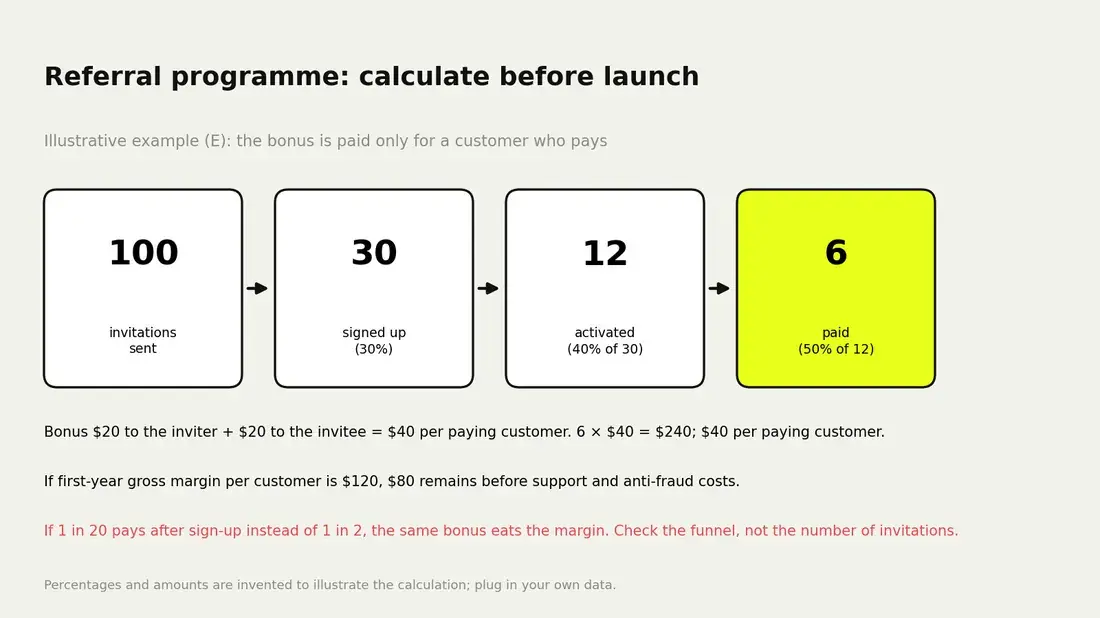
The arithmetic on this scheme is simple. Out of 100 invitations, 30 sign up, 12 of them activate, 6 of them pay. A $20 bonus to the inviter plus $20 to the invitee is paid only for those who paid: 6 × $40 = $240, that is $40 per paying customer. If first-year gross margin per customer is $120, $80 remains before support and fraud-protection costs. And if after sign-up one in twenty pays instead of one in two, the same bonus eats the margin. A referral programme without unit economics is a gift to fraudsters.
Fits: products with repeating value and a natural circle of acquaintances. Doesn’t fit: rare, expensive purchases where the decision is made once. Metric: invitations → activations → payments → retention of invitees. Stop: if invitees don’t activate.
6. User ideas: LEGO Ideas
UGC is often confused with reviews. LEGO Ideas is an example of an organised system: a user proposes a product idea, collects votes, and if it reaches 10,000 supporters, the idea goes to a review panel. The official rules describe the path of an idea after the 10,000-vote threshold (page found in search, retelling limited). From public discussions something else is also known: the threshold doesn’t guarantee a release, and some ideas are rejected.
The mechanism is strong because the participant gets status and influence on the product, and the company gets demand research, content and an audience that brings people to the project itself. You can’t “order” such UGC: the user’s contribution must give them benefit, status or pleasure. Label: practice with public rules; result figures were not verified in open sources.
7. Integrations and directories
You embed yourself where the customer already solves the task: an app directory, a CRM plugin, a platform extension. The advantage is simple: the audience exists and you only need to be useful in someone else’s environment. The downside: it is not a free registration. You need development, support, compliance with rules and often a marketplace fee, and a change in the API can kill the channel in a week.
Check before starting whether the platform has real traffic in your category, who is responsible for support and whether you can get attribution of installs and payments. I found no verified figures in open sources that I could give without caveats, so the mechanism stays without a case: label, practice. For EdTech it can be a plugin for a learning platform; for a consumer app, an integration with a popular messenger.
Block II. Content as an asset on other people’s and your own audience
Here you pay with time and expertise. The signal arrives more slowly than from partners, but the result doesn’t disappear after publication. The main question of the block: where your audience already sits and why it should care about exactly this.
8. Research on your data and a stats page
Most products have what the market doesn’t: aggregated data on customer behaviour. It becomes material people link to without being asked. Next to it lies another route: build an up-to-date statistics page on a topic where people search for it, and politely notify the authors of outdated pieces.
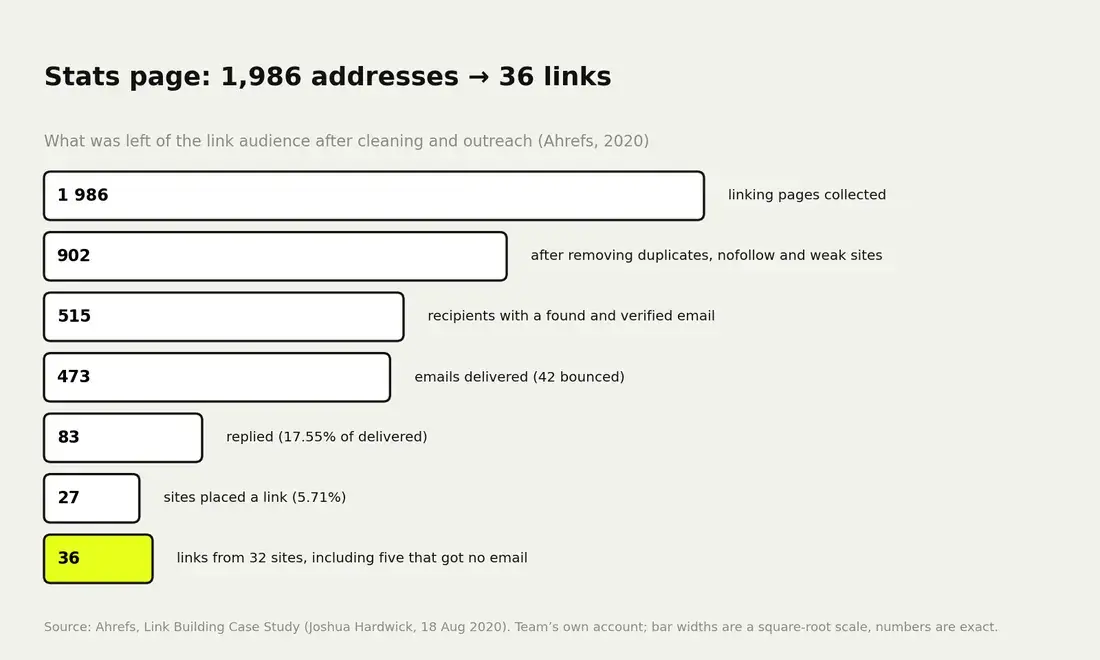
Case. Ahrefs (mature company, SEO tool, 2020). The team collected 1,986 pages linking to competing stats pages; after cleaning, 902 remained, for 515 a verified address was found, 473 emails were delivered (42 bounced). 83 recipients replied (17.55% of delivered) and 27 placed a link (5.71%). Result: 36 links from 32 sites, including five that were not emailed.
Arithmetic check. 27 / 473 = 5.71%. 83 / 473 = 17.55%. 36 and 27 don’t contradict each other: 27 sites placed a link after an email, five more sites that got no email placed one on their own (27 + 5 = 32 sites), and some placed more than one link (36 in total).
What is not proven. This is a campaign by a team that lives on links, for a page it built for links. How many customers came from the page is not in the text. The result shows a working outreach funnel, not content payback.
What transfers. The order of actions: collect people who already link to a similar piece, clean the list, write each one a clear reason (an outdated figure, a dead link, a new sample). It doesn’t transfer: the expectation of a 5% response in any niche. Your result may differ, and that is fine if you measured it.
Stop: if 50 emails with a real reason brought zero replies, the problem is the material or the recipients, not the wording.
9. Guest posts on other platforms
The principle is simple and dull: write for those who already have an audience instead of building an audience for yourself.
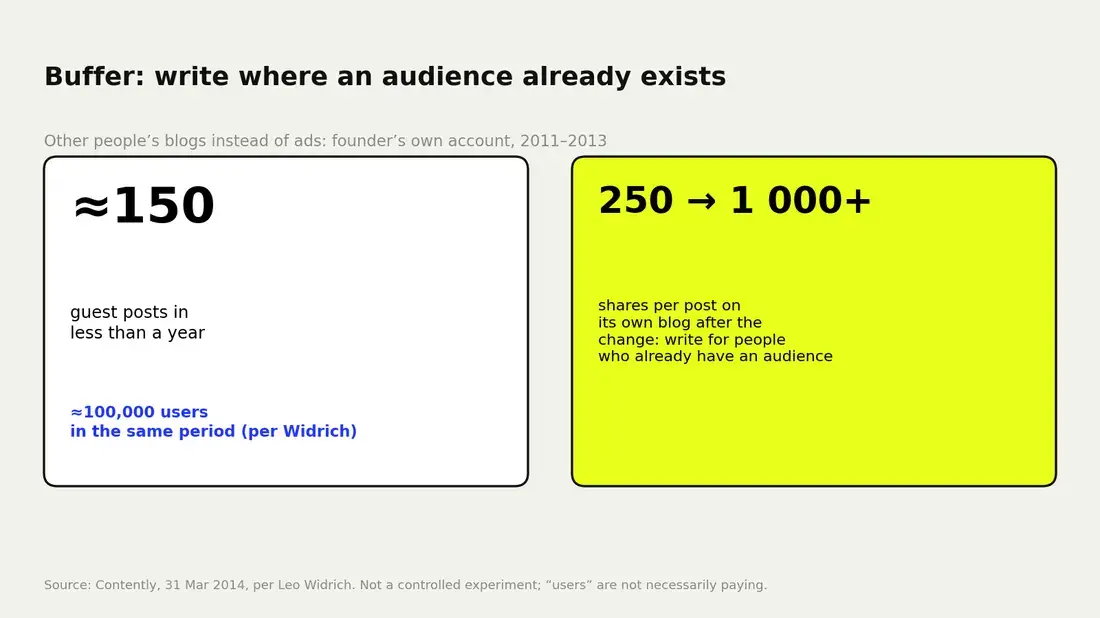
Case. Buffer (USA, early stage, 2011–2012). Founder Leo Widrich wrote about 150 guest posts in under a year and, by his account, brought about 100,000 users that way. In an interview with Search Engine Watch he speaks of nine months, Contently says “less than a year”. I noted the difference in wording and kept the figures as they are. Contently adds that after a change of approach, shares of Buffer’s own posts grew from 250 to 1,000 and more: the point was to write about what the audience cares about, not about the product.
What to be careful about. These are the founder’s words. What a “user” is (a sign-up or a payment) is not stated. The 2011 market was much less crowded with content, and a free plan helped conversion.
Cost. 150 posts are hundreds of hours of writing and platform search. The channel is free in money and very expensive in one person’s time.
What transfers. A list of 10–15 platforms where your customers sit. A post written for their format, with figures and experience, not an ad. An author profile with a next step. Stop: if after five publications there are no clicks or conversations, change platforms, not the number of posts.
10. Expert answers where the question has already been asked
Niche chats, forums, Q&A sites. A person arrives with a task, and you answer on the merits. The signal is slow, but answers have a long tail: the thread is found through search for a long time.
I have no case with a public figure, so the label here is “practice”. Rules that work almost everywhere: the answer must be useful without your product; a link only where it answers the question; on platforms with advertising rules, read them first; keep a table of threads from which a conversation started. The main risk is reputation. One irritated moderator can close the channel for the whole brand.
Metric: conversations that started from an answer. Stop: if for three months answers collect likes, not direct messages with questions.
11. Journalist requests
A journalist writes: need an expert on a topic, deadline Friday. You answer briefly, with a figure and a name. You get a mention in a publication you couldn’t buy yourself.
It is fragile by design. The main English-language platform HARO, which many considered the standard, closed as Connectively on 9 December 2024 (description of the closure). What happened afterwards is described differently by different sources: Featured, Qwoted, Source of Sources, Help a B2B Writer and others work, some paid, some free. The descriptions are mostly written by the vendors themselves, so I don’t give “acceptance rate” percentages. In Russia a similar role is played by Pressfeed, but I did not check its terms or prices.
Label: practice. Risk: a journalist needs a fact with a name and a number, not advertising. Answer only where you are a real expert, and only on deadline.
12. Cold emails to media and bloggers
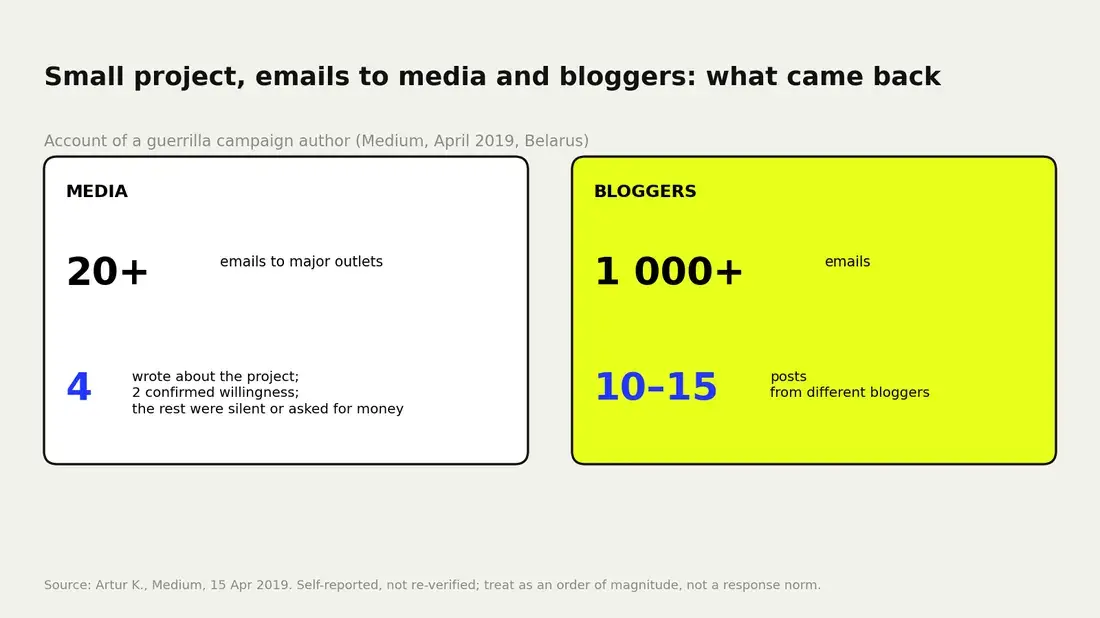
Case. The author of a Medium note (Belarus, a small project, 2019) writes that he sent more than 20 emails to major outlets; four wrote about the project, two confirmed willingness, the rest were silent or asked for money. To bloggers he sent more than a thousand emails and got 10–15 publications.
How to read it. This is an order of magnitude: the author got roughly 1–1.5% publications from bloggers’ outreach and about 20% from emails to major media. Neither can be transferred to your market. The valuable takeaway is different: you need many bloggers, and that requires automating the mailing and keeping a database, that is, time.
Risk. Spam. Mass mailing identical emails ruins the sender’s and domain’s reputation. A template with an inserted name is not personalisation. Every email needs one sentence showing you read their pieces.
13. Small opinion leaders
Bloggers with 3–30K followers often take not money but product, experience, barter or a percentage of sales. The effect can be more noticeable than from a big name, because trust is denser and the request is closer to yours.
I have no open, verifiable figures on this, so the label is “practice”. Practical terms I would build in: a trial by result (D), a tracking link or promo code for each blogger, written terms, a separate “partner content” label where your country’s law requires it, and a ban on fake boosting. If a blogger can’t show audience statistics, that is a signal.
14. Refreshing old content
The most underrated tactic on this list: before writing something new, open an old page that already gets traffic and refresh it. New data, current links, an answer to a question readers ask in the comments.
There are no public figures I could verify and give, so I leave it as a practice with a caveat: the gain depends on the age of the page and on competition. It is easy to test without others’ cases: pick three pages that are falling in search, refresh them and compare clicks over 8 weeks with the previous period. It is one of the few mechanisms on my map with the lowest cost of entry.
Block III. Partners, other people’s bases and other people’s currencies
If content works with search and social traffic, the partner block works with ready bases of customers who already pay. The signal here is the fastest: a week or two later you know whether orders will come. But you need discipline in record-keeping, or reconciliation turns into quarrels.
15. Partner base: list, terms, reconciliation
The working partner spreadsheets I studied are built the same way: platform, category, audience, reach, terms, format, status, start date, tag. It is not a method but hygiene. Without it you can’t answer “who brings us what”.
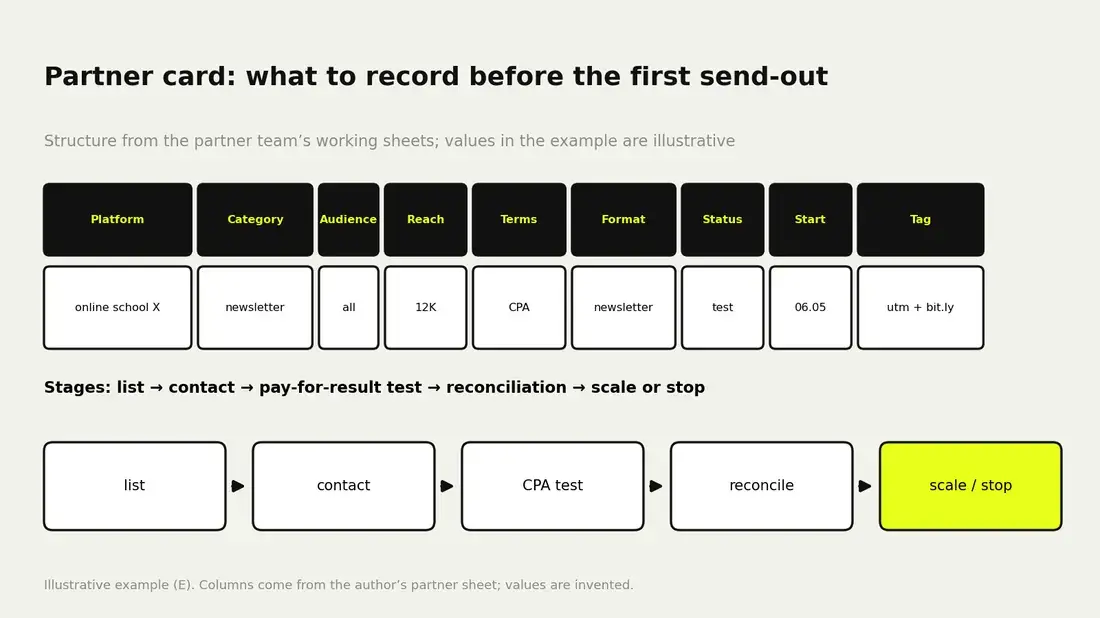
A five-step process: list → contact → pay-for-result test → reconciliation → scale or stop. A test by result (CPA or promo code) solves the main thing: you don’t pay until there is a confirmed action. The tag (UTM, promo code, unique link) is created before the send-out, not after. Otherwise at reconciliation nobody can prove whose orders these are.
Metric: orders by tag, cost per order, share of repeat customers. Stop: if after two tests a partner brings no orders, stop immediately: dragging it out is pointless, you have 20 more on the list.
16. Cross-promo in the partner’s currency
An idea from Roman Kumar Viyas’s materials: instead of money for impressions, offer the partner what is valuable to their customers, and pay only for confirmed orders.
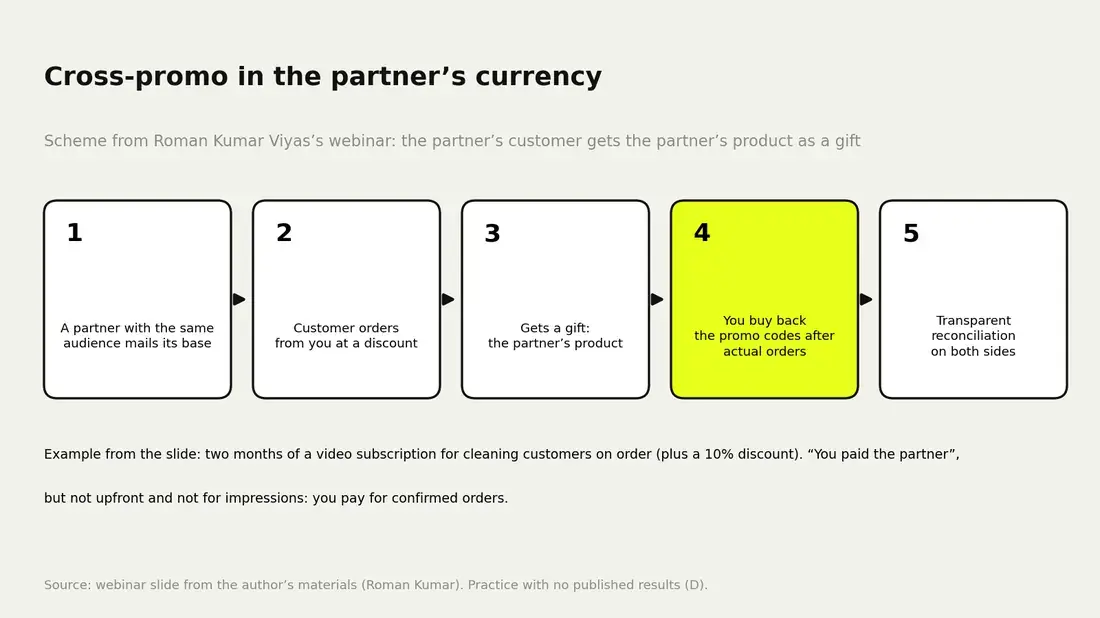
In the example from the slide, cleaning customers get two months of a video subscription service as a gift plus a 10% discount. The partner does the mailing. Promo codes are bought back after the fact, by actual orders, and both sides reconcile the report. You pay the partner not for an impression but for each confirmed order, and the customer gets more than a discount.
What matters here. The partner must have the same audience but a different product. The gift must be worth more to the customer than it costs you. A promo code can’t be put into open access without a limit. Risk: if the gift feels cheap, it spoils the impression of your brand.
17. Banks and loyalty programmes as a channel
Banks and loyalty operators look for ways to please cardholders. You offer a deal, they show it to customers, and you pay a commission on sales.
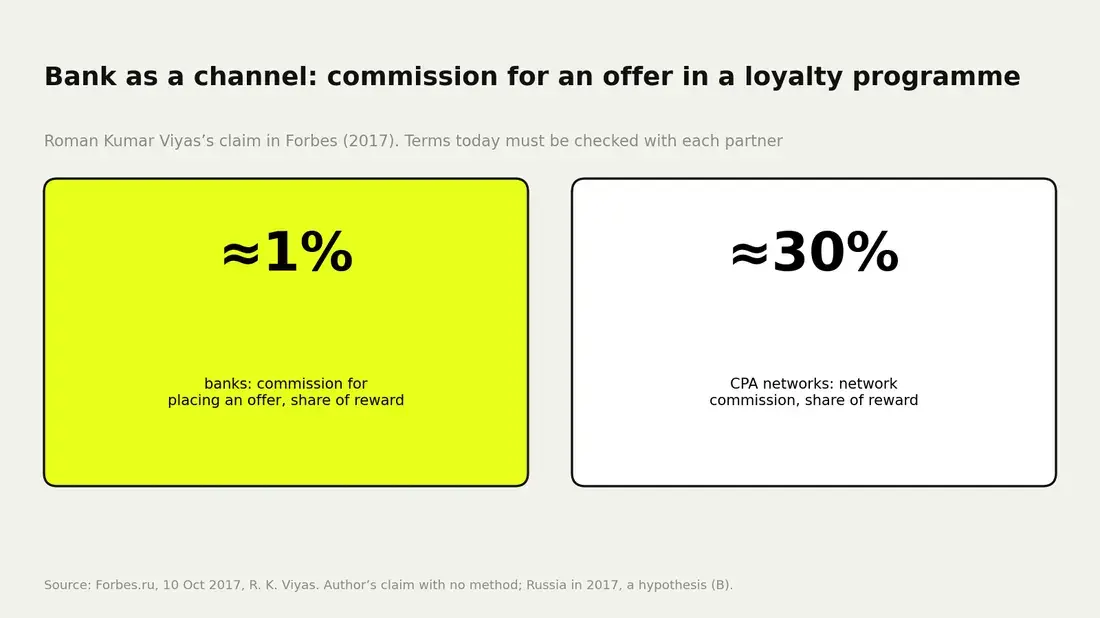
In the same Forbes piece the author claims banks take about 1% of the reward for placing an offer and CPA networks about 30%. It is his estimate for the Russian market in 2017. Today each bank has its own terms and the figures must be checked separately. I include the mechanism as a hypothesis, not a promise. The main takeaway: banks and payment systems have an audience with ready purchasing power and are motivated to give customers a benefit.
Fits: consumer brands with a clear offer for a mass audience. Doesn’t fit: B2B. Risk: you depend on a programme the bank can close without explanation.
Block IV. Trust and repeatability
18. Customer cases and reviews
A good case answers the future customer’s question: “did they get what I need?”. It must contain the starting situation, actions, timing, a measurable result and the client’s permission to publish. General thanks like “everything is great” don’t work.
Ask for a review at the moment of success: after the first result, not at contract close. Fake and bought reviews break the rules of most platforms and the laws of many countries, so they are not discussed in this article. Label: practice.
19. Community and meetups
A small chat or a regular meeting for customers and prospects. Here you pay with a moderator’s and host’s time. You win because people help each other, and you get topics for content, feedback and a flow of recommendations.
There are no figures that can be checked. Label: practice. Pitfall: a community without a regular rhythm is dead in three months. Start with one meeting a month and 10–20 people, not with a 500-member chat where nobody writes.
20. A digest as an asset
A regular newsletter with a selection of useful things, where you lead a topic rather than sell. This is my own case: the “EdTech Digest” (a Spektr and Ed.Partners project, issues 1–17, June 2022 – November 2023) and the “Partners Digest”, a monthly review of marketing and e-commerce trends. Some of the interviewees later became subjects of “connects” on sabirov.club. EdTech Digest had on the order of 12,000 subscribers. A direct “digest → revenue” link isn’t in my materials, and I won’t invent one.
What it teaches. A digest works well as a reason to write to a person: “I put your case in the issue”. It also ties the audience to your name. It is expensive: you need an editor, regularity and work with sources. Label: the author’s own practice, no payback estimate.
21. Directories, roundups and listings
Product-launch platforms, app directories, “best tools” roundups. Getting in gives a short spike and several permanent links. You pay with time to prepare a description and screenshots. The result depends strongly on launch day and competition that day. A spike is not a channel: most products get one peak and return to the previous level. I won’t give figures. Practice.
22. Do things that don’t scale
The last mechanism is the oldest. Paul Graham in the essay “Do Things That Don’t Scale” (2013) describes how founders found their first users by hand. One example is the Collison brothers of Stripe: when someone agreed to try the service, they said “give me your laptop” and set everything up on the spot. YC calls this a Collison installation. The essay is published by the author; I don’t use growth figures from it, only the idea.
The lesson isn’t that you should walk around with a laptop. It is that the first 10–100 customers are bought with personal attention, not with a channel. You write to each, ask why they didn’t buy, record the reason. It is the cheapest way to find what can later be scaled. Metric: the number of conversations and reasons for refusal. Stop: when the reasons start repeating and you can describe what exactly to automate.
Block V. Openness, education and community
Eight more mechanisms. Here you pay with transparency, teaching and attention to people who already love the product.
23. Openness as content: public metrics and salaries
Buffer has published its salaries and finances since 2013, and in April 2020 launched a public revenue dashboard: annual run rate, average revenue per account and number of paying customers, updated monthly (description of the dashboard). In January 2024 the company replaced the salary formula with an “Open Salary System” (post). The latest figures I could confirm: about 75 people, an average salary of $151,113 and ARR of about $18M per a January 2024 entry. It is a self-report from almost three years ago; see the live page for current values.
What works here. Open data gives journalists and bloggers a reason to link, and candidates and customers a reason to trust. Cost: you reveal what competitors and employees will see. It is a decision for management, not for a marketer. Label: self-report. No measured payback of openness as a channel exists in the sources.
24. A free grader: a site score in a minute
HubSpot launched Website Grader in February 2007. According to a HubSpot blog entry, over 150,000 addresses were submitted for grading in nine months, by June 2009 the mark reached a million, then two million (HubSpot post on 2 million). In 2011 the tool was replaced by Marketing Grader. The idea: a person enters their site, gets a score and recommendations, and leaves a contact for the full report. It is the same mechanism as in Block I, but with a ready lead at the output.
Label: HubSpot’s self-report (figures on the number of checks, not customers). What transfers: the result must be useful before the email is entered, and the score must be honest, or people won’t return. Stop: if many check but only a few open the full report.
25. A free academy
A free learning section for customers and those who will become customers: courses, certificates, practice. HubSpot Academy offers its core courses and certificates for free (academy.hubspot.com). Reach figures in third-party sources diverge (from 250,000 learners for one certificate to “10 million” overall); I found no official figure, so I give neither.
Mechanism. A profession learns on your product, so professionals come to companies as carriers of the skill. Cost: course development, support and updates. For a small business a smaller version: three free lessons and a checklist on the customer’s main task. Label: practice with a public page.
26. An ambassador programme
Notion, according to a third-party 2022 analysis, got 600+ applications in the first week of its ambassador programme and had about 200 ambassadors in 23 countries. They worked as volunteers: made templates, translations, local communities (analysis on Indie Hackers). Later figures (300+ ambassadors, 40+ countries, 60% of templates from them) I did not confirm. There is no current official figure.
What transfers. Start with a dozen of the most active customers in a shared chat, give them early access, status and a direct channel to the team, then expand. Volunteering rests on status and influence; money can’t replace it. Label: estimate from a third-party analysis. Risk: a programme without the team’s attention dies within a quarter.
27. Podcast guest
You come to someone else’s podcast with a story and figures and get an audience that already listens. Cost: preparation and recording, rarely money. I have no figures that can be checked in open sources; the label is “practice”. A working rule: offer the host not “I’ll tell you about the company” but a ready topic with a headline, three theses and a figure they won’t hear anywhere else. Next: use the recording as material for posts and articles.
28. Open source and open data
If you build a tool for developers or collect data, give part of it away for free. A library on GitHub or an open dataset brings people who will decide for themselves whether they need your paid product. Cost: maintaining the open part and answering users’ questions. Label: practice, no verifiable figures in this work. Risk: if the paid part doesn’t differ from the free one, there is nothing to sell.
29. Profiles on review sites and rankings
Directories like G2 or Capterra let you create a product profile for free. It is one of the dullest but most reliable steps for B2B: a customer comparing options looks for exactly such pages. The difficulty is that reviews must be real. Ask satisfied customers after the first result; don’t buy them or write them yourself. Label: practice, no result figures.
30. Joint webinars
Two businesses with the same audience and different products hold a joint webinar: each invites its base, both get registrations. It is a simplified version of cross-promo (mechanism 16) without promo codes and gifts. Cost: preparation and hosting. Label: practice, no figures. What matters: agree who gets the contacts and how they are used before the broadcast, not after.
Distribution: the most underrated part
Of the 30 mechanisms almost none works without a distribution plan. A piece you wrote and put on the site does not exist. A minimal plan for any asset: name three places where your audience sits; find in each one person for whom the piece is useful; write to them personally, not to a general channel; a week later ask whether it helped. It is 15 minutes per person and noticeably more important than one more article.
A separate rule: if you can say who your material is not for, you know who it is for. The phrase “suits everyone” means you know neither.
What it really costs
Take the calculator from Block I and count it the way an accountant would, not an enthusiast.
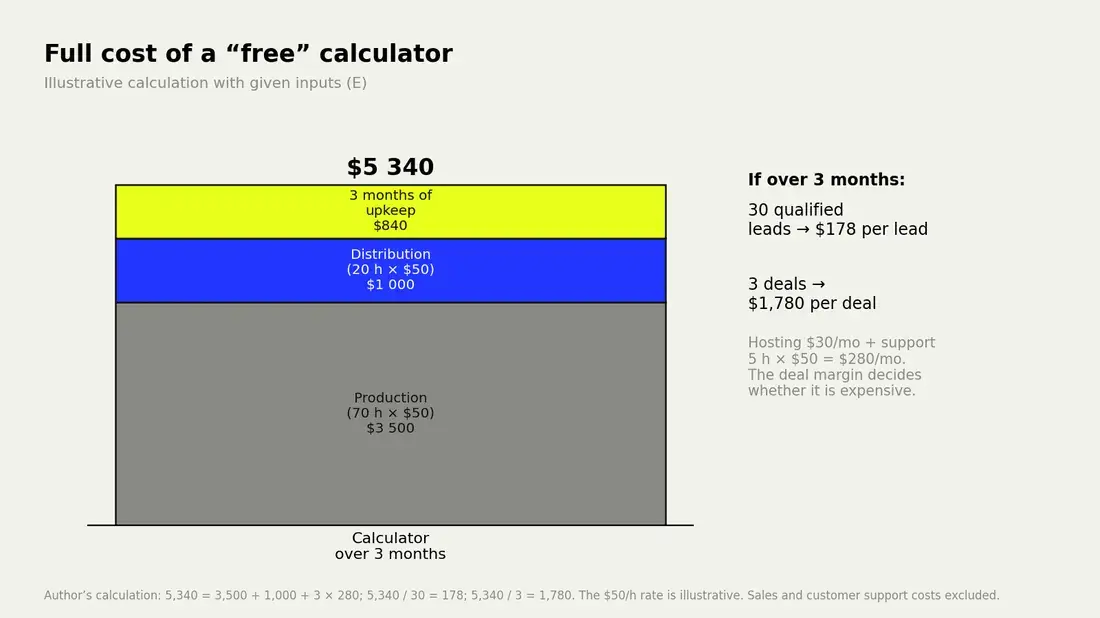
Inputs (invented): 70 hours of production, 20 hours of distribution, a rate of $50 an hour, hosting of $30 a month and 5 hours of support a month.
Production: 70 × 50 = 3,500. Distribution: 20 × 50 = 1,000. Upkeep for a month: 30 + 5 × 50 = 280, for three months 840. Total: 3,500 + 1,000 + 840 = $5,340.
If over three months 30 qualified leads came, the cost per lead is 5,340 / 30 = $178. If one deal in ten closed, that is 3 deals, the cost per deal is 5,340 / 3 = $1,780. Sales and customer support costs are not included.
Whether it is expensive or cheap is decided by the deal margin. For a B2B product with a margin of $10,000 a year, three deals give $30,000 against $5,340 of costs. For a shop with a margin of $40, three deals give $120, and the calculator loses money. That is why every “free” label must be turned into a formula: full CAC = production + distribution + tools + support + rewards, divided by the number of customers acquired.
Part of these hours is not an expense but an investment in an asset: the calculator keeps working after the third month at a cost of $280 a month. If it keeps giving even 10 leads a month, the cost per lead over a year will fall several times. But that is a hypothesis, not a fact, and it is checked against data.
AI: an accelerator, not a spam factory
AI changes zero-budget marketing from two sides: it speeds up your work and changes audience behaviour.
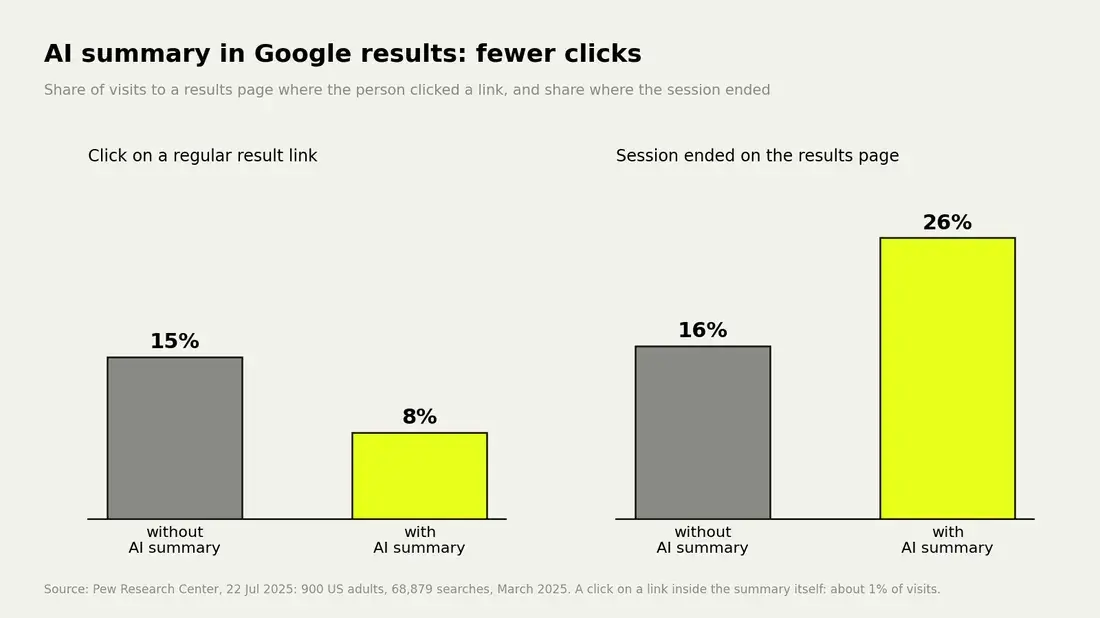
What changed for the audience. Pew Research Center compared the behaviour of 900 American adults. On pages with an AI summary users clicked a regular link in 8% of visits, without a summary in 15%. A click on a link inside the summary itself happened in about 1% of visits. These are visits, not users, a US sample, March 2025. The conclusion for our topic: search traffic to informational pages is on average becoming a less reliable asset, and betting on it alone is riskier than two years ago.
Where the conflict of interest comes from. Many figures on tool and search growth are published by companies that sell search and AI tools. The Ahrefs article on free tools is published by a company that sells tools. Treat such materials as a good description of a tactic and a poor measurement of payback.
Where AI helps. Interview transcription, an email draft with mandatory editing, tagging and cleaning the partner base, finding customer questions in support tickets, a calculator prototype, translation. A human checks facts, figures and tone.
Where it must not be used. Mass generation of SEO pages with nothing new, fake reviews and “expert” quotes, sending identical emails as personal ones, automation that breaks platform rules. It is not only about ethics. Platforms tighten rules, and readers quickly notice a template. If you can’t say what is new in the material, you don’t need AI: you need a different material.
Comparing the mechanisms
The table below is an editorial estimate, not measured data. It is meant for a first choice, not as a norm. “Money costs” exclude your team’s pay.
| Mechanism | For whom | Money costs | Time and skills | Speed of signal | Scale | Main risk | Metric |
|---|---|---|---|---|---|---|---|
| Free tool | product with a repeating task | small | 40–100 h, a developer | months | high | traffic without sales | click into product |
| Templates | any expert niche | minimal | 10–30 h | weeks–months | medium | downloaded and forgotten | sign-ups |
| “Made with…” | product with a public result | small | hours of development | weeks | high | annoys customers | clicks, activations |
| Shareable result card | product with data | high | a team | months | very high | not for small products | shares with click-through |
| Referrals | repeating value | bonus per payment | 20–60 h | weeks | high | fraud, broken unit economics | payments by invitees |
| Integrations | product in an ecosystem | medium | development | months | high | platform dependence | installs |
| Research | you have product data | small | 60–150 h | months | high | weak sample | links, leads |
| Guest posts | expert business | minimal | 5–10 h per post | months | medium | no audience | clicks, conversations |
| Community answers | expert business | zero | 3–5 h a week | weeks | low | ban and reputation | conversations |
| Journalist requests | real experts | zero or subscription | 2–4 h a week | weeks | low | no topic filter | mentions |
| Emails to media and bloggers | an unusual story | zero | 20–60 h | weeks | medium | spam | publications |
| Micro-influencers | consumer product | product, barter, percentage | 10–30 h | weeks | medium | fake boosting | orders by tag |
| Refreshing old pages | pages with traffic | zero | 2–4 h per page | weeks | medium | traffic loss to AI | clicks |
| Partner base | product and tags in place | by result | 5–10 h a week | days–weeks | high | inaccurate reconciliation | orders, CAC |
| Cross-promo | similar audience | gift and discount | 10–20 h | days–weeks | medium | gift worse than product | orders by promo code |
| Banks and loyalty | mass B2C | commission | 20–40 h | months | high | programme closes | orders |
| Cases and reviews | any | zero | 3–5 h per case | weeks | medium | fake reviews | page conversion |
| Community | product with expertise | zero | 4–8 h a week | months | medium | community dies | members, leads |
| Digest | expert, editor | small | 8–15 h per issue | months | medium | not enough regularity | subscribers, replies |
| Listings | new product | zero | 10–20 h | days | low | one spike | sign-ups |
| Manual first customers | early stage | zero | 10–20 h a week | days | low | doesn’t scale | conversations |
| Open metrics | companies ready to disclose | zero | management decision | months | medium | disclosure to competitors | mentions, trust |
| Free grader | product with a measurable result | small | 40–100 h | months | high | people check but leave no contact | reports, leads |
| Free academy | complex product, a profession | medium | content team | months | high | expensive to update | completions, leads |
| Ambassadors | product with active fans | status, early access | 5–10 h a week | months | medium | programme dies without attention | contributions, new members |
| Podcast guest | expert with a story | zero | 3–6 h per episode | weeks | low | wrong audience | clicks, conversations |
| Open code and data | developers, data | small | maintenance | months | high | nothing left to sell | stars, adoption, leads |
| Review-site profiles | B2B product | zero | 3–5 h + reviews | weeks | medium | fake reviews | clicks from profile |
| Joint webinars | similar audience | zero | 8–15 h | days–weeks | low | dispute over contacts | registrations, orders |
Four mini-plans
If you are alone and have no customer base. Choose mechanisms 22 and 10: 20 personal conversations with prospects, 10 answers in niche communities in a week. Metric: how many conversations grew into a talk. Stop: if in 30 days there is not one conversation about price.
If you have expertise but no product that spreads. Mechanisms 9 and 8: three guest posts and one study on your data. Metric: clicks and conversations from publications. Stop: if after 90 days there is not one call.
If you have a customer base. Mechanisms 5, 16, 18: recommendations, cross-promo and cases. Metric: invited → payments. Stop: if invitees don’t activate.
If you have a product with a repeating task. Mechanisms 1 and 3: a calculator or converter and a “made with…” mark. Metric: transition from the tool into the product. Stop: if there is traffic but no transitions.
Common mistakes
- Treating organic as free. Converting time into money changes priorities. If an hour costs $50, 100 hours on an article is $5,000.
- Substituting the metric. Shares, views and downloads are not customers.
- Copying someone else’s scale. Spotify and Ahrefs do what you can’t repeat in size, but you can repeat the principle.
- Believing founders’ stories as experiments. A self-report is good as a hypothesis and poor as proof.
- Not counting the referral funnel. Invitations don’t pay.
- Not keeping partner records. In a month you won’t remember what you promised to whom.
- Spamming. Sending identical emails costs you domain reputation.
- Using AI for mass content with nothing new. Readers and platforms see it.
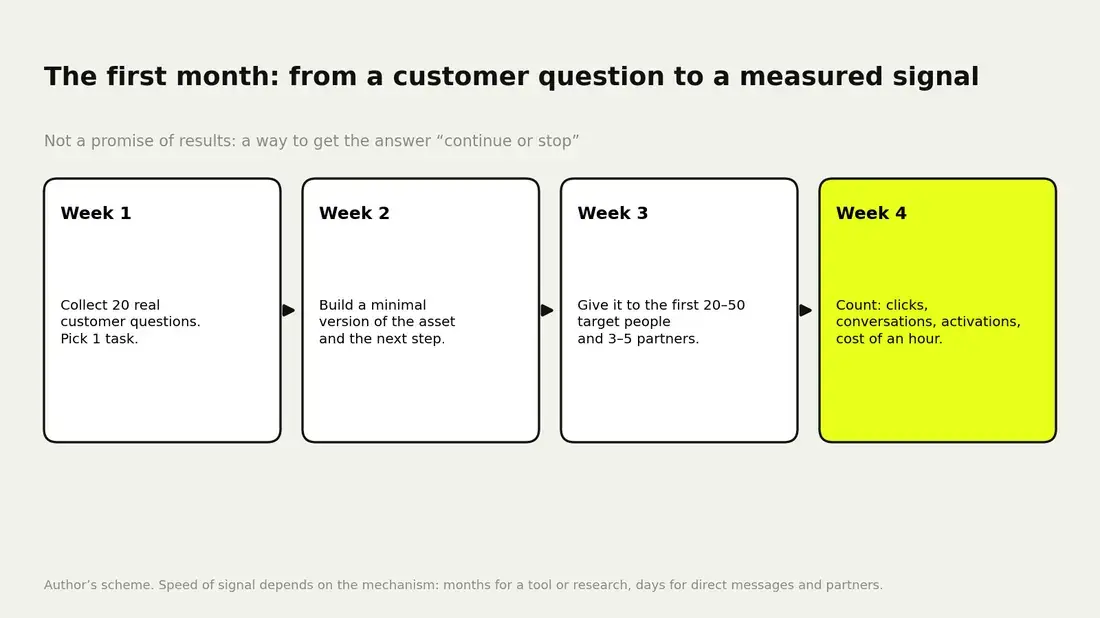
- Expanding before getting a first signal. First one mechanism and a month of observation.
- Not defining when to stop. The stop criterion must be written before launch.
How it ends
If you remove all the cases from this article and leave one question, it will be this: what do you pay with if you don’t pay with money, and how much is that in hours, partnerships and risk? Answer in writing, before launch. Someone who can name the price of their “free” channel is already ahead of most.
And the easiest way to start is one conversation with a customer who didn’t choose you.
Sources
Checked while preparing (opened or found in search, check date 6 November 2026):
- Ahrefs, The Free Tools SEO Strategy: traffic estimates for tool pages, templates.
- Ahrefs, Link Building Case Study, 18 Aug 2020: the 1,986 → 36 funnel.
- TechCrunch, P.S. I Love You: Get Your Free Email at Hotmail, 18 Oct 2009: an excerpt from Penenberg’s “Viral Loop”.
- Spotify, Q4 2025 Earnings, 10 Feb 2026: Wrapped, MAU.
- Lenny’s Newsletter, How to drive word of mouth (Nilan Peiris, Wise), 2023: page found in search.
- Business Insider India, Robinhood: the waitlist: a retelling, the primary source was not checked.
- LEGO, What happens to my product idea after 10,000 supporters: LEGO Ideas rules.
- Contently, How Buffer’s Blog Posts Get Shared Thousands of Times, 31 Mar 2014.
- Search Engine Watch, How guest posting propelled one site from 0 to 100,000 customers, 26 Jul 2012.
- Buffer, How We Built Our Guest Posting Program: found in search, not used in calculations.
- Pew Research Center, Google users are less likely to click on links when an AI summary appears, 22 Jul 2025.
- Paul Graham, Do Things That Don’t Scale, 2013: a link to the essay; only the idea is used.
- Inbound Blogging, Connectively (ex-HARO) Is Shutting Down on December 9, 2024: a secondary source on the closure.
- Buffer, Public Revenue Dashboard and Open Salary System.
- HubSpot, Website Grader Analyzes Over 2 Million Sites.
- HubSpot Academy, Welcome.
- Indie Hackers, analysis of the Notion Ambassador Program: third-party analysis, 2022.
Self-reports: R. K. Viyas, Forbes.ru, “Almost free: nine secrets of bum marketing”, 2017 (in Russian); Artur K., Medium, 2019 (in Russian); materials of a webinar by R. K. Viyas (slides, no link). Dropbox (“from 100,000 to 4M”) was deliberately not used: the primary source could not be checked.