
Prologue
In 2022, together with my partners, I launched a marketing agency, Ed.Partners — I became a co-founder and CEO. At its peak the company earned up to 200 million rubles a year, and in 2026 I exited the business, selling my stake. Looked at through the numbers alone, this is a success story. What stood behind the numbers I wrote about in a separate article. This isn't that one.
This article opens a new cycle — about how to get rich. An opinion without evidence is just another post in the feed, even if it's my own. So I gathered the material the way I would for a business report: more than 20 academic papers and industry studies, 15 statistical charts, a breakdown of three systematic thinking errors from behavioral economics, takeaways from six landmark books about wealth, quotes from a billionaire entrepreneur and a practicing psychologist — and laid all of it over my own experience and conversations with entrepreneurs more experienced than me.
Before drawing conclusions, I turned to a study by the consulting firm Yakov and Partners on Russia's fastest-growing companies. It sets the structure for the entire cycle.
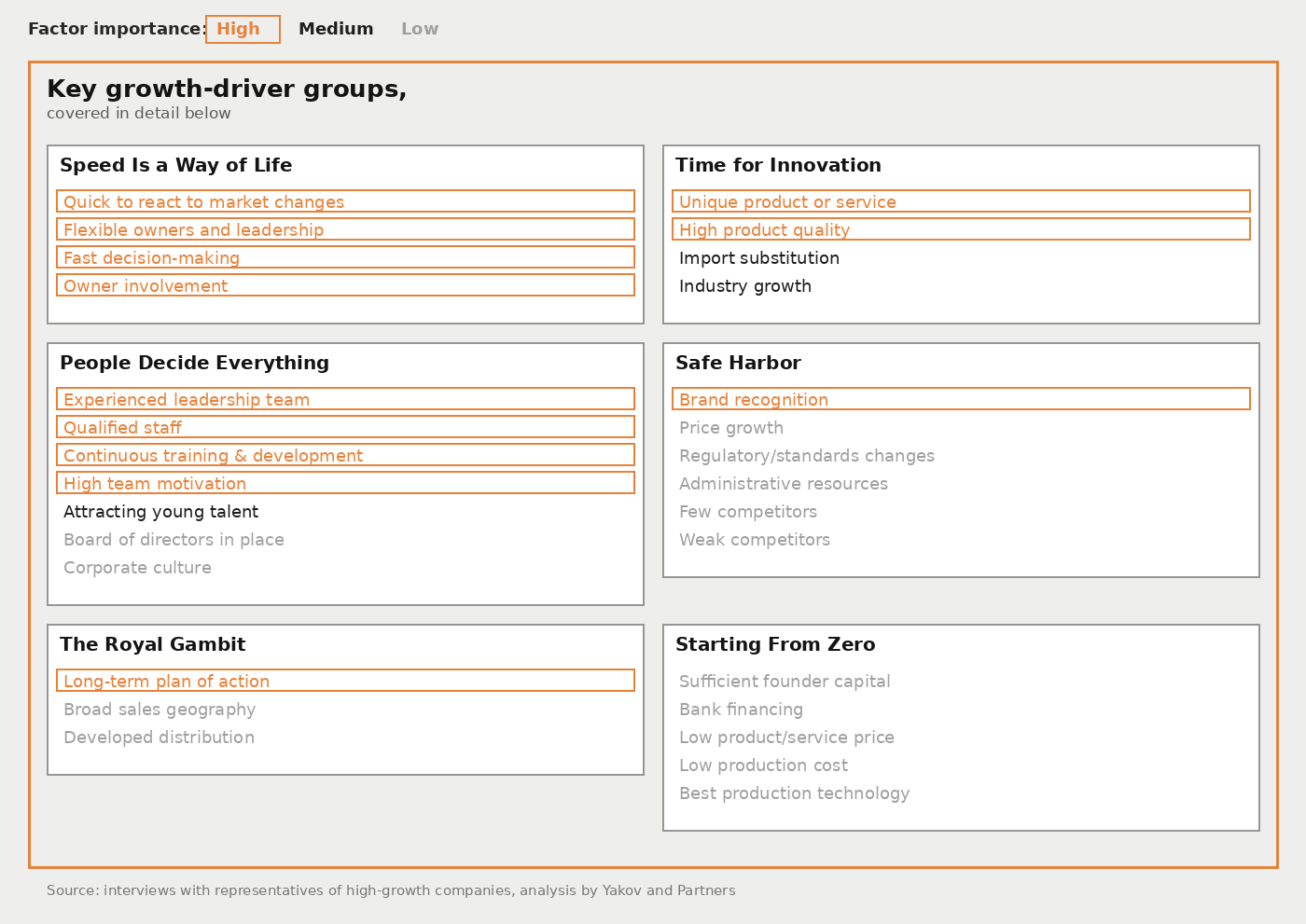
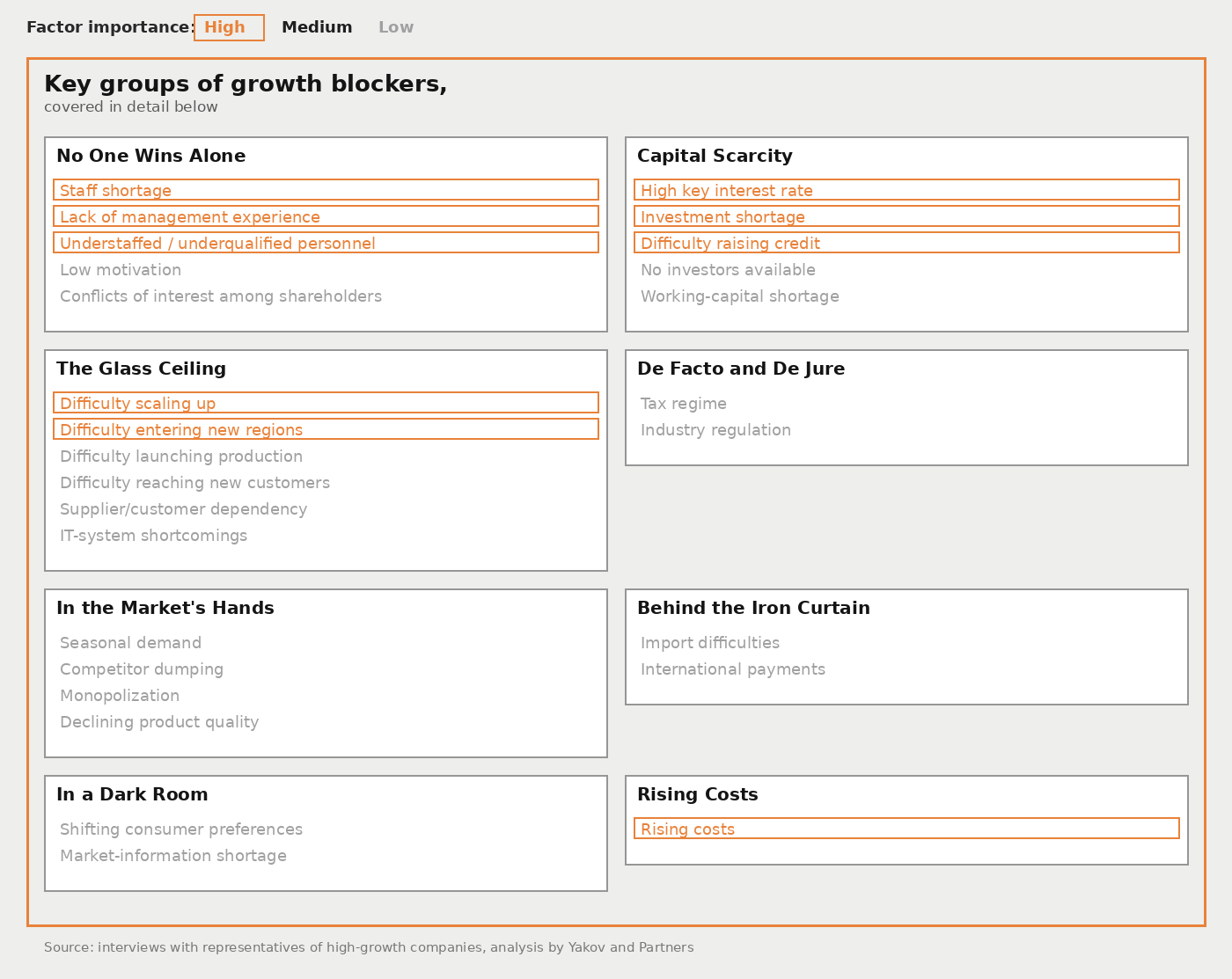
These two diagrams contain the entire future cycle of articles. “Speed is a way of life” is about the psychology and path of the owner — and that's what this whole article is about. “People decide everything” and “No one wins alone” are about team and partnerships — a separate article, where I'll break down the mechanics of equity splits, roles, and exiting a partnership; here, only what happens in your head when you make those decisions. “Time for innovation,” “The glass ceiling,” and “Rising costs” are about product and scaling. “Capital scarcity” and “Starting from zero” are about money and financing. “The royal gambit” is about long-term strategy. Every block comes down to one thing: not the market, not capital, but who the owner became as a person.
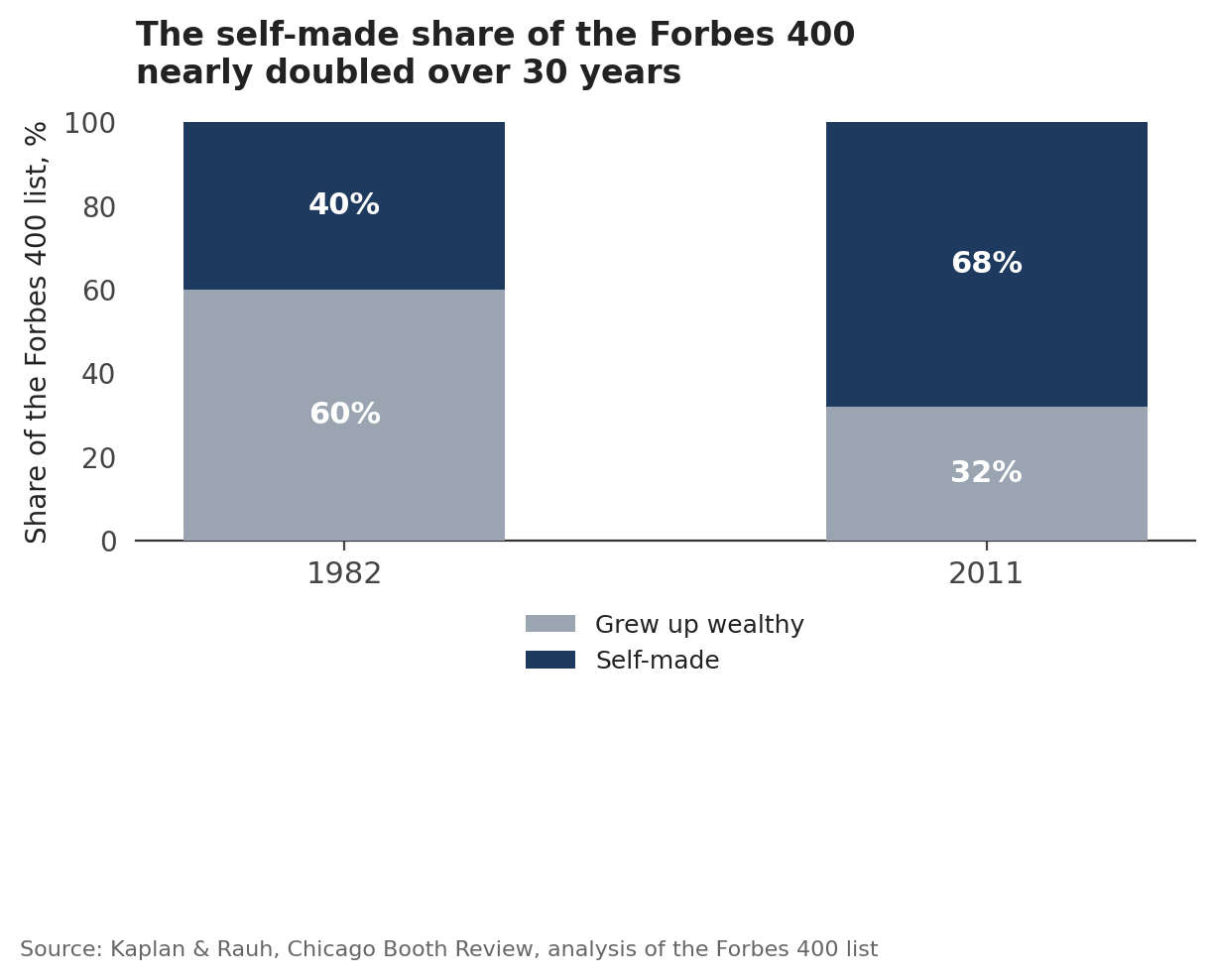
And this isn't an exaggeration in service of a nice metaphor. The Chicago Booth Review analyzed the composition of the Forbes 400 list over three decades — and the share of those who made their fortune themselves, rather than inheriting it, nearly doubled:
What follows are 17 conclusions about the psychology of this path, arranged from the most fundamental to the most practical. Some are about business, some about therapy and relationships, but separating them would be dishonest — in my experience they arrived as one continuous stream.
Insight #1Wealth isn't about the market — it's about who the owner became
When I first saw the structure of the Yakov and Partners report, what struck me was that almost every block — from “people decide everything” to “the royal gambit” — ties back to one person: leadership flexibility, owner involvement, decision-making speed, a long-term plan of action. It isn't the market that makes decisions. It isn't the product that gets involved in processes. A specific person does that, and his personal limitations become the company's ceiling before the market's limitations do.
I confirmed this in my own experience: the agency grew roughly 10% a month for two years straight, not because the market was exceptional, but because I kept pushing forward without counting the cost to myself. Once I became the constraint, growth stopped — regardless of what was happening in the market. This is the first and most important conclusion, and every other one flows from it: before you sort out your product or your strategy, it's worth sorting out yourself.
Insight #2The four components of wealth
If you collapse everything this cycle of articles is about into one formula, it comes out roughly like this: wealth is a function of four variables. This shows up across countless breakdowns of how millionaires and billionaires got there, but it's captured especially well in one video from the Russian YouTube channel Faib: wealth depends on education, on ambition, on business acumen, and on the lucky starting conditions a person enters the game with.
Education isn't a diploma for its own sake — it's the ability to quickly absorb new models of thinking, and the link is measurable: according to the U.S. Health and Retirement Study, the average net worth of someone without a high school diploma is about $9,000; with a college degree, $363,000; and with a postgraduate degree, $415,000. Ambition isn't a single burst of effort but the ability to move toward a specific, hard-to-reach goal for years — more on that in Insight #11. Lucky starting conditions mean honestly admitting the role of luck: country, family, the moment you entered the market — a factor you can't control, but can partly correct by changing your environment (Insight #7).
The fourth factor — business acumen — is the most interesting of the four, because it's the only one that trains roughly like a muscle. At its core, it's the brain's ability to see the signal through the noise: keeping two or three parameters in focus that actually determine the outcome, and consciously ignoring the other twenty that just create the feeling of busyness. Here the brain works like the body's main muscle: the more you train it on real decisions rather than theory, the faster it separates signal from noise. More on this skill in Insight #15, where it becomes a practical tool rather than just a personality trait. And at some point, business acumen runs straight into the most personal choice an owner ever faces.
Insight #3Personal brand, partnership, and the “rich or king” dilemma
Three seemingly different topics — how the market sees you, how your team hears you, and why you'd want a partner at all — actually rest on the same psychological axis: how comfortable you are being alone with responsibility, and how much your authority rests on facts rather than status.
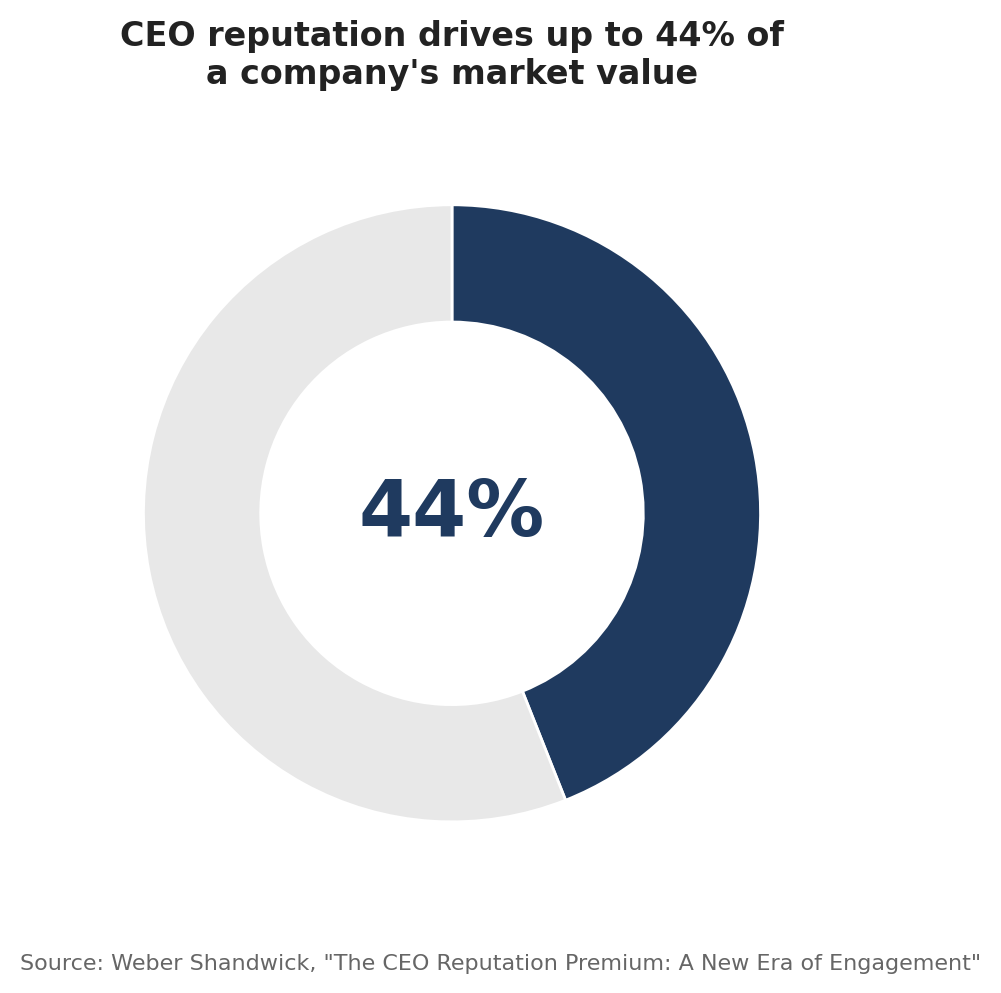
Start with the market. That's exactly why, when we launched Ed.Partners, we framed every service on the website not as a standalone offering but tightly linked to a specific partner — his name, his credentials, his track record. A personal brand sells because people buy from people, and up to 44% of a company's market value is determined by perceptions of its CEO:
Every unit of trust converts into real money — the average deal size grows, deals close faster, the cost of borrowed capital falls, and the company recovers from crises faster. But a personal brand only solves half the problem: you can win over the market with reputation, but not your own team. I've known plenty of sharp specialists who said the right things, yet the team didn't listen and made the wrong calls anyway — because persuasiveness inside a company runs on different mechanics: numbers and facts instead of value judgments, logical argument, reference to historical precedent, and, above all, reputation, which can be destroyed instantly but takes a long time to build.
There's an old rule that fits perfectly here: a Roman engineer who built a bridge was required to stand under it the first time carts crossed it; in the English version of the same rule, his entire family had to stand there. Nassim Taleb describes the same principle in his book Skin in the Game: when a person risks something of their own because of their own decision, the quality of that decision changes. Lie or manipulate the facts once, and the weight of your voice drops to zero for a long time, regardless of your personal brand.
Partnership is the third facet of the same story, except now the risk isn't reputational but psychological. I'll break down the mechanics of partnerships — equity splits, roles, exit rules — in a separate article in the cycle, under the “no one wins alone” block from the Yakov and Partners framework. Here the psychological layer matters more: the decision to bring in a partner is usually made not out of calculation but out of anxiety — the fear of carrying sole responsibility for the outcome, the fear of not having enough competence, the fear of being the only one to blame if it fails. In that moment, a partner is needed not as a source of expertise but as shared anxiety — and anxiety is a poor foundation for a business decision: expertise can almost always be hired, but trust built on anxiety tends to crack first, exactly when things get genuinely hard.
And even once a partnership exists, the same conflict-avoidance logic continues: “let's split everything equally” sounds like fairness, but fairness is almost always subjective — what feels fair to you can be completely unfair to someone else if you never said it out loud. When my partners started pointing out my mistakes, I found what seemed to me an elegant way out: I ceded part of the management, forgave part of a debt, and told myself this was generosity. In reality, something much simpler was behind it: I couldn't stand being in conflict, and I'd rather give up control than defend my position. This is a classic pattern — a person becomes accommodating not out of natural kindness, but because compliance is a survival strategy in conflict.
But here's the paradox: giving up control isn't always weakness. Harvard professor Noam Wasserman studied 212 American startups from the late 1990s and early 2000s and found that half of founders lose the CEO title by the company's third year. The key fork in the road, which he calls “rich or king,” is that the desire to keep control and the desire to grow your wealth almost always conflict: holding onto both at once is a reliable way to get neither in full.
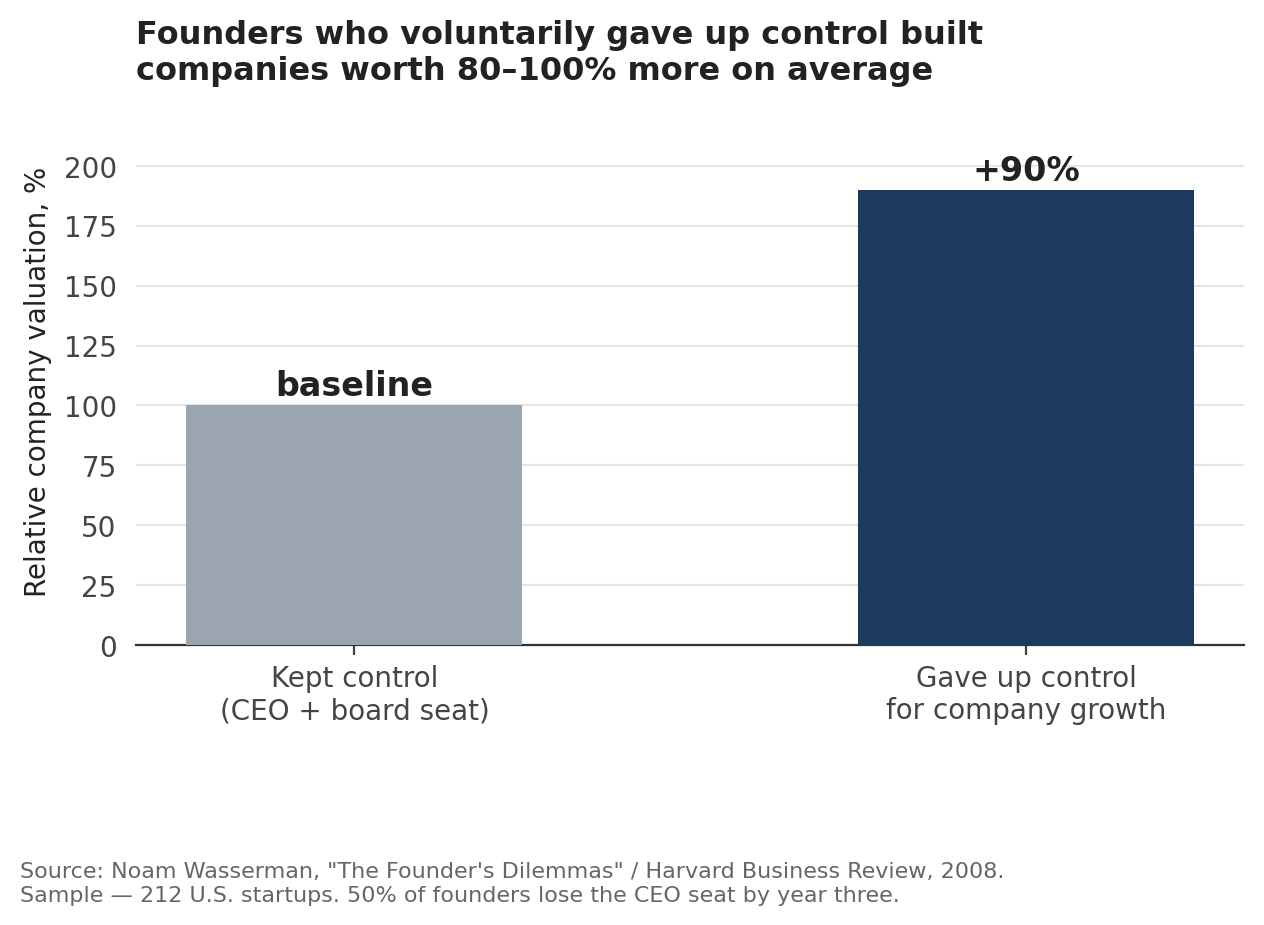
The difference between my story of ceding control out of anxiety and this statistic is that the decision can look identical — give up control — while the underlying reason is fundamentally different: it's one thing to give up control because you can't tolerate conflict, and something else entirely to give it up deliberately because you understand the company will grow bigger than it would under you alone. On paper, the outcome is the same. Psychologically, it isn't.
And it's worth keeping business hierarchy separate from personal hierarchy: one of the sharpest conversations I ever had with my wife started with a phrase I said on autopilot — “I need to check with my partner” — in a conversation about a decision inside our own family. A spouse is the one person in your life who chose, on their own, to spend it next to you, expecting nothing in return, and importing business-style sign-off logic into that relationship is a hierarchy mistake, not care. And having handed responsibility to other people's hands hoping for recognition, I also discovered that recognition doesn't run on the formula “the more you give up, the more you're valued” — it runs the opposite way: in practice, I made money by connecting people who could do what I couldn't. Next time, I'd build a business on what I myself know how to do — not only more reliable, but more honest toward myself.
Insight #4The “employment → business → employment” cycle isn't defeat — it's a normal rhythm
Sometimes the resolution to the “rich or king” dilemma isn't a choice inside one company at all — it's stepping out of the game entirely for a while. In business circles, entrepreneurship is increasingly treated as a way of life that may require returning to salaried work or making new attempts depending on your life situation — that's not weakness, it's flexibility. In your own business you can make mistakes, burn out, fall behind on trends, and your obligations may not let you pivot onto the right track in time. The most logical way out is a temporary return to employment, as a reset.
Even Evgeny Chichvarkin, who had already built a major company in Russia, didn't rule out a return to salaried employment in 2015 — he considered an offer to head Ukrnafta and told RBC in an interview that “it would be foolish to turn down an offer like that.” Going back to employment after running a business isn't always the upgrade “it was good, now it's better”; sometimes it's a way to keep from falling apart and rebuild yourself — “it was bad, now it's good.” My first attempt at 19 failed, and I had to “force” myself into a job; years later I went back into business — and it worked. Now, at 33, I want to return to employment again for a while. This cycle doesn't depend on age — and, oddly enough, the later in life it happens, the higher the odds of success.
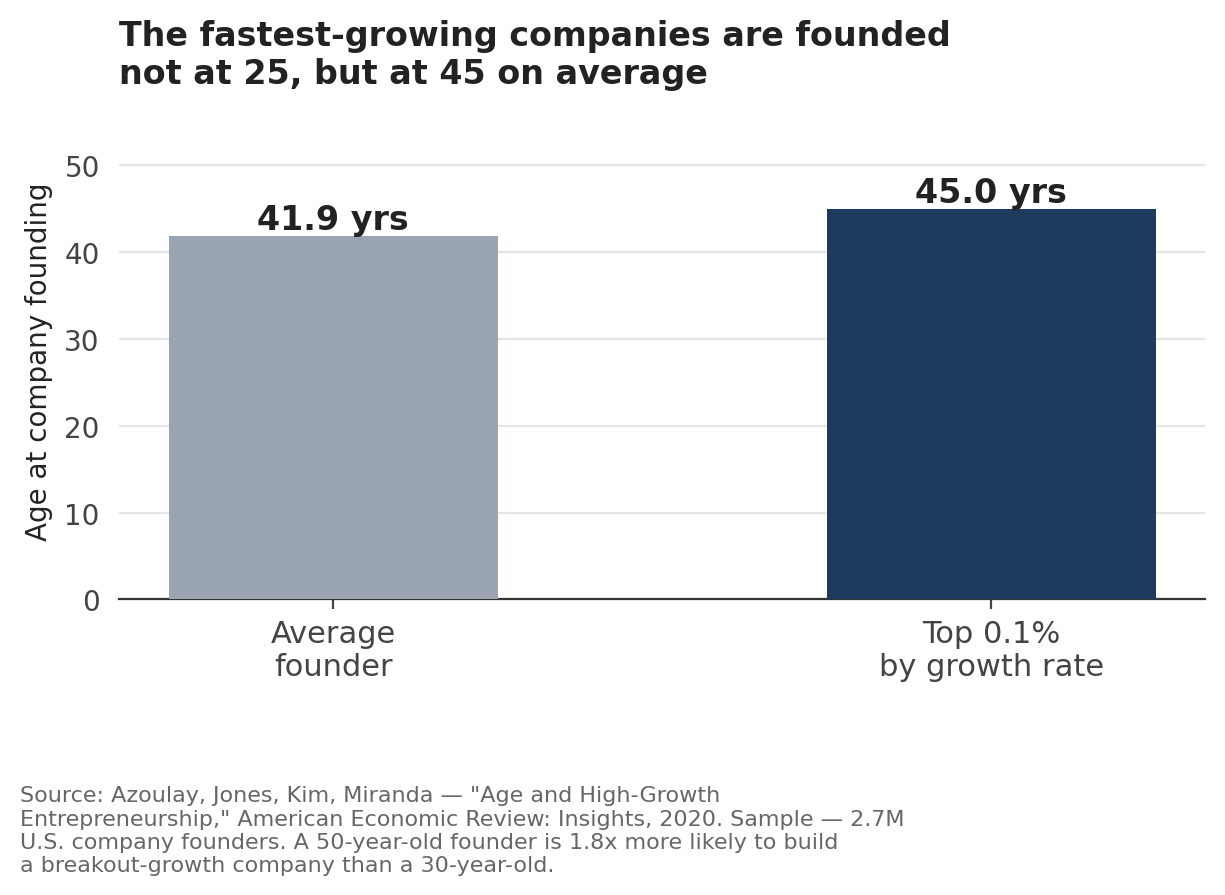
A large-scale analysis of 2.7 million American founders found that the fastest-growing companies are founded, on average, not at 25 but at 45 — and a 50-year-old entrepreneur builds breakout growth 1.8 times more often than a 30-year-old. Age isn't an obstacle to a new attempt — it's often the precondition for one: the experience of previous cycles accumulates, it doesn't burn away.
Insight #5The successful are the ones who failed more often than others
This cycle almost never happens without failures along the way — and that's normal too. Some people believe it's better to learn from other people's mistakes. Others are convinced that's simply not possible. My own sense is that nothing teaches as powerfully as your own mistake: start, fail, reflect, don't repeat it. If you got a business wrong, it just means you put your money in the wrong place — next time, the odds of hitting the right one are statistically higher.
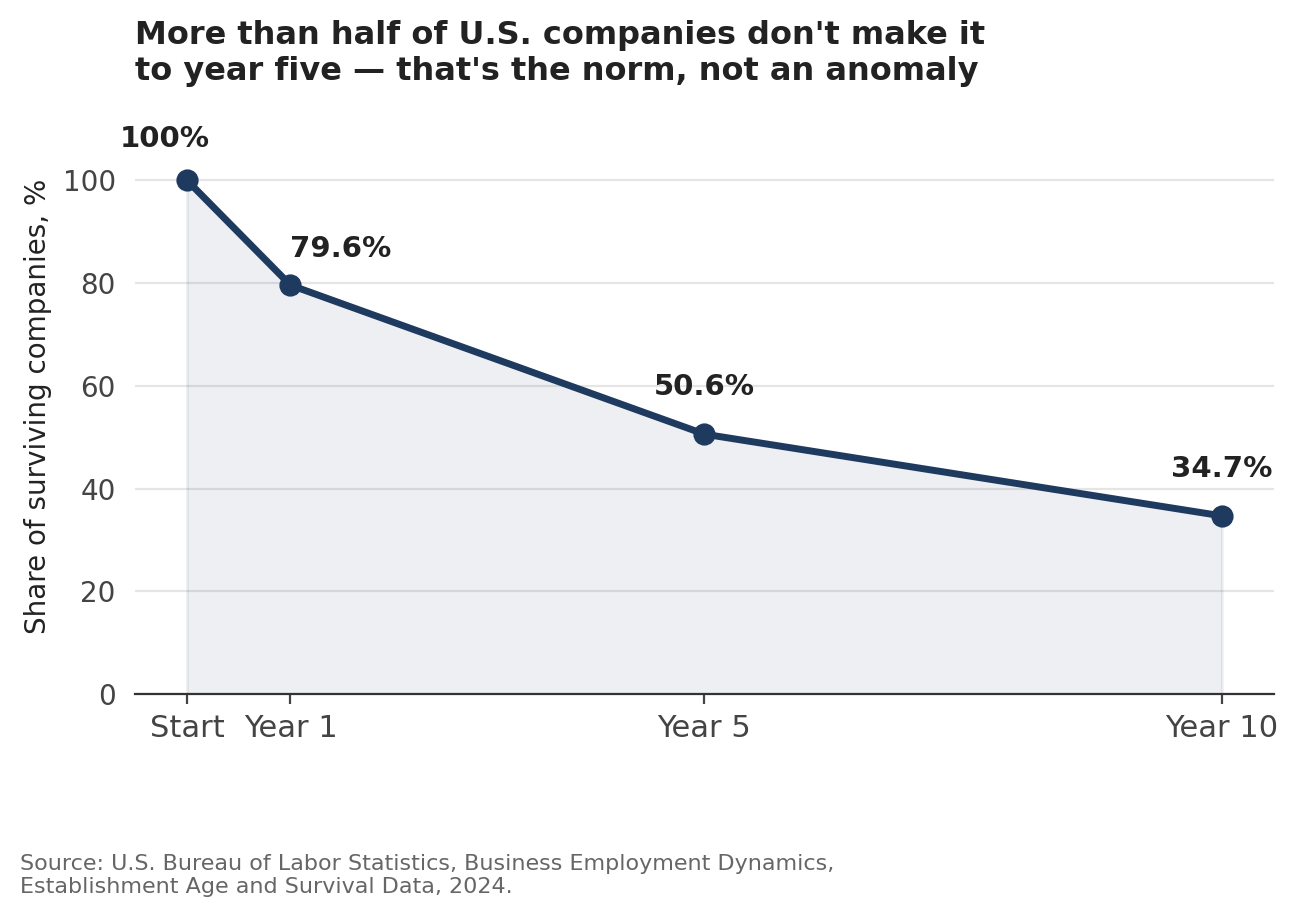
This isn't an exaggeration: according to the Bureau of Labor Statistics, almost half of American companies don't survive to their fifth year, and almost two-thirds don't make it to their tenth. Failure is a statistical norm of the path, not a signal of personal inadequacy.
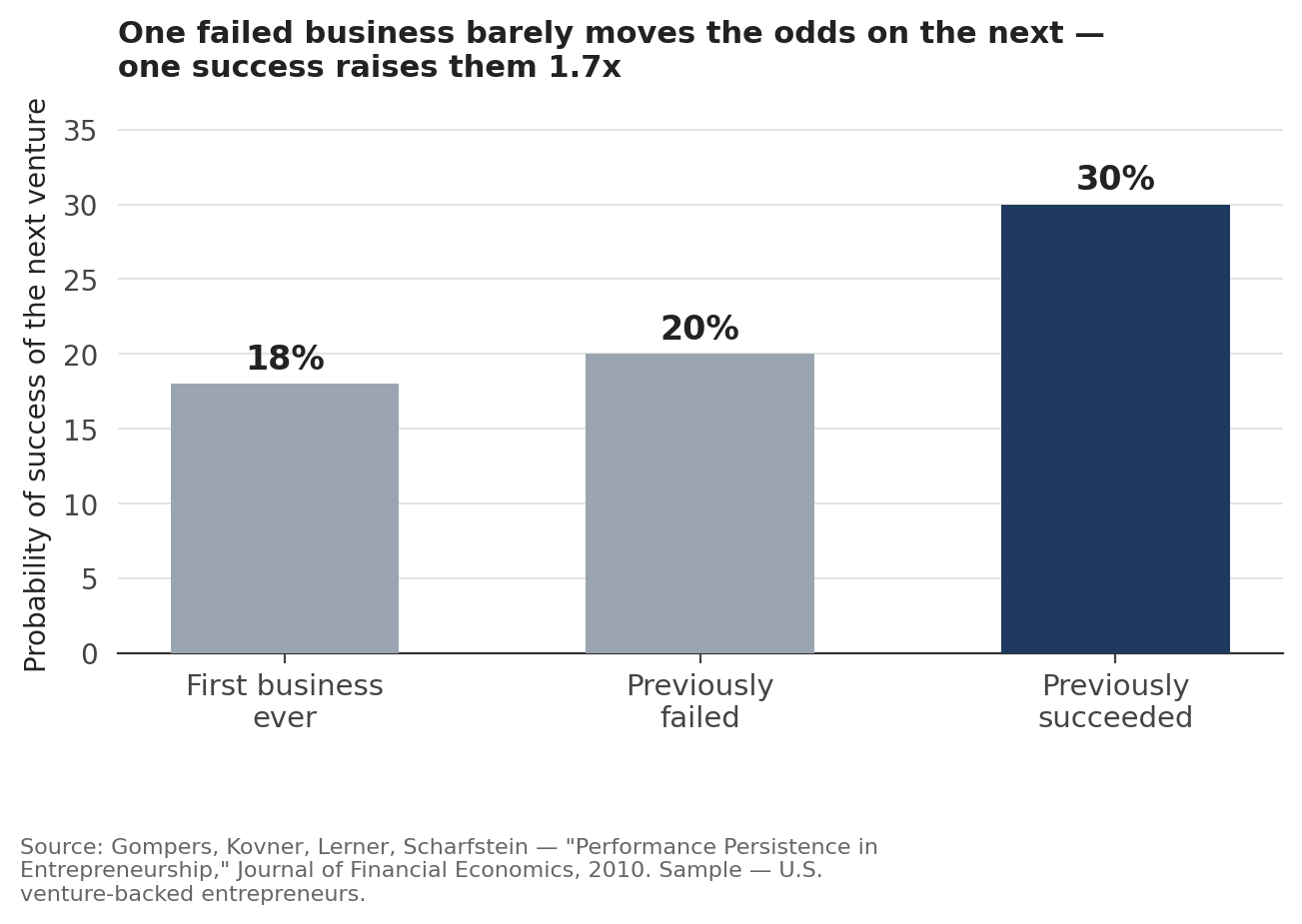
There's an important nuance here: a past failure by itself barely improves the odds for the next business — for those who've already failed, the probability of success on the next venture (20%) is nearly the same as for first-timers (18%). But for those who've already succeeded once, it jumps to 30%. The value isn't in the mistake itself — it's in actually pushing something through to a result at least once.
This leads to a non-obvious point: don't be afraid to close a business. If you're stuck on a problem instead of solving it on the move, the thing is no longer “in flow,” and it's worth looking for something new — that's not an ending, it's the start of the next chapter. Business isn't target practice at a single bullseye; as Alex Banayan, author of The Third Door, put it, it's about throwing as many balls into the air as you can and watching which one lands: the more bets you're running at once, the less you depend on any single one of them working out.
“I promise you: if you decide to go for it and work hard, if you never give up and never listen to the rejection — you can achieve anything that life throws your way”
— Lady Gaga
And if, after yet another attempt, some inner voice keeps insisting on the same dead plan just because you've already sunk time and money into it, it's worth remembering the old Dakota saying: when you discover you're riding a dead horse, the best strategy is to dismount. Don't drag a project's corpse to the finish line out of principle — change the horse, not the rider.
Insight #6Discipline and rapid hypothesis testing: revenue loves speed, profit loves consistency
But resilience in the face of failure isn't the same thing as endless patience with an approach that simply doesn't work. What follows is about how to tell the two apart in practice. Discipline isn't about being charged at 100% every day — it's about consistency. On a bad day you might only give 20%, but still get through the small set of actions the result actually depends on: make the calls, find the right person through your network, publish the post. This is the paradox of habit: first you build the useful habits that move you toward your goal, and then they start building you.
Maxim Batyrev, in his book 45 Tattoos of a Character, puts it almost as an aphorism: the fast one isn't the one who runs faster — it's the one who doesn't stop. The difference between revenue and profit is exactly the difference between speed and discipline. Revenue grows from bursts and bets. Profit grows from consistency — from doing, every day, the boring 20% of effort that produces 80% of the result.
This is exactly why a fast hypothesis test matters more than perfect preparation. One of my most expensive lessons wasn't visible at the time — only in hindsight: preparing a new business direction sometimes took me half a year, and by the time it launched, the market had already shifted, so something that took that long to prepare turned out to be unnecessary. And the whole time, there were literally thousands of connections around me who could have given feedback within a week: partners, clients, former colleagues. A fast test isn't “asking one person's opinion” — it's a built habit of chasing feedback before chasing perfection. Energy matters here just as much as speed: if your circle during the active phase of a business shrinks to two or three people instead of the hundreds of connections available, nothing changes — not because there's a shortage of ideas, but because there's no one left to test them on.
Insight #7Who to listen to: your circle, mentors, and the trap of expert consensus
Discipline and fast testing both depend on a steady stream of feedback — which means sooner or later the question becomes whose feedback to trust at all. There are two mutually balancing conclusions here. Changing your circle doesn't just open new opportunities — it changes the scale of your thinking, and this is probably the most underrated point in the whole cycle. It's also the central conclusion of Alex Banayan's The Third Door: almost everyone we consider successful was, at some point, brought together by fate with the right person or the right company — and with the exact same effort that had already been going in before that meeting, the results multiplied.
Mentors work on the same logic — not because they hand you ready-made answers, but because they light up blind spots you can't see from inside your own head. An old saying that Dan Millman quotes in Way of the Peaceful Warrior states this more sharply and more precisely: we have no friends, we have no enemies, we only have teachers. Everyone on the path, including those who hurt you or let you down, ends up teaching you something — the only question is whether you're willing to see it in the moment, not just in hindsight.
But here's an important caveat: not everyone who sounds confident deserves to be listened to with equal weight — because most experts are experts in the previous version of the world, not the one you're trying to build. If you believe in your own vision, you're not obligated to follow the consensus, because expertise is almost always trained on the past, not on what's only just taking shape.
A vivid example from the history of technology: in 1996, virtually every telecom operator and equipment maker, including Cisco, was convinced that the future of the internet belonged to the ATM protocol. Investor Vinod Khosla bet the opposite way and put $3 million into Juniper Networks — a company betting on TCP/IP, the very protocol the entire modern internet ended up running on. A few years later that bet delivered Kleiner Perkins one of the largest venture returns in its history — roughly a 2,500x return on investment.
This isn't just a good story: Philip Tetlock's long-running research into the accuracy of expert forecasts found that predictions from recognized experts were, on average, no more accurate than simple trend extrapolation — especially in situations that were genuinely new rather than a repeat of something familiar. The practical takeaway: a mentor who has walked a similar path is usually worth more than a consensus of experts — and consensus is good for stable, well-understood domains, and bad precisely where the biggest opportunities are born.
Insight #8Ambition is fuel that easily turns into poison
Having sorted out whose advice to trust, it's worth checking what fuel you yourself are running on. There's a simple formula that helps keep ambition within healthy limits: mind your own sword, not his — meaning your own work and your own development, not who around you is pulling ahead and how. Comparing yourself to others turns ambition into a pattern of defending status; comparing yourself to who you were yesterday turns it into a pattern of growth.
It's worth asking yourself honestly: from what state did you decide to build a business? If it's to prove to yourself that you're “no worse than everyone else,” that's bad fuel. If it's to show other people how impressive you are, that's also bad fuel. The right motivation sounds different: to earn a specific amount by creating something you genuinely enjoy the process of, and that benefits people.
Ambition is dangerous precisely because it turns into a pattern: psychologically, it's easier to “defend” what you already proved yesterday, over and over, than to grow and actually enjoy it. There's a crucial difference between ambition and being possessed by an idea: ambition always looks outward — at status, at comparison, at other people's judgment — while being possessed by an idea looks inward, into the process itself, and needs no audience. Irina Khakamada makes the same point:
“When a person dreams of doing something for other people — something people will genuinely like — they run on a different energy. And when the energy is different, they think with their head, they think with their gut, they think with their spine. The whole body is at work”
— Irina Khakamada
The point is to work not from ambition but from that same sense of being possessed by an idea, where not just your head but your whole body switches on. The difference is physically felt: ambition drains you, because it demands constant external validation; being possessed by an idea energizes you, because it needs no validation at all — only the process.
One way to check yourself is by indirect signs of personal growth rather than one-off wins. Psychotherapist Vladimir Levi, drawing on years of clinical practice, identified ten such signs: a widening circle of interests and pursuits; a firmer grip on your own outlook and positions in life; a growing understanding of other people's actions; a clear awareness of your own needs and desires; inner freedom and looser, less constrained thinking; voluntarily accepting responsibility for your own actions; a willingness to defend your own opinions and interests; fully accepting yourself as a unique person; the ongoing, unavoidable work of confronting your own shortcomings; and, finally, seeking out and developing your inner talents. When you're moving along these axes, ambition is no longer needed as fuel — growth itself takes its place.
Insight #9Pain along the way is normal — as long as you don't carry it alone
Being possessed by an idea is excellent fuel, but it doesn't cancel out the fact that the path will still hurt. Jensen Huang, founder and CEO of Nvidia — a company he built from nothing to a $4 trillion valuation — described his own path this way in conversation with Lex Fridman:
“The road to any goal runs through pain. I credit our success to the fact that I can work harder and withstand more hardship than just about anyone. When I feel anxious, I break the problem into pieces and talk them through with the team — and the anxiety lifts, because it stops being mine alone and becomes something we carry together”
— Jensen Huang, CEO of Nvidia, on the Lex Fridman podcast
He attributes his success not to the absence of hardship but to the ability to endure more of it than everyone else, and to not letting his mind pre-limit the scale of the goal. But the key detail isn't the endurance itself — it's that phrase “with the team.” Pain along the way is normal. Being alone in that pain is not.
To understand exactly how the body and mind cope with pain at their limit, it's worth looking at an exercise from combat-diver and commando training informally known as the “death tunnel.” Picture this: a narrow concrete pipe barely wider than your shoulders, completely flooded, with almost no air pocket at the top. No light at all. Your hands are bound or full of gear; you can't see the exit or even your own hands — just the cold of the water and the pressure of the walls on every side. On paper, it's a breath-holding and coordination drill. In practice, it's a drill in what happens to the mind once every familiar reference point disappears.
Instructors almost unanimously describe the same mechanism: those who try to lunge straight for an imagined exit get drowned by panic faster than by lack of oxygen — sudden movements burn through the entire air supply and disorient them even further. What unites the people who make it through is one thing: they don't try to cover the whole distance in one push. They move in small, slow, feeling-their-way steps — one step, then another — without knowing exactly how many meters remain, and without letting themselves think about it. Progress in that kind of darkness isn't a lunge at a distant goal — it's the next meter of pipe, covered without panic. It's the same mechanism described in Navy SEAL training around controlled breathing: not the absence of fear, but the few seconds it takes to regain control of your body before acting again.
This is probably one of the most underrated ideas in this entire cycle: a big goal, seen in full, paralyzes you exactly the way an unlit pipe does — it feels unreachable, and your hand reaches for panic on its own. What saves you isn't the scale of your ambition — it's the willingness to measure progress by the meter of pipe in front of you, not the length of the whole tunnel: by what you can do today, not by everything you need to do over a lifetime.
Insight #10Luck is, in a sense, a skill: how to let go of control
But gritted-teeth endurance isn't the only psychological mode that works. Sometimes, on the contrary, it helps to loosen your grip. In 1962, psychologist Sam Glucksberg ran a simple experiment known as the candle problem: participants were given a candle, a box of thumbtacks, and matches, and asked to fix the candle to the wall so that wax wouldn't drip onto the table below. The correct solution requires a creative shift — seeing the tack box not as packaging but as part of the solution, by tacking the box itself to the wall as a shelf.
One group of participants was offered a cash reward for solving it quickly; the other wasn't. Logically, the reward should have sped things up. Instead, the group with the cash prize took, on average, 3.5 minutes longer: the promised reward narrowed their focus and made it harder to see the unconventional solution. Creative tasks, unlike purely mechanical ones, suffer from extra pressure and excitement rather than benefiting from it.
This is direct experimental proof that luck isn't some mystical category — it's a skill, in a sense: not gripping every chance convulsively, but doing the work that genuinely engages you, and loosening your grip just enough that your brain is able to notice the unconventional option when it shows up. People who are constantly “forcing it” and pushing in business often literally cannot see the solution sitting in plain sight — because tension narrows the very peripheral vision that would have caught it. Maxim Batyrev has a tattoo in 45 Tattoos of a Character about exactly this — “let go and forgive”: as long as your hands are full of an old grudge, an old plan, or old control, they can't pick up anything new.
Insight #11Until you can answer “what do you need it all for,” your brain won't build the road there
And since we're already on the subject of letting go of control, it's worth returning to a question that usually gets skipped in the rush: what do you actually need all that money for. “A billion rubles a year in personal income” sounds like a great goal — but until you've spelled out exactly what for and why that specific amount, your brain can't finish building the picture of the future and doesn't generate a real pull toward the goal. Batyrev, in the same book of tattoos, puts the question even more bluntly: “I live in order to... what?” — and insists that without a clear answer, any income figure stays an abstraction.
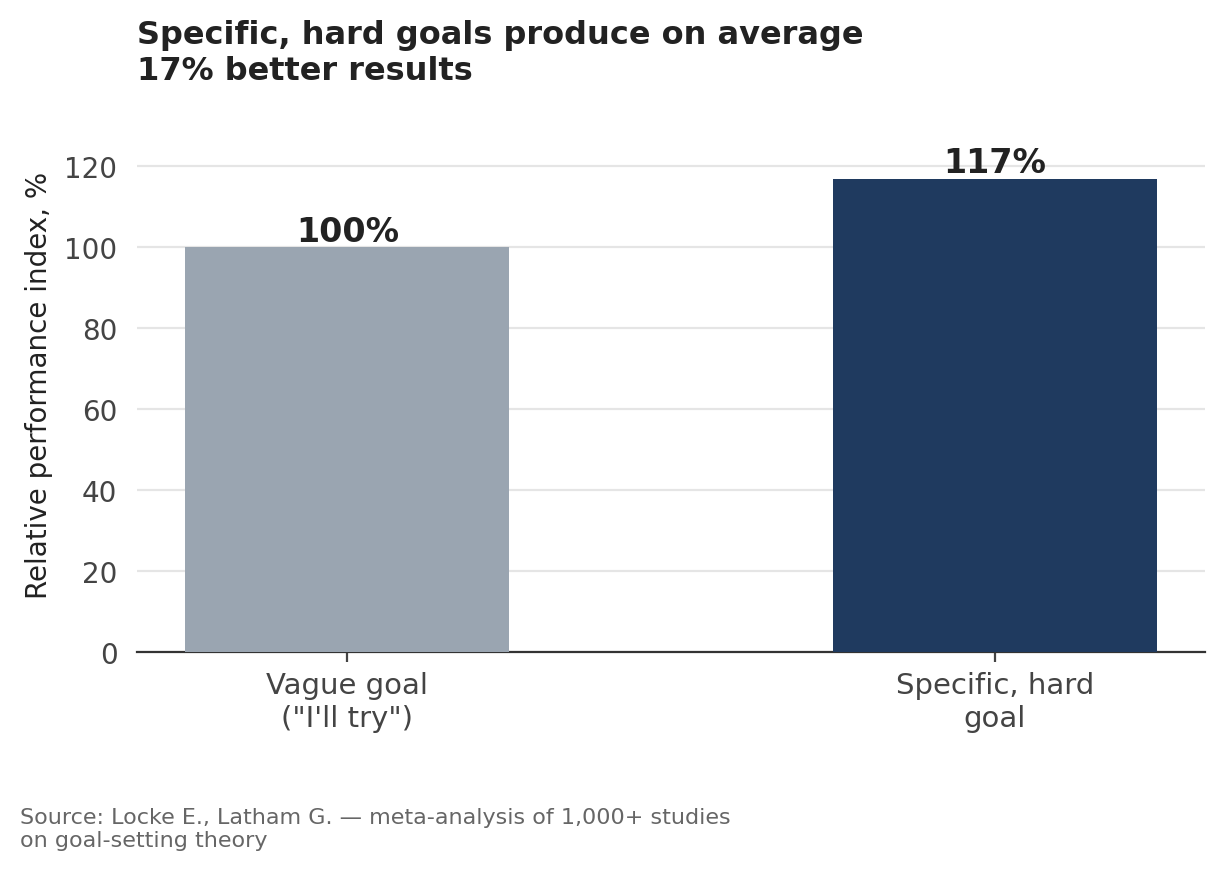
Behind goals like that there's often not calculation but a chase after someone else's expectations — the neighbor's imported car, a friend's iPhone — absorbed back in childhood along with the idea that “you should have what others have, or better.” This isn't an abstraction: across Locke and Latham's research on goal-setting theory — more than a thousand studies over half a century — specific, hard goals consistently beat a vague “I'll try”:
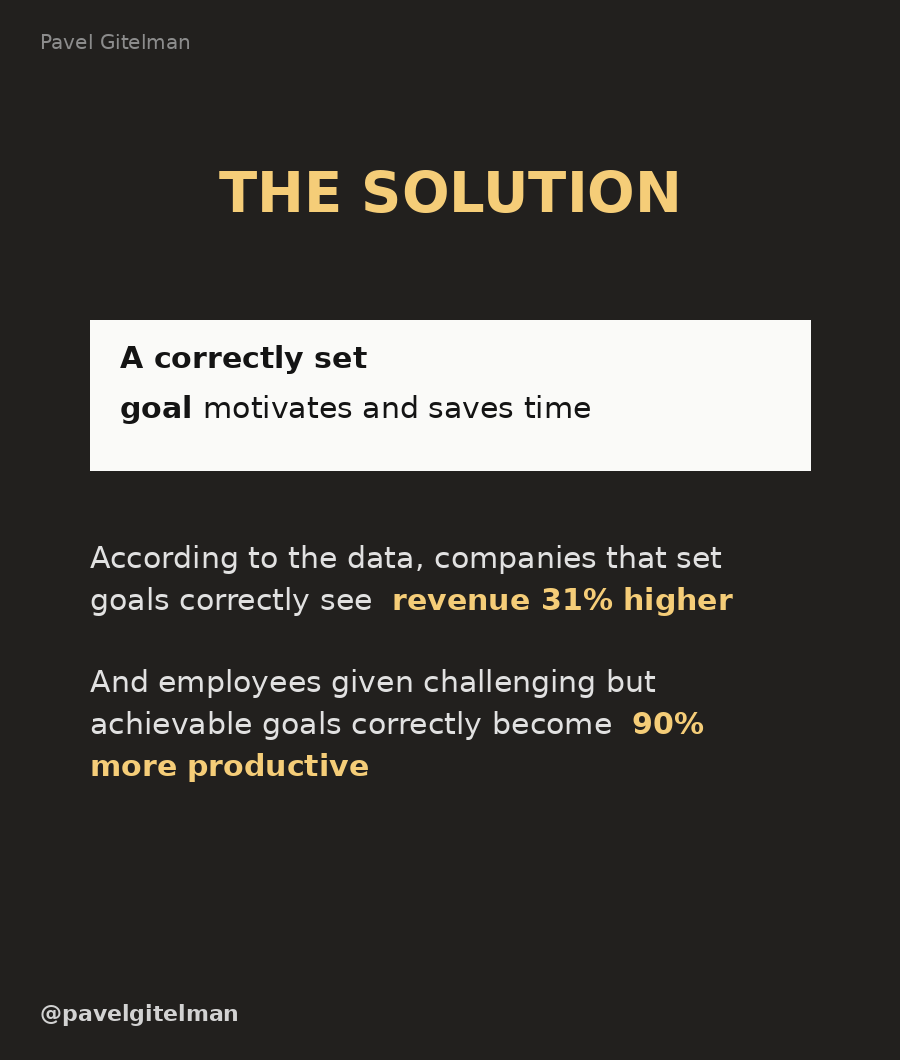
Corporate data from Pavel Gitelman shows a similar picture: in companies that set goals correctly, revenue is on average 31% higher, and employees with challenging but achievable goals become nearly 90% more productive.
And since the question keeps coming back to money, it's worth unpacking a popular myth: that happiness stops rising past a certain sum. Kahneman and Deaton did find a ceiling around $75,000 a year in 2010, above which day-to-day well-being stopped improving — and that figure spread across the internet as settled fact. But in 2021, Matthew Killingsworth got the opposite result on different data: happiness kept rising well above that mark. In 2023 the two of them ran a joint, deliberately adversarial reanalysis — and found they'd both been right, in their own way. A plateau really does exist, but only for the subset of people who are unhappy for other reasons: for them, more income stops helping at around $100,000. For everyone else, happiness rises linearly — and for the happiest group, it even accelerates:
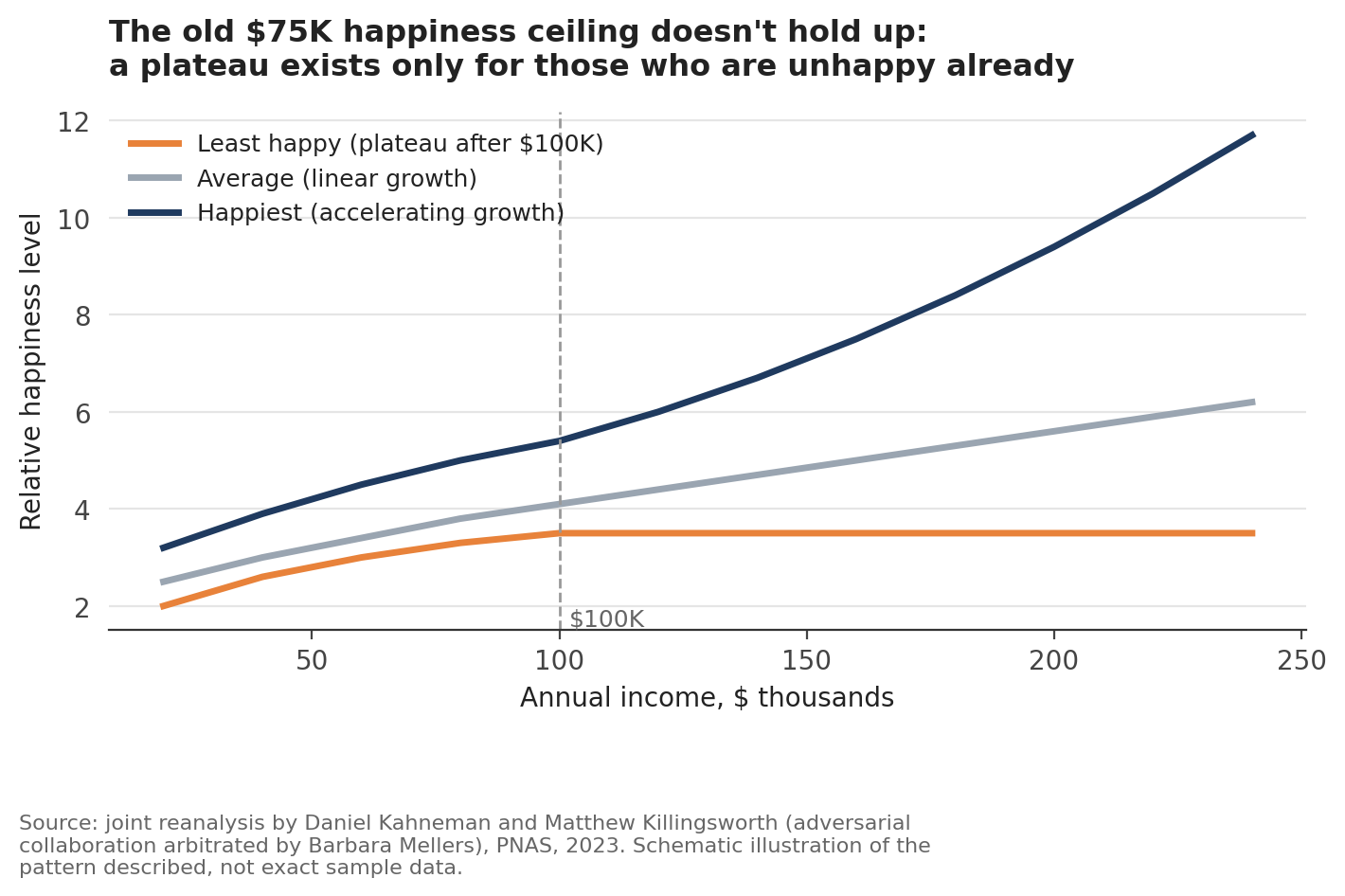
The practical takeaway from this research is harsher than it looks at first glance: it's not about the income figure itself, but about what's going on in the rest of your life. If unhappiness has causes outside of countable income — health, relationships, meaning — then no next sum of money will fix it, and it's important to tell that apart from a genuine goal whose answer you've already worked out in advance.
Insight #12Health, rest, and energy aren't the reward for success — they're its precondition
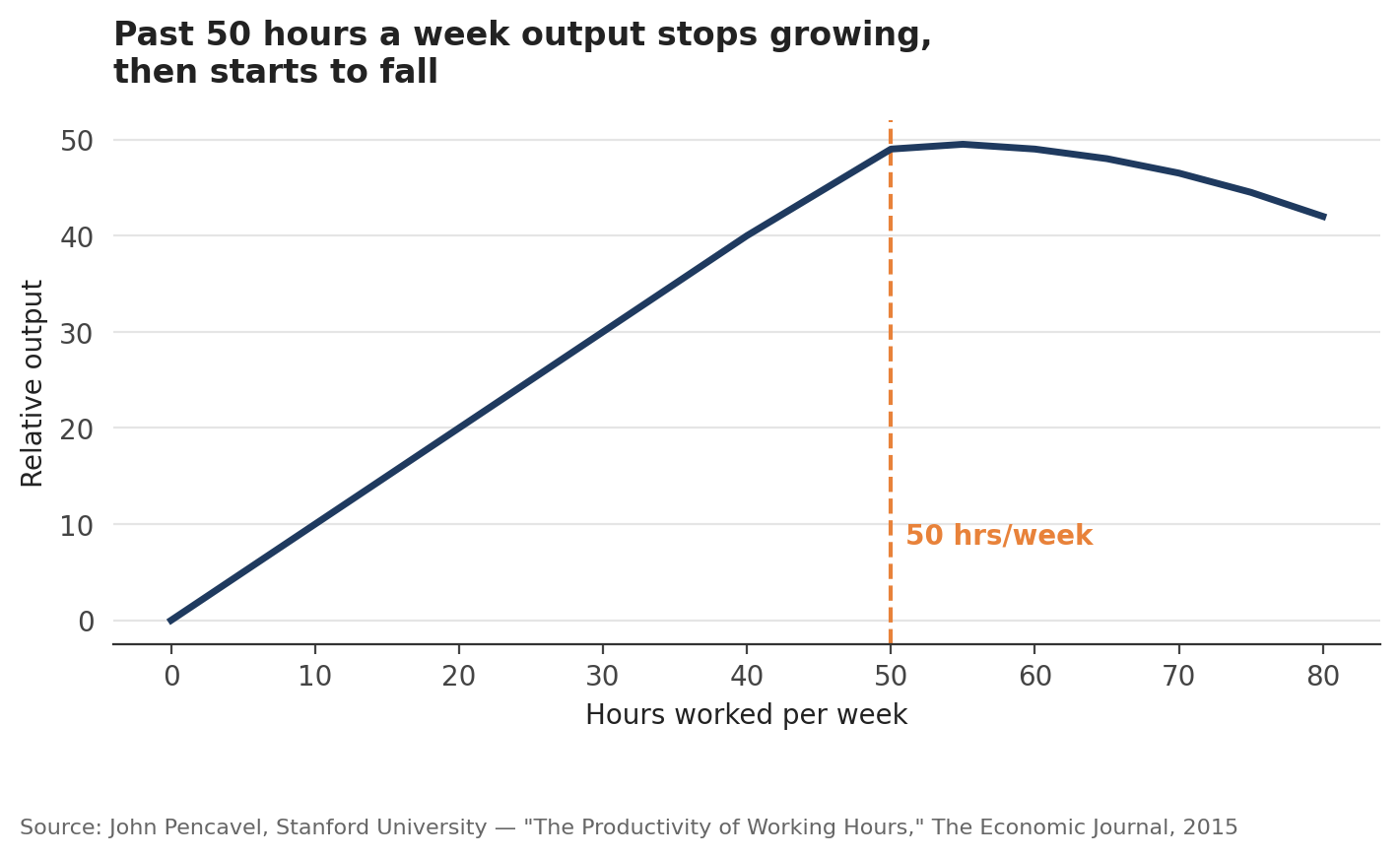
But whatever the goal, you'll only reach it on your own resources — and those deserve more care than they usually get. You can work 16-hour days for years, numb the stress with food and alcohol, and stay afloat for a while. Year one works. Year two, too. By year three, problems start. This isn't a metaphor — it's a measurable pattern: Stanford economist John Pencavel analyzed data from British munitions factories and found that output stops rising after about 50 hours a week:
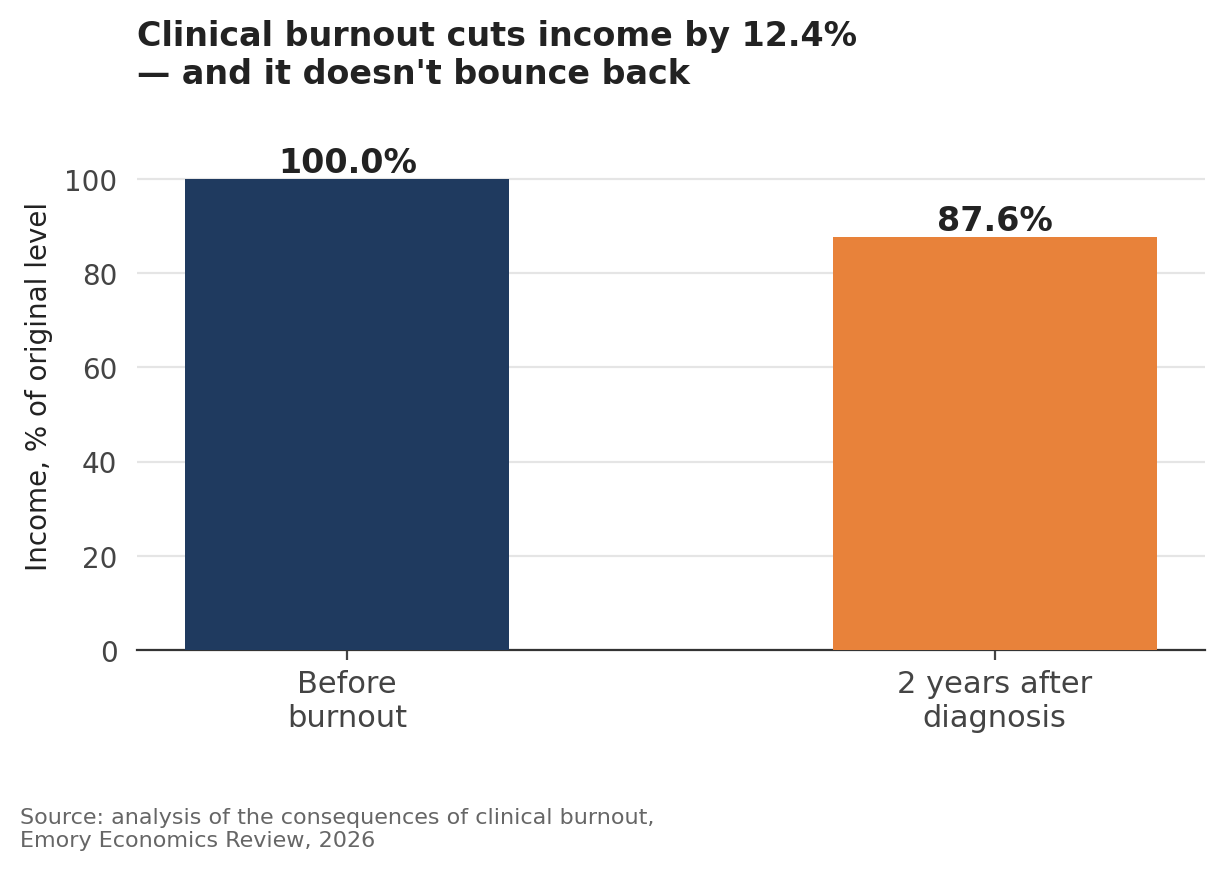
A separate study shows that the cost of overwork isn't limited to lost output in the moment — it hits income even after a person has formally recovered:
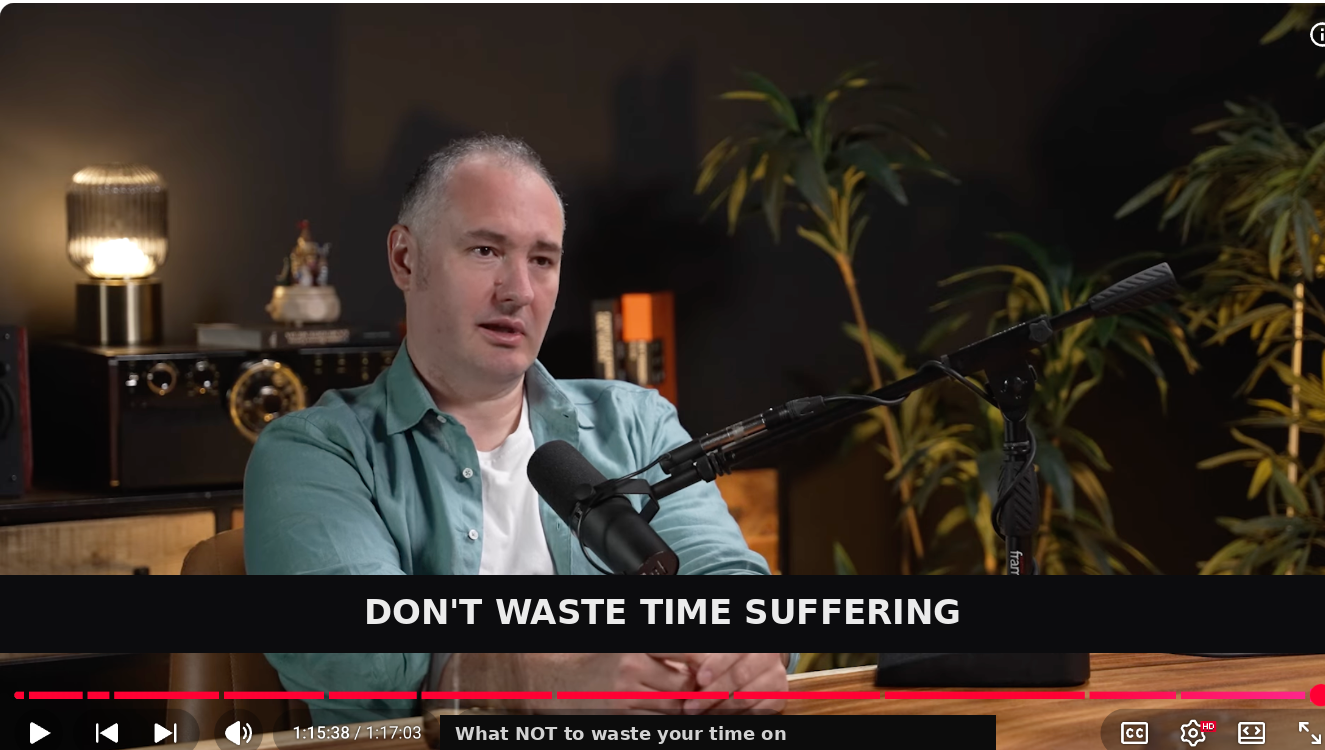
Serial entrepreneur and investor Alexey Korolyuk, asked for his single most important piece of advice to entrepreneurs, answered in three words:
“Don't waste time suffering”
— Alexey Korolyuk, co-founder of Reg.ru, on the podcast “Vsevidyashchee Shoko”
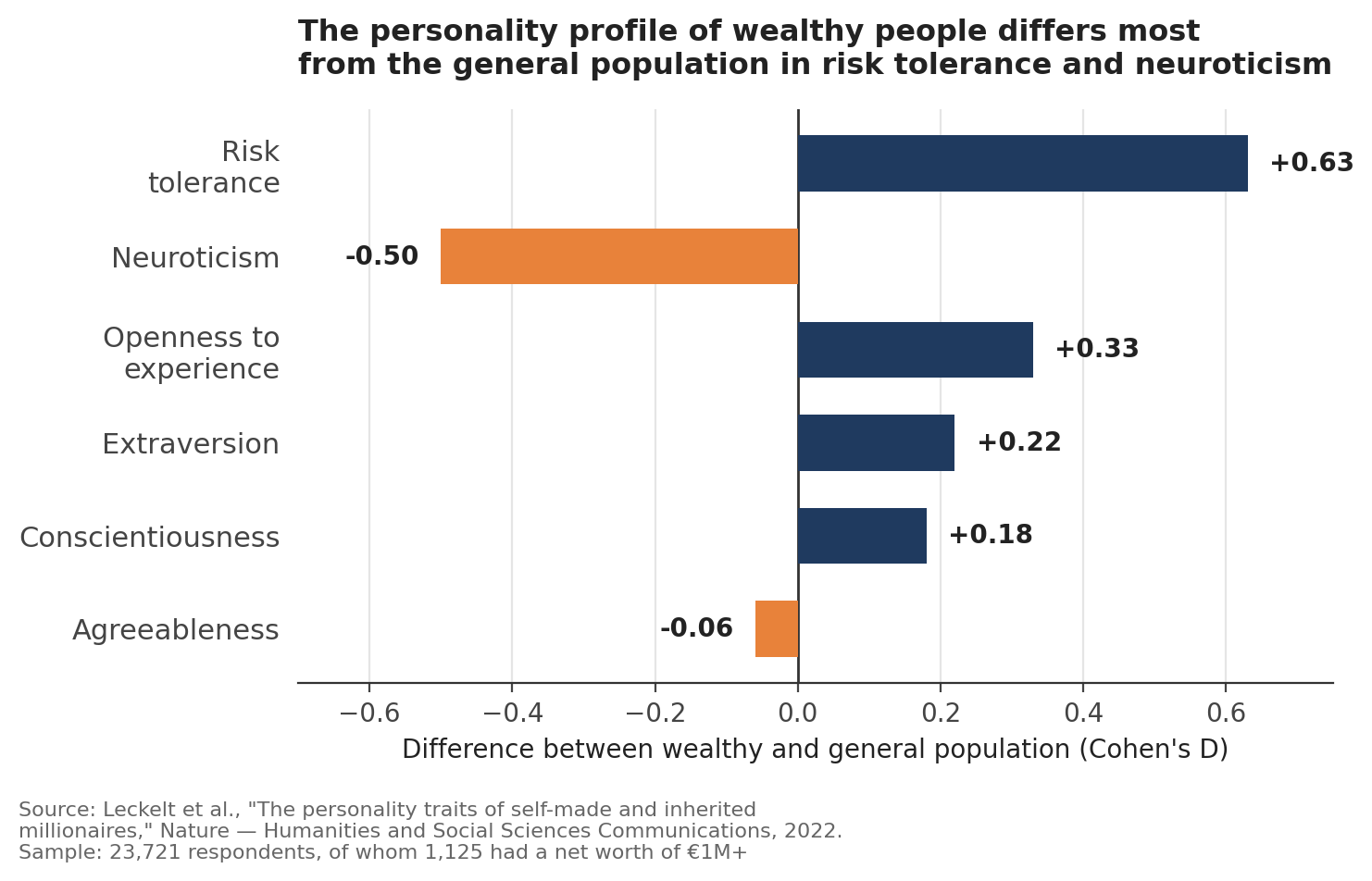
There's data behind that phrase, not just words. A German study of the personality traits of wealthy people (a sample of 23,721 people, of whom 1,125 had a net worth of €1 million or more) found that the wealthy differ from everyone else most sharply in low neuroticism and high risk tolerance:
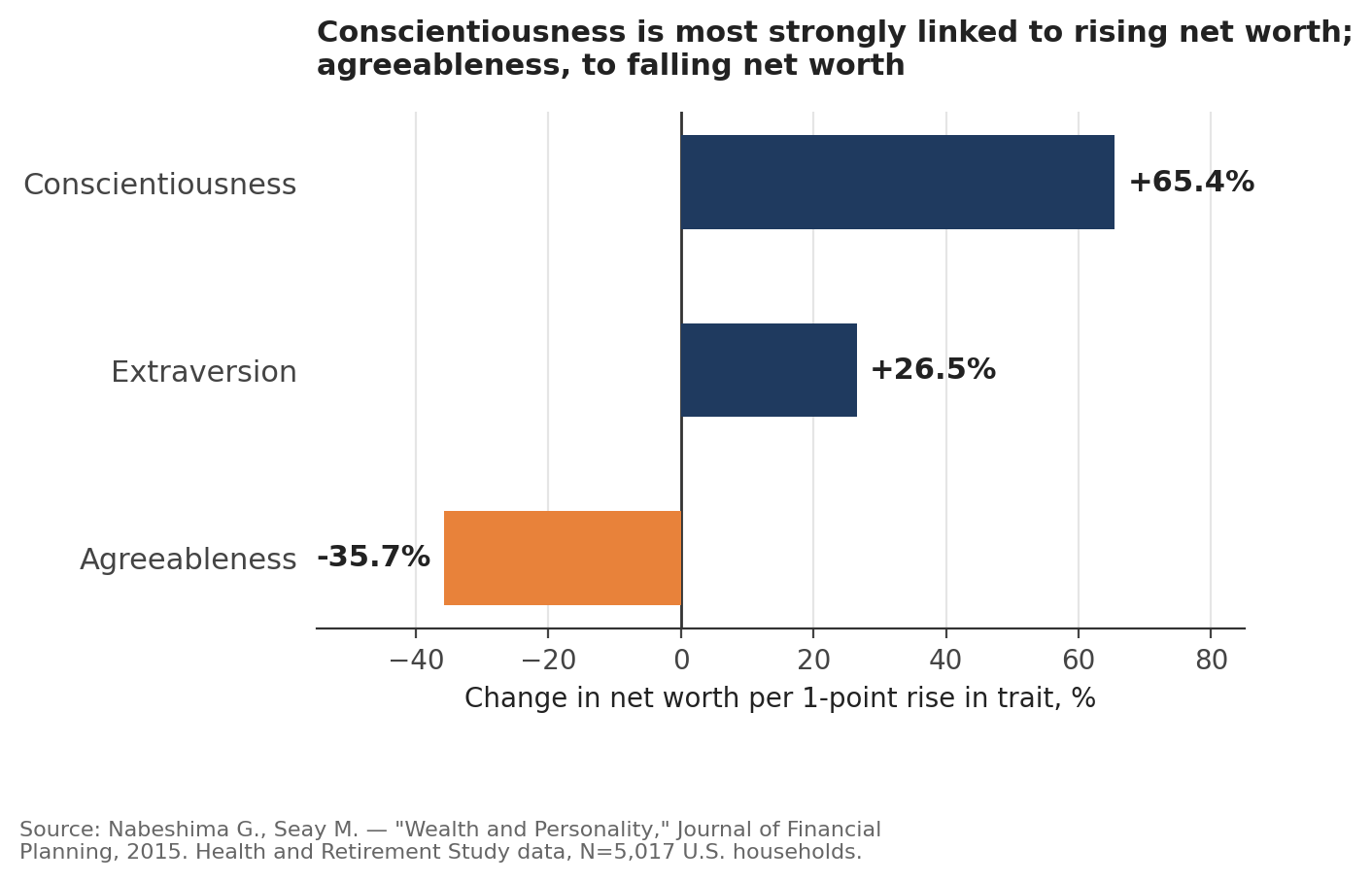
A similar but separate American dataset — the Health and Retirement Study, 5,017 households — shows the specific dollar price of personality traits: a one-point rise in conscientiousness is linked to a 65.4% rise in net worth, extraversion to a 26.5% rise, while a rise in agreeableness, by contrast, is linked to a 35.7% drop in net worth — likely because a tendency to put other people's interests ahead of your own doesn't mix well with accumulating wealth:
That trait isn't innate — it's the result of working on yourself. I myself drove myself into deep depression by shortchanging my own needs to save the company, and it took a long time to pull out of that spiral. Since then, I see the pattern clearly: the poor economize on their own development; the wealthy pay to accelerate it.
At the physiological level, this is fairly simple. Psychologist Viktor Mizilin, breaking down entrepreneurs' energy, explains that ATP is what powers energy in the body, and synthesizing it requires three conditions at once: food, oxygen, and calm. Food and oxygen are usually fine — it's calm that people living in permanent crisis mode systematically lack. A chronically exhausted entrepreneur, meanwhile, doesn't look tired — he looks driven: proud of being perpetually busy, rescuing other people's problems in his spare time, narrowing his circle down to “just leave me alone,” unable to fall asleep because of chronic muscle tension, and constantly stimulating himself — coffee, nicotine, a drink at night. That's exactly why the common phrase “I don't have time to rest” almost always means a shortage of calm, not a shortage of hours.
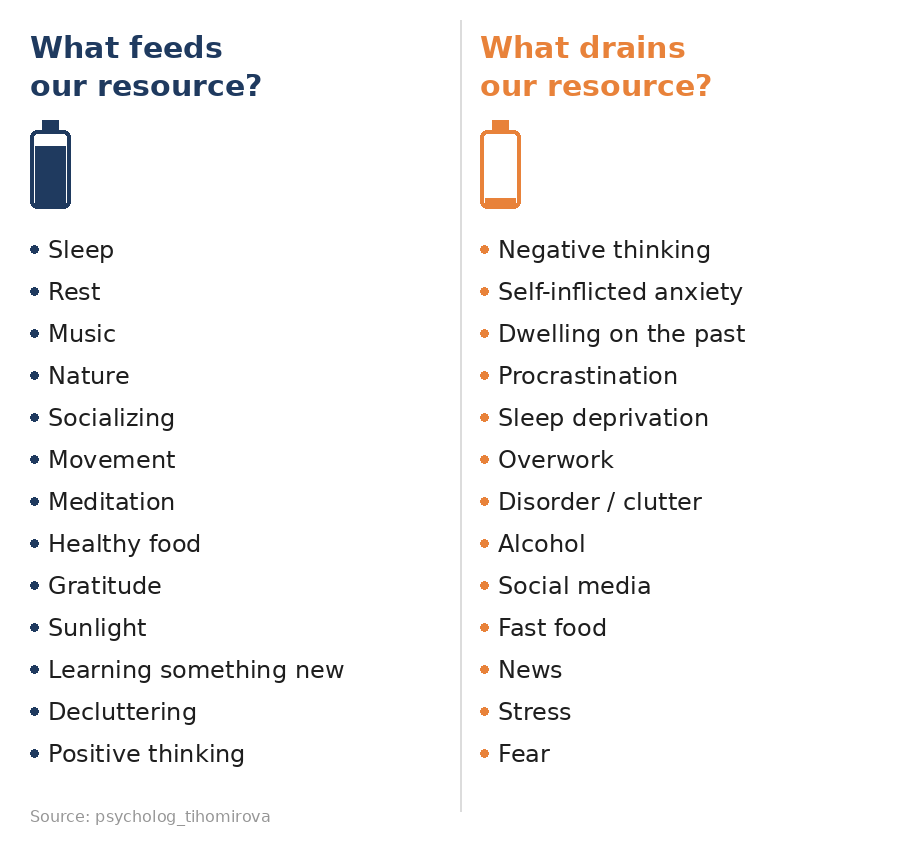
In psychology, people increasingly talk about a “resourced state” — the combination of mental and physical energy that lets you actually live and pursue your goals. This resource has six sources: imaginative (dreams and imagination), cultural (art, music, books), relational (trust, respect, openness — with a partner, in the family, on the team), environmental (nature, walks, a timely vacation), physical (sleep, food, exercise), and personal (learning, stress tolerance, managing your finances).
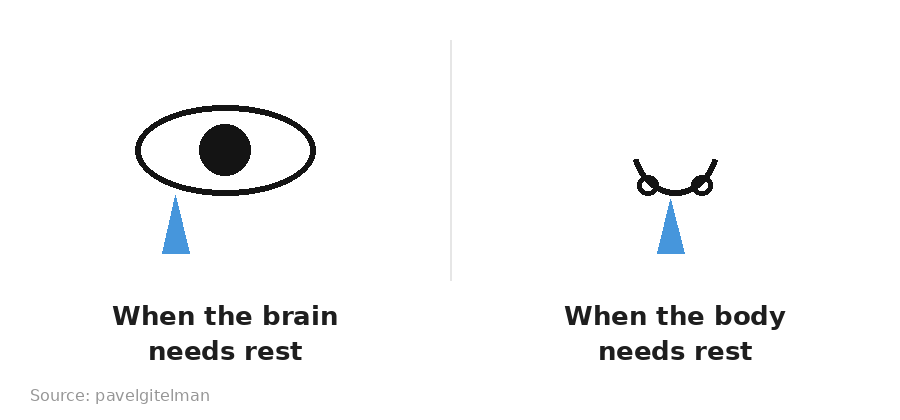
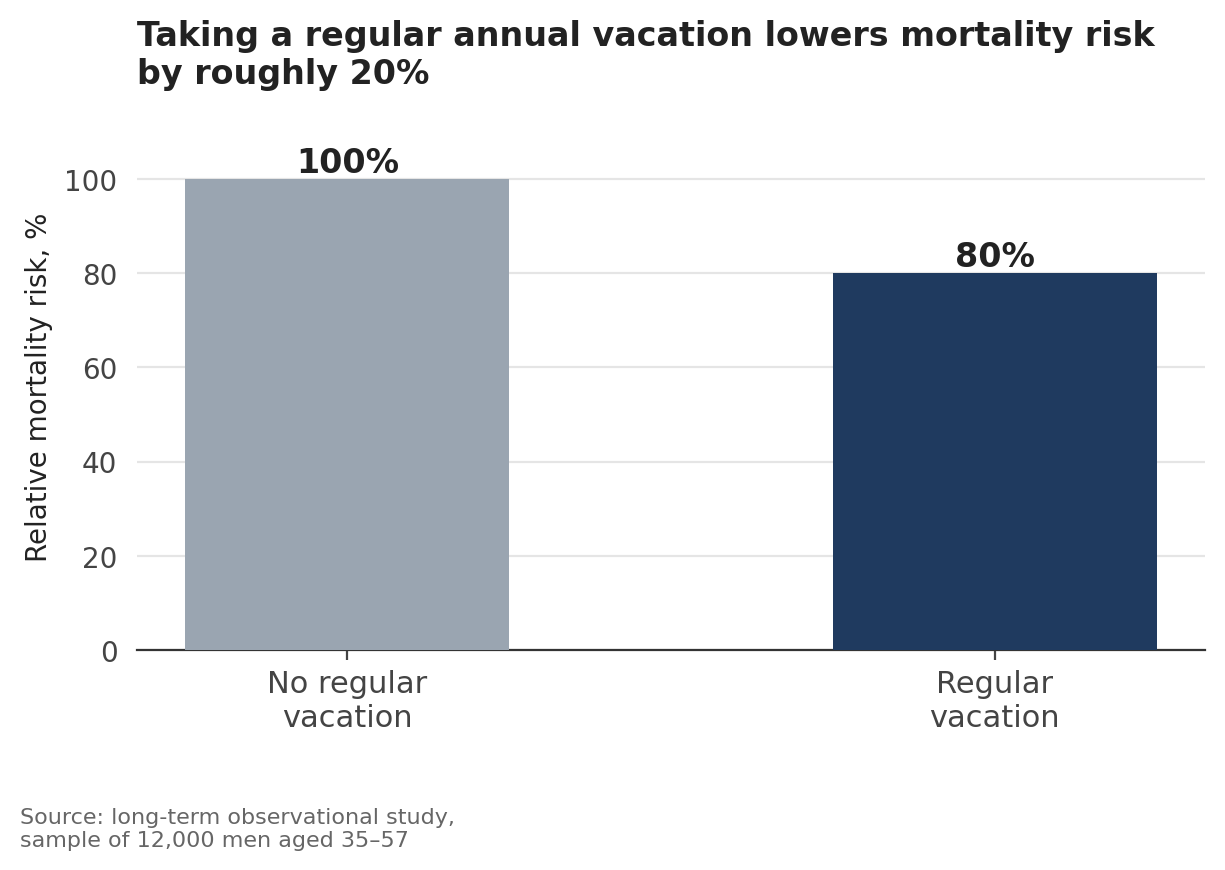
In this model, vacation isn't a luxury — it's a measurable economic necessity: men who take a regular annual vacation, according to a long-term study of 12,000 people, lower their overall mortality risk by roughly 20%, and according to Dutch researchers, simply planning a vacation produces a noticeable happiness boost for up to eight weeks in advance — meaning it works before the vacation even starts:
The rule is simple: a break is needed at least once every two months, and one to two full weeks off every six months. Work isn't the same thing as your right to a life — that simple idea became a turning point for me. Not escaping into work, but learning to step into your right to a life. As Po the panda puts it in Kung Fu Panda:
“Yesterday is history, tomorrow is a mystery, but today is a gift. That is why it is called the present”
— Kung Fu Panda
Insight #13The “cycle of contact”: why the brain won't let go of unfinished tasks
Not everyone manages to actually close out the workday just by closing their laptop in the evening — thoughts keep circling around unfinished tasks. In Gestalt therapy this is called the cycle of contact: an unfinished action keeps demanding attention until it's either completed or consciously let go of.
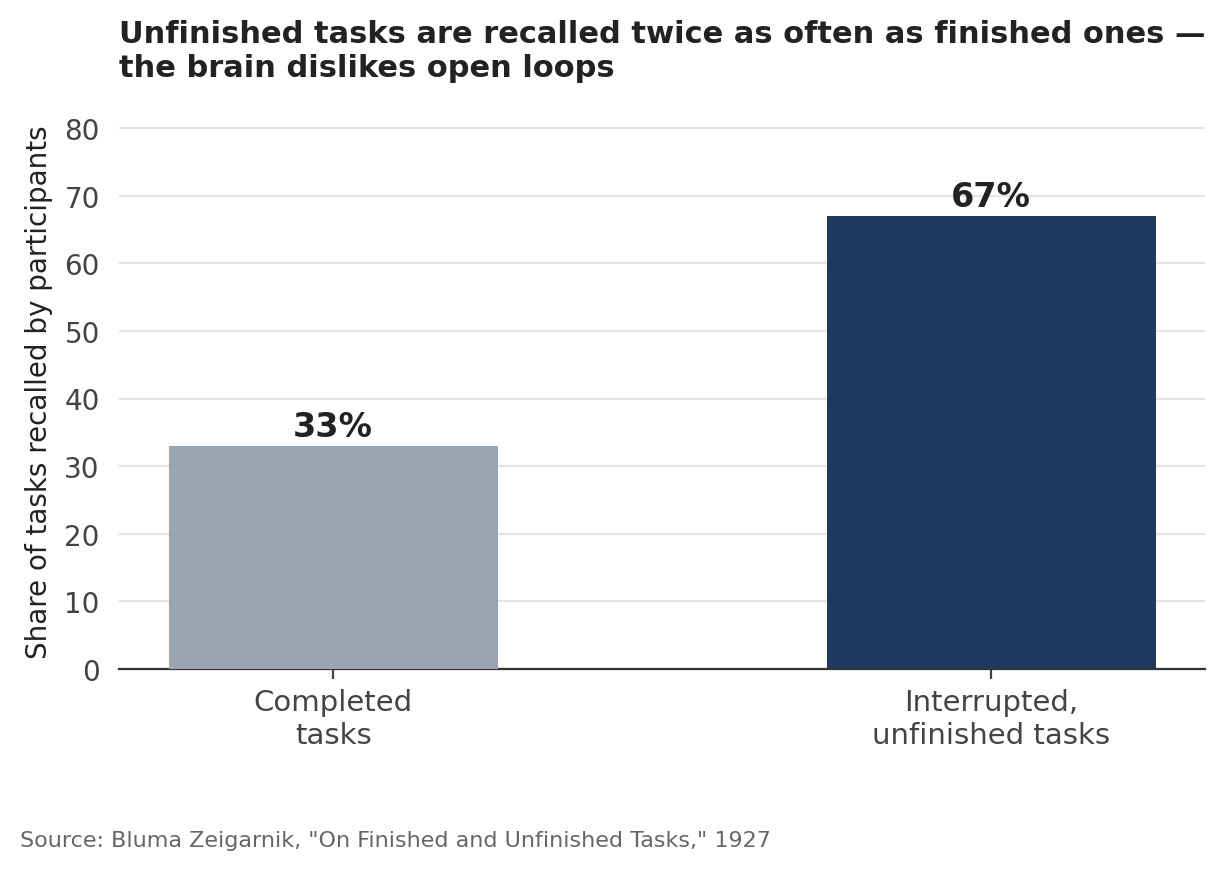
There's precise experimental confirmation of this from nearly a century ago. In 1927, psychologist Bluma Zeigarnik found that participants remembered interrupted, unfinished tasks twice as often as tasks they'd finished: the brain literally keeps open loops at a higher priority than closed ones, regardless of whether the task actually matters.
The simple practical takeaway: if a task can't be closed out by the end of the day, don't hold it in your head — consciously “park” it, writing down where it stopped and what the next step is, because the act of putting it on paper gives the brain a signal equivalent to completion and lifts some of the background tension. There are also working ways to close out the whole day: knowing in advance what you'll do right after work; working from an office or a co-working space rather than from home, so the line between work and rest doesn't blur; and having a personal end-of-day ritual — a walk, a short workout, a shower, anything that physically marks the shift from one state to another.
Insight #14A weekly check-in with yourself — a simple ritual against burnout
Buried under a pile of tasks, meetings, and other people's expectations, it's easy to notice too late that you're running yourself into the ground. A working way to avoid that is to ask yourself four questions at the end of every week. How did the week go — with an honest look at negative moments and credit given even for small wins. How do I feel — paying attention to your physical and psychological state, not just your deadlines. Why do I feel this way — that is, did I actually take care of my own resources this week. And what do I do about it — a short plan for the next few days, alternating passive rest with active rest.
The main rule is simple and counterintuitive: you replenish your resources in advance, not once they've already run out. It's worth writing yourself a personal list, once, of what specifically restores your resources — and reaching for it before exhaustion piles up, not after.
Insight #15The Pareto principle and “clogging”: train your main muscle — the ability to see what matters
Time is the one truly non-renewable unit of measure; Luc Besson's film Lucy shows this literally, when the main character starts perceiving time as a physical substance. Once you feel this in your body, not just as a slogan, the question “what am I spending my hours on” stops being abstract.
Only 20% of effort produces 80% of the result — and that's exactly where your focus needs to be. When you manage this, the phrase “I don't have time” gets replaced with “I have priorities,” and everything else can and should be delegated to the team: if they can't handle it, the problem isn't a shortage of your time — it's that you need different people. What actually sets a professional apart is the ability to identify that vital handful of tasks, rank them by their contribution to the outcome — from money down to mere formality — and negotiate the removal of everything else, instead of trying to hold onto everything at once and never say no to anyone. Batyrev captures this in a separate tattoo of his own — “learn to say no”: without that skill, none of the others are possible.
Behind all of this is one core trainable skill: the ability to see what matters and consciously ignore the rest — in other words, training the brain like the body's main muscle. The more you practice filtering signal from noise on real tasks, the faster and more precisely your brain identifies which two or three parameters decide the outcome, and which twenty are just creating the illusion of busyness. There are plenty of practical techniques for this: build an “ideal week” schedule with specific hours blocked out for the tasks that genuinely matter; cut an hour-long meeting down to 45 minutes — it makes the rest of the day more productive; skip a scheduled meeting if there's actually nothing to discuss; when a new task shows up, don't retreat into thinking it through alone — pull the team into a short brainstorm instead, which saves hours of solitary deliberation; and if you're burning a lot of time worrying about an outcome you're afraid of, run a trial A/B test of the worst-case scenario and prepare for it in advance, instead of endlessly replaying it in your head.
There's also a state worth calling out on its own, which I call “clogging”: being so deep in the day-to-day grind that you lose the ability to step back and see your own priorities. It's usually the result of fatigue, spiraling anxiety, self-doubt, a lack of discipline and clear goals, and getting sucked into social media and gadgets. The working fix is simple: set a five-minute timer and write down every way you could free up time, without criticizing any idea as it comes — delegate it, drop it, reassign it — then pick one option and carry it out yourself; if that doesn't work, take it to your manager, whose job is to hold focus not just for themselves but for the whole team.
How you structure the day itself also helps. It's useful not to dive straight into the hardest task but to ease into the day — for example, with industry news — and then “eat the frog”: tackle the task that demands the most resources, and not push it into the afternoon. One rule per day: one genuinely heavy task, and the further you get from that “frog,” the lighter and more pleasant everything else on the list should be. Meetings, where possible, are better held in the second half of the day, and messaging apps are best checked no more than once every two hours: any frequent switching of attention costs more than it looks like it does, because the brain pays a separate tax every time it has to refocus.
There's a simple, blunt way of putting all of this that I once wrote for myself in a draft of this very article: business is, in a sense, the art of saying no, on time, to everything that doesn't move you toward your goal. Not the most elegant phrasing, but an honest one — and it's exactly the reminder that focus isn't about politeness, it's about defending your time as fiercely as you defend your money.
Insight #16Three cognitive biases that cost entrepreneurs the most
Separate from personal psychological patterns, there's behavioral economics — the field that studies systematic thinking errors that recur across most people regardless of intelligence. For entrepreneurs, three of them are especially costly.
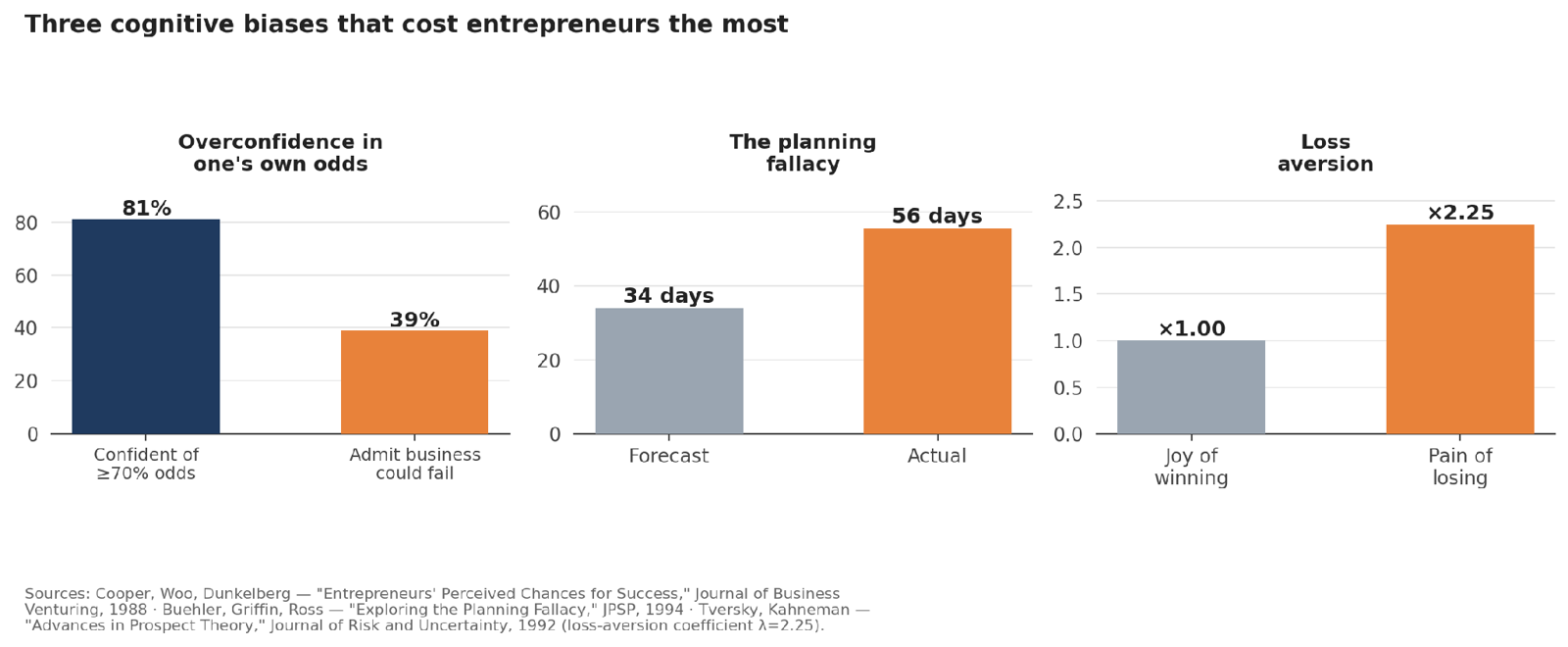
The first is overconfidence in your own odds: in a survey of nearly three thousand aspiring entrepreneurs, 81% rated their chance of success at 7 out of 10 or higher, but only 39% even entertained the idea that the business might fail — even though the survival statistics from Insight #5 say otherwise.
The second is loss aversion: according to Daniel Kahneman and Amos Tversky's calculations, a loss is felt roughly 2.25 times more intensely than an equally sized gain. That's exactly why it's so hard to close a business on time or walk away from a bad deal — the brain resists not because the decision is wrong, but because admitting the loss hurts more than the missed alternative itself.
The third is the planning fallacy: even when people were asked for a deadline they were “99% confident” in, the actual time a task took averaged 64% longer than the forecast. The practical takeaway for Insight #6: build in a buffer on any deadline, and check your forecast not against your own optimism but against how long a similar task usually takes other people.
Insight #17What the classic books say about the same thing
The six books most often cited when people talk about the psychology of success, compressed to one takeaway each, confirm almost word for word everything written above.
Daniel Kahneman's Thinking, Fast and Slow splits cognition into fast, intuitive System 1 and slow, analytical System 2 — and explains why exactly this gap is where the three biases from Insight #16 are born: System 1 generates confidence faster than System 2 can check it.
Stephen Covey's The 7 Habits of Highly Effective People opens with proactivity — the idea that there's always a zone of choice between stimulus and response — and with the habit of “putting first things first,” which is the same Pareto principle covered in Insight #15, just phrased in the language of management rather than business.
Napoleon Hill's Think and Grow Rich reduces success to three elements — a clear desire, belief in it, and persistence — and introduces the concept of a “mastermind group” of like-minded people with different strengths, which almost word for word describes the mechanism from Insight #7 about a circle that raises your ceiling faster than personal effort alone.
Richard Branson's Screw It, Let's Do It is the scrappiest of the six books: in business, Branson argues, there's no universal instruction manual, and success goes to those who are persistent, keep a sense of fun, and know how to pick the right people — echoing both Insight #5 on persistence and Insight #3 on partnership.
George Clason's The Richest Man in Babylon is the only one of the six not about psychology but about tactics, which is exactly why it complements the rest so well: set aside at least 10% of your income, live on the remaining 90%, put your money to work, and invest in your own development — seven rules that haven't changed in the century since the book was first published.
Maxim Batyrev's 45 Tattoos of a Character is the most personal of the six: 45 principles drawn from his own mistakes, with no claim to being a universal theory. All forty-five share one throughline — radical personal responsibility for your own life, and a refusal to make excuses — and that throughline is what holds up most of this cycle's conclusions: the employment-business-employment cycle, resilience to failure, the ability to let go of control, and the ability to say no on time all ultimately require admitting that the responsibility lies with you, not with your circumstances.
Conclusions: 17 insights on one page
1. Wealth isn't about the market — it's about who the owner became.
2. Wealth is a function of four variables: education, ambition, business acumen, and starting conditions.
3. Personal brand, partnership, and the “rich or king” dilemma all rest on the same psychology — your relationship to risk and conflict.
4. The “employment → business → employment” cycle isn't defeat — it's a normal rhythm, independent of age.
5. The successful are the ones who failed more often, tested more, and weren't afraid of rejection.
6. Discipline and rapid hypothesis testing: revenue loves speed, profit loves consistency.
7. Your circle and mentors raise your ceiling faster than personal effort alone — but not every expert deserves equal weight.
8. Ambition is fuel that easily turns into poison; work from being possessed by an idea, not from ambition.
9. Pain along the way is normal, as long as you don't carry it alone and measure progress by the step, not the whole distance.
10. Luck is, in a sense, a skill: it requires letting go of control, not tightening your grip.
11. Until you can answer “what do you need it all for,” your brain won't build the road there — and money alone doesn't cure unhappiness that has other causes.
12. Health, rest, and energy aren't the reward for success — they're its precondition.
13. The “cycle of contact”: the brain won't let go of unfinished tasks until they're recorded or closed.
14. A weekly check-in with yourself is a simple ritual against burnout.
15. The Pareto principle and “clogging”: train your main muscle — the ability to see what matters, ignore the rest, and say no.
16. Three cognitive biases cost entrepreneurs the most: overconfidence, loss aversion, the planning fallacy.
17. Six landmark books about wealth, each in its own way, confirm all sixteen points above.
Epilogue. Wealth isn't counted only in money
Looking back on this path today, I don't regret starting this business, and I still count it as a success: the money let me live without denying myself anything, help the people close to me, and still lets me, if I wanted to, go a year without working. But, strangely enough, that's not the most valuable part.
I learned a great deal that can now be turned into experience and income multiple times larger than before. But the main thing is that I became someone who notices when it's time to stop, who knows how to ask for help, who can call a bad result a bad result, and who knows how to say no — including to himself. Therapy, and the years of this path, didn't make my life easier — they made me more honest with myself, and that, it turns out, is a far rarer and far more lucrative skill.
This is the first article in the cycle about how to get rich, and it's deliberately only about psychology — about what goes on in an owner's head. What follows will be separate breakdowns: on team and partnerships (“People Decide Everything”), on product and scaling (“Time for Innovation”), on money and financing (“Capital Scarcity”), on long-term strategy (“The Royal Gambit”). But if I had to keep only one conclusion out of everything here, it would be this: the road to money almost always runs through the road to yourself, and there's no shortcut that bypasses the second one.