
Preamble: this text is long, and every number in it carries a label. [Fact] means I found it in a named source. [Estimate] means I calculated it from facts. [Hypothesis] means it is my forecast, and you are welcome to argue with it. When sources disagree I show both numbers instead of picking the prettier one.
Why I wrote this
Most forecasts about marketing start with a global number: ad spend grows by 5 percent, digital takes 69 percent, AI changes everything. All true, and useless on a Monday morning. A mother in Izmir deciding whether her 12-year-old should learn Python does not live in a global number. She lives in a country with its own rules for advertising to children, its own payment habits, its own messenger, and a free school course that may or may not exist yet.
So I built the picture from the bottom. I took six markets: Italy, Spain, Indonesia, the Gulf (the UAE and Saudi Arabia), Turkey and the United States. For each of them I collected audience data, ministry decisions, regulation, provider price pages, parent surveys and platform earnings. Then I asked one question: what happens to the cost of getting a paying family over the next 24 months, and which channels stay cheap when paid traffic does not?
A word on my angle, so you can weigh what follows. At SkillFactory (CMO and Head of User Acquisition, 2020 to 2022) I ran acquisition on about $1 million a month, with around 35 people in eight departments. I co-founded Ed.Partners, a CPA and influencer agency for EdTech that reached $3 million in ARR; over five years I have worked with 236 companies, and that sample is where the correlations in a LinkedIn post come from. At Timepad I ran lifecycle marketing: four playbooks, lifetime value up 15 percent in eight months, the biggest campaign sent to more than 180,000 users.
What I have not done is live in these six markets. Most of my operating experience is in Russian-speaking markets, and I will not pretend otherwise. This text is built differently: the market facts come from public sources, and what I bring is a system for turning them into decisions. I have moved that system across products and countries, and I have the habit of letting local people tell me where my model is wrong.
1. The base rate: everything gets more expensive, in three different ways
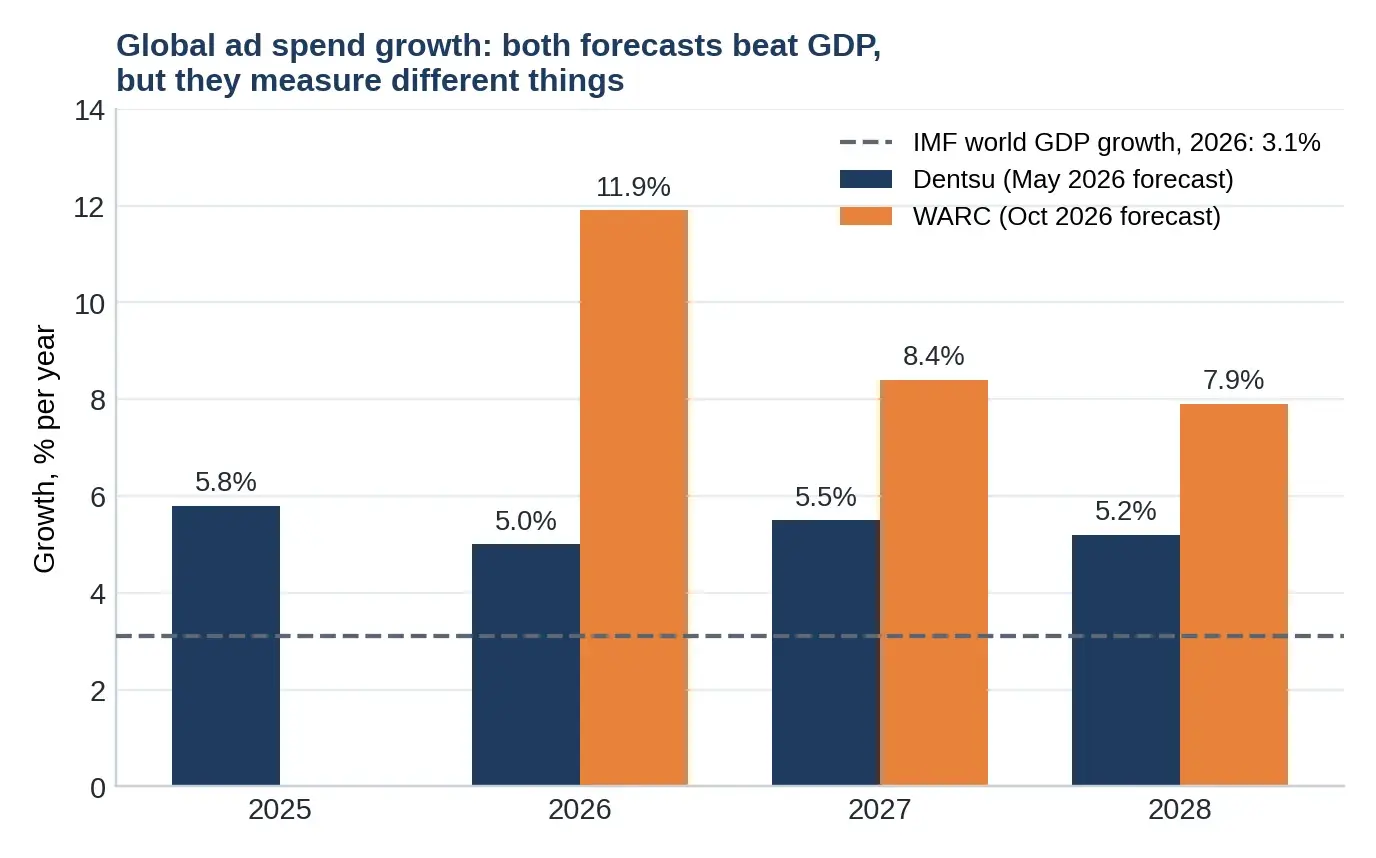
Start with the macro. Dentsu’s May 2026 forecast has global ad spend growing 5.0 percent in 2026 and 5.5 percent in 2027, after 5.8 percent in 2025, reaching $1.06 trillion this year. The IMF expects world GDP to grow 3.1 percent [Fact]. Ad budgets outgrow economies, so every advertiser fights for attention that grows more slowly than the money chasing it. WARC’s October forecast is higher: $1,343 billion in 2026 (+11.9 percent), then +8.4 percent and +7.9 percent [Fact, via secondary coverage]. The two forecasters differ by a factor of two for the same year because they count different things, so do not average them. What they agree on: growth beats GDP, and it flows to platforms. Dentsu puts digital at 69 percent of spend across the 56 markets it tracks, and expects 75 percent of spend to be algorithm-driven by 2028 [Fact].
Inflation No. 1: the price of attention
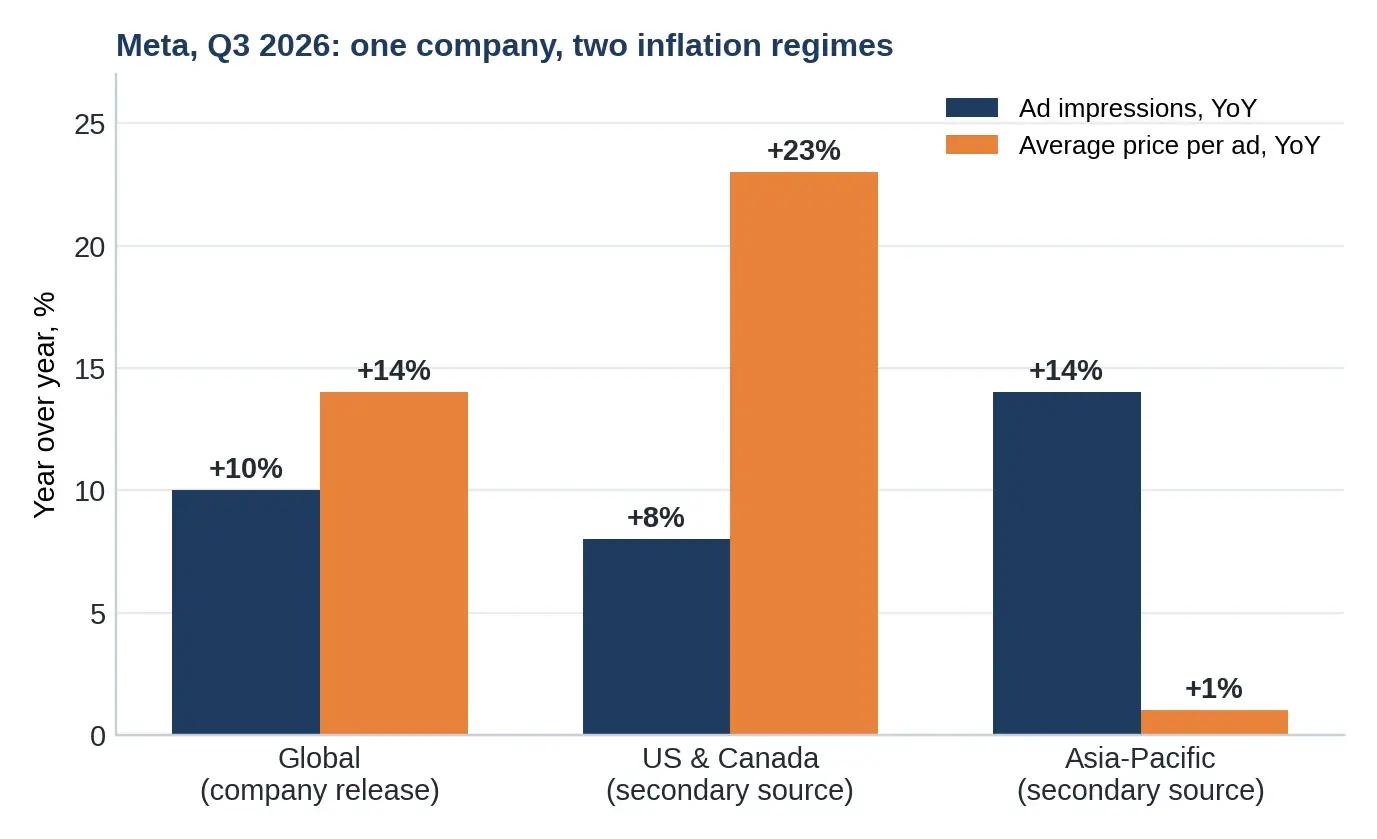
Meta’s third quarter is the cleanest data point I have. Ad impressions grew 10 percent and the average price per ad grew 14 percent year over year; revenue was $64.6 billion, up 26 percent [Fact, company release]. Regional detail comes from one secondary source, so I treat it as direction: price per ad in the US and Canada +23 percent on 8 percent more impressions, in Asia-Pacific +1 percent on 14 percent more impressions [Fact, secondary]. Same company, two regimes. In the US you pay more per unit; in Asia you get more units for about the same price. That single split explains a lot of what follows for Indonesia and for the United States.
The strongest counterargument is that a higher price per ad is not a higher CAC if conversion improves, and Meta’s CFO credited better ad performance for part of the price gain [Fact, secondary reporting]. I take that seriously. But the only CAC series I found points the other way: an agency network of 230+ brands reports Meta CAC up 31 percent between February 2024 and April 2026 ($40.27 to $52.86) with ROAS falling from 2.57 to 1.56. Other vendor blogs say +40 percent for e-commerce over 2023 to 2026 and +60 percent over five years [Fact, vendor sources, all of them selling something]. There is no neutral CAC index, so I will not hand you a decimal. The direction is the same in every source I read, and it is up.
Planning assumption [Hypothesis]: in mature markets paid CAC rises by low double digits a year unless conversion work offsets it. Test that against your own cohorts, not against a blog.
Inflation No. 2: the click that used to be free
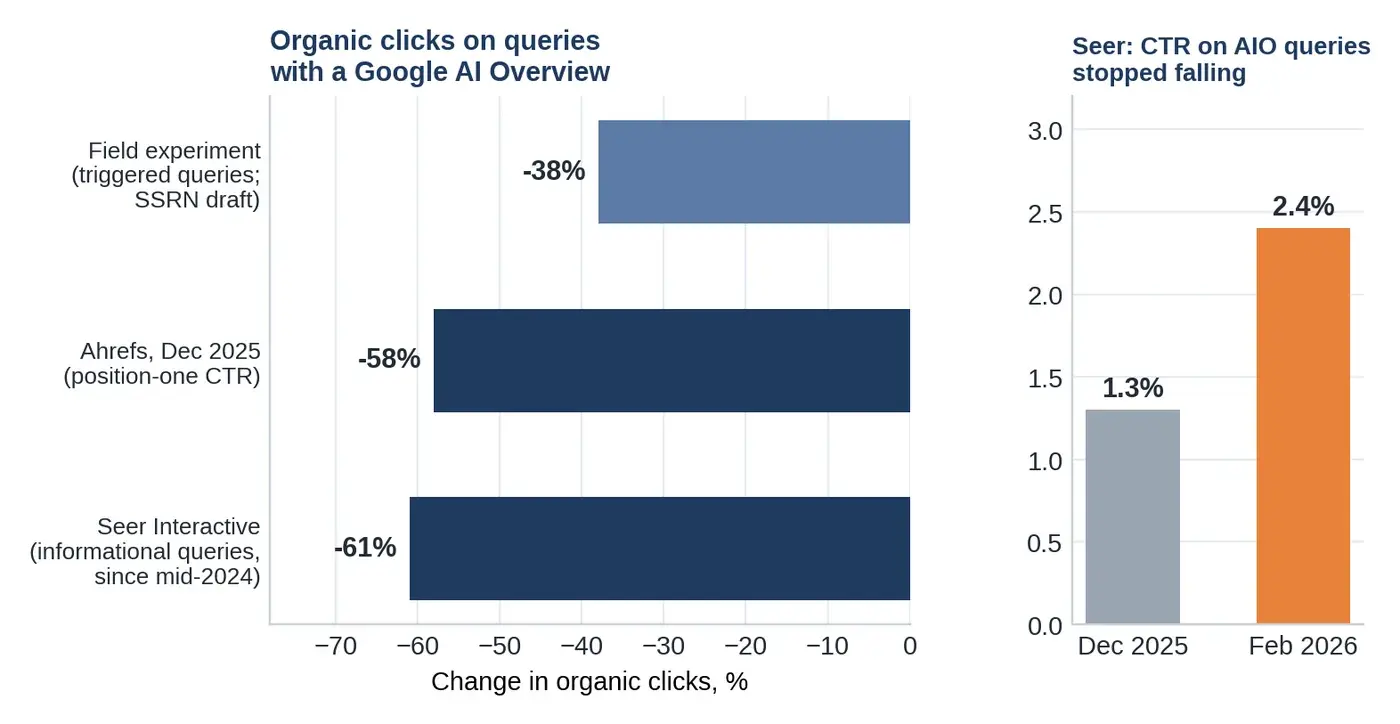
Organic search changes price in a different way: the click disappears. A randomized field experiment found that Google AI Overviews cut organic clicks on triggered queries by 38 percent [Fact, SSRN working draft, not peer reviewed]. Ahrefs measured position-one click-through down by as much as 58 percent on keywords where an AI Overview appears (December 2025). Seer Interactive saw informational queries lose 61 percent of organic CTR since mid-2024 (3,119 queries, 42 organisations). In its 2026 update CTR on queries with AI Overviews rose from 1.3 percent in December 2025 to 2.4 percent in February 2026, so the fall looks like it is levelling off [Fact]. Google says AI Mode passed one billion monthly users in 2026, and Dentsu expects search spend to grow only 3.4 percent this year, the slowest of the large formats.
In a Web Digest Pro article on AI-powered information intelligence I am quoted with the rule I apply to every forecast in this text: “AI is an ‘assistant’ that speeds up work; humans own judgment, accountability, and final decisions.” The same piece makes a point I would underline for parents’ search: AI applied to poor data does not create intelligence, it scales disorder. A parent’s first question to an assistant (“is my 9-year-old ready for Python?”) will be answered from whatever the internet knows about your brand. Prices, reviews, school partnerships and pages in the local language are now a marketing asset, not a website chore.
For SEO, then, I would plan for traffic that is smaller and better qualified, not for zero. The pages that keep working are the ones an assistant can quote: a real price, a real syllabus, a named teacher, a dated review.
Inflation No. 3: the permission to talk to the parent
The third price is not in any auction. Rules in all six markets have changed or will change within roughly eighteen months: Italy’s AI law and AGCOM’s influencer code, Spain’s Real Decreto 444/2024 and a pending bill that raises the digital consent age to 16, Indonesia’s PP Tunas, the UAE’s child digital safety law and Saudi licensing of paid creators, Turkey’s under-15 social media ban and influencer labelling, and the amended US COPPA rule. I go through them market by market below. For now the point is economic: consent screens cost conversion, labels cost creative freedom, licences cost cash (Saudi Mawthooq is reported at about SAR 15,000 for three years, one source), and none of it appears in a media plan. It belongs in the acquisition P&L.
The usual escape, and why it is not free either
The usual escape from auction prices is creators, and the money has noticed. The IAB puts US creator ad spend at about $37.1 billion in 2025 and $43.9 billion in 2026 (+18 percent), and 57 percent of buyers plan to raise creator budgets, up from 48 percent a year earlier [Fact]. eMarketer counts a narrower thing, what US creators earn from brand payments, and gets $9.29 billion for 2025, up 14.2 percent [Fact]. Same word, a four-fold difference in size. The lesson is not the number. It is that non-paid is not free of inflation: when every brand moves into creators, creator fees rise. In my list of 30 acquisition mechanisms that do not buy impressions one section is called “Organic is not zero CAC”, because a fee or somebody’s time sits behind every free-looking channel.
Numbers I do not trust, and why
CPM by country. Two trackers put the UAE Facebook CPM at $5.40 to $9.80 and at $19.20, a gap of two to three and a half times. I found no usable benchmark for Turkey, Indonesia or Saudi Arabia, so there is no CPM table in this text.
Market sizes. Vendor estimates for kids’ coding in the US run from about $1.9 billion (one vendor) to $5.4 to 6.5 billion (global, several vendors). Definitions differ, and I do not add them up.
Reach. DataReportal’s ad audiences are not monthly active users, and in the UAE and Saudi Arabia some of them exceed 100 percent of adults because of duplicate accounts and expatriates.
2. AI and children’s education: three things happen at once
2.1 Children move first, wallets move last
Start with behaviour. Common Sense Media’s 2026 census found that 86 percent of US children aged 9 to 17 have used generative AI tools, more than 80 percent use them for schoolwork (94 percent among older teens), and 16 percent of those who use AI for homework say it is hard to start or finish without it [Fact, via press coverage]. Pew found that 64 percent of US teens use chatbots while only 51 percent of parents think they do, and about one in ten use AI for all or most of their schoolwork [Fact]. Parents are warm and nervous at once. In a July 2026 survey of 2,053 parents, 76 percent favoured at least some AI in schools. In Deloitte’s 2026 back-to-school survey of 1,207 K-12 parents, 49 percent worried their child relies on AI too much, and 13 percent planned to pay for generative-AI classes or tutoring outside school [Fact, secondary write-ups].
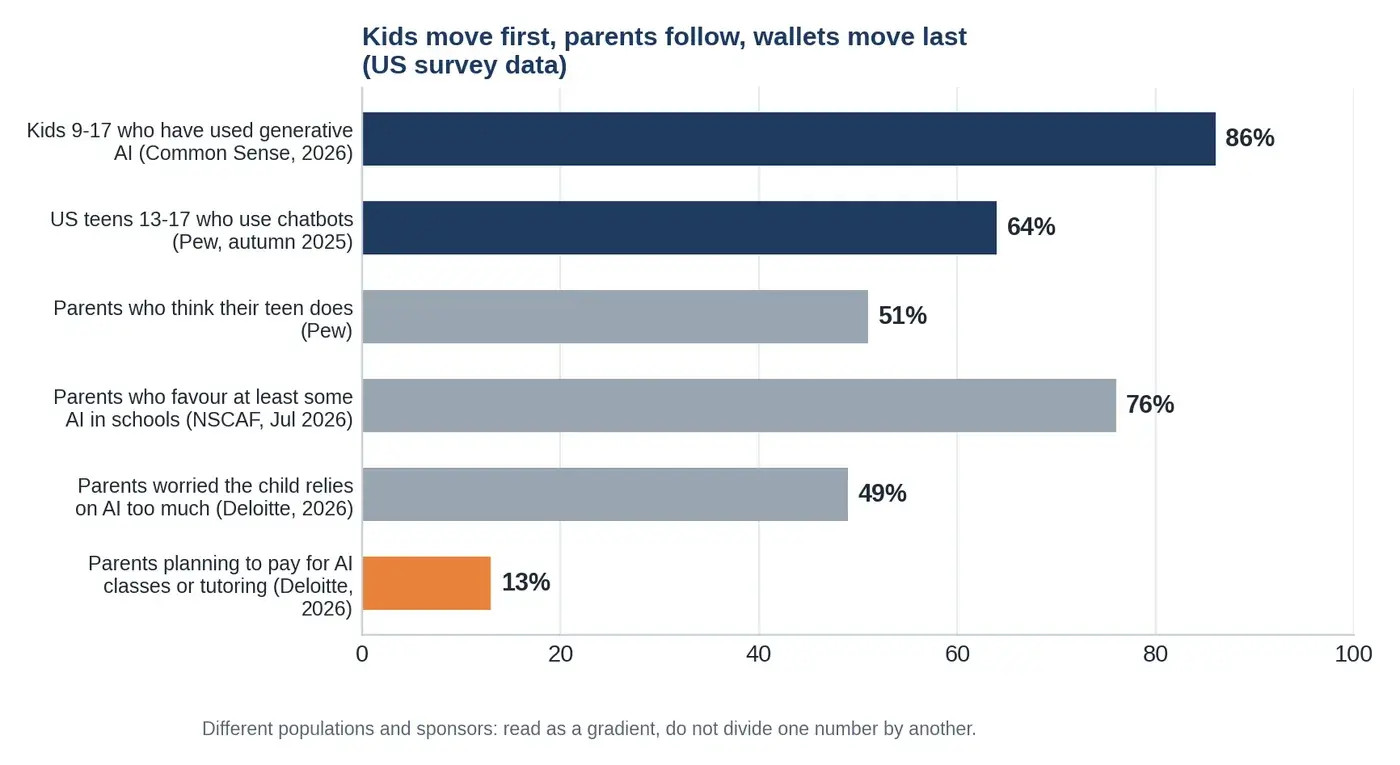
Read Figure 4 as a gradient, not a ratio. The populations differ (children 9 to 17, teens 13 to 17, parents of K-12 pupils) and so do the sponsors. The shape is the useful part: use is close to universal, approval is high, and the intention to pay is 13 percent. Paid demand starts where a parent can name an outcome, and “my child knows what a neural network is” is not an outcome a parent can check.
Money follows the same gradient. HolonIQ counts $1.0 billion of global EdTech venture funding in the first half of 2026, 26 percent below the $1.35 billion of the first half of 2025; the first quarter alone was $512 million in 63 deals, down 24 percent in value [Fact]. HolonIQ’s own note on the half-year is headlined with the observation that Asia and MENA bucked the trend. I would not build a forecast on a headline, but it points the same way as the school policies below: more movement where the state pushes AI into classrooms.
2.2 Governments turn AI into a free baseline
The second thing is that the state is becoming a competitor. Every one of the six markets has moved on AI in schools, at very different speeds, and the table below is the version I use to judge how much of an “intro to AI” course a parent will soon get for free.
| Market | What the state did | When | Limits |
|---|---|---|---|
| Italy | Law 132/2025: parental consent for under-14s to access AI, 14 to 18 consent themselves. Ministry (MIM) decree 166 with guidelines for AI in schools, favourable opinion from the data protection authority; an AI area on the national school platform; a two-year pilot with virtual assistants; a EUR 100 million fund (DM 219) for teacher training in AI | Law in force 10 Oct 2025; guidelines 9 Aug 2025; fund 11 Nov 2025 | Commentators at Agenda Digitale say the gap between principles and school capacity is still wide. No AI subject for pupils found |
| Spain | No national AI subject found. Regions act: Valencia set up a teacher-training centre for AI and computational thinking; Catalonia’s new-year plan adds authorisations, tutorials and oral defence of student work. Eight in ten teachers already use generative AI, and Spanish pupils use AI for school tasks more than the OECD average (PISA 2025). Government tabled an AI organic law in Congress | AI law tabled 12 Jun 2026; data protection authority (AEPD) guide Feb 2026 | Law still in parliament; rules differ by region |
| Indonesia | Coding and AI as an elective subject from grade 5 of primary school to senior secondary; academic paper released; about 2 hours a week planned; tens of thousands of teachers have been trained | School year 2026/27 (earlier plans said 2025/26) | Elective, only in “ready” schools; the minister cited about 25% of schools teaching it; critics warn of digital inequality |
| UAE | AI becomes an official subject from kindergarten to grade 12 in public schools; over 1,000 teachers teach it in year one; G42 and AI71 build products; smart textbooks in all schools by 2028 | From school year 2025/26 | Press-reported, sources differ on exams |
| Saudi Arabia | National AI curriculum in phases across public-school levels, reported reach over 6 million students, after a pilot “Introduction to AI” for third-year secondary | School year 2025/26 | Actual coverage in November 2026 not confirmed; one outlet describes modules, not one subject |
| Turkey | Ministry (MEB) runs an IT and software course in grades 5 and 6 with AI themes, plus a middle-school elective “Artificial Intelligence Applications” (grades 7 and 8) with a programme updated in 2026 under the Maarif Model: block-based programming and AI ethics | Programmes 2025 and 2026; unit pages updated 26 Aug 2026 | Elective; real reach not found |
| United States | Executive Order 14277: White House task force on AI education, a Presidential AI Challenge, AI priority in teacher-training grants. Code.org: about 60% of public high schools offer a foundational computer science course, 6.1% of eligible students enrolled | EO 23 Apr 2025; Code.org data Dec 2025 | No federal curriculum; a patchwork by state |
The strongest counterargument to “free baseline” is that free arrives unevenly. About a quarter of Indonesian schools teach coding and AI as an elective; Italian commentators say schools lack the capacity; Saudi coverage in November 2026 is not confirmed. I agree, and that unevenness is itself a forecast. In 2027 the gap between schools that teach AI well and those that do not becomes a marketing angle (“prepare for the school AI course”), exactly as exam prep did a generation ago.
2.3 Parents get more rights, marketers get more steps
Regulation moves in the same direction as school policy, but for the opposite reason. Schools want children to learn AI; legislators want children protected from systems that learn from them. For a marketer the combined effect is simple: the buyer is the parent, the user is the child, and the child’s data is a liability. Figure 5 is the calendar I keep on the wall.
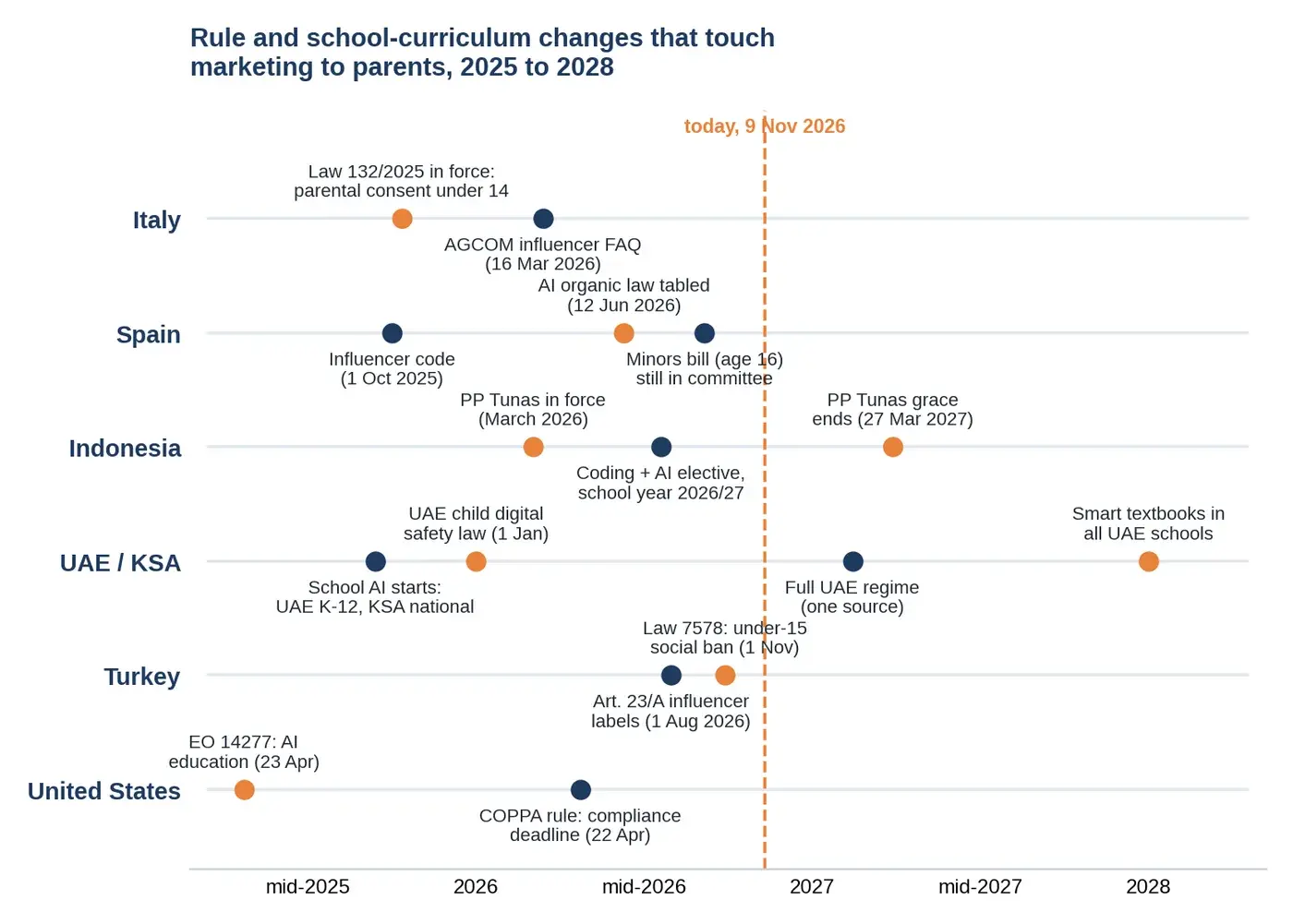
2.4 Three predictions I am prepared to be wrong about
First, the first meeting with your brand moves into an AI answer [Hypothesis]. Children already turn to AI before they turn to adults for homework help (Common Sense Media, 2026), and I expect parents to follow. You cannot buy your way into that answer; you earn it with citable material and with other people talking about you: reviews, creators, schools, press. This is the biggest reason I would put non-paid channels at the centre of a 2027 plan rather than on its edge.
Second, a free school course resets the price anchor [Hypothesis]. Once a parent in Dubai or Ankara knows that school teaches AI, a paid “intro to AI” becomes unsellable. What remains sellable is what a school cannot do at scale: a teacher who knows the child, a finished project, a short report the parent can read. The offer shifts from content to outcome and relationship. It is also why the Gulf has the strongest free baseline of the six, and why generic AI courses will be hardest to sell there.
Third, consent costs conversion, but parent-first marketing is the only road that stays open [Hypothesis]. Every extra consent step loses some share of leads. In Turkey, children under 15 may not hold social media accounts from 1 November 2026, so there is no child to advertise to. In the US, the amended COPPA rule has applied since April. The brands that already speak to the parent, and keep the child’s data out of the funnel, pay the lowest compliance tax.
In a piece about agentic systems and the future of software I was quoted on the same shift from the other side: strategic vision and a deep understanding of market needs become the primary drivers of value. In children’s education the scarce judgment is not “can we produce a course with AI”. It is “what will a parent in this country pay for, and who does she trust to tell her?”
3. Six markets, six constraints
One playbook will not travel, and two charts show why. Figure 6 shows how unevenly reach is still growing: in one year the US added more Instagram reach (16.0 million) than Italy, the UAE, Saudi Arabia and Turkey combined (10.35 million), and more adult TikTok reach (15.2 million against 14.81 million) [Estimate, summed from DataReportal]. Figure 7 shows price anchors for children’s coding: from $14 a month in an Indonesian local centre to $299 and up for a US one-to-one teacher, a 20-fold spread. A paid-media plan, a creator fee and a payment page that work at one end of that range will not work at the other.
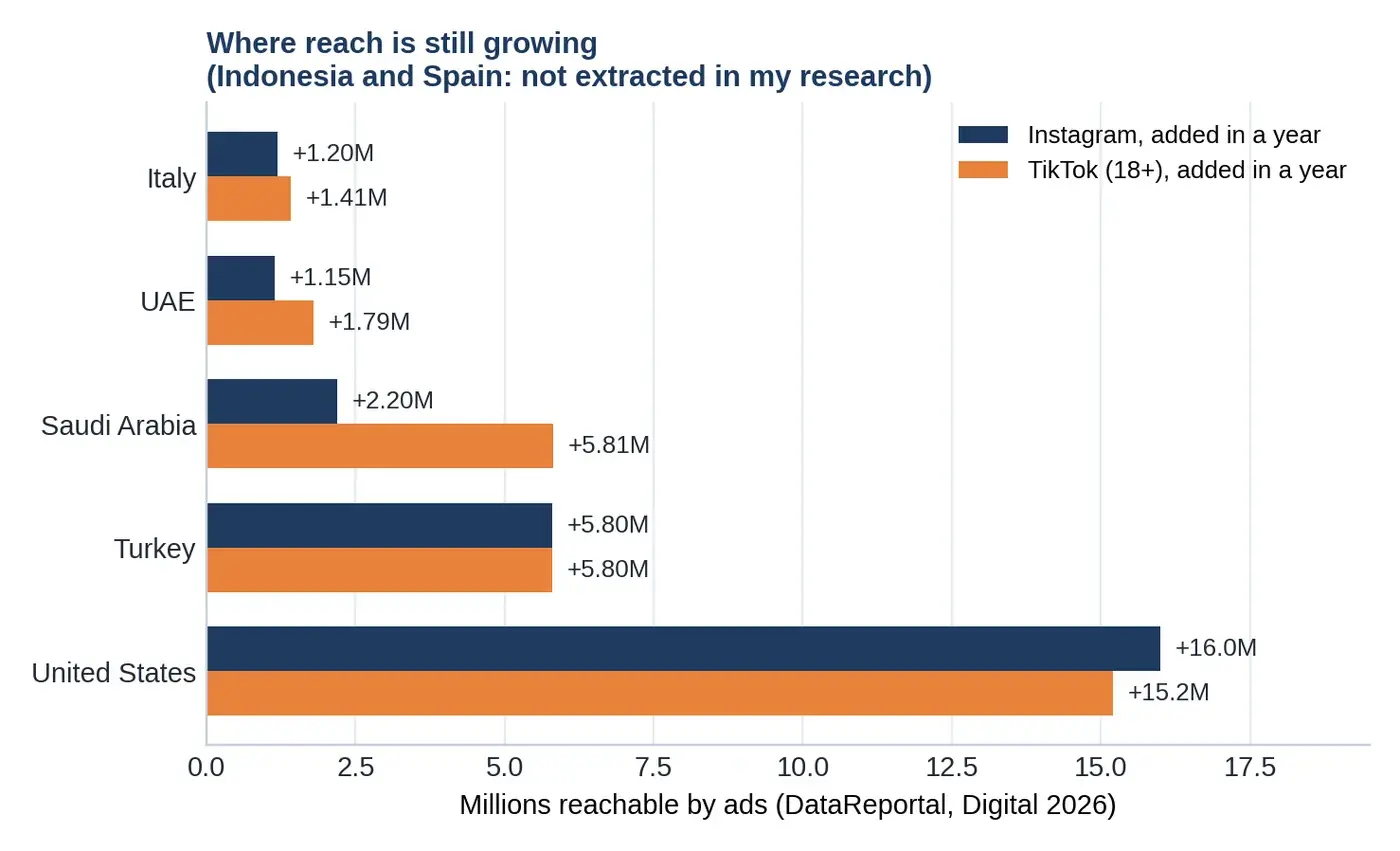
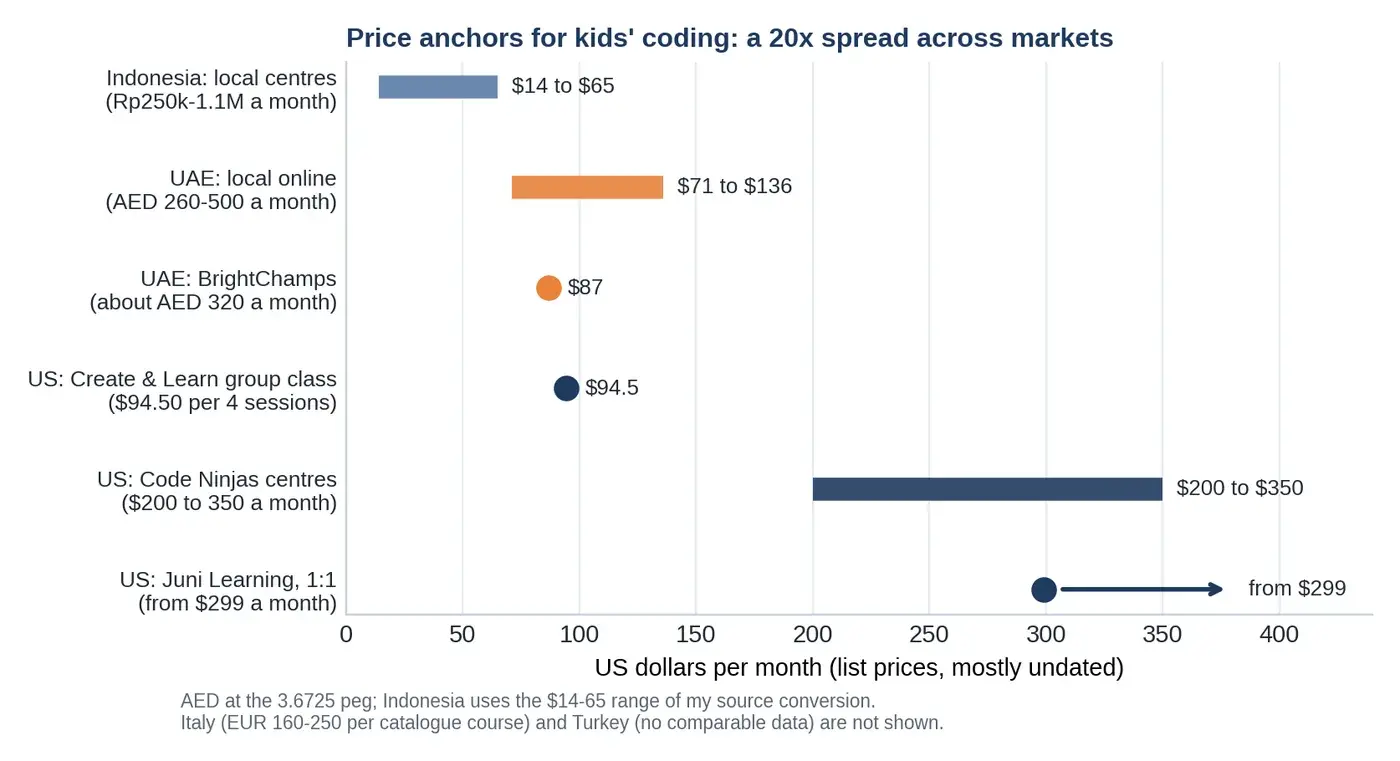
For each market below I give the facts that matter, the rules, my forecast for 6, 12 and 24 months, the non-paid plays I would start with, and what I would measure. Everything under “Forecast” is a [Hypothesis].
3.1 Italy: trust is the currency, and the audience has stopped growing
| Indicator | Value |
|---|---|
| Population, internet | 59.1 million (October 2025), 72.7% urban. Internet users −182,000 (−0.3%) in a year |
| Ad audiences, change in a year | Instagram +1.20M (+4.2%), about 29.8M [Estimate]; TikTok +1.41M (+6.9%), about 21.8M [Estimate]; Snapchat +490,000 (+10.6%); YouTube −1.00M (−2.4%); Facebook −750,000 (−2.6%); X −2.15M (−29.9%) |
| Basic digital skills, ages 16 to 74 | 54.3% (Istat 2025), up 8.4 points; EU average 60.4%; 45.8% in 2023 |
| How parents hear about activities (vendor survey) | Friends and family 59%, school 48%, websites 44% (Novakid, sample not disclosed, language courses) |
| Budget pressure | 11% of families with children cut or dropped extracurriculars (Eumetra); price of classes up 10 to 18% by 2023 (Moneyfarm model) |
| EdTech market | About EUR 2.7 to 2.8 billion (Politecnico di Milano 2023; Il Sole 24 Ore 2026: EUR 2.7 billion, 11,000 employed) |
| Price anchors | EUR 160 for a catalogue course “Coding per bambini”, EUR 250 for “pensiero logico” (Emagister); local brand Coderkids; Code.org and Scratch free |
What I see. Italy is a mature market with a flat audience. Internet users and social identities fell in the year to October 2025, YouTube and Facebook lost reach, and only Instagram, TikTok and Snapchat grew. Reach-driven paid growth is over: you buy a stable audience in an auction that gets more crowded. The parent decides on recommendation, and the vendor survey above is a proxy at best (it is about language courses). Budgets are stretched, and a Teleborsa headline of 19 October 2026 says families are cutting children’s activities because of the cost of living [Fact]. With 54.3 percent of adults holding basic digital skills against an EU average of 60.4, “digital skills” is a socially approved story, but “programming for everyone” is not yet a mass need [Hypothesis].
AI effect. The state has moved faster than the market: Law 132/2025, in force since 10 October 2025, requires parental consent for under-14s to access AI, and the ministry has published school guidelines, a two-year pilot with virtual assistants and a EUR 100 million teacher-training fund. For a private provider the consequence is that AI in the child’s hands has to be explained to the parent before it is sold to the child.
Rules. The digital consent age is 14 (GDPR and the Italian Privacy Code). AGCOM’s influencer code (197/25/CONS) and guidelines 7/24/CONS, with FAQs of 16 March 2026, carry fines for breaches of minors’ protection of up to EUR 600,000 [Fact]. I did not save the primary links, so read the texts at agcom.it before signing a creator contract.
Forecast. 6 months: paid costs rise on shrinking bases (YouTube, Facebook) while Instagram and TikTok keep growing at 4 to 7 percent; AI literacy stays high on the public agenda, but family budgets cap what parents pay. 12 months: AGCOM rules harden, micro-creators get more expensive, and referral and school channels become cheaper than paid. 24 months: the winners have a local face and a report to the parent; the risk is that free tools and AI assistants take the first meeting.
Non-paid play. Referral after the fourth lesson (two-sided reward, not a one-sided bonus); ten to fifteen micro-creators among mothers and teachers on a hybrid contract (fixed fee plus a bonus per attended trial) with an AGCOM checklist; a response-time standard for the first reply, in minutes, on WhatsApp or phone; Italian SEO pages (“coding per bambini online”, online versus centre); and a free class-level masterclass through schools and parent committees.
What I would measure. Referral share of paid customers; cost per attended trial by source; first-reply time against attendance; the share of AI-assistant referrals in the “how did you hear about us” field.
3.2 Spain: strong offline players and a rulebook still being written
| Indicator | Value |
|---|---|
| Internet, population | 96.4% penetration, about 47 million (DataReportal, Digital 2026). Platform reach not extracted; take it from the same report before any media plan |
| Family spending on private tutoring | EUR 2.782 billion in 2023/24 (EsadeEcPol from INE; link not saved, re-check). All subjects, not coding |
| Digital consent age | 14 (LOPDGDD art. 7). A bill raising it to 16 and requiring parental authorisation for social accounts under 16 was admitted by Congress in September 2025; still in committee in September 2026; one October 2026 law-firm note flags a risk of expiry |
| Influencers | Real Decreto 444/2024: labelling and minors’ protection for “users of special relevance”, fines up to EUR 1.5 million (DLA Piper); self-regulatory code (Autocontrol, IAB Spain, AEA) since 1 October 2025 |
| Offline competitor | Algorithmics: 40+ centres, school-year programmes and summer camps |
| Teachers and AI | Eight in ten teachers use generative AI (Empantallados and Gad3); Spanish pupils use AI for school tasks more than the OECD and EU average (PISA 2025) |
| Language | Catalan, Basque, Galician and Valencian: regional landing pages are a test, not a given |
What I see. Spain has the same trust-first parent as Italy and a competitor Italy lacks: a dense offline network with a physical address next to the school. I found no parent survey on coding or online learning, and I will not infer one from memory. The legal picture is the most unsettled of the six. A proposed digital-minors law would lift the age of data consent from 14 to 16, but its status is unclear, and an EU-level proposal (the EU KIDS Act) points to 15 for a child’s own account. Whatever the outcome, targeting teenagers 14 to 17 on paid social gets harder while the buyer stays the parent [Hypothesis].
AI effect. AI is already everywhere in the classroom, and the debate is about control: regions set up training centres (Valencia) and plans for oral defence of student work (Catalonia). A private course that sells “help with homework” competes with a free chatbot; one that sells a project and a teacher who knows the child does not.
Forecast. 6 months: the age-16 debate and age checks grow louder; platforms adjust targeting; SEO and parent content gain weight. 12 months: either the bill passes or the EU framework sets the rules, and paid targeting of 14 to 17 narrows. 24 months: the winners own a parent base (email, WhatsApp, referral) and school partnerships; the risk is that offline networks add an online product.
Non-paid play. An SEO cluster in Spanish with regional pages and an honest “online versus the centre near you” comparison; a referral programme and a first-party parent list; pilots with parent associations (AMPA) and schools in two or three regions; mother and teacher creators under Real Decreto 444/2024 (contract, label, no child’s face without written consent).
What I would measure. Organic leads by region; attended-trial rate by language of the page; share of leads from AMPA pilots; cost per attended trial for creators against the paid baseline.
3.3 Indonesia: WhatsApp, mobile payments and the cheapest anchors
| Indicator | Value |
|---|---|
| Internet | 229 million users, 80.66% penetration (APJII 2025, 8,700 respondents aged 13+); 83.39% go online by smartphone |
| Platform use, internet users 16+ (Q2 2025) | WhatsApp 90.8%, Instagram 82.4%, Facebook 81.0%, YouTube 80.3%, TikTok 78.4%, Telegram 58.4% (We Are Social) |
| Payments | QRIS: 56.3 million users and 2.6 billion transactions in Q1 2025 (secondary source). E-wallets and bank transfers lead; cards trail |
| Local price anchors | Koding Akademi Rp250,000 to 700,000; Coding Bee Academy Rp350,000 to 1,100,000 a month plus Rp200,000 registration; Rumah Coding Rp250,000 to 350,000; KodeKiddo Rp800,000 per programme. About $14 to 65 [Estimate] |
| Parenting creators | About 4,900 TikTok accounts in “parenting and family” (InfluData, June 2026); vendor rates: nano under $200 per TikTok video, micro $300 to 1,500 |
| Scam risk | Fraud is the main online threat for 24.89% of users (APJII 2025) |
| Meta, Asia-Pacific | Impressions +14%, price per ad +1% in Q3 2026 (secondary source) |
What I see. This is the one market of the six where paid media is still a volume game: reach is large and, on the one regional data point I have, impressions are growing much faster than prices. The constraint is elsewhere. Price anchors sit at Rp250,000 to 1.1 million a month, payment is by QRIS, e-wallet or bank transfer, the selling conversation is in WhatsApp, and trust in a foreign brand is low in a country where fraud is the number one online fear. A landing page in English with a card form is a leak at three steps at once [Hypothesis].
AI effect. The ministry has made coding and AI an elective from grade 5 to senior secondary, for school year 2026/27 and only in schools that are ready; the minister has cited roughly a quarter of schools teaching it, and critics warn that it will widen the digital divide. Demand for “preparation” will appear before the free option is widely available, and then the free option will cap how many families pay [Hypothesis].
Rules. Government Regulation 17/2025 (PP Tunas) defines a child as anyone under 18, requires parental consent and a data protection impact assessment, and lets under-13s use only low-risk platforms; sources give 1 or 28 March 2026 as the start and 27 March 2027 as the end of a grace period [Fact, secondary]. Read the text on the official legal portal before collecting leads on children.
Forecast. 6 months: consent flows go in, WhatsApp-led sales win, and TikTok creators get more expensive. 12 months: the school elective creates “school preparation” demand, but the free option limits the paying segment. 24 months: local providers at Rp250,000 to 700,000 take the mass segment; a premium niche remains for a live teacher with a report to the parent.
Non-paid play. A Bahasa, mobile-first landing page and a trial flow that runs inside WhatsApp (booking, reminders, the report, the referral link); payment by QRIS, e-wallet and bank transfer in rupiah; ten to fifteen micro-creators among mothers on TikTok and Instagram; teacher webinars built around the school elective; referral through parent groups.
What I would measure. Lead-to-attended rate inside WhatsApp against the web form; time to first reply; share of payments by QRIS; cost per attended trial for creators against paid.
3.4 The Gulf: expensive decisions, instalments and a state that teaches AI
| Indicator | UAE | Saudi Arabia |
|---|---|---|
| Internet users (Digital 2026) | 11.3 million, 99.0% | 34.4 million, 99.0% |
| Snapchat ad audience | 5.13 million | 25.3 million, about 72.9% of the population |
| TikTok ad reach as share of adults 18+ | 134.6% | 154.3% |
| Reach added in a year | TikTok +1.79M, Instagram +1.15M | TikTok +5.81M, Facebook +2.60M, Instagram +2.20M, Snapchat +1.01M |
| School AI | Official subject, K-12 public schools, from 2025/26 | National AI curriculum from 2025/26, over 6 million students (press) |
| Child data and creator rules | Federal Decree-Law 26/2025 on Child Digital Safety, in force 1 Jan 2026 (full regime from Jan 2027 in one source); PDPL 45/2021; advertiser permit for influencers | PDPL: guardian consent; Mawthooq licence for paid creators, about SAR 15,000 for three years (one source) |
| Price anchors | BrightChamps about AED 320 a month (AED 2,399 per course); Cordoba Institute AED 500 a month; Skillza from AED 260 (old); Dubai Coding Club AED 195 an hour | BrightChamps SAR 236.77 a month (generative AI course); CodaKid packages SAR 331 to 668 for 12 months |
| Payments | Tabby and Tamara (BNPL, four interest-free instalments) | BNPL over 20% of online retail value in 2024 (Redseer); Tabby and Tamara about 95% of BNPL (aggressive estimate) |
What I see. The Gulf is two markets that look alike from far away. The UAE is an expatriate-heavy, bilingual, high-price market with a mandatory AI school subject. Saudi Arabia is a larger, younger, Snapchat-first market where creators need a licence and BNPL is part of how people shop. Reach figures above 100 percent of adults are duplicates and expatriate denominators, so I use them only as a relative signal. A parent in Dubai pays up to AED 12,000 a term for out-of-school activities in some cases (Edarabia, undated) and summer camps often run past AED 10,000 (Khaleej Times); a UAE survey of 614 parents found that 96 percent believe computer science develops creativity and problem solving (e&) [Fact, secondary]. The money exists. The question is what the school already gives away.
AI effect. This is the strongest free baseline of the six. When every public-school pupil in the UAE studies AI from kindergarten, an entry-level AI course is a commodity; a project course, a specialisation and a teacher who knows the child are not. The same state is also the largest buyer: G42 and AI71 are building the school products, and the plan includes smart textbooks in all schools by 2028. Outsiders should expect to be partners or niche providers, not the default [Hypothesis].
Forecast. 6 months: the Child Digital Safety Law starts to bite for platforms; age verification grows; BNPL fees and Snapchat and TikTok costs rise. 12 months: school AI becomes ordinary and demand shifts from “intro to AI” to projects and specialisation; the licensing regime for creators tightens. 24 months: brands with local faces and Arabic-language support win; the risk is state programmes and big EdTech partnerships crowding out outsiders.
Non-paid play. BNPL in checkout (Tabby, Tamara) tested against cards for conversion from trial to payment; licensed micro-creators in Saudi Arabia and permitted ones in the UAE on a hybrid contract; WhatsApp follow-up; referral inside expatriate communities and school chats; the price visible before the trial; an Arabic-language landing page and support pilot in Saudi Arabia against English only; a parent masterclass called “homework in the age of AI”.
What I would measure. Trial-to-payment conversion with and without BNPL, net of the merchant fee (I found no public fee data, so it goes into marginal CAC as its own line); cost per attended trial by licensed creator; Arabic versus English page attendance.
3.5 Turkey: the law moves to the parent, the lira moves to instalments
| Indicator | Value |
|---|---|
| Internet | 88.3% penetration. Social identities 70.9% of population, +4.8M (+8.3%) in a year (DataReportal, Digital 2026) |
| Ad audiences | Instagram 62.3M (+5.80M, +10.3%), 92.1% of adults 18+; TikTok 44.9M adults (+5.80M, +14.8%); YouTube 57.9M (+0.4M); Facebook 34.7M (+1.0%). WhatsApp about 90% of internet users (weak secondary source) |
| Household budget | Education is 1.8% of household consumption against 29.3% for housing and rent (TÜİK 2025) |
| Payments | Instalments (taksit) were 57.8% of online card transactions in 2025, 55.5% in 2024 (secondary; re-check the primary payment statistics) |
| School AI | IT and software course, grades 5 and 6, AI themes; elective “Artificial Intelligence Applications”, grades 7 and 8; programmes updated 2025 and 2026 |
| Law 7578 | Adopted 22 April 2026, published 1 May 2026; social platforms may not serve children under 15, with age checks and parental controls; main provisions from 1 November 2026 |
| Advertising rule | Regulation amended 1 July 2026 (Official Gazette 33297), in force 1 August 2026; Art. 23/A: influencers must label “Reklam” or “Tanıtım” and name the advertiser; fines TL 1,083,706 to 10,837,065 (one source). A ban on targeting children by profiling is reported by one outlet and is not confirmed |
| Competitors found | Logiscool Türkiye (franchise, ages 6 to 18); Boğaziçi Enstitüsü children’s course, TL 750 digital or TL 999 printed certificate; Robotistan (STEAM retail); free: Robin Code (Code.org partner, over 1 million students claimed), Turkcell Whiz Kids |
What I see. The audience is growing fast (Instagram +10.3 percent, adult TikTok +14.8 percent), money is tight and priced in a volatile currency, and the payment habit is instalments. The gap in my research is the largest of the six: I could not find the names and prices of local online coding schools for children in Turkish, which tells me that either the segment is thin or it sells through channels that are invisible to a researcher abroad. Both readings argue for local interviews before spending [Hypothesis].
AI effect. School AI is present but optional: an IT course in grades 5 and 6 and an elective in grades 7 and 8. The more important effect comes from Law 7578. From 1 November 2026 platforms must stop serving children under 15, so advertising to the child on social media is not a strategy, it is a liability, and a parent-facing message becomes the default. For “what my child builds” content, the parent is both the audience and the legal addressee.
Forecast. 6 months: the law is applied from 1 November; platforms add age checks; parent channels (WhatsApp, YouTube, Instagram for adults) take a larger share; instalments become the expected default. 12 months: the winners have a Turkish website, prices in lira, instalments and local support; a school AI course in grades 5 to 8 sets baseline demand. 24 months: consolidation of local franchises is possible, and rules on influence and children’s data get tighter.
Non-paid play. A WhatsApp-led funnel with a payment link in instalments; mother micro-creators on Instagram with proper “Reklam” or “Tanıtım” labels and a bonus per attended trial; YouTube and SEO in Turkish (“the school AI course at home”, Roblox and Python projects for grades 5 to 8); referral after the fourth lesson; teacher masterclasses in private schools. Before any of it, five to ten interviews with parents and local centres to find out what the market looks like.
What I would measure. Conversion to payment with 3, 6 and 9 instalment options; response time in WhatsApp; creator cost per attended trial in lira; share of leads from parents of children aged 10 to 14.
3.6 United States: the most mature market, and the one where honesty is a channel
| Indicator | Value |
|---|---|
| Internet and platforms | Internet 93.1%. YouTube 254M; Facebook 198M (+4.9M); Instagram 182M (+16.0M); TikTok 153M adults (+15.2M) |
| Price anchors | CodeWizardsHQ $499 to 799 per course; Juni Learning from $299 a month (1:1); Code Ninjas about $200 to 350 a month; Create & Learn $94.50 for 4 group sessions (about $23.6 a session [Estimate]) or $240 for 1:1; Codeyoung from $22 a lesson; Outschool typically $10 to 50 a lesson |
| Market size | One vendor puts US kids’ coding at about $1.9 billion against $5.4 to 6.5 billion globally; definitions differ |
| What parents spend | $532 per child (Deloitte 2025, fees and gear); about $731 (LendingTree); $6,588 for the highest-income against $734 for the lowest-income families (Afterschool Alliance 2025, 30,515 parents) |
| Homeschool | 3.4% of K-12 pupils in 2022/23 (2.8% in 2018/19), 5.2% including fully virtual (NCES); 3.408 million in 2024/25 (NHERI estimate) |
| AI in schools | Executive Order 14277 (23 April 2025). Code.org: about 60% of public high schools offer foundational computer science; 6.1% of eligible students enrolled. One tracker counts 37 states plus Puerto Rico with school-AI guidance (single source, not verified) |
| Rules | Amended COPPA rule, compliance date 22 April 2026; FTC rule on reviews and endorsements (16 CFR Part 465, since 21 October 2024); TCPA for SMS; a patchwork of state privacy laws |
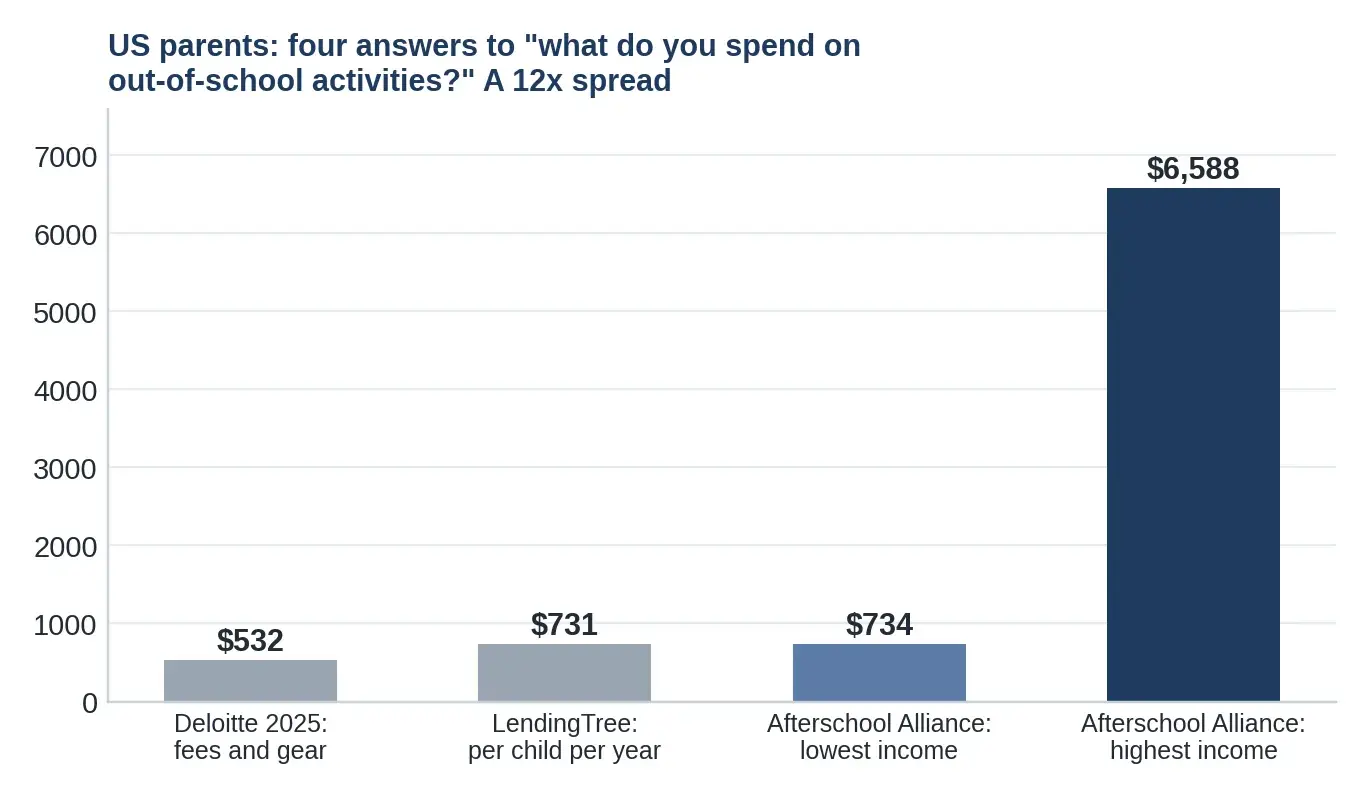
What I see. Figure 8 is my favourite chart in this text, because it is a lesson in market sizing. The same question gets a 12-fold range of answers depending on whether you ask about fees and gear, all out-of-school spend, or family income. Anyone who multiplies one of these numbers by the number of children and calls it a market is selling something. The US is the market with the highest price anchors, the highest price per ad (+23 percent in the US and Canada on a secondary source), the most providers and, I suspect, the most sceptical parents [Hypothesis]. The trust problem I expect here is price opacity: a “free trial” that is really a sales call, and a price that appears only after the call [Hypothesis]. Publishing the price before the trial is the cheapest trust signal I know.
AI effect. Children use AI at home before schools decide what to do about it (86 percent have tried it, 13 percent of parents plan to pay for AI classes), the executive order gives AI literacy a political tailwind, and homeschooling families, who curate their own curriculum, are the most open to buying outside the school. I expect the “AI plus coding” message to sell, but only attached to a visible project.
Forecast. 6 months: COPPA is fully in force, parental consent flows tighten, SMS and targeting of minors face pressure, and paid channels keep getting dearer. 12 months: interest in AI literacy rises as policy turns into school programmes; homeschool and hybrid learning grow. 24 months: online providers consolidate, acquisition cost per paying family rises, and those with transparent pricing, referral and strong reviews win.
Non-paid play. Referral after the fourth lesson, designed around FTC rules on incentivised reviews; partnerships with homeschool co-ops and parent groups (co-hosted masterclasses); micro-creators among mothers, teachers and homeschool bloggers with FTC disclosures; an SEO cluster by age, game (Roblox, Minecraft, Python) and format, with comparison pages; a trial with the price shown before sign-up; SMS and email lifecycle with explicit consent.
What I would measure. Share of trials from price-visible pages against hidden-price pages; payment rate after the trial; referral share; cost per attended trial for homeschool partners against paid.
3.7 The scorecard, and what I assume about costs
Figure 9 puts the six markets side by side on five dimensions. It is a set of hypotheses I derived from the facts above, not measured data, and I show it because a map you can argue with is better than six paragraphs you can only nod at.
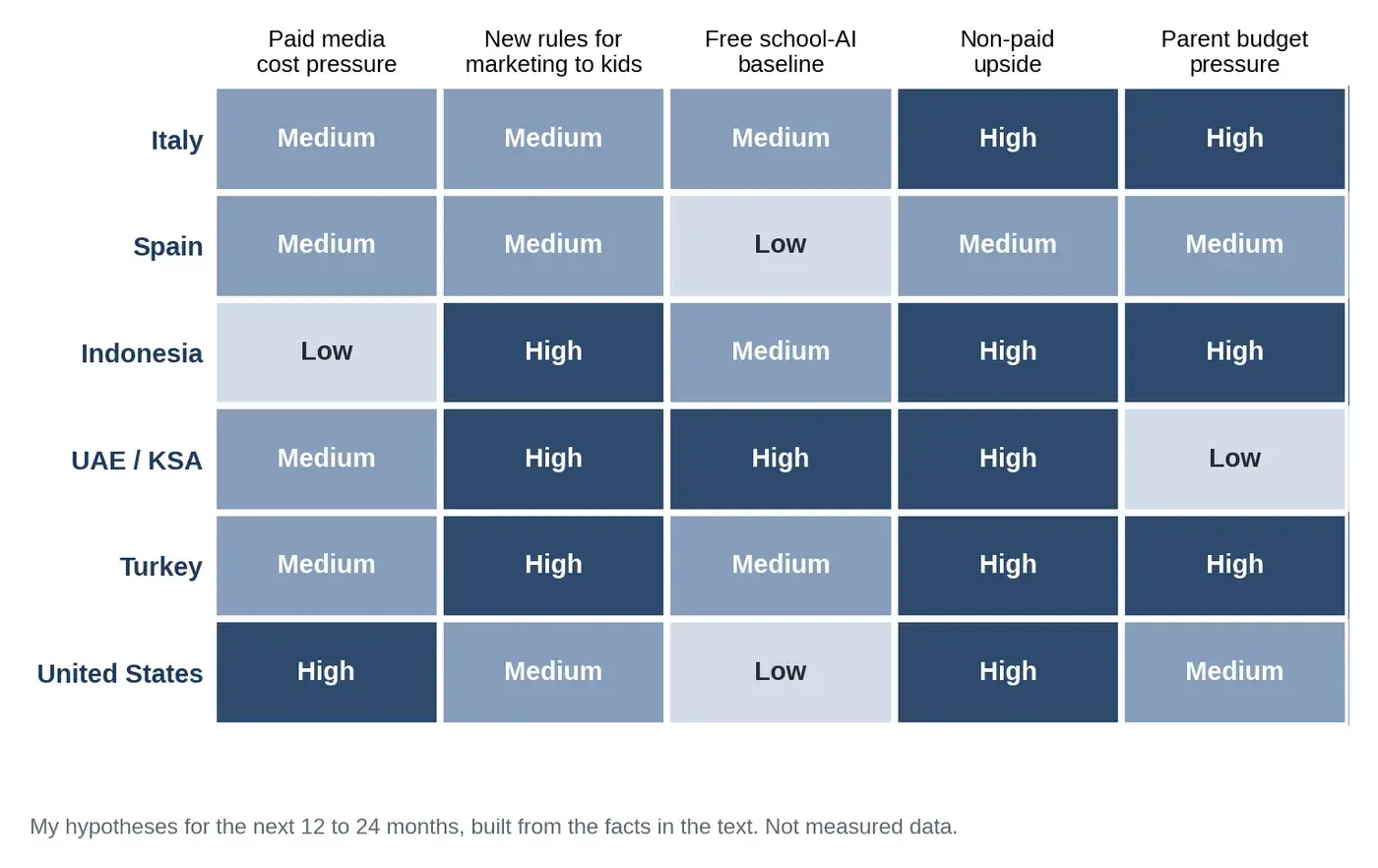
Numbers help more than colours, so here are the planning assumptions I would put into a model on day one, to be replaced by cohort data within the first 90 days. They are guesses with a stated basis, and they move with the next earnings call.
| Market | Paid CAC drift per year [Hypothesis] | Basis |
|---|---|---|
| United States | +15 to 25% | Price per ad +23% in the US and Canada (secondary); highest CPM tier in one tracker; mature auction |
| Italy and Spain | +8 to 12% | Flat or shrinking audiences, YouTube and Facebook losing reach; Instagram and TikTok still growing |
| Gulf | +10 to 15% | Premium creator rates (20 to 40% above a US baseline in a single vendor source); BNPL fees; licensing costs |
| Indonesia | 0 to +8% | Impressions +14% against price +1% in Asia-Pacific (secondary); creator rates rising from a low base |
| Turkey | No defensible number | Costs in lira and instalment financing matter more than CPM; I found no benchmark |
4. The non-paid stack, and how I would keep it honest
Everything above points one way. Paid media gets dearer in the US and the Gulf and stays cheap but fragile in Indonesia, organic search loses clicks to AI answers, children’s data gets fenced in, and parents are the only legal and commercial addressee. That does not make non-paid channels a bargain. It makes them the place where a team with good economics can still win, and the place where a team without economics loses money quietly, because nobody counts it as spend.
4.1 One P&L, three definitions
The first job is not a channel. It is three words that mean the same thing in every market: lead (a parent who left a contact), attended trial (a child who actually came to the first lesson) and paid (a family that paid after it). Most of the losses I have seen in education marketing are hidden between those words, not inside any ad account.
On top of them I would run one acquisition P&L. Blended CAC is all acquisition spend (media, creator fees, commissions, tools, the share of the team) divided by new paying families. Marginal CAC is the extra spend divided by the extra paying families when a channel grows. Cost per attended trial is channel spend divided by attended trials. Payback is CAC divided by monthly gross margin per customer. LTV comes from the real cohort (months retained times margin), not from a forecast. The contribution of a non-paid channel is measured by lift (a holdout or a geo-split), not by last click. That last rule matters more than it sounds: Facebook’s own field experiments found that observational measurement of ad effect can be off by a factor of three.
This is the argument of my piece on marketing and sales sharing one result: revenue is not profit, leads are not customers, activity is not output. It also carries the numbers that decide a trial funnel. In the Harvard Business Review study of online lead response a lead contacted within an hour was about seven times more likely to qualify; SiriusDecisions found that aligned marketing and sales grow revenue up to 19 percent faster and with 15 percent higher profitability [Fact, as cited in that piece]. In a LinkedIn post drawn from my work with 236 companies I listed seven correlations between traffic, site, product, leads and sales; two apply directly to a trial funnel: the more time sales spend on bad leads, the worse they handle the good ones, and the more leads there are, the lower the lead-to-sale conversion, so sales should be warned about peaks and peaks should not be stacked.
4.2 The channels, one at a time
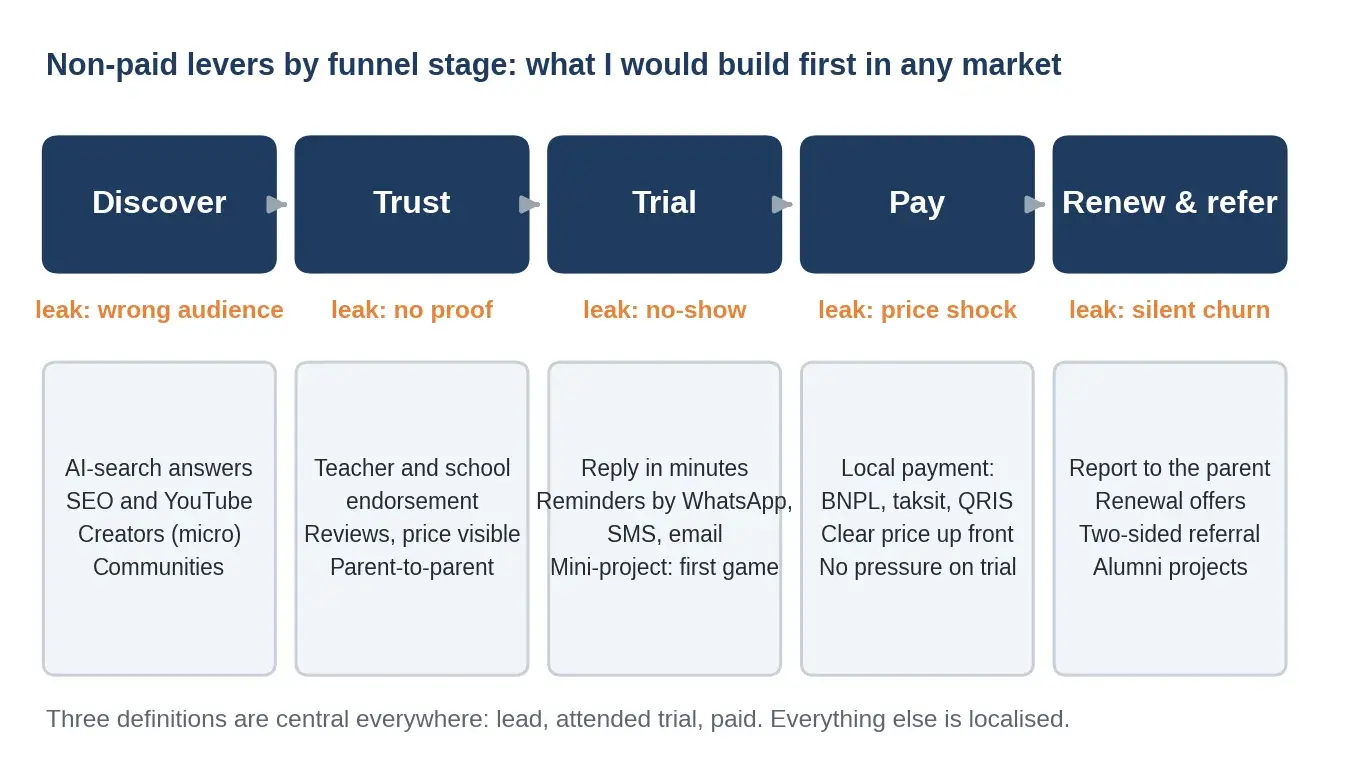
Reply speed and trial mechanics. This is the cheapest lever in the stack and the most transferable asset between markets, because a reminder works in Italian, Bahasa and Arabic alike. At Timepad I ran four lifecycle playbooks, lifetime value rose 15 percent in eight months, and the largest campaign reached more than 180,000 users. The levers were lifecycle mechanics, not media spend. In children’s education the same logic means a first reply in minutes, three reminders in the messenger the family actually uses, a short report to the parent after the first lesson, and a conversation about payment only after the child has built something.
Referral. In Italy 59 percent of parents in one vendor survey hear about activities from friends and family. A two-sided reward after the fourth lesson, when the child has a project to show and the parent has a report, is the version I would test first. In the US the FTC rule on reviews and endorsements (16 CFR Part 465, in force since October 2024) forbids buying reviews, so the reward must be for the introduction, never for a rating.
Creators. The market is moving here fast (see Section 1), so the contract matters more than the name. I would pay a small fixed fee and a bonus per attended trial, not for reach, and I would pick mothers, teachers and educators with 10,000 to 100,000 followers whose audience is the parent. I come to this from the CPA side: at Ed.Partners the unit of sale was a result, not an impression, and I would keep that unit. Each market adds its own paperwork: AGCOM in Italy, Real Decreto 444/2024 in Spain, the Mawthooq licence in Saudi Arabia, the “Reklam” label in Turkey, FTC disclosure in the US, and no child’s face without written parental consent anywhere.
Content, search and video. Search in the age of AI answers rewards pages that a model can quote. In my guide to 16 non-obvious content marketing tactics I wrote that search was 40 to 45 percent of Netology’s traffic, and that at Timepad the same material got about 1,500 views as a blog post, roughly ten times more as an email and about thirty times more once the headline was right. The lesson holds under AI search: the packaging of a fact decides whether anyone sees it. For video, my YouTube, Rutube and VK business guide collects the platform numbers (YouTube has more than 2.5 billion active users; 77 percent of consumers say they prefer to buy from brands they follow); for children’s education the practical version is a long, honest review of a real lesson that a parent can watch at midnight.
Creative as a hypothesis. AI tools inside the platforms (Meta Advantage+, TikTok Symphony, Google’s asset generation) now produce variants in bulk, so the number of creatives is no longer scarce. Meaning is. As I put it in the guide on ad creative as a hypothesis: beauty is not conversion, CTR is not sales, and a creative is a filter. The platforms distribute traffic, they do not invent meaning. In practice I would test claims (“your child builds a game in four lessons” against “safe screen time” against “prepare for the school AI course”) rather than colours, and judge them by attended trials, not clicks.
Schools, partners and other people’s audiences. Teachers and parent committees are the cheapest trust you can borrow in Italy, Spain and Turkey; teacher webinars around the elective do the same in Indonesia; homeschool co-ops in the US. In the Gulf the “other people’s base” can be a payment provider or a school chat. The partners and loyalty-programme block in my list of 30 non-paid mechanisms is the one I would read twice before starting in a new country.
Messenger and payment as part of the offer. WhatsApp is the operating system of the sale in Indonesia (90.8 percent of internet users), Turkey (about 90 percent, a weak source) and the Gulf, and the payment method is part of the price: QRIS in Indonesia, instalments in Turkey (57.8 percent of online card transactions), Tabby and Tamara in the Gulf. A product that cannot be paid for the local way has a conversion problem that no creative can repair.
4.3 What I have run, and what it taught me
At SkillFactory I moved the team’s main number from cost per lead to profit per lead and built a model of what a lead turns into: 54 factors. The model prioritised four of 47 channels. Over the period leads grew 1.8 times, revenue 2.2 times and profit per lead 2.4 times, and advertising fell from 42 to 28 percent of revenue. I use the same lens on the six markets in this text.
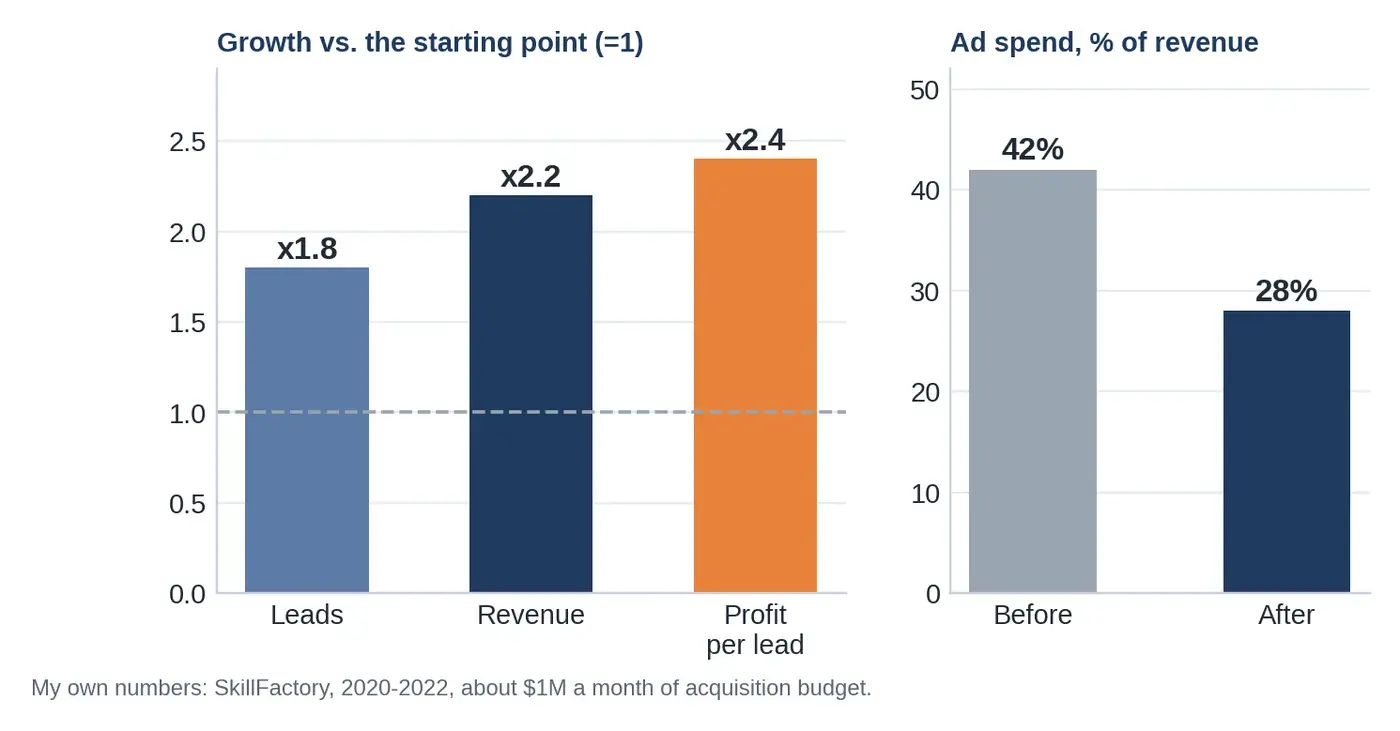
I would not call that proof that it transfers. It is proof that the method works on a large budget when it is applied to the right unit (a profitable customer, not a lead), and the six markets are the test of whether it survives a change of language, regulation and payment habit. It will not survive on my authority. It will survive if local leads can see their own numbers and argue with the model.
5. Central economics, local distribution: an operating model for many markets
The temptation in a multi-country role is to do one of two things: copy the home playbook everywhere, or let each country do what it wants and report vanity metrics. Both fail, for opposite reasons. The first ignores that trust, language, rules and payments are local. The second makes it impossible to tell which country is making money. My answer is to centralise economics and localise distribution.
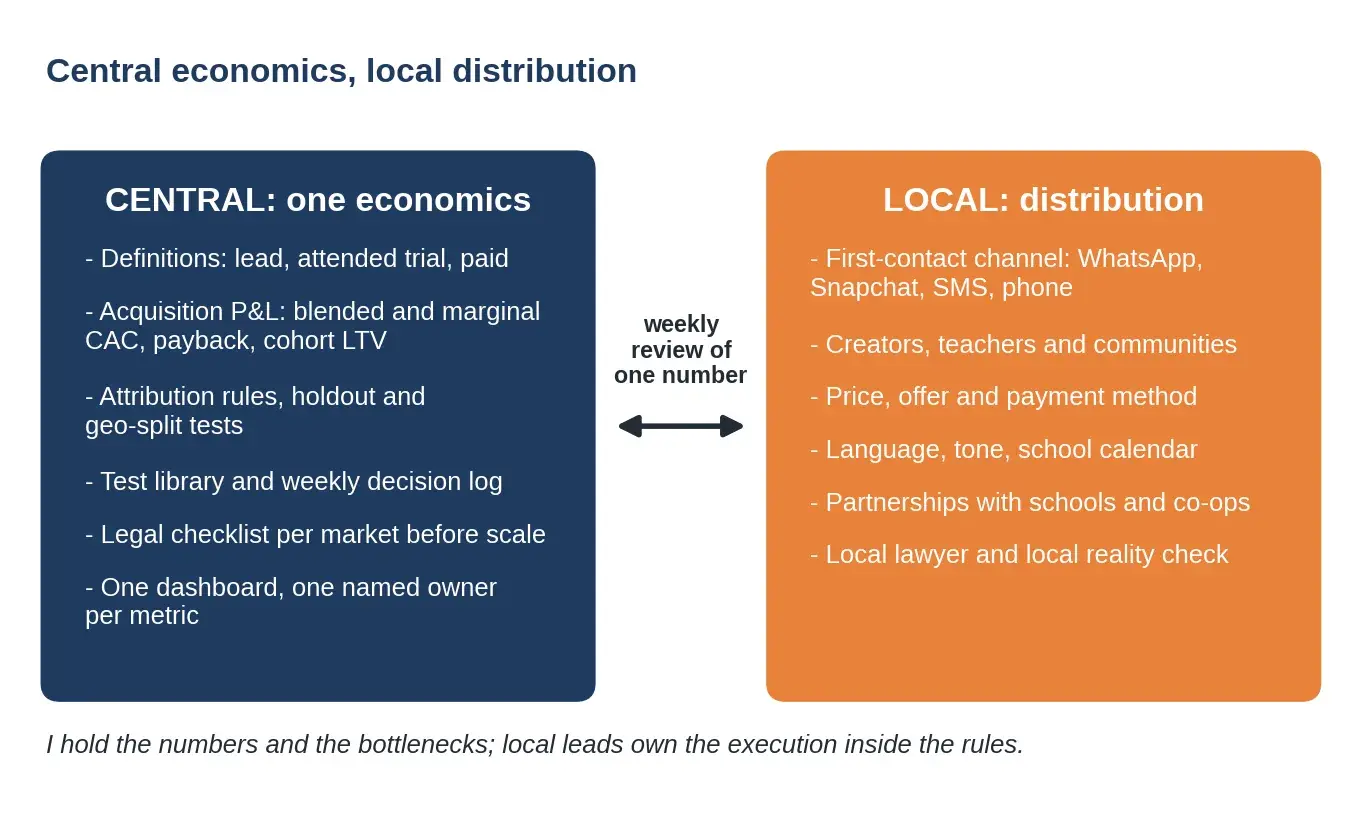
Central means the three definitions, the acquisition P&L, attribution rules, a test library, a legal checklist per market and one dashboard with one named owner per metric. Local means the first-contact channel (WhatsApp, Snapchat, SMS, phone), the creators and communities, price and payment method, language and tone, and the relationships with schools. The weekly review has one number per market, and I would hold that number myself, along with the bottlenecks. Execution I would delegate: local leads know their market better than I do, and the job of the centre is to give them a frame in which good decisions scale and weak ones stop quickly.
5.1 What a CMO is for in this setup
When I wrote what a CMO actually does, I collected nine functions from Deloitte’s five roles of the CMO, Heidrick & Struggles and Gartner, 16 international studies, 12 statistics and comments from five practising CMOs. Two things from that work apply here. First, the one metric on which CMOs agree: 95 percent name revenue as their growth indicator (Deloitte, 2018). Second, a base rate I like because it is humbling: hh.ru held about 1.4 million marketing CVs against roughly 1,000 known CMOs, so 99 percent of marketers will never be the ideal CMO. I do not plan to be the exception, which is why the answer is a system and not a person: a role that is defined by revenue, a model that local people can check, and rules that survive a bad month.
5.2 The team: seven rules for a function that spans six countries
The team part of my growth principles series (Part 2: Team, insights 18 to 33) is where I put what I know about building people around a number. Here is how it maps to six markets. A note on the evidence: the studies are the ones I cite in that series, and the design is mine.
| Rule | Evidence I rely on | In six markets |
|---|---|---|
| 1. Hire the local lead before the playbook | In a survey of 889 venture investors, 47% named the team as the single most important factor | The first hire in a market is the person who decides which of my assumptions are wrong |
| 2. One owner with a name for each number | Management by objectives and OKRs (Drucker and successors); “rules of the game instead of hands-on control” | The centre owns the definition of “attended trial”; each local lead owns the cost per attended trial in his or her market |
| 3. One weekly review around one number | Weekly syncs in my team series; the four sync rules in the marketing and sales piece | Forty-five minutes per market cluster, one number, one decision, written down |
| 4. Keep teams small | Katzenbach and Smith: effective teams are five to nine people | Cluster the six markets into five groups (Southern Europe, Gulf, Turkey, Indonesia, US) rather than six reports to one person [Hypothesis] |
| 5. Make it safe to say “the model is wrong” | Google’s Project Aristotle: 180 teams, over 250 characteristics tested, psychological safety on top | The local lead must be able to tell the centre that a rule does not work in Jakarta, and the retrospective logs it as a record, not a blame |
| 6. Tight on money and definitions, loose on execution | Andy Grove’s task-relevant maturity; BCG on freedom within a framework | Compliance, budget caps and definitions are non-negotiable; channel mix, creators, language and offers are the local lead’s |
| 7. Onboard for ninety days, promote on results | Michael Watkins: a structured first 90 days can cut time to productivity by up to 40% | Each new local lead gets a 90-day plan; promotion is tied to a named metric, not tenure |
A sketch of the size [Hypothesis]: a central core of five (a head of growth who owns the P&L, an analyst for the acquisition P&L and experiments, a lifecycle and CRM lead, a content and search lead, a creator and partnership lead) plus one local growth lead per cluster, and a lawyer per market on call before anything goes live. The agentic-systems piece I mentioned makes the same point from the software side: smaller teams, and judgment as the scarce input. Execution has become cheaper, so the central core should be built from people who can decide, not people who can produce.
And a word on AI inside the team. I use the rule from that LinkedIn post: you can delegate about 80 percent of the work to AI, but 20 percent must come from leadership. Reports, classification of leads, drafts of landing pages and first-pass creative are the 80. Budget shifts, pricing, strategy and anything involving a child’s data are the 20, and a human signs them.
5.3 The first 90 days in a market you do not know
If you have to start in a market you do not know, this is the order I would go in. It is deliberately short.
- Days 1 to 30. One set of definitions and one dashboard. A look at competitors in each market through Meta Ad Library, TikTok Creative Center, Snapchat Ads and Google Ads Transparency (I did not do this in my research, and it is the first gap to close). A baseline cost per attended trial per market from existing data. A legal checklist per market. Five to ten parent interviews and three to five calls with local centres per market, starting with Turkey, where my desk research found the least.
- Days 31 to 60. Three tests per market from the non-paid list: a first-reply standard with reminders, a two-sided referral after the fourth lesson, and a pilot of ten to fifteen micro-creators on a hybrid contract. Holdouts or geo-splits designed before launch, not after.
- Days 61 to 90. The first reallocation of budget based on marginal CAC and cost per attended trial, a written decision log, and a retrospective with every local lead on what the model got wrong.
6. What would change my mind: signposts for 2027
A forecast without a way to be wrong is an opinion. These are the signals I would watch, with the thresholds at which I would change the plan. Thresholds are [Hypothesis] and are a starting point for argument.
| Signal | What to watch | If this happens | I would change |
|---|---|---|---|
| Meta pricing | Price per ad against impressions in the next quarterly results, regional split if disclosed | Asia-Pacific price per ad above +10% for two quarters | Raise the Indonesia CAC assumption and cut reliance on cheap paid volume |
| AI search | Seer and Ahrefs series on CTR for queries with AI Overviews | CTR on AI Overview queries falls back below 1.3% | Shift SEO effort from ranking to being cited: reviews, prices, press, creators |
| Turkey | Enforcement of Law 7578 after 1 November 2026; secondary regulation; whether the ban on targeting children by profiling is confirmed | Targeting ban confirmed, or age checks reach parents’ accounts | Move budget out of paid social targeting into WhatsApp, YouTube and search |
| Gulf | Date and content of the full UAE regime; Cabinet data rules; Mawthooq enforcement against brands | Fines or licence checks reach advertisers, not only creators | Licence-first creator contracts; a legal gate before any campaign |
| Spain | Fate of the digital-minors bill (age 16) | The bill passes or the EU proposal sets 15 | Cut paid targeting of 14 to 17 and widen parent-facing content |
| Indonesia | End of the PP Tunas grace period (27 March 2027); real start of the school elective | The elective starts in more than a quarter of schools | Build a school-preparation offer and teacher partnerships |
| United States | FTC action under the amended COPPA rule; state age-verification laws | First visible enforcement against an education provider | Move from SMS and retargeting to email, referral and search |
| Italy | AGCOM enforcement on influencers; results of the school AI pilot | First fine on a children’s education brand | Shorten the creator list, lengthen the contract checklist |
| Saudi Arabia | Confirmed coverage of the national AI curriculum | Coverage above one third of schools in 2027 | Move from “intro to AI” to projects; test an Arabic-first page |
| Capital | HolonIQ second-half 2026 funding (January 2027) | Full-year funding below 2025’s $2.6 to 2.8 billion | Assume less VC-subsidised competition in paid auctions |
One question I cannot answer yet. If a free class at school teaches every child in Dubai, Istanbul and Jakarta what a neural network is, what exactly is a parent paying for in 2028? My answer today is a person who knows her child and a report she can read. I have not seen anyone prove that this scales to six languages and six sets of rules, and I would like to find out who does it first.
PS: in the CMO piece I wrote that 99 percent of marketers will never be the ideal CMO. It still sounds right. I would rather build a function that works without one.
Sources and gaps
Links are the pages I used; secondary coverage is marked as such in the text. Where a primary document was not saved, the line says so. Please re-check anything you plan to quote.
Marketing macro, platforms, search and creators
- Dentsu, Global Ad Spend Forecasts, May 2026 and the press release
- WARC Q3 2026 forecast, via Relevant Audience
- Meta, third quarter 2026 results; regional split from Relevant Audience (single secondary source)
- AI Overviews: Search Engine Journal on the field experiment; Seer Interactive 2026 update; PPC Land on Seer’s 61%
- Creators: IAB, creator marketing as a core media channel (Marketing Dive)
- CAC claims: vendor and agency blogs (single sources, no neutral index); CPM by country: Lebesgue and Superads trackers (conflicting)
Children, parents and AI
- Common Sense Media census 2026, via KMPH; Pew on teens and AI, via Fortune; Deloitte 2026 parents survey, via Digital Trends; NSCAF survey, July 2026
- HolonIQ, EdTech venture funding, first half 2026
Italy and Spain
- Italian Law 132/2025 (Squire Patton Boggs); MIM guidelines on AI in schools (Orizzonte Scuola); Il Sole 24 Ore on EdTech; Teleborsa, 19 October 2026; Istat via Italpress; Eurostat via Orizzonte Scuola
- DataReportal, Digital 2026: Italy and Spain
- Spanish Ministry of Justice, digital-minors bill; DLA Piper on Real Decreto 444/2024; Osborne Clarke on the EU KIDS Act; The Objective on teachers and AI; El Español on PISA 2025; Valencian regulatory compendium on AI in education
Indonesia, the Gulf and Turkey
- DataReportal, Digital 2026: Indonesia and Turkey; APJII 2025 via Detik; Digital in Asia, Indonesia 2026
- Indonesia school policy: CNA Indonesia, Antara
- Gulf school AI: Semafor on the UAE; Gulf News on Saudi Arabia. The UAE decree-law, PDPL and Mawthooq details come from law-firm and press summaries whose links I did not save
- Turkey: Daily Sabah on Law 7578; Mondaq; MEB, AI Applications course; MEB, IT and software course
United States
- Executive Order 14277; Code.org, State of AI and CS Education 2025; Deloitte Back-to-School 2025; LendingTree; Afterschool Alliance, America After 3PM 2025; Pew on homeschooling; FTC rule on reviews; Hunton on COPPA
My own materials cited in the text
- LinkedIn post on seven correlations from 236 companies; Web Digest Pro: From Information Management to AI-Powered Information Intelligence; Web Digest Pro: Agentic Systems and the Future of Software
- What does a CMO actually do; Marketing and sales: one shared result; Principles of growth, Part 2: Team; 30 zero-budget acquisition mechanisms; Ad creative is a hypothesis; 16 non-obvious content marketing tactics; YouTube, Rutube and VK: a business guide
What I did not find, so I did not claim
- The size of the children’s coding segment in Italy, Spain, Indonesia, Turkey, the UAE and Saudi Arabia; the only US figure is a single vendor estimate.
- Instagram, TikTok and YouTube reach for Spain and Indonesia from DataReportal; I did not extract them.
- Names, prices and volumes of local online coding schools for children in Turkish; named creators whose audience is parents of children who study coding, in any market. I give categories and selection filters instead of names.
- A usable CPM benchmark by country; a neutral CAC index; the fees BNPL and instalment providers charge merchants for education.
- Qatar, Kuwait, Bahrain, Oman, Egypt and Jordan. The Gulf section covers the UAE and Saudi Arabia only.
- Whether the Turkish rule banning the targeting of children by profiling exists as written (one outlet); the real start and grace dates of PP Tunas; the full UAE regime date (one source says January 2027).