User Acquisition

Reels and TikTok in 2026: A Guide to Virality and Revenue

How Instagram and TikTok decide what to show, how to shoot a Reel people don’t drop at second three, and how to turn views into leads and sales: with templates, scripts, a creator brief and 10 AI prompts.

By Ilya Sabirov, CMO in EdTech, ex-cofounder of the CPA marketing platform Ed.Partners. 13 November 2026

You can't order virality, but you can raise its odds and make sure even an ordinary video works for revenue. I put in one place how Instagram and TikTok decide who sees a video, how to shoot a Reel people don't drop at second three, and how to turn views into leads and sales for a brand and for an expert. Every section has something you can take and launch: a template, a script, a brief, a DM script or a prompt.

How to read the numbers

[M] — from materials I collected: working documents, screenshots, video breakdowns. These are mechanics, not proven data.

[P] — public data: source and date next to it, links at the end. Vendor data (Dash Social, Metricool, Emplifi) describes their samples, not the whole platform. Brand numbers in cases are claims by the brands themselves.

[H] — a hypothetical example or model: the numbers are invented for the calculation, they are not facts.

Scope of the guide: the consumer market of the US, the UK and the EU. There is no Russian data or cases here, on purpose.

Why I put this together

I have worked in marketing and growth since 2012. I ran marketing with a budget of 40 million rubles a month, co-founded the CPA platform Ed.Partners and built the agency Sabirov.Capital. For any new format I ask one question: is it a channel or noise? For Reels and TikTok the answer is: a channel, but only if you count it as a channel and not as a lottery.

With bloggers I have a personal score. In an interview about failures I said that at Ed.Partners the first direction to go into the red was influence marketing, buying ads from bloggers. “We saw the loss, but did not understand how bad it was.” That is why in this guide reach is never the last link: after a view there is always a step you can measure.

The whole logic fits in one line: hook → retention → send to a friend → profile → offer → money. Each section below fixes one link of that chain. Let's go in order.

Inside: 12 sections, 14 figures, 6 real cases and one calculated, a bank of 12 hooks, 3 scripts, a DM script for a keyword, a creator brief, 10 prompts, a tracker table, checklists and a 30-day plan. The guide came out long: it is full of templates, and cutting something finished means taking it away from you.

1. Why Reels and TikTok are the main virality channel

Where the attention is. Instagram passed 3 billion monthly active users, video watch time in it grew by more than 30% over the year, and the annual revenue run rate of Reels exceeded $50 billion [P · Meta, Q3-2025 earnings call, 29 Oct 2025]. In the US 51% of adults use Instagram and 37% use TikTok [P · Pew Research Center, 19 Oct 2026; survey of 5,511 adults, 30 Jan–18 Jun 2026].

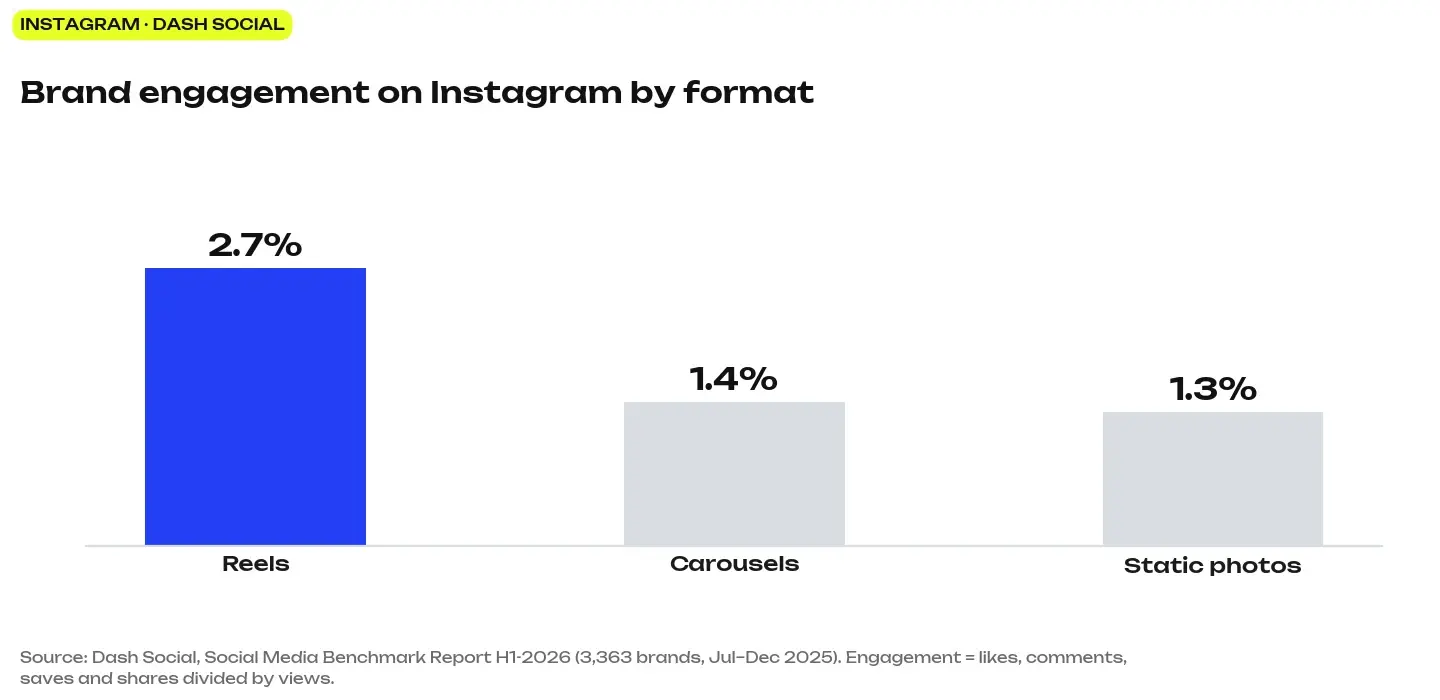
The format decides. For brands, Reels engagement is 2.7% of views against 1.4% for carousels and 1.3% for static photos [P · Dash Social H1-2026; 3,363 brands, Jul–Dec 2025]. On TikTok a video gets 5 times more reach and 6 times more interactions than photos and carousels [P · Metricool, 12 May 2026]. Short-form video was named the highest-return format by 49% of marketers, followed by long-form (29%) and live (25%) [P · HubSpot, State of Marketing 2026].
Engagement by format
Fig. 1. Engagement of brand Instagram content by format

Original content wins. In January 2026 Meta said that in the US the share of original content in Instagram recommendations grew by 10 percentage points in the fourth quarter, and 75% of recommendations now go to original posts [P · Meta, Q4-2025 earnings call, 28 Jan 2026; Motley Fool transcript]. My takeaway: when three quarters of impressions go to originals, reposting someone else's video with your logo stops being a strategy. Your face, your voice and your numbers are now a condition of distribution, not a style.

Money inside the feed. TikTok Shop sales in the US grew 120% year over year; 83% of shoppers, per the platform and GlobalData, found a new product there and 70% a new brand [P · TikTok Newsroom, 13 Jun 2025]. Over last year's Black Friday and Cyber Monday in-app sales exceeded $500 million, and LIVE Shopping sales in the US in the first half of 2026 more than doubled year over year, per the company [P · TikTok via Social Media Today, 15 Oct 2026]. These are platform metrics, not the conversion of an organic video. But the direction is visible: the purchase happens right in the feed.

Why algorithms like short video. This is my working version, not a platform quote: a short video gives fast feedback, within seconds you can see whether it was watched through, forwarded or skipped. The head of Instagram describes ranking as predicting a person's reaction: will they watch to the end, will they send it to a friend [P · Mosseri, Social Media Today, 24 Sep 2026]. And Meta plans to label topics and keywords inside videos more precisely with LLMs [P · Meta, 29 Oct 2025]. A vague video is read by the machine worse and worse, a specific one better and better.

But virality is rare. In the NP Digital database (4.5 million posts, 6,000 profiles on YouTube, Instagram and TikTok) 92.1% of posts stayed at the account's usual level, 7.9% got twice the norm or more, 0.2% ten times or more [P · NP Digital, Dec 2024]. Plan not for a “hit” but for a series of attempts where each one pays off as trust-building content.

Reach gets more expensive in attention. On TikTok brands' engagement is 3.4% against the previous 3.9% with views up only 3% [P · Dash Social H1-2026]. In the Metricool sample (the service's clients) the number of published videos grew 72.1% over the year while views fell 31.3% (Jan–Feb 2025 vs Jan–Feb 2026) [P · Metricool, 12 May 2026]. More videos does not mean more reach.
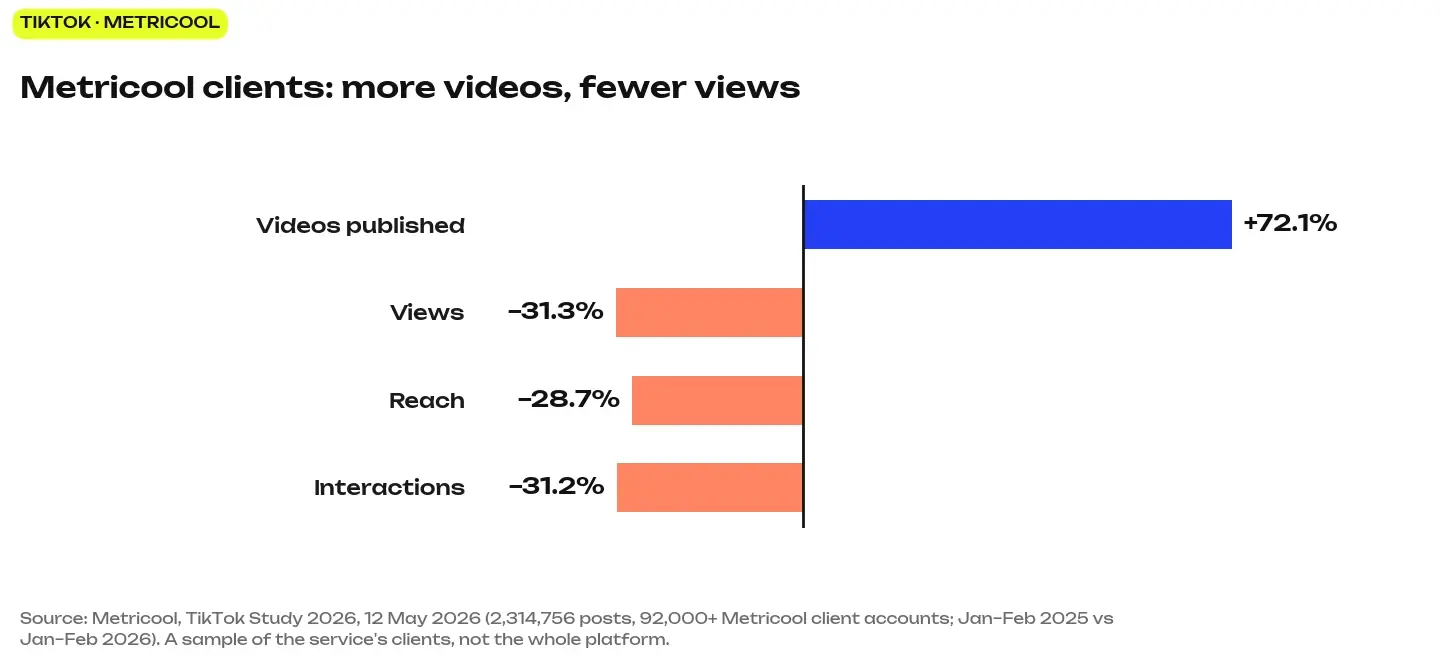
Metricool paradox
Fig. 2. Metricool clients: more videos, fewer views

Insight

Other people's averages are not a benchmark. Dash Social, Metricool and NP Digital describe their own samples, and an account with your niche and your audience may match none of those averages. The only base worth trusting is your last 10–20 videos.

Do this · Monday morning

  1. Pick one main platform for 8 weeks. Run the second one by exporting the same videos without watermarks.
  2. Write down three numbers for your last 10 videos: median views, best video, share of videos above 2× the median. This is your baseline: you beat it, not other people's records.
  3. Start the tracker table (template in section 8) and enter those 10 rows.

2. How the algorithm works: Instagram and TikTok

Instagram

The three main ranking signals according to the head of Instagram: watch time, likes and sends. Look at average watch time, likes per reach and sends per reach; for content from followed accounts likes matter slightly more, for recommendations to strangers sends do [P · Mosseri, Social Media Today, 22 Jan 2025]. Watch time is counted both in percent and in seconds so that long videos are not penalized [P · Mosseri, Social Media Today, 25 Feb 2025].

In September 2026 Mosseri named four ranking principles: originality, freshness, “breaking content” (public content from small creators is shown to non-followers to test the reaction) and model size. He also noted that the system looks at engagement, not raw views and likes, and that Trial Reels are good for experiments [P · Social Media Today, 24 Sep 2026]. Accounts where most content is reposts without added work are not recommended to strangers; from 30 Apr 2026 the rule was extended from Reels to photos and carousels [P · Tubefilter, 30 Apr 2026].

In Insights there are two metrics I would rank above likes. Retention is the retention curve: the flatter the line, the more engaged the audience. Skip rate is the share of views where the video was swiped away in the first 3 seconds [P · Instagram via Social Media Today, 24 Aug 2025]. The platform itself says in Best practices → Reach: every eligible post is shown to an audience the system estimates will like it, whether they follow you or not; as engagement grows, reach expands [M · screenshot from my materials].
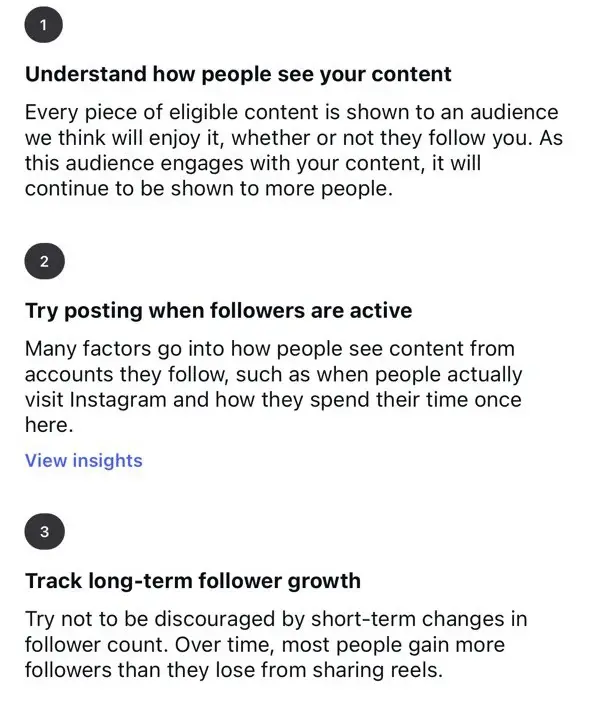
Instagram Best practices Reach
Fig. 3. Instagram, Best practices → Reach (screenshot from my materials)

TikTok

By the platform's own description, For You is assembled from three groups of factors: user interactions (watching a long video to the end is a strong signal), video information (captions, sounds, hashtags), device and account settings (lower weight). Follower count and the success of past videos are not named as direct factors [P · TikTok Newsroom, 18 Jun 2020]. The document is old, and I found no other official list.

What the data says: For You accounts for 72.7% of video views; a video collects 96% of its reach and about 98% of its interactions in the first 10 days; at least one hashtag is associated with roughly 5% more views [P · Metricool, 12 May 2026; Metricool clients]. Since 22 Jan 2026 TikTok in the US runs through the joint venture TikTok USDS Joint Venture (Oracle, Silver Lake and MGX together own 45%), which, per the company, will retrain the algorithm licensed from ByteDance on American users' data [P · Axios, 23 Jan 2026]. Test any two-year-old “secret” for the US before you trust it.

ParameterInstagram ReelsTikTok
Main signalsWatch time, likes and sends per reachInteractions (including watching to the end), video information, account settings
Role of followersRecommendations go to non-followers too; for “your own” likes matter slightly moreFollower count is not a direct factor
First secondsSkip rate in Insights: exits within 3 secondsAverage watch time and completion rate in analytics
Video lifespanNo public data found96% of reach in 10 days (Metricool clients)
Originality75% of recommendations in the US are original posts; reposters are not recommendedDuplicates and spam are not recommended (Newsroom, 2020)
What to optimizeSends per reach, retentionCompletion, keywords in caption and sound

The table summarizes facts whose sources and dates are given in the text above.

What they share: both systems predict whether a specific person will like the video, and both dislike duplicates. Instagram describes reach expanding as engagement grows; for TikTok I found no such mechanic in official sources. Treat blog claims like “300–500 views for a test” as rumor.

What changed in the last three weeks

11 Nov. Meta published an explainer on “Your Algorithm”: users tune the topics they see in recommendations themselves. My takeaway: a vague topic loses twice, to the algorithm and to the person who picks topics on their own.

26 Oct and 1 Nov. Instagram launched a limited test of “Features” (long-form video) in the US; per Business Insider, creators were offered up to $500,000 for long videos. Watch it, but don't rebuild your plan around a test.

10 Nov and 14 Oct. TikTok is testing a TikTok Shop Plus subscription (about $10 a month after a free period) for selected users in the US; TikTok Shop UK got group buying, auctions and shoppable carousels.

27 Oct. Meta Ad Manager got a Breakdown by individual ad creative elements. Hooks are now easy to test as separate variables.

5 Nov. Through the Graph and Marketing APIs businesses can add and remove AI-use disclosure (AI self-disclosure).

Source: headlines and short texts of Social Media Today, Oct–Nov 2026 [P]; I did not check them against platform primary sources.

Do this · Monday morning

  1. Open Insights for your last 10 Reels. Enter skip rate, average watch time, reach and sends in the table. Calculate sends per reach by hand.
  2. Mark the 2 best and 2 worst videos: you will break down their first 3 seconds in the next section.
  3. Check whether you have videos with other people's clips or watermarks and no added work: the originality rules hit those first.

3. Anatomy of a viral Reel: hook, retention, value, ending

In my materials a video rests on three parts: a hook of 1–2 seconds, a middle that isn't boring and a strong ending [M · document “What the success of new-audience growth on IG depends on”]. I'll go through each with numbers and templates, and at the end of the section give three ready scripts and a 60-second checklist before publishing.

The hook

The fate of a video is decided at the start. Skip rate shows the share of views where the video was swiped away within the first 3 seconds [P · Instagram via Social Media Today, 24 Aug 2025]. By Dash Social's numbers a viewer watches a Reel for about four seconds on average [P · Dash Social H1-2026]. There is no time to warm up.

My materials name three hook types: Shock Value (an unexpected fact or claim), Visual Hook (an unusual picture or action in the first frame) and the Stitch hook (a reaction to someone else's video or a comment). A rephrasing trick: instead of “today I'll talk about biceps exercises” — “how to pump your biceps like there's a football under the skin” [M]. The same source has the claim “70% of videos that blow up start with a question”. It has no source, so use it as a hypothesis for an A/B test, not as a statistic [M].

A correction to the cult of hooks. In NP Digital's marketer ratings “hook strength” scored 6.5 out of 10 against 10 for engagement, 9.3 for novelty and 9.2 for hitting a trend. The study's own conclusion: connection with the audience first, hooks second [P · NP Digital, Sep 2025]. A hook is there so a person doesn't leave; what keeps them is the feeling “this is about me”.
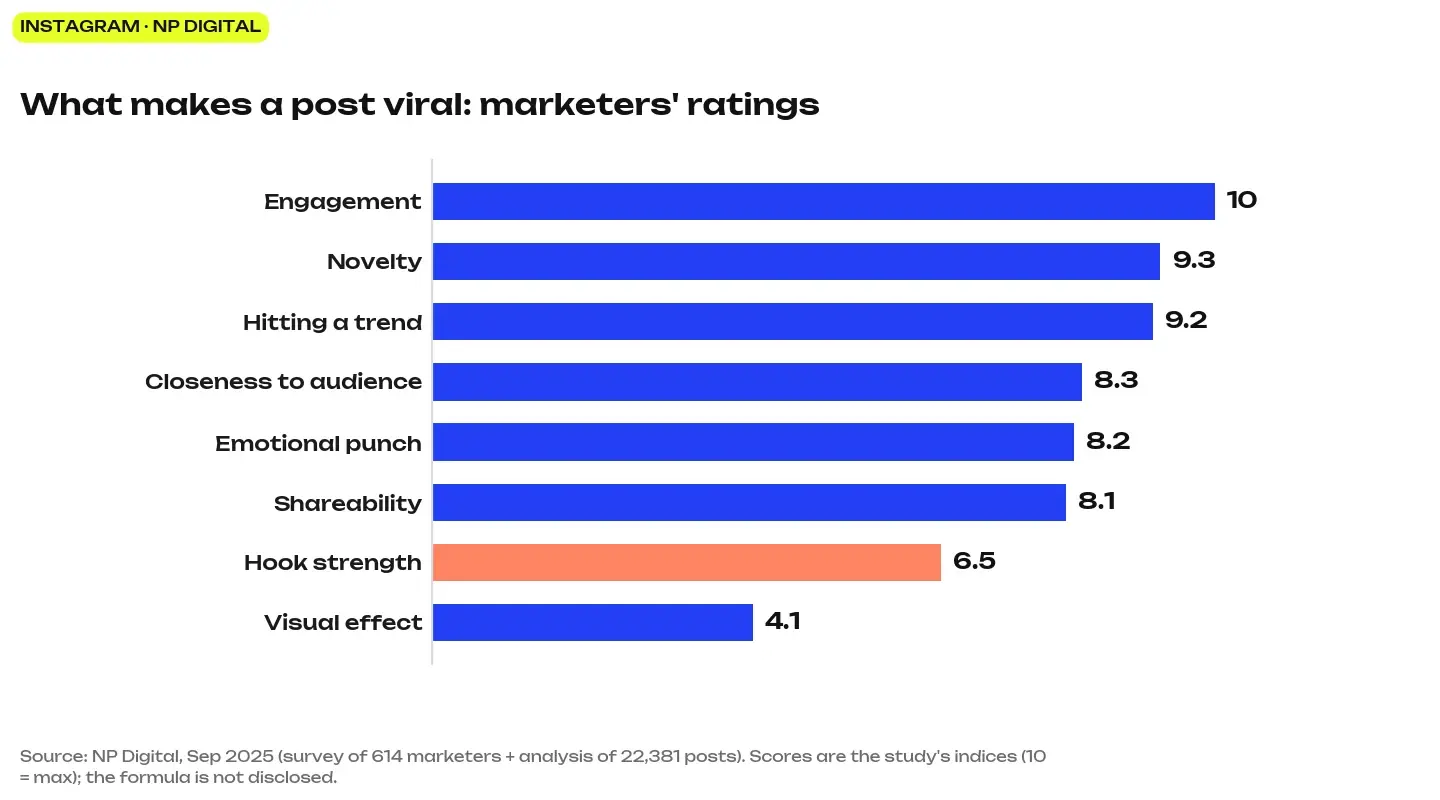
NP Digital virality factors
Fig. 4. Virality factors of Instagram posts as rated by marketers (index)

What holds attention after the hook. In an Emplifi sample (10,110 Facebook Reels, 704 brand pages; that is Facebook, not Instagram) speech in the first 3 seconds raised retention at second 10 by almost 25% versus music; a person on screen by about 10%, but by second 30 that effect turns to minus 2.4%. For videos under 7 seconds a seamless loop gave +18.7% repeat views [P · Emplifi via Social Media Today, 22 Mar 2026]. For Instagram these are hypotheses: test them.

Hook bank: take it and fill it in

Twelve templates by type. Fill in only your own real numbers, names and stories: an invented statistic in a hook kills trust faster than a weak hook does.

TypeTemplateExample [H]
Shock“You lose [resource] every time you [common action]”“You lose the first three seconds of every Reel before it even starts.”
Shock“[Popular advice] doesn't work for [audience]”“‘Post every day’ doesn’t work for small brands.”
Shock“Stop [action] if you want [result]”“Stop picking music first. Fix your first two seconds.”
VisualFirst frame is the result: “Here's what happened in [period]”Split screen: the same profile on day 1 and day 30.
VisualAn unusual action or object + no more than five words of textA hand covering the camera lens; text: “Don’t film like this.”
VisualA screen with a red circle on a number or a dropRetention curve, red circle at second 2: “Here’s where you lose them.”
Stitch“I was asked: [comment]. Answering”“You asked: why does every Reel stop at 300 views?”
StitchReaction to someone's video: “This is only half right”“This tip is half right. Here’s the missing half.”
Curiosity“Nobody talks about [detail], but it decides [result]”“Nobody mentions the first frame, but it decides the whole Reel.”
Curiosity“[A number from your data] — that's how many people leave at second two”“[Your skip rate] of viewers leave at second 2. Here’s why.”
Story“In [month] [situation]. After [period] — [result]” (a real story only)“A client posted 12 Reels in March and got 600 views in total. Then we changed one thing.”
Story“The mistake that cost [loss]” (only if it happened)“The mistake that cost one client two months of posting.”

For comparison, a slide from a chatplace.io carousel that I saved: twenty hook templates for curiosity and exposé. The set of formulas is clearly limited: what wins is not the formula but how precisely you hit your audience's pain.
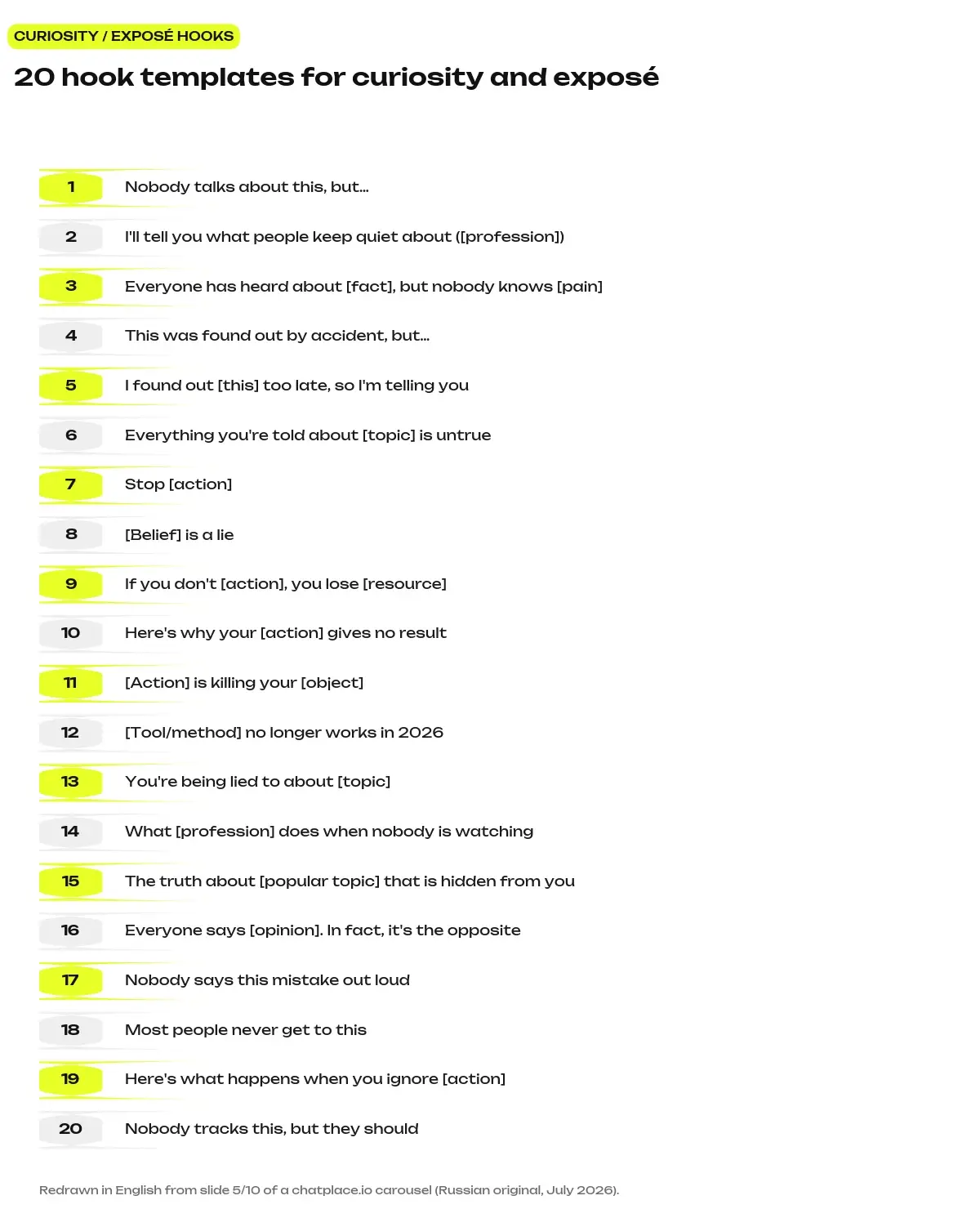
chatplace.io hook templates
Fig. 5. Hook templates from a chatplace.io carousel slide (20 curiosity and exposé formulas; saved July 2026, redrawn in English from the Russian slide in my materials) [M]

My filter for a hook

If the first sentence can be glued onto any video in your niche, it isn't a hook. A good first line belongs only to your video: it has your topic, your number or your conflict.

The middle

A principle from my materials: show, don't tell. Give the viewer a visual teaser of what comes at the end and keep changing the picture: a cut, a sharp change of intonation, any change in the frame [M]. In the video breakdowns I saved (videos by Russian creators; I did not transcribe the audio, I describe them from frames), red circles mark background details that hold the eye [M]. A working rule, not platform data: something changes in the frame about every 2–3 seconds.
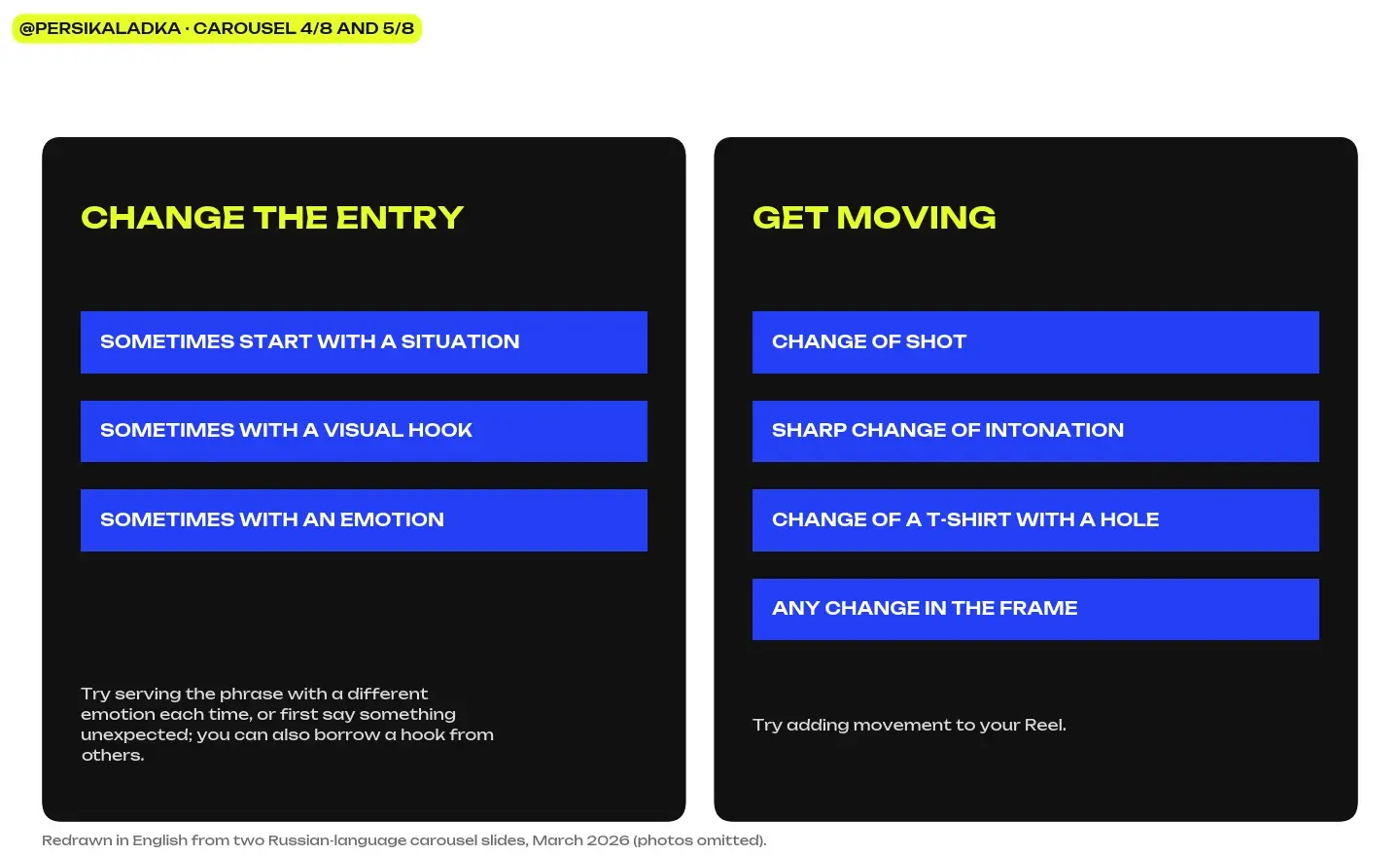
Carousel on how to liven up a Reel
Fig. 6. Two slides from a @persikaladka carousel on how to bring a Reel to life: “Change the entry” (left) and “Move” (right). Saved March 2026, redrawn in English from the Russian originals in my materials [M]

The ending

My materials advise ending on value, not on a call to action (the “edge effect”) [M]. The data supports it indirectly: across 72 US e-commerce brands 36% of captions contain a call to action, but within a single brand posts with and without a call perform the same [P · Metricool, E-commerce Report, 29 Oct 2026]. Instagram asks you to watch sends, which means the ending must be a thought people want to forward.

The shape of a 30-second story

Stories that hold attention have a shape. Kurt Vonnegut, as Maya Eilam's infographic tells it, believed the ups and downs of a hero can be plotted on a graph to see the shape of the story. For Reels I would take three shapes from the first row of that infographic; translating them into a video format is my adaptation, not Vonnegut's recipe.
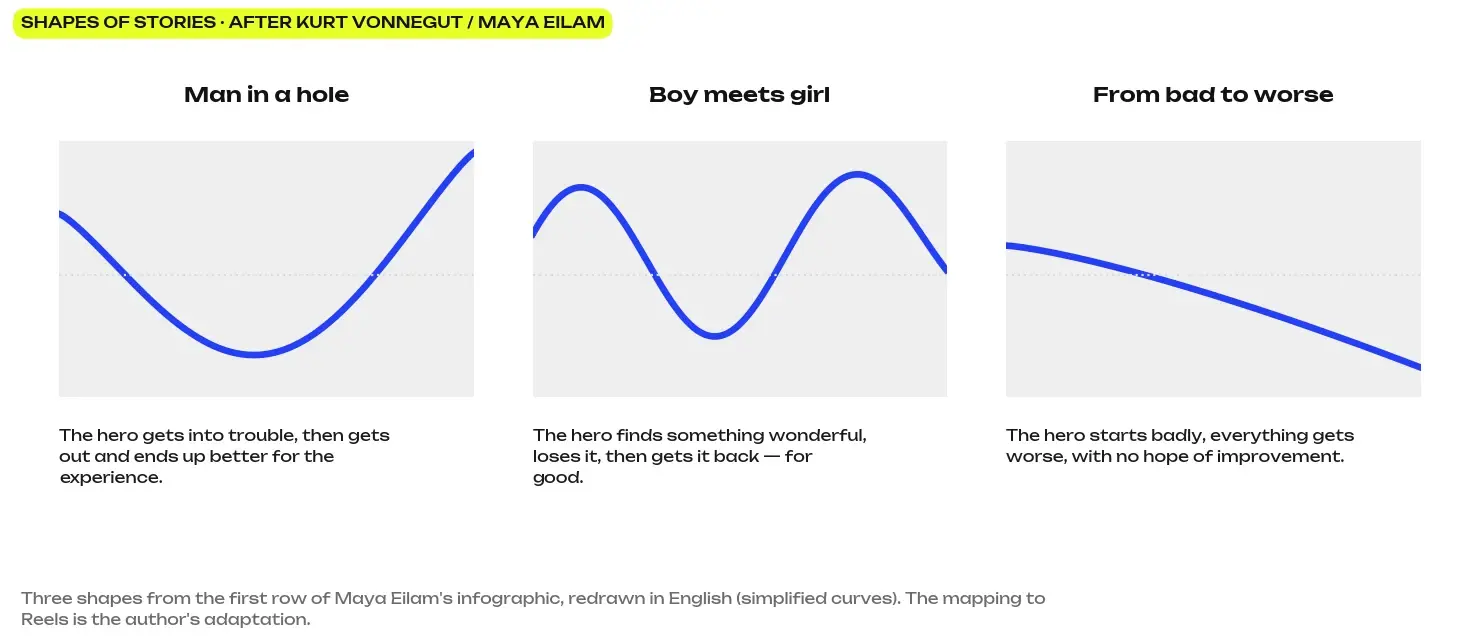
Vonnegut story shapes
Fig. 7. After the “Shapes of Stories by Kurt Vonnegut” infographic by Maya Eilam (mayaeilam.com): three shapes from the first row, redrawn in English [M]
ShapeHow to turn it into a ReelWhere it works
Man in a holeThings were bad → did [step] → ended better than before the trouble (before and after)Client case, breakdown of a mistake, renovation, transformation
Boy meets girlFound a solution → it broke → fixed it for goodA product that “let you down” and what you did
From bad to worseA mistake everyone makes and how it endsA warning, Shock hook

Creative structure: hook, storytelling, offer

For ad creatives I saved a scheme from a Miro board (27 Aug 2025): the hook (first 3–5 seconds, visual and audio), storytelling (JTBD and activating knowledge: which jobs of the user the video creative touches), the offer and the USP, that is “why us”. The inputs are research data and sales-team calls [M]. In Reels it works the same way: the hook holds, the story explains, the offer says what to do next. More on a creative as a hypothesis is in my guide on ad creatives (link at the end).
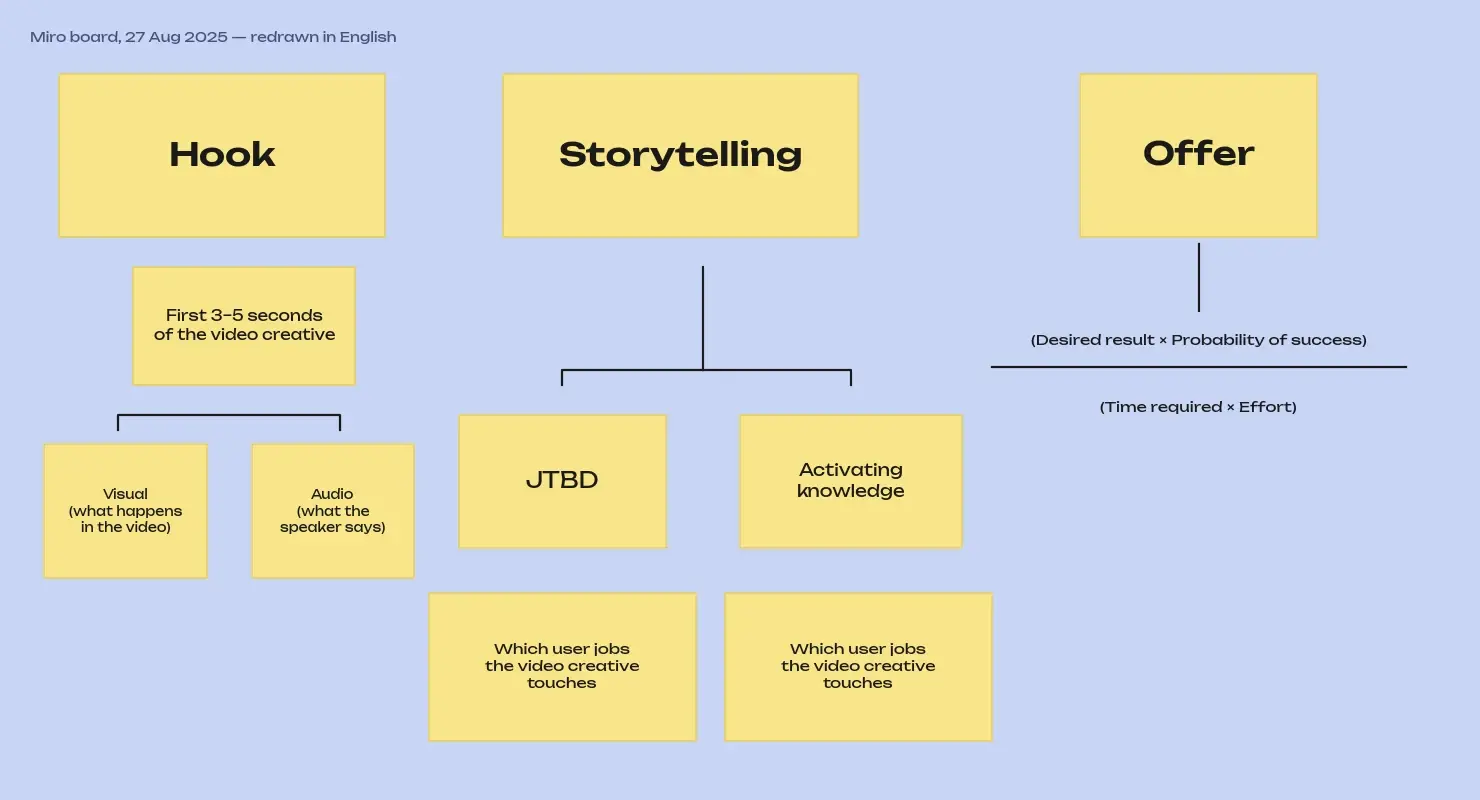
Creative structure on a Miro board
Fig. 8. Creative structure: hook → storytelling → offer (Miro board from my materials, 27 Aug 2025, redrawn in English; the fourth block, the USP, is left out) [M]

The offer formula from this scheme is covered in section 6: an expert needs it to understand why people follow one Reel and pay for another.

A 40-second template
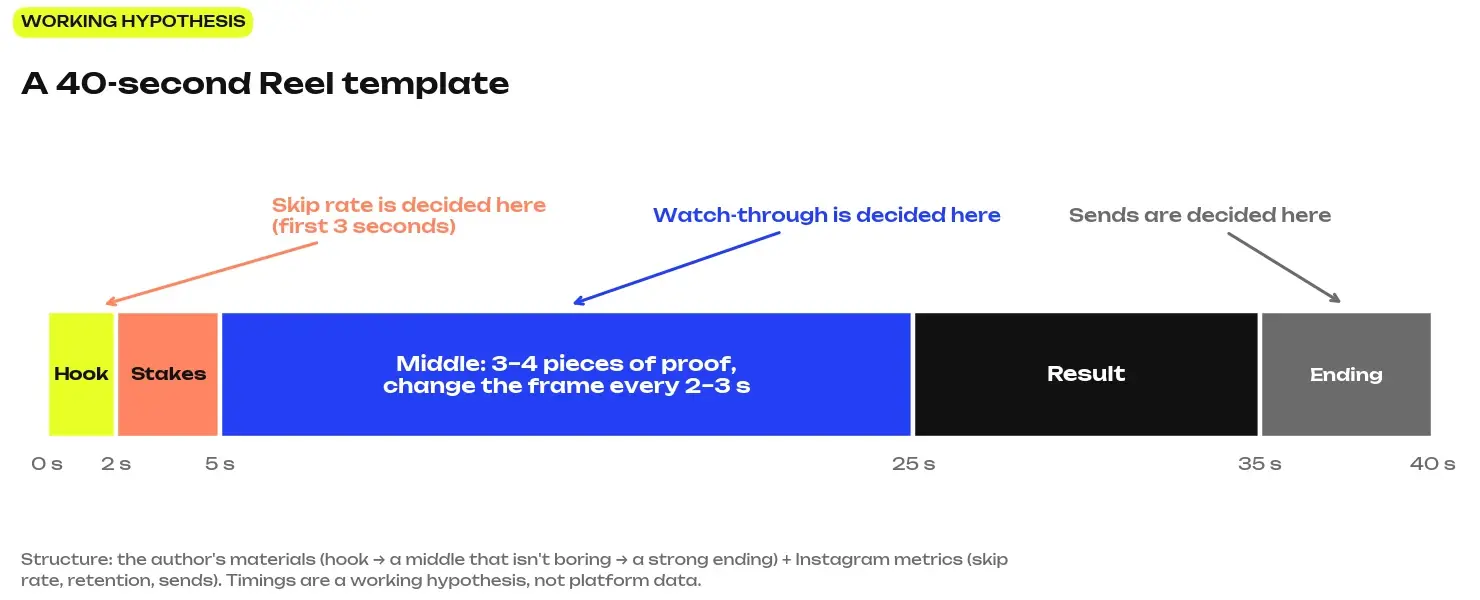
Reel template
Fig. 9. A 40-second Reel template

Three scripts: take them and shoot [H]

Script A. Expert: breakdown of a mistake (40 seconds). The example topic is Reels, the on-screen text is in English for a US/UK/EU audience.

SecondsJobWhat's in frame and on screen
0–2Hook: conflict in the first frame (Shock + Visual)On screen: “Your Reel doesn’t die at second 20. It dies at second 2.”
2–5Stakes: what the viewer gets“Instagram counts who skips in the first 3 seconds. Here’s how to fix yours.”
5–253–4 pieces of proof, change the frame every 2–3 sScreenshot of the Retention curve with a red circle on the drop; first frame before and after; the same phrase on screen and in text
25–35ResultNew version next to the old one; your skip rate before and after (real numbers)
35–40Ending: the most useful thought with no call to action; soft loop“…and that’s why second 2 is the whole game.” Return to the first frame

Script B. Brand: product demo (25 seconds). The example is a washable rug; any product with a clear “before and after” will do.

SecondsJobWhat's in frame and on screen
0–2Hook (Visual): the problem in frameRed wine falls on a white rug. Text: “Red wine. White rug. Watch.”
2–6Stakes“Most rugs stain. This one goes in the washing machine.”
6–16Proof: three cuts of 2–3 seconds eachBlot → into the wash → take it out wet; the sound of the process, no music
16–22ResultThe rug next to a photo from before the wash. Text: “Same rug. Zero stain.”
22–25Ending: a useful tip and a loop“Tip: cold water, never hot.” Return to the first frame; the link goes in the caption, not in frame

Script C. Client case: before and after (35 seconds). Works for consultants and services. Numbers and screenshots must be real and used with the client's permission.

SecondsJobWhat's in frame and on screen
0–2Hook: the result first“One client. 30 days. [Metric] from [A] to [B].” (insert the real number)
2–6Starting pointA “before” screenshot or screen recording, the problem circled in red
6–24Three steps, 6 seconds eachWhat changed #1, #2, #3: each on screen, with proof
24–32ResultThe “after” screen, the same metric, the time frame
32–35Ending: the takeaway in one line and a loopOne lesson with no call to action; the keyword goes in the caption

60-second checklist before publishing

  1. First 2 seconds: an action or a claim, not a greeting and not a logo.
  2. There is text in the first frame: it can be read without sound.
  3. Within 3 seconds it is clear who is in frame and what the video is about: algorithms read this, and so do people who pick topics themselves.
  4. The frame or shot changes every 2–3 seconds, no sagging.
  5. Subtitles are on; key words are spoken and written in the caption.
  6. The ending gives a thought worth forwarding, not just a call to action.
  7. The call has one action: a keyword, or a link, or a save.
  8. Advertising is disclosed, AI material is labelled, music rights are checked (for TikTok business accounts, per secondary sources, only the Commercial Music Library is available).
  9. The video is exported without watermarks and is not a repost without added work.
  10. The caption has a question and 1–3 relevant hashtags: for Metricool clients a question in the caption gave +26.19% comments, and at least one hashtag about +5% views [P · Metricool, 12 May 2026].

Do this · Monday morning

  1. Take the 5 weak videos from the previous section. For each, pick three hooks of different types from the table (Shock, Visual, Stitch) and keep one.
  2. Shoot one video from script A, B or C and run it through the ten-point checklist.
  3. Test the new hook in Trial Reels: in that mode the video is shown to non-followers first [P · Social Media Today, 24 Sep 2026: Trial Reels are good for experiments].

4. Content strategy: what to shoot and where to get ideas

Four types of content

TypeJobWhat to measureExample formats
EducationTrust, saves, sendsSends per reach, average watch time“3 mistakes”, breakdown, template
EntertainmentNew audienceReach, share of non-followers, skip rateTrends, sketches, humor
InspirationEmotional bond, followsFollows per 1,000 viewsStory, behind the scenes, client result
ConversionLeads and salesClicks, DMs, leadsProof plus offer, demo

Read the table as a pyramid: at the base reach (entertainment, trends), in the middle trust (education, stories), at the top money (proof and offer). A starting proportion for 10 videos: 4 educational, 3 entertaining, 2 inspiring, 1 with an offer. This is a hypothesis to test [H], not a norm. The data supports the direction: in the Metricool sample a hard sell (3.2% of posts) was the weakest content type relative to the brand's own average, while tutorials and posts inviting participation were slightly above average, and 33 of 72 brands had none of them [P · Metricool, E-commerce Report, 29 Oct 2026].

What to do with each video: the reach × interest grid

A week after publishing, place each video on the grid. Compare reach with your median over the last 20–30 videos; measure interest as sends per reach and profile visits. After that the decision takes a second.
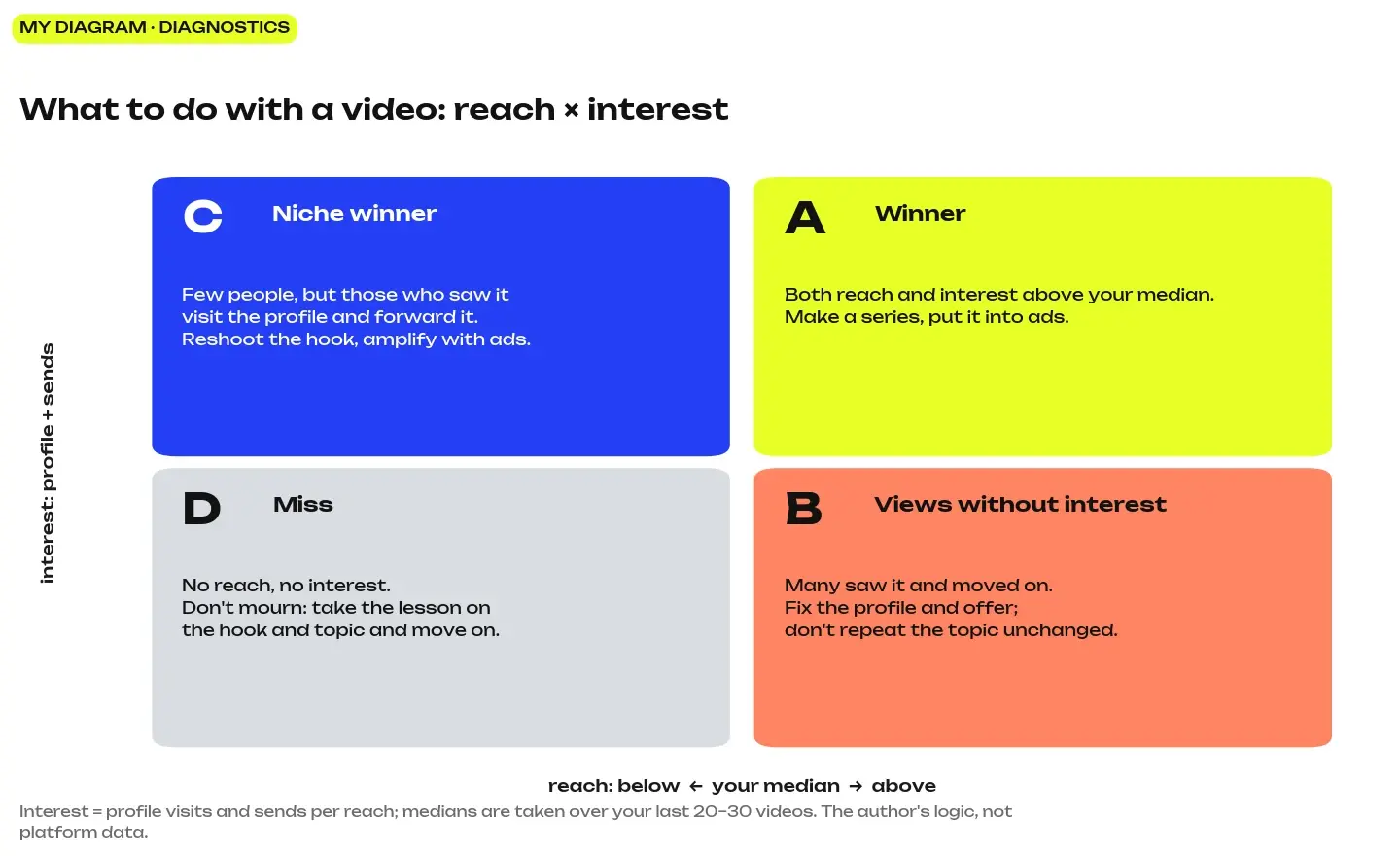
Reach by interest grid
Fig. 10. Diagnosing a video: reach × interest

Where to get ideas

  1. Comments and direct messages. A question you were asked twice is a ready topic.
  2. Competitors and adjacent niches. Look not at views but at videos whose result is double the usual for that account, and save 10 of them.
  3. Trends. Take a trend (format, sound, structure) and move it to your topic [M].
  4. External data. Google results, the “related searches” block at the bottom of the page [M].
  5. Content filter. 10–15 text posts on other social networks; where there is a response, make a short Reel; rewrite the ones that took off into a long format and cut them into dozens of videos for all networks [M].
  6. AI. Mining ideas from comments and direct messages (prompt 1 in section 7).

Turn a winner from quadrant A into a series: the same hook template, a different topic, five videos in a row. A series lowers risk and saves energy: you don't have to invent the form every time, you only substitute the content.

Rhythm

Platforms don't reward quantity. Dash Social cites its trends report: brands that post fewer than six times a week get 93% higher engagement, although on TikTok they post eight times a week on average [P · Dash Social H1-2026]. A Buffer study of 2M+ posts shows that 3–5 posts a week on Instagram can more than double the follower growth rate [P · Buffer via Social Media Today, 2025]. Both numbers say the same thing: a moderate steady rhythm, 3–5 videos a week. Shoot in batches: one day for 6–8 videos [M].

From my interview about failures the principle closest to me is “the fewer the details, the higher the reliability”. That is why the content plan below is one page for two weeks, not a forty-page regulation.

Two-week plan: 10 videos in a 4/3/2/1 proportion [H]

#TypeTopic (example for a Reels expert)HookWhat we watch
1EducationWhy a video dies at second twoShockskip rate
2EducationHow to read the Retention curve in two minutesVisualsends per reach
3EntertainmentPOV: take 15 of the first sentenceVisualreach, non-followers
4EducationOne video before and after a hook editVisualskip rate
5InspirationA client story (real, with permission)Storyfollows per 1,000 views
6EducationReply to a comment: should you post every dayStitchsends per reach
7EntertainmentA trend with no idea or an idea with no trendShockreach
8ConversionA breakdown of your Reel for a keywordCuriositycomments, DMs
9EntertainmentSketch: a client asks “make us something viral”Visualreach, sends
10InspirationBehind the scenes: how I review the week in 30 minutesVisualprofile visits

Do this · Monday morning

  1. Collect 40 comments and DM questions, mark 5 competitors and save 2 of their best videos each.
  2. Fill in the two-week plan from the table above: 10 rows, a type and a hook for each.
  3. Set one day for shooting the batch (6–8 videos) and put it in the calendar.
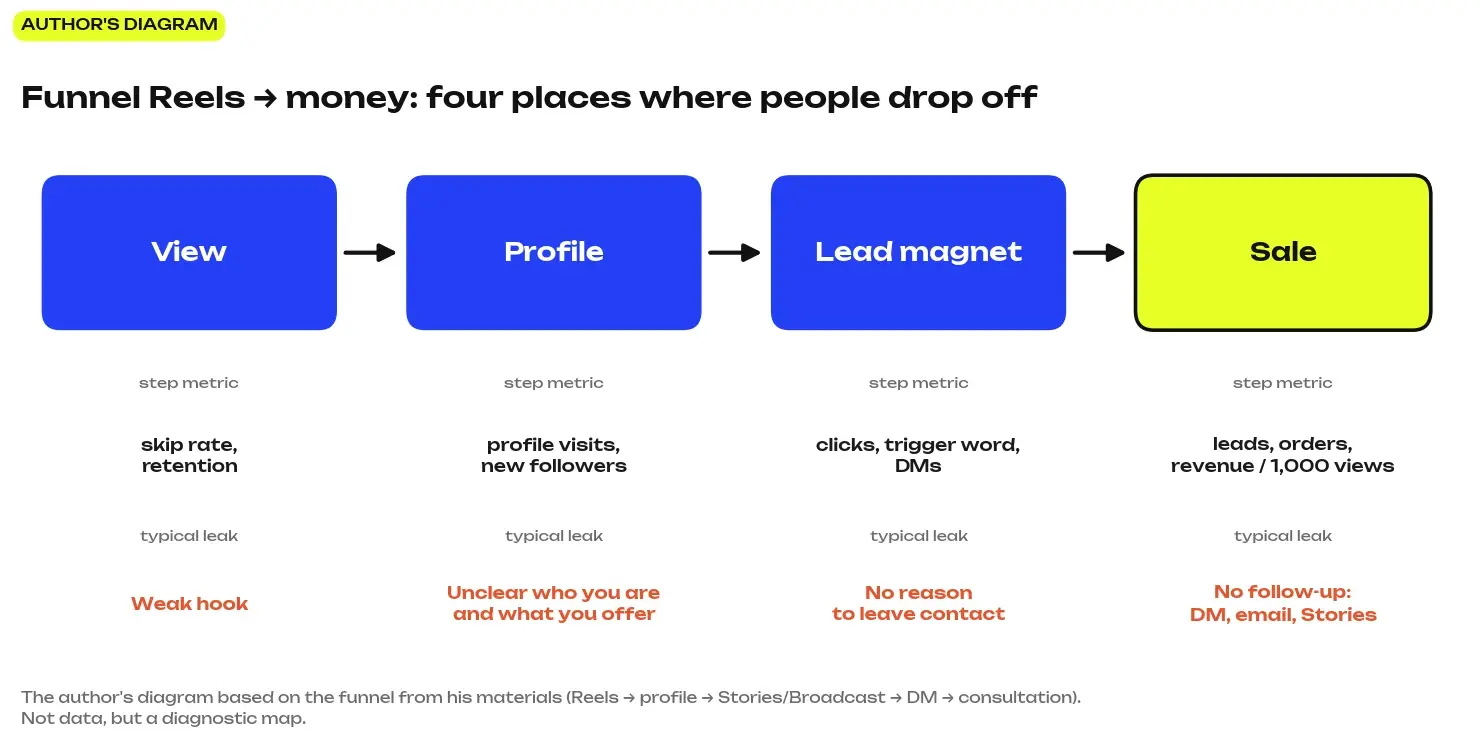
5. How a brand monetizes virality

A brand has one job: turn attention into an action you can count. Below are the funnel, five mechanics that led to money in real cases, a creator brief you can send today, and the rules worth knowing before launch.

The funnel and four leaks

The path is simple: Reel → profile → lead magnet → sale [M · funnel from my materials: Reels → profile → Stories/Broadcast → DM → consultation]. At each step people drop off for their own reason. You can calculate revenue per 1,000 views: share of clicks to the site × site conversion to order × average order value × 1,000. With 0.3% clicks, 1.5% conversion and a $60 order that is $2.70 per thousand views [H].

Reels to money funnel
Fig. 11. Funnel: Reels → money

What pays: five mechanics

  • Offer + date + sales channel. Chipotle tied a TikTok challenge to free guacamole on digital orders on National Avocado Day and got a record guacamole day (case 1) [P · Chipotle, 1 Aug 2019].
  • Creator as a demand test. By 2019 Stanley had stopped restocking the Quencher; a batch of 5,000 for the audience of the blog The Buy Guide sold out in a few days, and the blogger was later brought in as a partner (case 3) [P · CNBC Make It, 23 Dec 2023].
  • Creators at scale and the right to paid amplification. Virgin Voyages invited more than 1,100 creators on a three-day cruise and got permission for 180 days to use their content for paid promotion of the best videos (case 6) [P · TikTok for Business, 29 May 2026; brand's figures].
  • Prize and song. In 2020 e.l.f. launched #elfMagicAct with an original song, influencers and a giveaway: creators could win a free Putty Primer provided they made a purchase on the brand's site; the company says the challenge drew more than 1 billion views in three days. The release has no sales figures for the challenge itself [P · e.l.f. Beauty, press release, 28 Jul 2020].
  • In-app purchase. In the Metricool sample (72 US brands, August 2026) TikTok Shop tags were on only 1.8% of organic TikTok posts, 9.3% of posts mentioned a retail partner such as Sephora or Target, and 84% of posts with a Shop tag were ads [P · Metricool, E-commerce Report, 29 Oct 2026]. Brands gain an audience but lead it to someone else's shelves.

How to count a creator

With bloggers I have a personal score, I mentioned it at the start: at Ed.Partners influence marketing was the first to go into the red, and we didn't grasp the scale right away. So a creator has to be counted as a purchase, not as an acquaintance. Before you talk about a fee you need three numbers: the acceptable price of a result (an order, a lead, an install) from your margin, the expected number of results from the integration (from a pilot test or the creator's own stats) and a stop condition under which you don't renew.

Fee ceiling = acceptable price of a result × expected number of results. Say an order is profitable for you up to $15 and the test promises 40 orders: the ceiling is $600 [H]. Above the ceiling pay only for results: a fixed fee below the ceiling plus a bonus for each order by promo code or tagged link.

A one-page creator brief

If a brief doesn't fit on a page, the creator won't read it. The fields below cover what most often breaks a collaboration: an unclear goal, hidden advertising and unclear content rights.

FieldWhat to writeExample [H]
GoalOne goal and a deadline40 orders by promo code in 30 days
AudienceWho you show it to and wherePet owners fed up with stains on the rug
One ideaWhat the viewer must rememberThis rug can go in the washing machine
Must-have shots2–3 things without which the video isn't acceptedA stain in frame; the rug in the wash; the result next to a photo from before the wash
Don'tsWhat can't be promised or saidDon't promise “stain-free forever”; don't name competitors
DisclosureHow advertising is labelledAn “Ad” label in the first frame and in the caption; not in comments or among hashtags
RightsOrganic and paid amplification, termPublication on the creator's account plus paid amplification for 180 days, as in the Virgin Voyages case
Format and deadlinesLength, format, number of revisions20–30 seconds, vertical video, one revision, deadline in the calendar
PaymentFixed fee plus a result bonusA fee up to the ceiling, a bonus for each order by promo code
ReportingWhat the creator sends and whenA link to the video and Insights screenshots on day 7: views, retention, sends

The paid layer: fresh TikTok ad cases

A viral video is a test. Money at scale comes when the winner is amplified with paid media. Cards from the TikTok for Business case catalogue show the order of effects that brands claim.

Brand, market, card dateWhat is known about the approachClaimed result
Merit America, US, education, 9 Nov 2026Lead Generation, Spark Ads, deep-funnel optimization, Pixel, Smart++116% completed sign-ups; −45% cost per lead; −76% cost per sign-up
Bloom Nutrition, 4 Nov 2026Not disclosed in the card−42% cost per new customer; 23.1K new customers
Club del Sole, Italy, small business, 22 Oct 2026Not disclosed in the card−61% CPC; conversion rate 9.75%; €5 per result
Pingo Doce, Portugal, 10 Nov 2026A mini-drama with a cat, made with AI15M+ views; +162% engagement of the pilot episode vs the brand average; +117% average watch time
Nespresso Vertuo World, 10 Nov 2026Brand Lift and Conversion Lift Study+241% consideration audience; +17% add to cart; 2.3K incremental web conversions
Cetaphil, 6 Nov 2026Branded Search Hub8× engagement vs the usual level; +6.4% brand favourability

The numbers are claims by brands from TikTok for Business catalogue cards [P · TikTok for Business, 22 Oct–10 Nov 2026]. TikTok has not verified them, and I did not open the full pages of these cases: read them as an order of magnitude, not as a promise.

What I took from this. Three of the six cards measure the price of a result (a lead, a sign-up, a new customer), not views. That is how to measure any video you amplify.

Organic payback model [H]

A hypothetical case: a D2C home-textile brand, 8 videos a month, an average video of 20,000 views, 160,000 in total. 0.3% of views go to the site — 480 visits. Site conversion 1.5% — 7.2 orders. Average order $60: revenue $432, at a 40% margin that is $173. Shooting and editing: 8 videos × 3 hours × $25 = $600. Organic as a direct sales channel does not pay back. It starts paying back when the site and profile collect email and the customer returns, when the best videos go into ads, and when at least one video a month lands in the 7.9% that get twice the account's norm or more (NP Digital database) and pulls the month up. Plug in your own numbers.

How not to burn budget on empty views

  1. Amplify with ads only videos where skip rate is below your median and sends per reach is above the median.
  2. Optimize for an action (click, lead, purchase), not for views.
  3. One video, one action: a keyword in the comments, or a link, or a save.
  4. Set the budget per hypothesis in advance together with a stop condition: for example, sends did not grow after three hook iterations.
  5. Don't buy followers and likes: since 21 Oct 2024 an FTC rule prohibits selling and buying fake social media influence indicators, with a penalty of up to $51,744 per violation [P · FTC, 14 Aug 2024].

Rules 1–4 are practice, not platform data.

Rules of the game: advertising, AI, music (US, UK, EU)

WhereWhat is requiredWhat to do
US: ad disclosureA connection to a brand must be disclosed “clearly and conspicuously”: not in comments and not in a pile of hashtags. “ad”, “advertisement”, “sponsored” are acceptable; “spon” and “collab” are not. The responsibility lies with the influencer and the brand [P · FTC, Disclosures 101, 2023]“Ad” in the first frame and in the caption; put it in the contract and the brief
US: fake indicatorsSince 21 Oct 2024 an FTC rule prohibits buying and selling fake reviews and influence indicators (bot followers, likes); a penalty of up to $51,744 per violation [P · FTC, 14 Aug 2024]Don't buy followers, likes and reviews
UKASA, CAP and CMA issued a new edition of the joint guidance for influencers: advertising must be clearly labelled as advertising; it rests on the DMCC Act, with stronger powers and attention to fake reviews [P · Lewis Silkin, 23 Oct 2026]An “Ad” label at the start of the video; read the current edition of the guidance before launch
EUThe basis is the Unfair Commercial Practices Directive; the European Commission has an Influencer Legal Hub [P · per search summaries; I did not check the Commission pages in full]Disclose advertising under the rules of the country where the audience lives
AI contentTikTok automatically labels AI content using C2PA metadata, including content uploaded from other platforms [P · TikTok Newsroom, 9 May 2024]. In the EU Article 50 of the AI Act applies from 2 Aug 2026, machine-readable marking for systems already placed on the market is postponed to 2 Dec 2026 [P · Jones Walker, Ropes & Gray, 2026; secondary sources, I did not check the regulation text]. Since 5 Nov 2026 businesses can add and remove AI disclosure through the Meta API [P · Social Media Today]Don't hide synthetic material; don't show nonexistent “customers”; don't clone someone else's voice
MusicTikTok business accounts, per secondary sources (Social Media Today, 2020), are limited to the commercial music library; not confirmed for InstagramTake music from the commercial library or license it; check the account settings

This is not legal advice. Check with a lawyer and with current versions of the rules before launch: they change.

Do this · Monday morning

  1. Walk the customer path from a phone in 5 minutes: Reel → profile → link → checkout. Wherever it is unclear what to do next, there is a leak.
  2. Add a UTM tag to the profile link and pin three videos: a story, proof, an offer.
  3. Fill in the brief for one creator and send it as a paid test with a stop condition; calculate the fee ceiling with the formula above.

6. How an expert monetizes virality

The trust ladder

An expert sells trust, not reach. The ladder: content → trust → lead magnet → product or service. Build prices in steps: a free lead magnet, an inexpensive product (a template, a mini-course), the core service, an expensive service. In my materials the working chain is: Reels → profile → Stories or Broadcast → direct messages → consultation; to collect requests a keyword in the comments is used, after which a bot sends a link to the DM [M].

The offer: why people follow one Reel and pay for another

On the Miro board from my materials the offer formula is written like this: (desired result × probability of success) / (time required × effort) [M]. In English-language literature it is associated with Alex Hormozi (the Value Equation, the book $100M Offers) [P · from retellings; I did not check the book]. For Reels it gives four questions to your offer, and each has its place in the video.

LeverQuestionWhere to show it in a Reel
Desired resultWhat outcome will the person get? Name a number and a time frameIn the hook
Probability of successHow will you prove it will work for someone like them: a case, steps, a guarantee?In the middle, as proof
TimeHow long until the first visible result?In the ending or the pinned post
EffortWhat do you take on to make it easier for them: a template, a review, support?In the offer and the caption

A personal brand in five steps

  1. Positioning in one sentence: “I help [whom] get [result] in [time] without [the main pain].”
  2. Three pillars: one expertise, one personal story, one type of proof (before and after, numbers, screenshots with clients' permission).
  3. A face and a voice in frame. Speech and a person in the first seconds raised retention (Emplifi, Facebook Reels, section 3).
  4. Dialogue. Reply to comments and turn questions into the next videos; Dash Social advises talking like a friend, not like a seller [P · Dash Social H1-2026].
  5. One main offer in the pinned post: within 10 seconds a person understands what to do next.

DM script: keyword → direct message [H]

A keyword in the comments and an automatic message with a link is a mechanic from my materials [M]. Use it by Meta's rules. By a summary of the Private Replies documentation, one private reply can be sent per comment within 7 days; it does not open the 24-hour window for free-form conversation, and the dialogue can continue only after the person replies [P · developers.facebook.com, per search summary; check the current version]. So the first message must contain a question people want to answer.

StepMessage (example in English)Why
Video and caption“Comment GUIDE and I’ll send you the checklist.”One action and one word
Auto-reply to the comment“Hi [name], here’s the checklist: [link]. One question so I send the right next step: what do you want to fix first — 1) hooks, 2) retention, 3) sales? Reply with a number.”The person already has the link; the question asks for a reply and opens a dialogue
Reply with a number“Got it — [hooks]. This 3-minute video helps most: [link]. Want me to look at one of your Reels? Reply YES.”The next rung of the ladder, with no pressure
Reply YESFrom here the person writes: “Thanks! Send me the link and I’ll reply within 24 hours.”A live dialogue instead of a bot; promise only what you will deliver
No replySend nothingHelp must not turn into a mailing

Rules: give people a way to opt out (“Reply STOP and I won’t message you again”), work through Meta's official integrations, don't buy lists and don't message en masse people who didn't ask you to.

Expert income model [H]

A hypothetical case: a consultant, 12 Reels a month, an average video of 15,000 views, 180,000 in total. 1% visit the profile — 1,800 people. 5% of them take the lead magnet or write the trigger word — 90 leads. 8% of leads book a call — 7.2 calls. 25% close — 1.8 clients. At a $1,500 check that is $2,700 a month. For comparison: direct TikTok payouts for the same 180,000 views at third-party RPM estimates of $0.40–1.00 per 1,000 views would be $72–180, and only for videos longer than a minute with 10,000 followers and 100,000 views in 30 days [P · third-party Creator Rewards review, Nov 2026; I did not check TikTok's official help page]. A difference of 15–38 times. The platform gives reach, you make money on your own offer.

A model example is Dr Julie Smith from the UK, from short videos to a book (case 5). There are no income figures in the sources, but you can see that the short videos were accompanied by a product of her own.

The rules for disclosing advertising and partnerships are in the table in section 5. If you advise on health or finance, don't promise a result you can't confirm.

Do this · Monday morning

  1. Write your positioning in one sentence and put it in the bio.
  2. Run your offer through the four questions and rewrite the hook, proof and ending to match the answers.
  3. Prepare a lead magnet (a PDF, checklist or template) and a trigger word; set up the auto-reply from the table and test the chain from someone else's phone.
  4. Pin three videos: a story, proof, an offer.

7. AI automation: what to hand to the machine and what to keep

Instagram names originality as a ranking principle, and repost accounts lose recommendations [P · Social Media Today, 24 Sep 2026; Tubefilter, 30 Apr 2026]. My takeaway is simple: give AI drafts and routine, and keep the face, the facts, the clients' numbers and the final decision for yourself. Everything that makes a video yours, a machine cannot invent.

TaskTools (examples)What it does and the limits
Ideas, scripts, hooks, calls to actionChatGPT, ClaudeDrafts from your data and formulas; you supply the facts
Localizing scripts into EnglishChatGPT, ClaudeAdaptation for US/UK/EU; a native speaker checks numbers and idioms
Covers, storyboards, backgroundsMidjourneyVisual drafts; shoot people and the product yourself
Voice-over, dubbing into another languageElevenLabsOnly your own voice or a voice with written consent; label synthetic audio
Editing, subtitles, clippingCapCut (auto-subtitles, templates); Instagram Edits is a free editor [P · Social Media Today, 1 Apr 2025]A rough assembly and subtitles; check the final with your own eyes
Analytics and reportsClaude or ChatGPT + an Insights export; Metricool with an MCP connector [P · Metricool, 29 Oct 2026]Metric analysis, hypotheses, a weekly report
Programmatic editingRemotion + WhisperFor a team with a developer; a demo in my materials [M]
Trend searchTrendsee and similarPicking trending videos to adapt [M]

Tool capabilities are per vendor claims; check the terms before adopting.

Ten prompts: copy and fill in

Replace the data in square brackets with your own. The main rule: put the facts into the prompt yourself, don't ask AI to “recall” them. Anything in the answer that looks like a number or a quote, check against a source.

1. Idea miningYou are a short-video editor in the [niche] niche. Audience: [who] in [country]. Below are 40 comments and questions from my Reels and DMs. Group them into 8 topics. For each give: the person's pain in one phrase, 3 Reel ideas (a breakdown of a mistake, before and after, an explainer) and what must not be promised in this topic. Do not invent facts or numbers. Comments: [paste].
2. ScriptWrite a 35-second Reel script in English: hook 0–2 s (type: [Shock, Visual or Stitch]), stakes 2–5 s, three pieces of proof with a frame description every 2–3 seconds, a result, an ending with no call to action that loops back to the first frame. Topic: [topic]. Use only my facts and numbers: [list]. Conversational tone, no clichés.
3. Hooks and callsGive 12 variants of the first 3 seconds for the topic [topic]: 4 each for Shock, Visual and Stitch. For each state what is in frame and what is on screen as text. Rate the swipe-away risk from 1 to 5, keep the 4 best and explain the choice in one line. Add 5 soft calls to action in the “trigger word in the comments” format.
4. Retention diagnosisHere is the transcript of a Reel and the points where the Retention curve drops: [seconds]. Skip rate: [number]. Determine the cause at each point and suggest two fixes: what to cut, what to show, what to say differently. Do not rewrite the whole video.
5. A/B test planDraft a 4-week test plan for the hypothesis “[hypothesis]”. I need: one variable, two variants, a success metric (skip rate or sends per reach), the minimum number of videos per variant and a stop rule. I publish 3 videos a week.
6. Clipping a long videoHere is the transcript of a 12-minute video. Cut it into 8 short Reels: start and end timecodes, the hook as the first line, on-screen text, a two-line caption and one question for the comments. Do not add anything that is not in the transcript.
7. Weekly reportHere is an Insights export for 4 weeks: [table]. Calculate for each video sends per reach, likes per reach and skip rate. Pick the 3 best and 3 worst, compare hooks and length, give 3 hypotheses for next week and one thing worth stopping.
8. Creator briefYou are a brand manager. Draft a one-page creator brief with these fields: goal, audience, one idea, must-have shots, don'ts, ad disclosure (an “Ad” label in the first frame and in the caption), rights (organic and paid amplification, term), format and deadlines, payment (a fixed fee plus a result bonus), reporting. Product: [description]. Allowed facts: [list]. What must not be promised: [list]. Do not invent product features.
9. Replies and auto-replyHere are 20 comments under my Reel and my offer: [offer]. Write two reply options for each: short, friendly, no pressure and no invented facts. For questions about price and booking, give a reply that moves the person to direct messages. Separately draft an auto-reply for the keyword in three messages: a link and a question, the next step after a reply, a stop if there is no reply. In every message leave a way to opt out.
10. Localization and risksHere is a script and caption in Russian for an audience in [the US, the UK or the EU]. First adapt the text into natural English: keep the numbers and meaning, replace idioms. Then check the risks: a promised result, comparison with competitors, medical and financial claims, missing ad disclosure, use of AI. Give a list of risky spots and safe wording; do not give legal advice, but mark what to show a lawyer.

On labelling and checking. The rules for the US, the UK and the EU are collected in the table in section 5. In short: don't hide synthetic material, don't show nonexistent “customers”, don't clone someone else's voice. The Pingo Doce case from the same section shows that a video made with AI can collect views, but those are the brand's own numbers.

A weekly pipeline

  1. Monday: idea mining and scripts with AI, 30 minutes of your edits.
  2. Tuesday: shoot 6–8 videos in one day.
  3. Wednesday: editing and subtitles.
  4. Thursday: captions, scheduling, replies to comments (prompt 9).
  5. Friday: metrics review (prompts 4 and 7), a decision on each video.

Do this · Monday morning

  1. Save prompts 1 and 3 in a note. Run your last 40 comments through prompt 1 and pick 3 topics.
  2. For each topic get 12 hooks with prompt 3 and pick one each.
  3. Build the script for the chosen hook with prompt 2 and shoot it the same day.

8. Metrics and analytics

Watch not one number but a chain by funnel step. If a link in the chain is weak, fix that one, not its neighbor.

StepMetricWhere to lookWhat to consider good
HookSkip rate: share of exits within 3 secondsReels InsightsBelow your median; Instagram publishes no external thresholds
RetentionAverage watch time, Retention curveReels InsightsThe flatter the curve, the better [P · Instagram via Social Media Today, 24 Aug 2025]
ResonanceSends per reach, likes per reach, savesInsights (you calculate sends per reach)Above your median; sends matter more for an unfamiliar audience [P · Mosseri, Social Media Today, 22 Jan 2025]
GrowthNew followers per 1,000 viewsInsights: posts that attracted the most followers [P · Social Media Today, Aug 2025]Your own trend
ActionProfile visits, clicks, DMs, leadsProfile, UTM, CRMConversion of each step
MoneyRevenue per 1,000 views, price of a resultCRM, site analyticsAbove content costs

Count by hand: six formulas

Sends per reach = sends ÷ reach. Likes per reach = likes ÷ reach.

Follows per 1,000 views = new followers ÷ views × 1,000.

Revenue per 1,000 views = click share × site conversion × average order × 1,000.

Price of a result from a creator = (fee + product cost + your time) ÷ number of orders or leads.

Winner share = videos above 2× your median ÷ all videos over 20–30 posts. For comparison: in the NP Digital database that share was 7.9% [P · NP Digital, Dec 2024].

External reference points (for scale, not for comparison). Instagram: Reels engagement 2.7% of views, average view about 4 seconds, brands' follower growth 0.7% a month (1.0% for growing brands up to 190K). TikTok: engagement 3.4% of views, growth 5.0% a month (10.2% for brands up to 40K) [P · Dash Social H1-2026; Jul–Dec 2025]. I found no public benchmark for “view → follow → lead” conversion with a clear methodology: count on your own data.

How to read the numbers

SymptomDiagnosisWhat to change
High skip rateWeak hook, unclear topicThe first 3 seconds, on-screen text, the first frame
The curve drops at second 5–8The stakes saggedShorten the intro, show the result earlier
Good retention, few sendsThere is value, nothing to “forward”Add a point or template people want to send
Many sends, few followsThe profile doesn't explain who you areBio, pinned post, covers
Many follows, few leadsA weak offer or lead magnetLead magnet, trigger word, follow-up
Leads, but no salesThe problem is in selling, not in contentCall script, price, offer

The tracker table: twelve columns

Start one table and fill it in once a week for each video. Twelve columns are enough to answer the questions from the table above.

ColumnWhere it comes from
1. Link and publication dateProfile
2. Content typeEducation, entertainment, inspiration, conversion (section 4)
3. Hook typeShock, Visual, Stitch, Curiosity, Story (section 3)
4. LengthEditor
5. Skip rateReels Insights
6. Average watch timeReels Insights
7. ReachReels Insights
8. Sends per reachYou calculate by hand
9. Follows per 1,000 viewsYou calculate by hand
10. Profile visits, clicks, DMs, leadsProfile, UTM, CRM
11. Quadrant of the reach × interest gridSection 4: A, B, C or D
12. DecisionKeep, rework, kill

A weekly report fits on one page: what we published; what worked (top 3 by sends per reach); what didn't (3 worst by skip rate); a hypothesis for next week; a decision on each video — keep, rework, kill.

Do this · Monday morning

  1. Start a table with the twelve columns and fill in your 10 latest videos.
  2. Calculate sends per reach for each and mark quadrant A, B, C or D.
  3. A rule for 4 weeks: after every video you set a decision: “keep, rework, kill”.

9. Typical mistakes

  1. Chasing views instead of a result. When reach grows, engagement falls (TikTok: 3.4% vs 3.9%) [P · Dash Social H1-2026], and the number of videos over the year grew 72.1% while views fell 31.3% [P · Metricool, 12 May 2026]. You need a next-step metric: sends, follows, clicks.
  2. A hard sell in every second video. For 72 e-commerce brands it was the weakest content type relative to their own average [P · Metricool, E-commerce Report, 29 Oct 2026].
  3. A slow warm-up. The average viewer watches a Reel for about 4 seconds [P · Dash Social H1-2026]; skip rate shows how many people left in the first 3.
  4. A trend with no closeness to the audience. In NP Digital's ratings hitting a trend (9.2) comes after novelty and engagement, while closeness to the audience got 8.3 [P · NP Digital, Sep 2025]. A trend with no link to your viewer is the cheapest way to get reach that does not turn into follows (this is my conclusion, not the study's data).
  5. No path after the video. Brands build an audience on TikTok, but Shop tags are on only 1.8% of organic posts [P · Metricool, E-commerce Report, 29 Oct 2026]. The person was left no next step.
  6. A creator without a calculation. Paying for reach with no fee ceiling and no stop condition is a path I know from Ed.Partners: influence marketing went into the red first. The cure is the fee ceiling and the stop condition from section 5.
  7. Ignoring the rules and believing in “hacks”. Reposts and watermarks (accounts where most content is reposts without added work are not recommended [P · Tubefilter, 30 Apr 2026]), undisclosed advertising, unlabelled AI content. Add claims like “70% of videos that blow up start with a question” or “TikTok first shows a video to followers” with no source: the Newsroom says outright that follower count is not a direct factor.

Do this · Monday morning

  1. Mark the mistakes you have on the list and fix one: most often it is a slow warm-up or no path after the video.
  2. Check that advertising is disclosed, AI material is labelled and videos are exported without watermarks.

10. Launch checklist: 15 actions

  1. Pick a main platform and a goal for 8 weeks: followers, leads or sales.
  2. Write down the baseline for your last 10 videos: median views, skip rate, sends per reach.
  3. Formulate your positioning in one sentence and put it in the bio.
  4. Pin three videos: a story, proof, an offer.
  5. Run your offer through the four questions from section 6 and rewrite the hook, proof and ending to match the answers.
  6. Prepare a lead magnet and a trigger word; walk the chain from someone else's phone.
  7. Add a UTM tag to the profile link.
  8. Collect 40 comments and DM questions and group them by topic (prompt 1).
  9. Make a two-week plan in a 4/3/2/1 proportion.
  10. For every video pick a hook from the bank: Shock, Visual, Stitch, Curiosity or Story.
  11. Shoot a batch of 6–8 videos in one day; speech or a face in the first 3 seconds is a hypothesis to test (section 3).
  12. Add subtitles, export the video without watermarks and run it through the 10-point checklist.
  13. Publish 3–5 videos a week when your audience is active: Instagram advises following your followers' active times [M]; for Metricool clients the TikTok window is 6–9 pm, peaking at 8 pm [P · Metricool, 12 May 2026]. Check against your own data.
  14. Once a week fill in the tracker table and set a decision for each video: keep, rework, kill.
  15. Once a month check ad disclosure and AI labelling, put the 1–2 best videos into ads and, if you work with creators, recalculate the fee ceiling.

Do this · Monday morning

  1. Do items 1–6 today. Put the rest in the calendar for the week.

11. Cases: six real and one hypothetical

The numbers in the six real cases are company claims or data from publications, with the source next to them. The seventh case [H] is calculated from sections 5 and 6: the numbers are invented.

Case 1. Chipotle: #GuacDance (US, 2019)

Situation. Chipotle, US. The occasion was National Avocado Day, 31 July 2019.

Actions. The #GuacDance dance challenge on TikTok built on Dr. Jean's viral guacamole song, plus free guacamole on orders through digital channels.

Result. More than 250,000 videos with the hashtag and almost 430 million video starts in six days; a record guacamole day with more than 802,000 servings; the day required 18,500 cases of avocados, 7,500 of them extra. The company calls #GuacDance the most successful branded challenge on TikTok in the US [P · Chipotle, 1 Aug 2019].

Takeaway. The combination of an occasion, an offer and an order channel worked. The release does not break out the challenge's own share: people could have been drawn by the free guacamole.

Case 2. Duolingo: the mascot's “death” (US, February 2025)

Situation. Duolingo has built its social media for years around the “unhinged” character of the owl Duo; in the year before the campaign its TikTok account added more than 6 million followers.

Actions. On 11 February 2025 the company announced that Duo had “died”: a fake press release and a video with a Cybertruck. In a couple of days the team built a campaign: 13 local accounts, merch, a page where users “resurrected” Duo by earning XP. Two weeks later he “came back”.

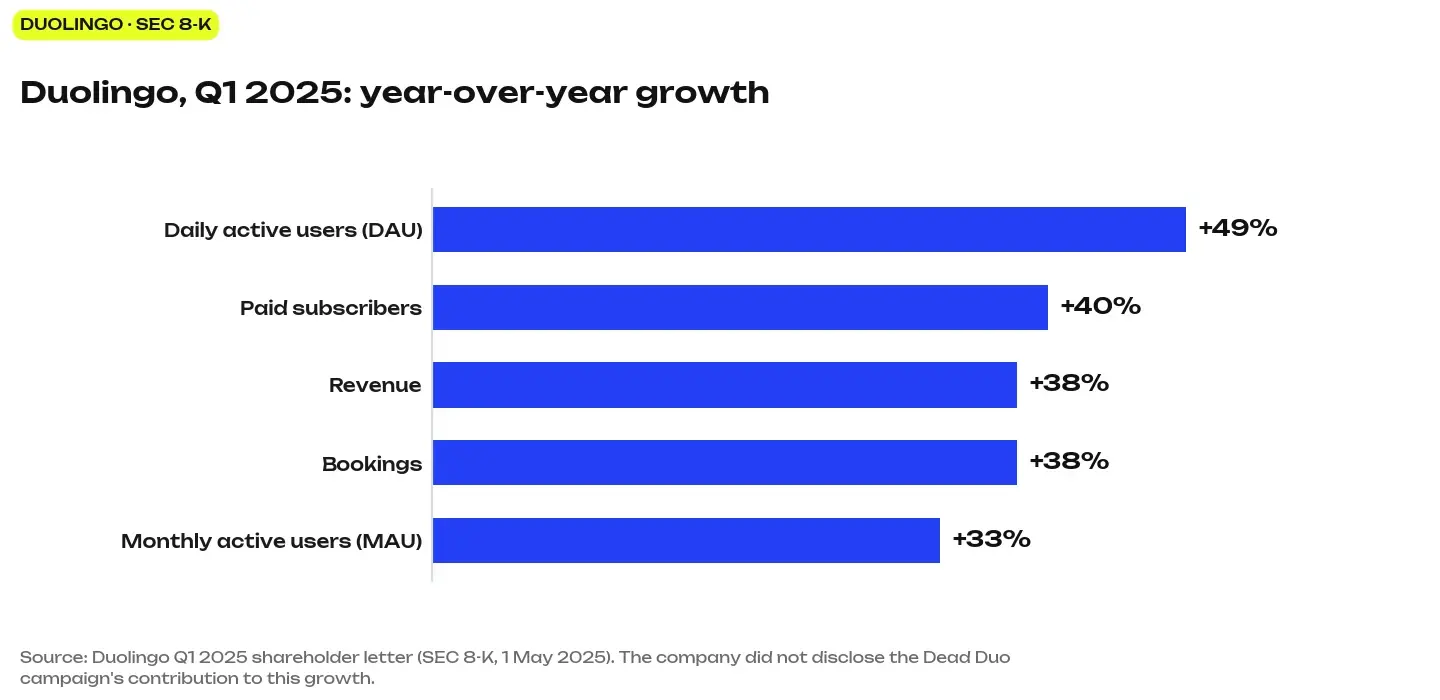
Result. 1.7 billion impressions in two weeks against a target of 70 million and about 160,000 user-made videos (roughly 25 times more than in past icon changes). The company did not disclose the effect on in-app engagement, confirming only a “notable increase in new and returning users” [P · Fast Company, 10 Apr 2025]. In Q1 2025 DAUs grew to 46.6 million (+49% year over year), revenue to $230.7 million (+38%) [P · Duolingo, 8-K, 1 May 2025]; I did not find the campaign's share in that growth.

Takeaway. A strong brand character gives huge reach, but the campaign does not prove a link to revenue. A brand voice has to be handled carefully: in May 2025, after an “AI-first” announcement, Duolingo temporarily deleted posts on TikTok and Instagram amid criticism [P · Fast Company via Slashdot, 24 May 2025].

Duolingo growth
Fig. 12. Duolingo growth in Q1 2025, year over year

Case 3. Stanley: a creator as a demand test (US, 2019–2023)

Situation. The Quencher came out in 2016; by 2019 Stanley had stopped restocking and promoting it. 2019 revenue was $73 million.

Actions. Ashlee LeSueur, founder of the blog The Buy Guide, bought 5,000 Quenchers wholesale for her audience; the batch sold out in a few days. From 2020 the company was led by Terence Reilly (previously Crocs): he brought in The Buy Guide as a partner, released 100+ colors, limited drops and collaborations.

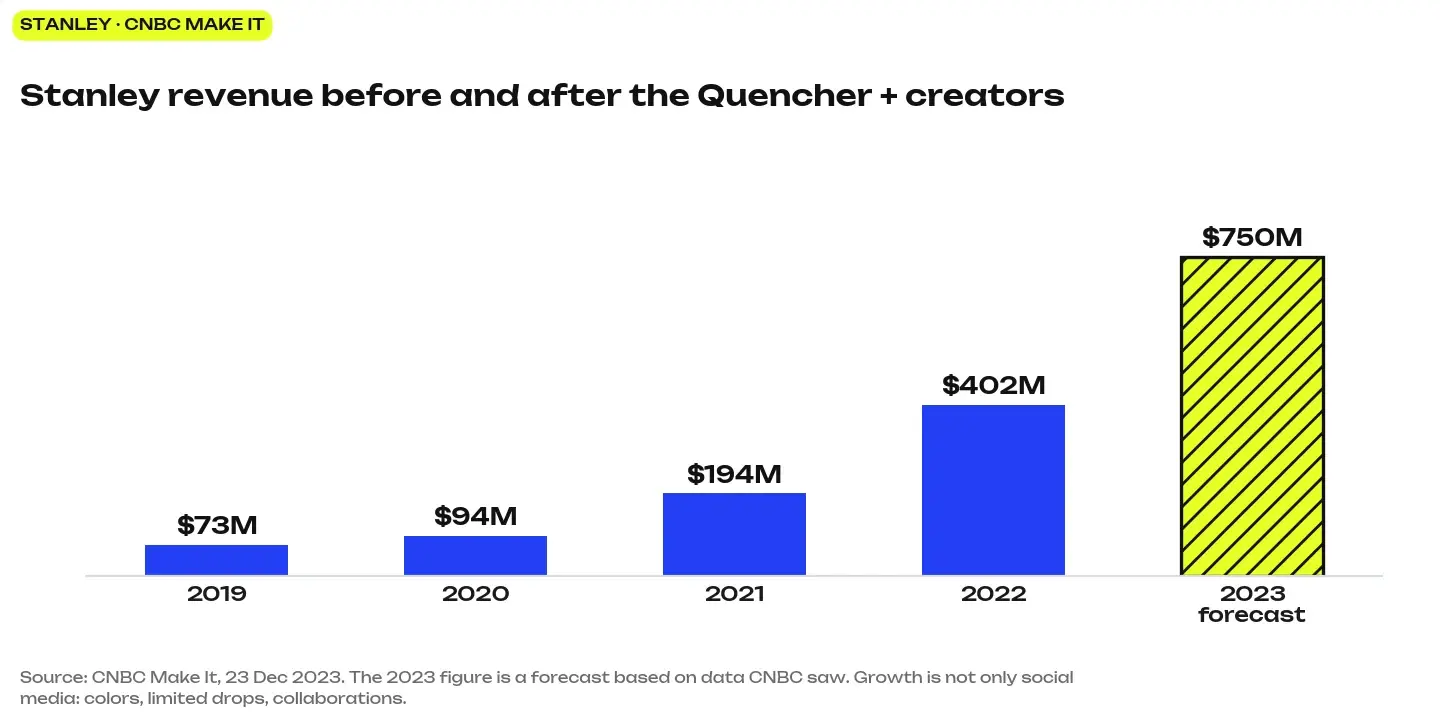
Result. Revenue: $73 million (2019), $94 million (2020), $194 million (2021), $402 million (2022); for 2023 CNBC cites a forecast above $750 million [P · CNBC Make It, 23 Dec 2023].

Takeaway. A batch for a creator's paying audience is a cheap demand test. But the growth cannot be credited to social media entirely: colors, drops and collaborations worked together with it, and the 2023 figure is a forecast.

Stanley revenue
Fig. 13. Stanley revenue, $ million

Case 4. Ocean Spray: a viral video not from the brand (US, 2020)

Situation. In autumn 2020 Nathan Apodaca from Idaho, getting to work on a skateboard after his car broke down, filmed himself rolling to Fleetwood Mac's “Dreams” and drinking Ocean Spray. The brand did not commission the video.

Actions. CEO Tom Hayes recorded his own version on a skateboard, and the company, through the author's agent, gave him a cranberry-red pickup full of juice. The aim, in Hayes's words, was to amplify the positivity, not to hijack the moment.

Result. More than 69.2 million views; per TikTok, as of 11 October about half a billion views came from 134,000 imitation videos. CNBC writes about a sales increase without figures; the CEO tied the 2020 demand growth to the pandemic as well: as the category leader the company, in his estimate, “probably disproportionately benefited” [P · CNBC, 7 Nov 2020; GBH, 8 Oct 2020; Modern Retail, 29 Apr 2021].

Takeaway. When virality comes not from the brand, the winner is whoever answered quickly and didn't pull the blanket over to itself. Don't attribute sales to the video entirely: the pandemic helped too.

Case 5. Dr Julie Smith: from short videos to a book (UK, 2019–2024)

Situation. A clinical psychologist joined TikTok in November 2019 and, by her account, found no other mental health professionals there. The aim was to make therapy more accessible.

Actions. Short videos with insights from therapy and props (a hose, a bursting exercise ball). Followers' questions, by her account, pushed her to write the book “Why Has Nobody Told Me This Before?”.

Result. By January 2022 — 3 million followers and 35.2 million likes, and the book came out then; by January 2024 sales exceeded 1 million copies across all formats [P · TikTok Newsroom UK, 7 Jan 2022; The Bookseller, 15 Jan 2024].

Takeaway. An educational format plus a product of her own is a working trust ladder. There are no income figures in the sources. A caveat: she came into a niche with no other specialists; today it won't be that easy (the author's estimate).

Case 6. Virgin Voyages: 1,100 creators on one voyage (US, 2026)

Situation. The cruise line Virgin Voyages (US, a large business, travel). The goal, per TikTok's description, was to gather 1,000 creators on board and deepen brand consideration through content discovery by the community.

Actions. A three-day cruise to the Bahamas with more than 1,100 creators of different sizes (nano, micro, macro and VIP). A custom Creator Led Package with the TikTok Creative Exchange partner #paid simplified onboarding, contracts and content delivery; creator workshops ran right on board. Branded Buzz gave 180 days of permitted use of the content for paid amplification of the best videos; posts were collected under the hashtags #SailingWithVirgin and #SailWithVirgin.

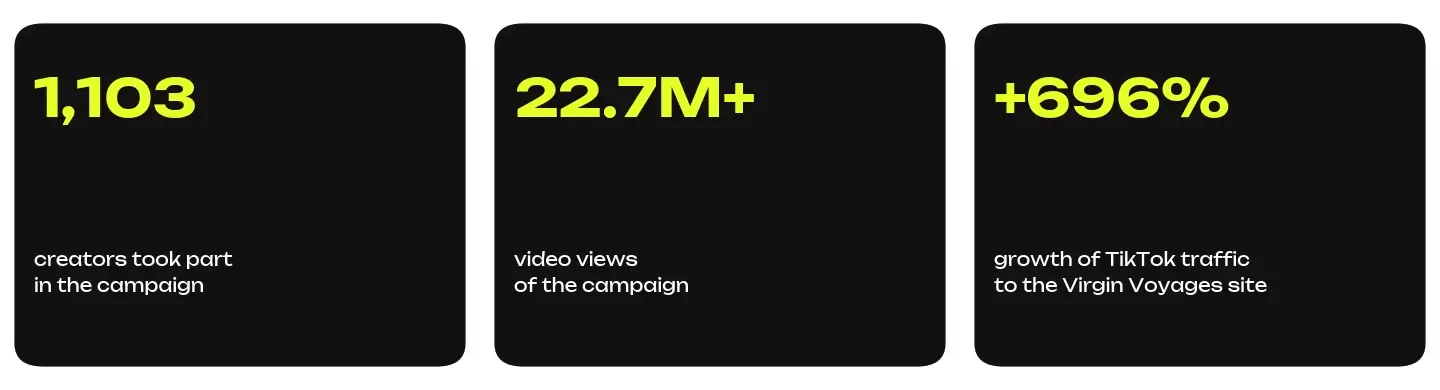
Result. Per the TikTok case page: more than 22.7 million views of the #sailingwithvirgin video, more than 3,200 TikTok posts around the campaign, a 696% increase in TikTok-referred traffic to the site and 1,103 participating creators [P · TikTok for Business, 29 May 2026]. The brand's own press release gives broader totals: 20,000+ pieces of content and 236 million views across all platforms, a 396% rise in brand engagement and a 386% rise in followers [P · Virgin Voyages, 8 May 2026]. The company's chief brand and marketing officer says visitors from social turn into passengers twice as fast as from traditional digital channels; the company does not disclose the method. The vice president of marketing and digital innovation explains the choice by saying that betting on creators yields a huge volume of creatives for different audiences at a small fraction of the cost.

Takeaway. Creator scale gives variety of creatives, and the right to paid amplification turns the best of them into ads. But all the figures are claimed by the brand, the cost of the voyage and the payback are not disclosed, so the case is not a model for a small budget: take the mechanics (different creators, amplification rights, one hashtag), not the format.

Virgin Voyages numbers
Fig. 14. Virgin Voyages per the TikTok for Business case page (brand's claims)

Case 7 [H]. Two accounts, comparable reach, different economics

Situation. Two hypothetical accounts: a D2C home-textile brand (160,000 views a month) and a consultant (180,000).

Actions. Brand: 8 videos, a link in the profile, no email and no ads. Consultant: 12 videos, a trigger word, a lead magnet, a call.

Result. Brand: 480 visits, 7.2 orders, $432 revenue and $173 margin against $600 of content costs. Consultant: 90 leads, 1.8 clients, $2,700 against $900 of costs (the same 3 hours per video and $25 an hour) and $72–180 of platform payouts by third-party estimates.

Takeaway. Comparable reach gives different money: what decides it is the price of the offer and the path after the video. The numbers are hypothetical: plug in your own.

Insight

In the cases where the money is visible (Chipotle, Stanley, Dr Julie Smith), reach was backed by a concrete mechanism: an offer tied to a date, scarcity and a paying audience, a product of her own. Where no mechanism is visible (Duolingo, Ocean Spray), reach stays reach. This is my conclusion from six stories, not a proven pattern.

Do this · Monday morning

  1. Pick the case closest to your model and write down one move you will repeat this week: an offer tied to a date, a batch for a creator, a quick reply to someone else's video, a right to paid amplification or an educational series.

12. Summary and the plan for Monday

Virality is made of three measurable things: a hook that doesn't let people swipe away, a video that is watched to the end and forwarded, and a path to money after the view. Platforms rank by predicting a person's reaction, so you have three levers: the first three seconds, value worth forwarding, and a clear next step. AI takes drafts and routine; the face, the facts and the decisions stay yours.

Monday, 90 minutes

  1. 0:00–0:20. Insights for your last 10 Reels, the tracker table (section 8).
  2. 0:20–0:40. Positioning in one sentence, the offer through four questions, bio, three pinned videos (sections 5 and 6).
  3. 0:40–1:00. Comments and DMs through prompt 1: 8 topics (section 7).
  4. 1:00–1:20. 12 hooks for each of two topics (prompt 3), pick one each.
  5. 1:20–1:30. Trigger word, lead magnet, testing the chain from someone else's phone.

30-day plan

WeekWhat we doWhat should exist by the end of the week
1. PackagingBaseline for 10 videos, tracker, positioning, pinned posts, offer, lead magnet and trigger wordA clear profile and a table with 10 rows
2. First batchA two-week plan, a batch of 6–8 videos, 3–5 posts a week, the 60-second checklist6–8 published videos with the hook noted
3. DiagnosisThe reach × interest grid for each video, a series from a winner (quadrant A), rework of B and C, prompts 4 and 7A decision on each video and a launched series
4. MoneyAmplify the 1–2 best videos with ads with a stop condition; a test with one creator by the brief (brand) or an auto-reply and calls (expert); the monthly reportThe first revenue-per-1,000-views figure and a decision on what to scale

PS: the numbers in this guide go stale in months. Platforms change ranking, and TikTok in the US promises to retrain its algorithm on local data. If your analytics disagree with the numbers in the guide, trust your analytics.

Sources

Materials [M] that I collected: the document “What the success of new-audience growth on IG depends on”; a screenshot of Instagram Best practices → Reach; a creative-structure board (27 Aug 2025); carousels and video breakdowns by Russian authors (@persikaladka, chatplace.io and others) as illustrations of mechanics, not as cases; the infographic “Shapes of Stories by Kurt Vonnegut” (Maya Eilam). Public sources [P]:

  1. Meta, Q3-2025 call, 29 Oct 2025. https://s21.q4cdn.com/399680738/files/doc_financials/2025/q3/META-Q3-2025-Earnings-Call-Transcript.pdf
  2. Meta, Q4-2025 call, 28 Jan 2026 (Motley Fool transcript). https://www.fool.com/earnings/call-transcripts/2026/01/28/meta-meta-q4-2025-earnings-call-transcript/
  3. SMT, 22 Jan 2025: ranking signals. https://www.socialmediatoday.com/news/instagram-shares-algorithm-insights-2025/738034/
  4. SMT, 25 Feb 2025: watch time. https://www.socialmediatoday.com/news/instagram-longer-video-watch-time-versus-completion-rate/740916/
  5. SMT, 24 Aug 2025: Retention and Skip rate. https://www.socialmediatoday.com/news/instagram-adds-retention-insights-reels/758464/
  6. SMT, 24 Sep 2026: principles, Trial Reels. https://www.socialmediatoday.com/news/instagram-chief-shares-algorithm-insights-and-posting-tips/831326/
  7. Tubefilter, 30 Apr 2026: reposts. https://tubefilter.com/2026/04/30/instagram-removes-algorithm-recommendations-repost-content-aggregator
  8. SMT, Aug 2025: Insights metrics. https://www.socialmediatoday.com/news/instagram-adds-new-metrics-followers-gained-demographics/756752/
  9. SMT, 1 Apr 2025: Instagram Edits. https://www.socialmediatoday.com/news/instagram-free-edits-video-editing-app-coming-soon/744139/
  10. SMT, 9 Nov 2026: visual effects in Edits. https://www.socialmediatoday.com/news/instagram-launches-visual-effects-creator-for-edits/874205/
  11. SMT, 10 Nov 2026: TikTok Shop Plus. https://www.socialmediatoday.com/news/tiktok-tests-shopping-subscriptions/874337/
  12. SMT, 14 Oct–11 Nov 2026: the other news in the “What changed” block (headlines). https://www.socialmediatoday.com/
  13. Buffer via SMT, 2025: posting frequency. https://www.socialmediatoday.com/news/study-shows-posting-more-instagram-leads-to-more-reach/757633/
  14. Meta for Developers: Private Replies (per summary). https://developers.facebook.com/documentation/business-messaging/instagram-messaging/features/private-replies
  15. TikTok Newsroom, 18 Jun 2020: recommendations. https://newsroom.tiktok.com/en-us/how-tiktok-recommends-videos-for-you
  16. TikTok Newsroom, 13 Jun 2025: TikTok Shop. https://newsroom.tiktok.com/tiktok-shop-is-where-shoppers-come-to-discover?lang=en
  17. SMT, 15 Oct 2026: TikTok sales on Black Friday and Cyber Monday. https://www.socialmediatoday.com/news/tiktok-shares-holiday-sales-data/833191/
  18. Metricool, 12 May 2026: TikTok Study. https://metricool.com/press-release-tiktok-study-2026/
  19. Metricool, 29 Oct 2026: E-commerce Report. https://www.socialmediatoday.com/press-release/20261028-only-18-of-organic-tiktok-posts-from-top-brands-use-tiktok-shop-metricoo-1/
  20. Dash Social, H1-2026: Instagram. https://pages.dashsocial.com/hubfs/social-media-benchmark/2026/H1/instagram.pdf
  21. Dash Social, H1-2026: TikTok. https://pages.dashsocial.com/hubfs/social-media-benchmark/2026/H1/tiktok.pdf
  22. NP Digital, Sep 2025: virality factors. https://neilpatel.com/marketing-stats/what-makes-content-go-viral-on-instagram/
  23. NP Digital, Dec 2024: share of viral posts. https://neilpatel.com/marketing-stats/content-viral-rate/
  24. Emplifi via SMT, 22 Mar 2026: Facebook Reels. https://www.socialmediatoday.com/news/human-speech-and-presence-help-drive-reels-engagement/815381/
  25. HubSpot, State of Marketing 2026. https://www.hubspot.com/marketing-statistics
  26. Pew Research Center, 19 Oct 2026. https://www.pewresearch.org/internet/fact-sheet/social-media/
  27. Axios, 23 Jan 2026: the TikTok USDS deal. https://axios.com/2026/01/23/tiktok-deal-trump-app-ban
  28. Creator Rewards, third-party review, Nov 2026. https://ttcalculator.net/learn/creator-rewards-program/
  29. TikTok for Business: case catalogue (cards of Merit America, Bloom Nutrition, Club del Sole, Pingo Doce, Nespresso Vertuo World, Cetaphil). https://ads.tiktok.com/business/en-US/inspiration
  30. TikTok for Business, 29 May 2026: the Virgin Voyages case. https://ads.tiktok.com/business/en/inspiration/virgin-voyages
  31. Virgin Voyages, 8 May 2026: press release on the Creator Voyage. https://www.virginvoyages.com/press/latest-releases/tiktok-creator-bahamas-cruise-goes-viral
  32. Chipotle, 1 Aug 2019. https://newsroom.chipotle.com/2019-08-01-Chipotles-National-Avocado-Day-Celebrations-Smash-Records
  33. e.l.f. Beauty, 28 Jul 2020: #elfMagicAct. https://investor.elfbeauty.com/stock-and-financial/press-releases/landing-news/2020/07-28-2020-073717465
  34. Duolingo, Q1-2025 shareholder letter, 1 May 2025. https://www.sec.gov/Archives/edgar/data/1562088/000156208825000098/q1fy25duolingo3-31x25share.htm
  35. Fast Company, 10 Apr 2025: Dead Duo. https://www.fastcompany.com/91313082/duolingo-dead-duo-owl-social-media-campaign
  36. Slashdot (after Fast Company), 24 May 2025: “AI-first”. https://tech.slashdot.org/story/25/05/25/0347239/
  37. CNBC Make It, 23 Dec 2023: Stanley. https://www.cnbc.com/2023/12/23/how-a-40-ounce-cup-turned-stanley-into-a-750-million-a-year-business.html
  38. CNBC, 7 Nov 2020: Ocean Spray. https://www.cnbc.com/2020/11/07/tiktok-star-gives-ocean-spray-boost-as-brand-looks-to-thanksgiving.html
  39. GBH, 8 Oct 2020: Ocean Spray CEO. https://www.wgbh.org/lifestyle/2020-10-08/ocean-spray-gifts-dreamschallenge-creator-a-new-truck-and-lots-of-juice
  40. Modern Retail, 29 Apr 2021: Ocean Spray CEO. https://www.modernretail.co/retailers/disproportionately-benefited-ocean-spray-ceo-tom-hayes-on-going-viral-and-expanding-into-new-categories/
  41. TikTok Newsroom UK, 7 Jan 2022: Dr Julie Smith. https://newsroom.tiktok.com/en-gb/tiktok-creator-spotlight-drjuliesmith
  42. The Bookseller, 15 Jan 2024: Dr Julie Smith's book. https://www.thebookseller.com/news/smiths-mental-health-bestseller-surpasses-one-million-milestone
  43. FTC, 14 Aug 2024: the fake reviews rule. https://www.ftc.gov/news-events/news/press-releases/2024/08/federal-trade-commission-announces-final-rule-banning-fake-reviews-testimonials
  44. FTC: Disclosures 101 for Social Media Influencers. https://www.ftc.gov/business-guidance/resources/disclosures-101-social-media-influencers
  45. Lewis Silkin, 23 Oct 2026: new ASA, CAP and CMA guidance for influencers. https://www.lewissilkin.com/insights/2026/10/23/new-influencer-guidance-from-the-asa-cap-and-cma-what-has-changed-and-what-to-d-102o6ar
  46. ASA: Influencers’ guide to making clear that ads are ads. https://www.asa.org.uk/advice-online/influencers-guide.html
  47. TikTok Newsroom, 9 May 2024: AI labelling. https://newsroom.tiktok.com/advancing-ai-transparency-and-literacy
  48. Jones Walker, 2026: EU AI Act, Art. 50 (secondary). https://www.joneswalker.com/en/insights/blogs/ai-law-blog/yes-august-2-still-matters-the-eu-approved-a-high-risk-ai-delay-but-most-trans.html
  49. Ropes & Gray, Aug 2026: EU AI Act (secondary). https://www.ropesgray.com/en/insights/viewpoints/2026/08/102nfqm/you-talkin-to-me-operationalising-the-eu-ai-acts-transparency-obligations
  50. Hormozi, $100M Offers: the Value Equation (a retelling, I did not check the book). https://creatoreconomy.so/p/the-value-equation-for-irresistible-products
  51. My materials: the guide on ad creatives. https://sabirov.club/ad-creative-is-a-hypothesis
  52. My materials: the guide on B2C and AI search (GEO). https://sabirov.club/geo-b2c-ai-search-guide
  53. My Instagram. https://instagram.com/sabirovilya
  54. My Telegram channel. https://t.me/proEdTech