
By Ilya Sabirov, CMO in EdTech, ex-cofounder of the CPA marketing platform Ed.Partners. 12 November 2026. A practical guide for e-commerce, D2C, travel, fashion, beauty and food delivery in the US, UK and EU.
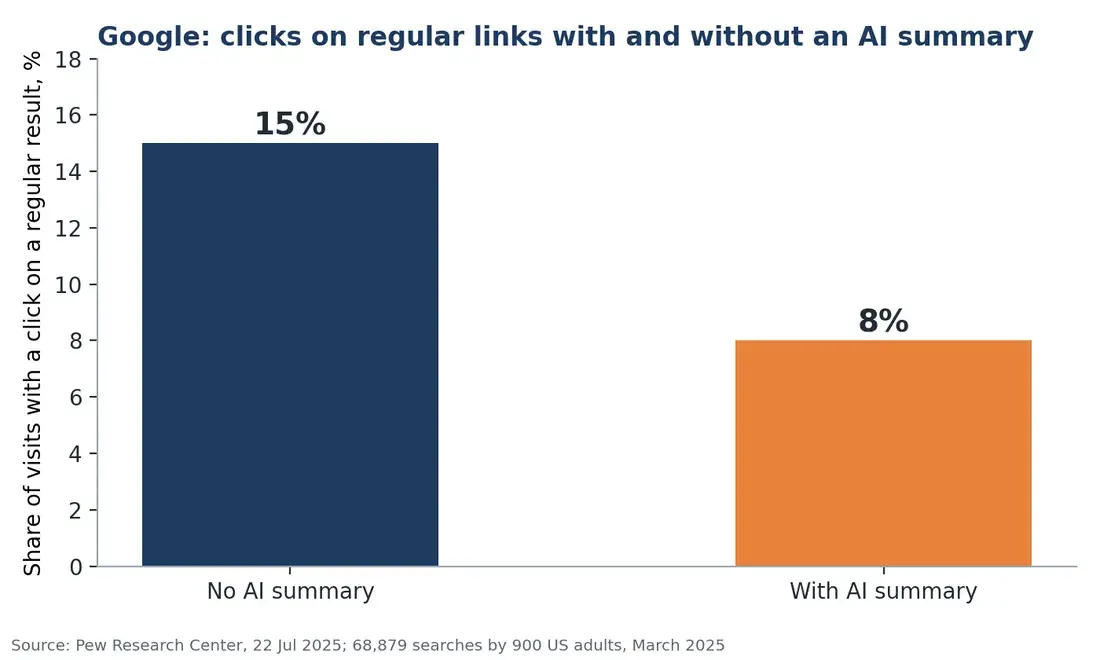
In March 2025 Pew Research tracked 68,879 real Google searches. When an AI summary appeared, people clicked a regular result in 8% of visits; without one, in 15%. By late September 2026 Ahrefs found AI Overviews on 83% of branded searches in the US on a single day, the queries people type when they already know your name. The assistant answers first, names a few brands, and often nothing gets clicked. If your brand is not among the ones named, you did not lose a ranking position. You were not considered. And your analytics will not show it: no click, no session, no row in a report.
That is the core difficulty of GEO (Generative Engine Optimization): the effect is real, and almost nothing measures it. So I go in a chain, and every section follows from the previous one. First the numbers: what is happening to clicks and traffic, and where the data contradict each other. Then the mechanics: how these systems pick a brand to name. Then the audit, the diagnosis, the fixes, and only then the money. The guide closes with a 90-day plan.
How to read the numbers
Fact is a number with a source and a date. Correlation is a link with no proven cause. Self-reported is a company talking about itself. Hypothesis is my logic, not data. Every case in this guide is real and linked; there are no invented companies. Charts credited to a vendor are published by that vendor; charts without a vendor name are mine, rebuilt from published numbers. If I could not check a number at the source, I say so.
1. Clicks are leaving the results page
Let me start with what is best verified. In July 2025 Pew Research Center published a field study: 900 US adults, 68,879 searches in March 2025. When Google showed an AI summary, users clicked a regular result in 8% of visits. When it did not, 15%. Clicks on links inside the summary itself happened in about 1% of visits. The browsing session ended on the page with an AI summary in 26% of cases, against 16% without one (Pew Research).
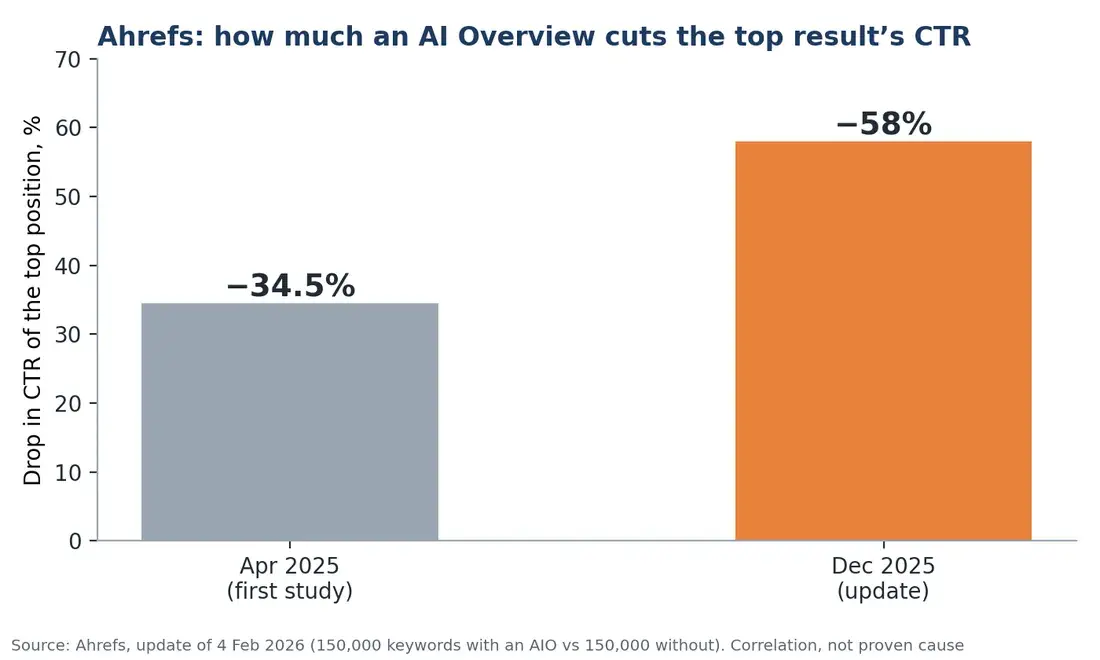
Ahrefs shows the same vector by position. In its 4 February 2026 update (150,000 keywords with an AI Overview against 150,000 without, Search Console data), the presence of an AI Overview correlates with a 58% lower click-through rate for the top-ranked page. In April 2025 the same method gave 34.5%. This is a correlation, and Ahrefs says so itself; but Pew used a different method and lands in the same direction (Ahrefs).
Be careful with generalising. This is about queries where Google showed a summary; Pew found them in roughly 18% of the searches in its sample. But that slice is growing, and it is exactly where informational and comparison queries live: “how to choose”, “which is better”.
It has reached brand-name searches too
For a long time brand-name queries were the safe zone: whoever types your name is already yours. Ahrefs checked it in autumn 2026 on 232.8 million US desktop search-result crawls (July to September). The share of branded keywords with an AI Overview rose from 61.3% in July to 65.1% in August and 73.3% in September, and on 29 September it was 82.91%. In Ahrefs’ earlier study (November 2025, a different sample) the figure was 13.1%. For non-branded keywords the monthly share went from 73.5% to 78.3%, so the gap between the two nearly closed (Ahrefs, 2 Oct 2026).
In a separate panel of 100 big brand names (Interbrand’s Best Global Brands 2025), five had an AI Overview on 1 July and 63 on 30 September; in 48 of those 63 it sat in position one. In the 57 overviews with visible source lists, Wikipedia was cited in 71.9%, YouTube in 38.6% and LinkedIn in 22.8%. The good news: only one competitor-owned site appeared across those lists, and two of 58 answers named a competitor.
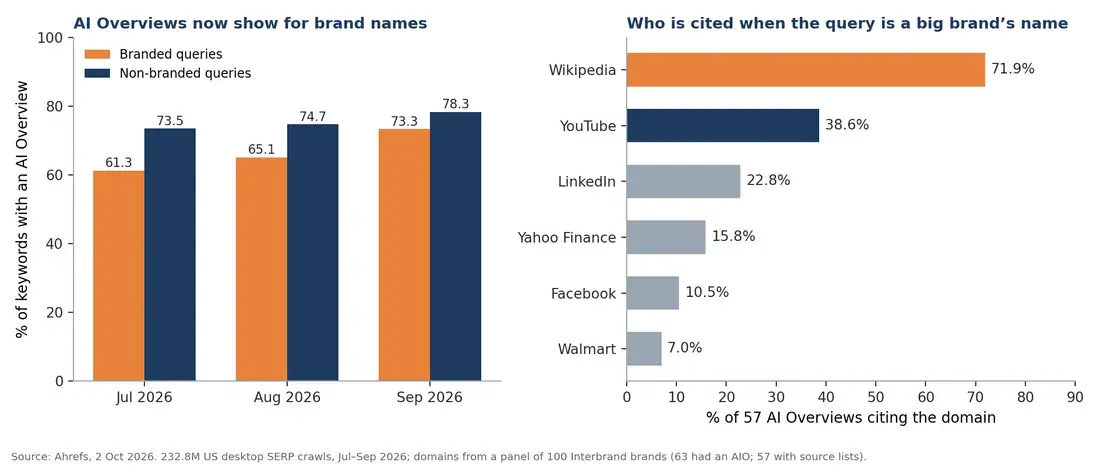
The practical reading: the first thing a person sees when typing your name is more and more often an assembled answer built from sources you do not own. If the Wikipedia article, the YouTube videos about you and your LinkedIn page are outdated, that is what the answer repeats. The sample is large brands; I have not seen the same measurement for small D2C stores, so take it as the direction of travel, not as a number for your shop.
The conclusion GEO starts from
If a click on a regular link nearly halves, and almost nobody clicks inside the summary, fighting for a “position” is not enough. You need to be inside the answer. The question is where attention goes and whether it is worth the effort. That is the next section.
2. Where demand goes: a small channel, fast growth, disputed quality
This is where most texts about GEO start lying in one direction or the other. “AI has replaced search” and “AI traffic is negligible” are equally wrong. Let us lay it out.
Volume: small, but the fastest-growing thing there is
Semrush’s traffic channel study (2025): AI traffic grew 66%, organic search 2.38%. AI is only 0.14% of total site traffic, while direct is 64.69% and organic 16.04% (Semrush). For e-commerce the peer-reviewed picture is similar: ChatGPT delivered under 0.2% of visits across 973 sites (INFORMS, Marketing Science).
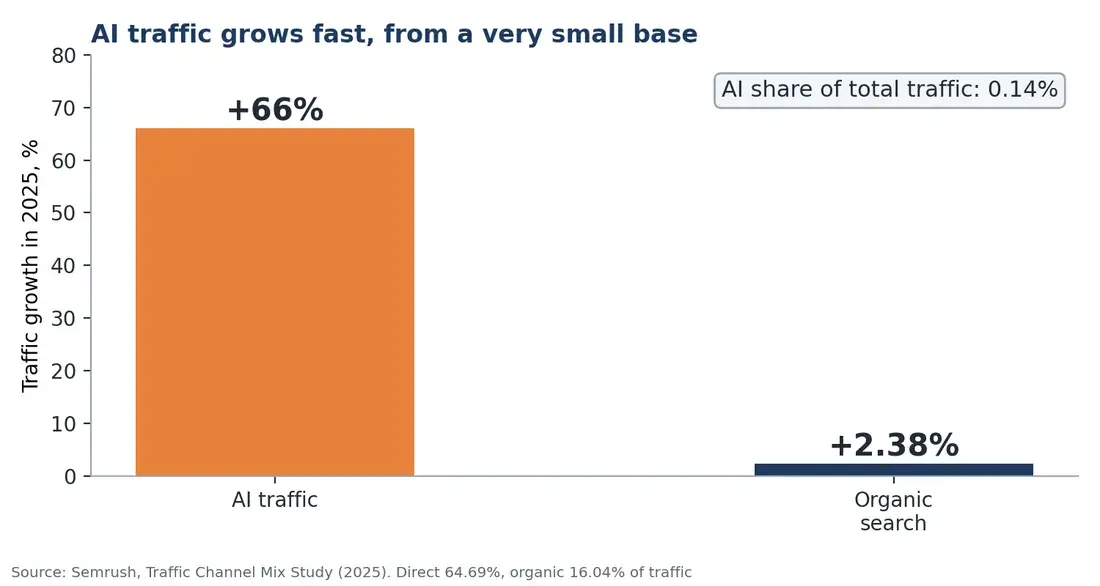
At the retailer level the picture is similar. In early 2026 leading online retailers told Digital Commerce 360 that less than 2% of their referral traffic came from AI; by September 2026 the typical figure was about 5%, and in some cases it was inching toward 10% (Digital Commerce 360, 16 Sep 2026). The individual retailers and what they say are in section 12.
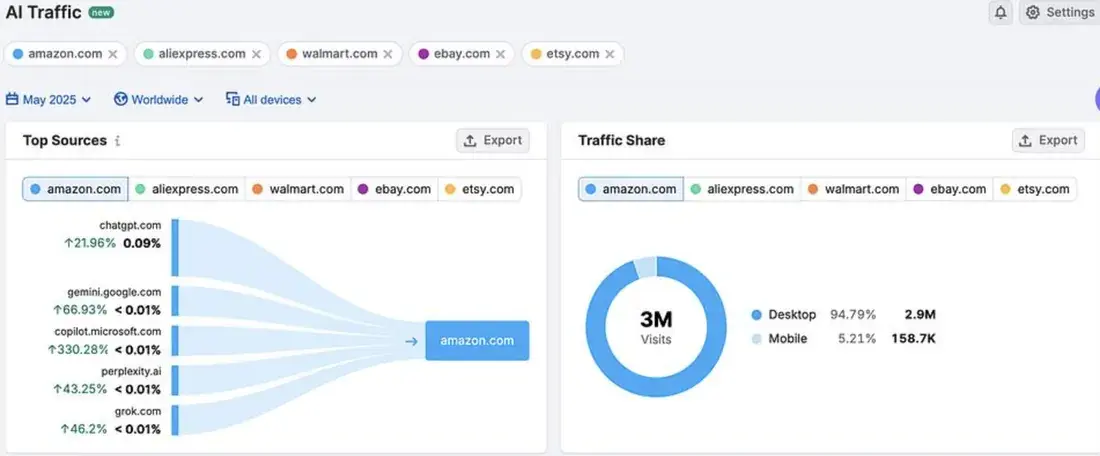
How small is small? Here is a traffic-analytics report for the world’s biggest retailer (screenshot below, May 2025, worldwide): chatgpt.com delivered 0.09% of amazon.com’s visits, and Gemini, Copilot, Perplexity and Grok each less than 0.01%. Even the largest marketplace gets almost nothing from AI referrals; the useful detail is the change column next to the shares: Copilot +330%, Gemini +67%, Grok +46%, Perplexity +43%, ChatGPT +22% (the period of comparison is not shown in the screenshot).
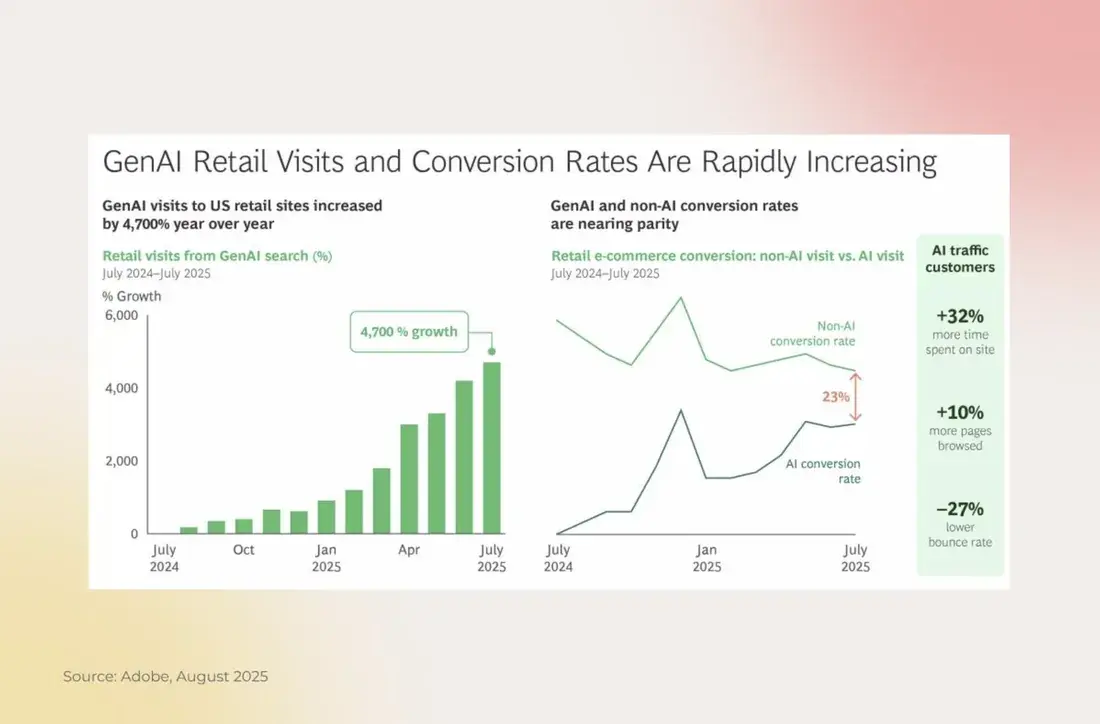
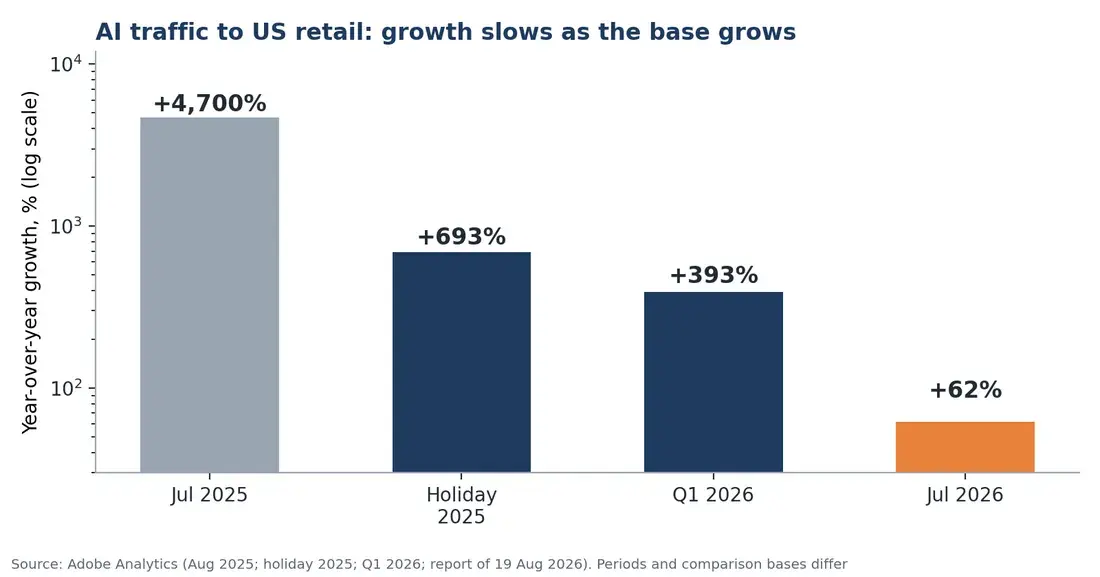
Adobe tracks the growth on US retail sites like this: in July 2025, visits from AI sources were up 4,700% year over year; in the 2025 holiday season, 693%; in Q1 2026, 393%; in July 2026, 62%. Look at the shape: the rate falls because the base grows. That is a young channel normalising, not a channel cooling (Adobe via Digital Commerce 360). In the UK Adobe reports AI referrals up 1,439% between October 2024 and August 2026 (Adobe UK); different write-ups give different starting months, so check the original.
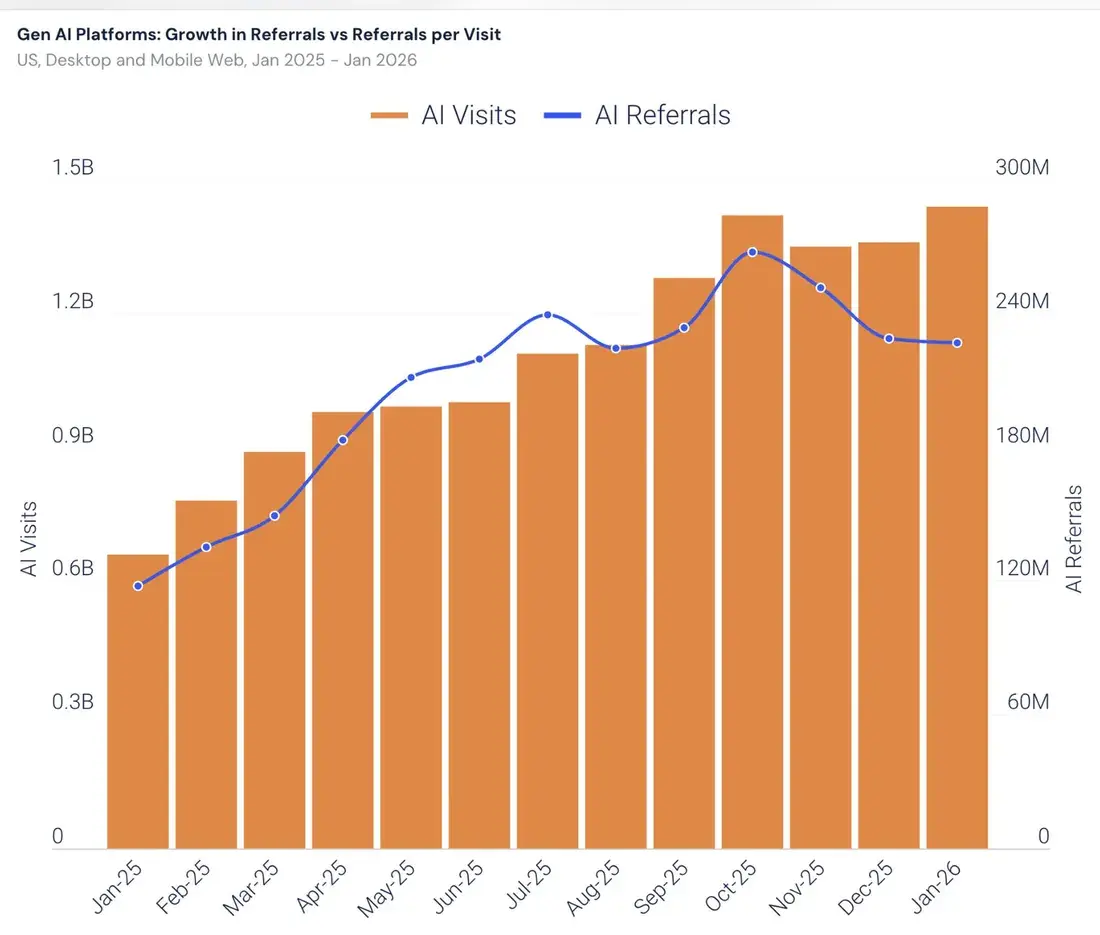
One more nuance that the growth charts hide. Similarweb tracked US generative-AI platforms from January 2025 to January 2026 and plotted visits against referrals out to other sites. Visits roughly doubled (from about 0.65 billion to about 1.4 billion a month, read from the chart). Referrals rose more slowly, peaked around October 2025 and then slid, while visits kept climbing. In plain words: people increasingly get their answer inside the chat and do not click through. Growth of use does not equal growth of your traffic.
Quality: the sources disagree, and that matters
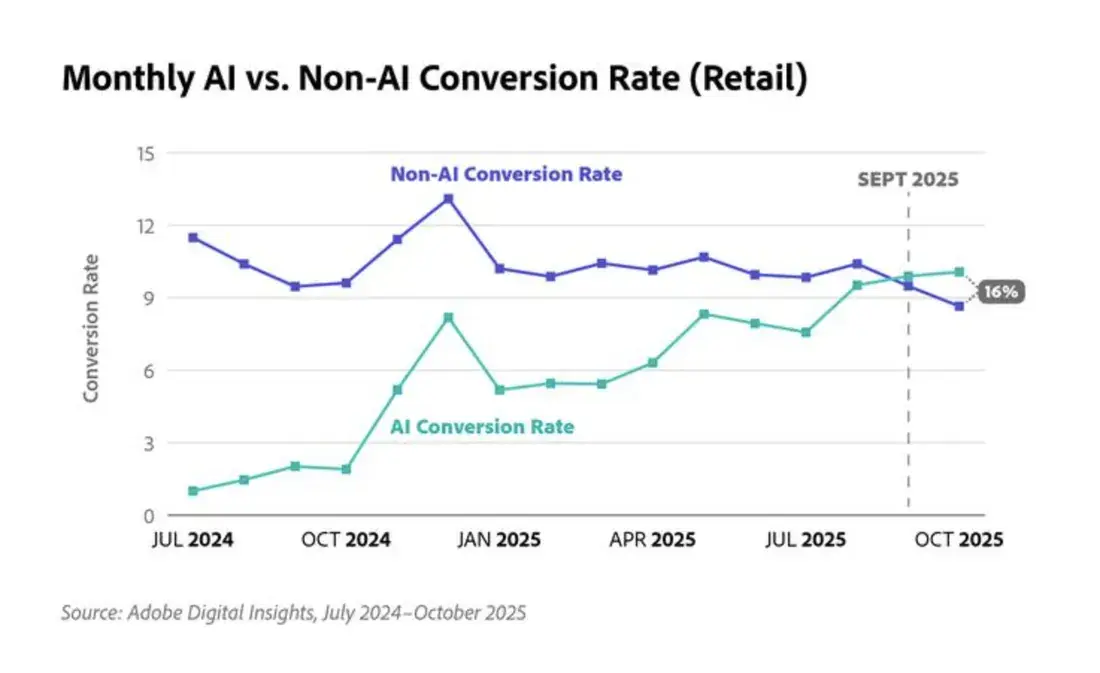
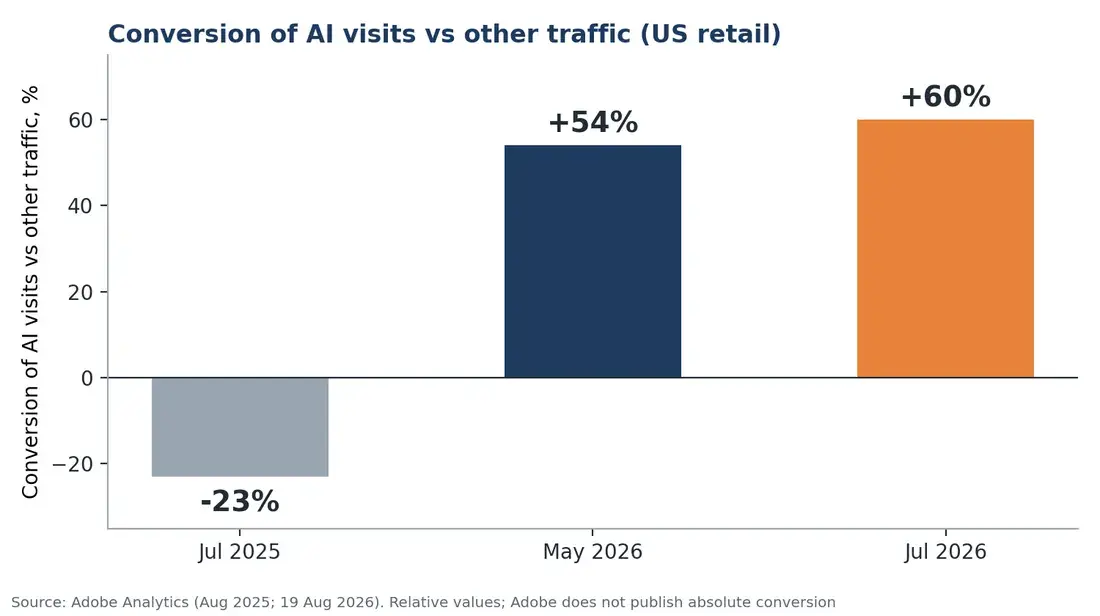
Adobe tells a story in time. In July 2025 AI-referred visits converted about 23% worse than other traffic. By September 2025 AI conversion had caught up and passed non-AI; in October it was 16% above. In May 2026 the gap was +54%, in July 2026 +60%, with revenue per visit +53% and pages per visit +22% (Digital Commerce 360). Adobe counts as “AI traffic” only people who clicked a link from an AI source, and publishes relative numbers: “+60%” can mean 8% against 5% or 1.6% against 1%.
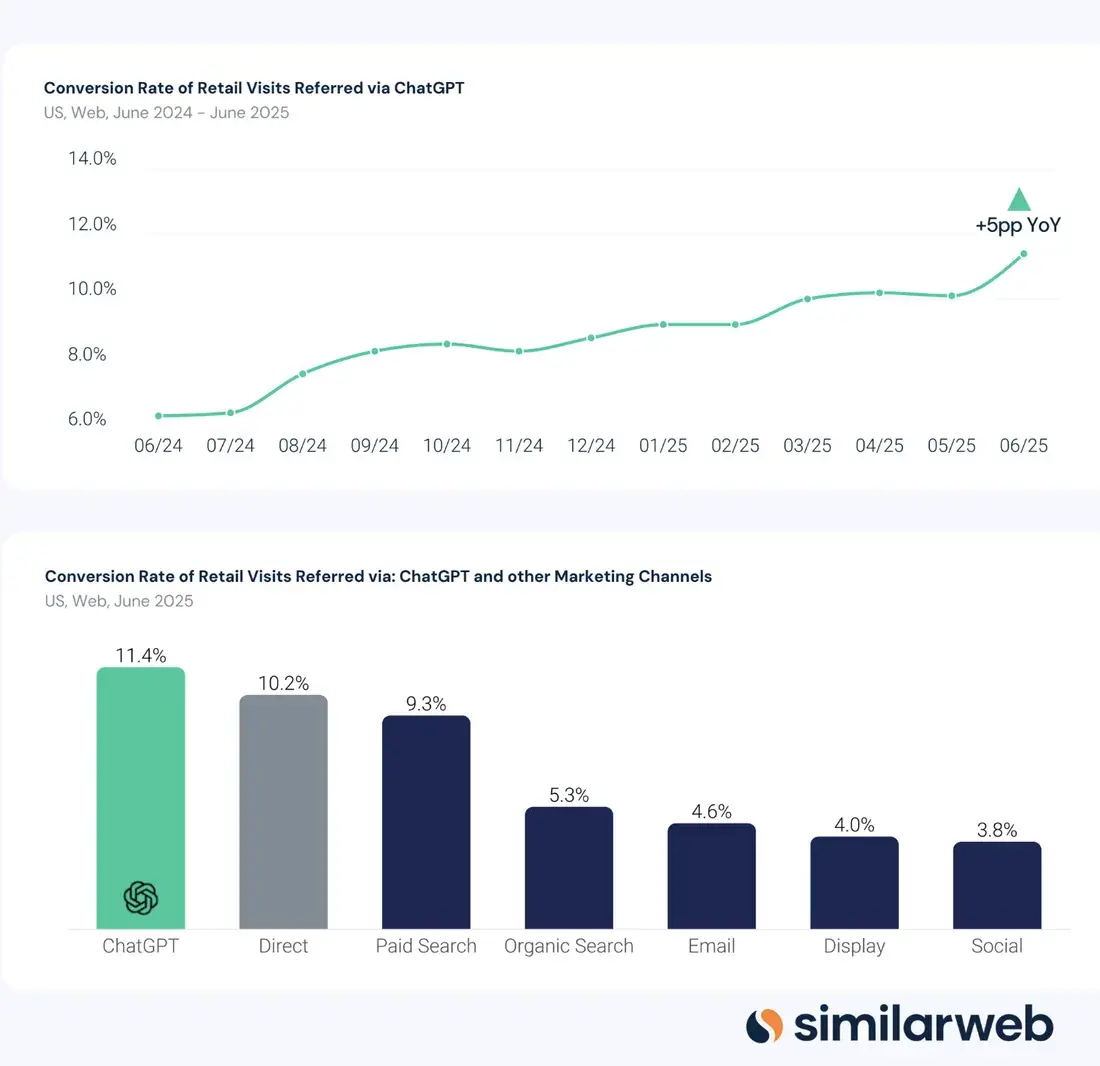
Similarweb looks differently. In June 2025 it measured conversion of US retail visits referred by ChatGPT at 11.4%, against 5.3% for organic and 9.3% for paid search; a year earlier, in June 2024, ChatGPT referrals converted at roughly 6.4% (read from the chart), so the quality of this traffic climbed by about five percentage points in twelve months (Similarweb).
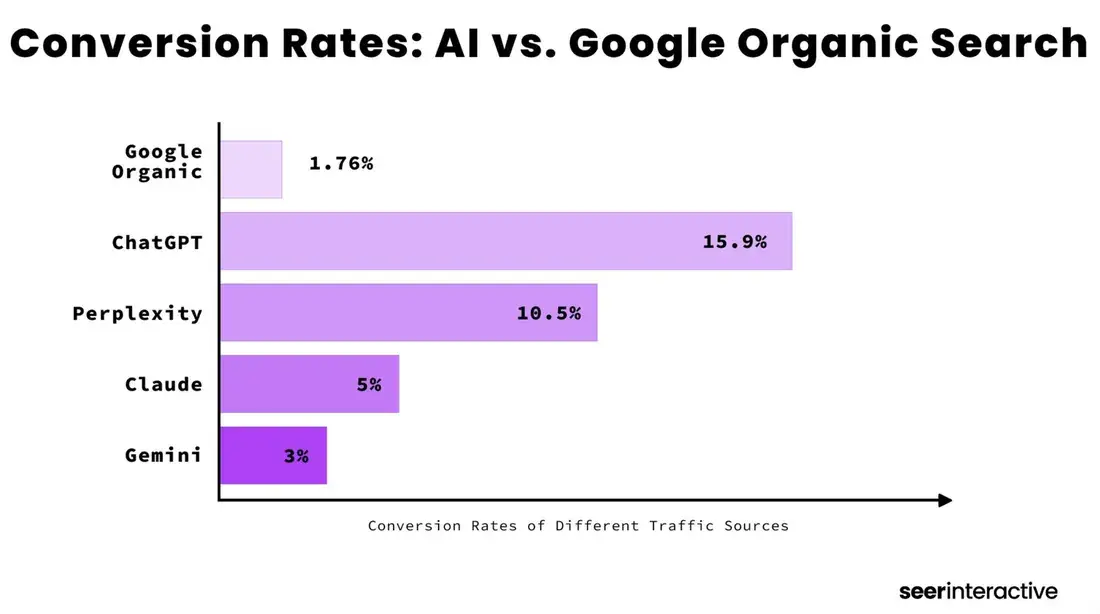
Seer Interactive published its own comparison, where ChatGPT converted at 15.9%, Perplexity at 10.5%, Claude 5% and Gemini 3%, against 1.76% for Google organic. I show it because it is real and widely quoted, but I have not audited its sample, and the spread between AI platforms is itself a warning: “AI traffic” is not one thing.
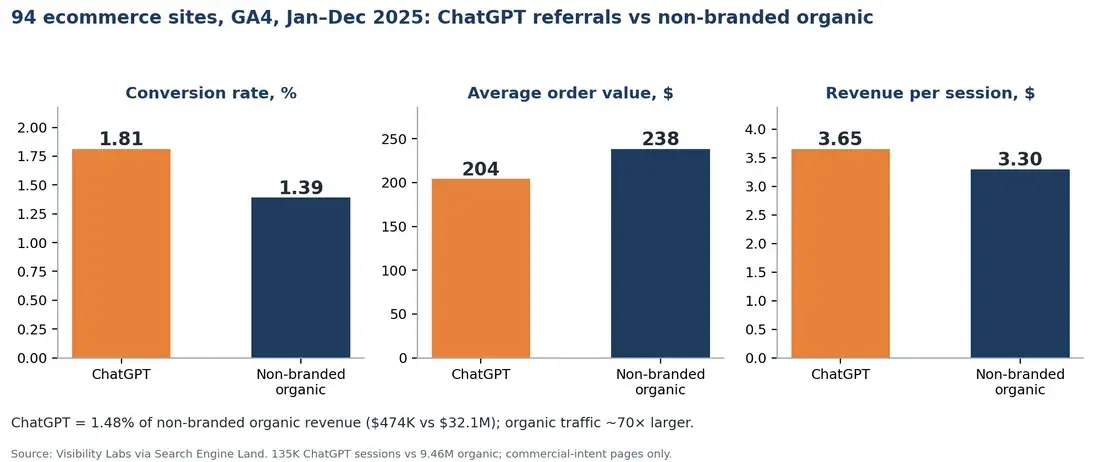
A fourth measurement comes from GA4 accounts rather than panels. Visibility Labs looked at 94 seven- and eight-figure ecommerce brands across 2025. ChatGPT referral sessions converted at 1.81% against 1.39% for non-branded organic (31% higher, and better in 10 of 12 months), with a lower average order value ($204 against $238) but still a higher revenue per session ($3.65 against $3.30). The scale tells the other half: ChatGPT brought $474,000 against $32.1 million from non-branded organic, 1.48% of it, and organic traffic was about 70 times larger. Visibility Labs ties the early-2025 spike to the shopping carousel launched in April 2025 and notes that growth flattened from August; some early months had only 15 to 37 ChatGPT conversions, so the early numbers are noisy (Search Engine Land).
And here is the sceptical counterexample. Kaiser and Schulze in Marketing Science analysed 12 months (August 2024 – July 2025) of 973 e-commerce websites with about $20 billion in annual revenue. ChatGPT referrals converted worse than every channel except paid social; ChatGPT was under 0.2% of traffic; conversion improved over the period (INFORMS; summary: Digiday).
How to reconcile the numbers
The sources measure different things: different periods (2025 vs 2026), samples and definitions of an “AI visit”. Consistently, three things follow. The channel is small. It is growing fast. Its quality is improving with time, and in 2026 Adobe puts it above average, although Edible Brands, for one, reports AI conversion above 5% but below its own site average. There is no universal “AI converts N times better”; your number exists only in your own analytics (section 11). And a chart that circulates saying “65% of e-commerce traffic goes to AI agents in 2026” has no source attached. Do not use it.
The main thing: influence without a click
If you only look at clicks, the channel looks negligible. But Similarweb tracked what happens after a recommendation. In “The Downstream Impact of AI Visibility” (US desktop panel, July–December 2025), users who saw a ChatGPT answer visited the recommended brand much more often than its competitor. When Capital One was recommended, 14.2% visited Capital One and 3.8% visited American Express. Kayak: 12.0% against 3.4% for Skyscanner. Sephora: 7.9% against 3.3% for Ulta; when Ulta was recommended, 7.6% visited Ulta and 4.6% Sephora. On average, recommended brands received a visit within seven days about 2.5 times more often than non-recommended ones. A key detail: a large share of those visits arrived through branded search (55.9% of the downstream traffic in the study), so in your analytics it looks like “organic”. The study has limits: it is a panel, not an experiment, and part of the gap reflects the brands’ initial popularity (Similarweb).
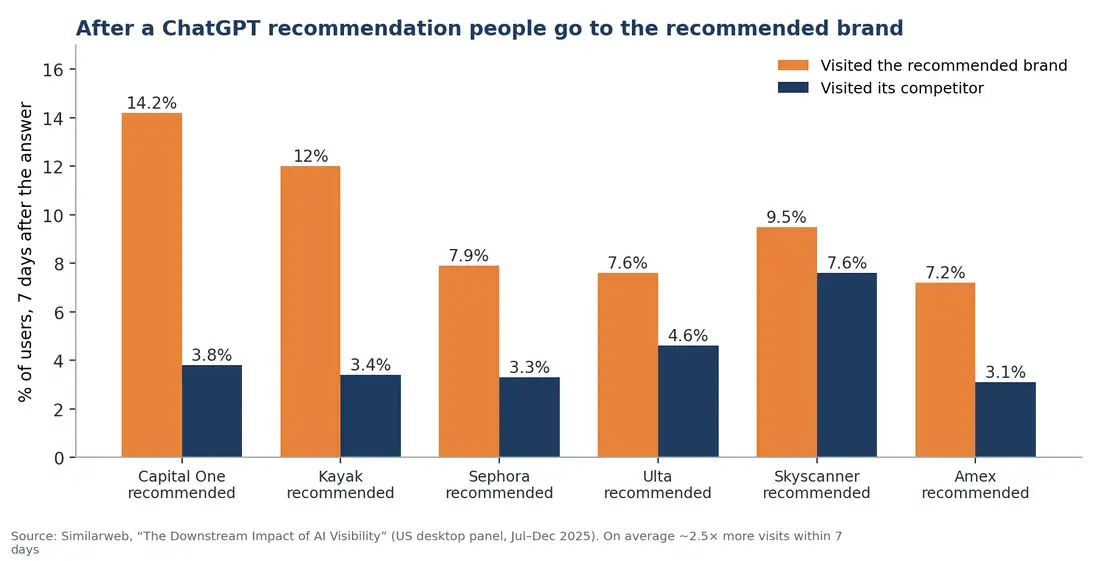
From here comes the constraint that defines everything after. Measurable AI traffic is small and undercounted, and the real effect hides in branded search and direct visits. So we must measure not clicks but presence in answers and what happens after. If you read my piece on marketing and sales as one shared result, the principle is the same: a metric is not the goal. A session from ChatGPT is not a customer, and a mention in an answer is not a session.
3. What GEO is, and what it is not
GEO is the work of making generative systems (ChatGPT, Google AI Overviews and AI Mode, Gemini, Perplexity, Copilot, Claude) name your brand, cite your pages and recommend your products. You will also see AEO (answer engine optimization) and LLMO. In practice the difference is small: the goal is presence in the answer.

The term entered circulation with the academic paper by Aggarwal and co-authors, “GEO: Generative Engine Optimization” (KDD 2024). They built a benchmark of diverse queries and showed that some content tactics can raise visibility in generated answers by up to 40%, with efficacy varying by domain (arXiv:2311.09735). Do not retell this as “quotes and statistics always give +40%”: it is a lab benchmark, not a promise for your store.
Now what GEO is not. In May 2026 Google published its own guide to optimising for generative features of Search. As retold by trade press, the substance is: there is no special markup for AI Overviews and AI Mode, no llms.txt is required, and the entry condition is ordinary indexability and eligibility to be shown with a snippet (retold in the Semrush blog). In other words, GEO is a layer on top of SEO, not a replacement. Without indexing, sensible architecture and crawler access, no “AI copywriting” will help.
| Parameter | SEO | GEO |
|---|---|---|
| Goal | Position and click | Mention, citation, recommendation; click as a bonus |
| Unit of work | A page for a query | Brand, facts and the environment: your page plus everything written about you |
| Main signals | Relevance, links, behaviour | Brand mentions, clarity and freshness of facts, trust of sources |
| Result | Reproducible within fluctuation | Changes run to run: needs a series of measurements |
| Metrics | Rankings, impressions, clicks, traffic | Share of mentions and citations, share of voice, AI referrals, branded demand |
What happened to buying inside the chat
A year ago the loudest promise was that the purchase itself would move into the assistant. OpenAI launched Instant Checkout in late 2025, and Walmart offered about 200,000 products through it from November. By March 2026 the experiment was being rolled back. Walmart’s Daniel Danker said purchases completed inside ChatGPT converted at one third the rate of click-outs to Walmart.com and called the experience “unsatisfying” (Search Engine Land). On 24 March 2026 OpenAI wrote that the first version of Instant Checkout “did not offer the level of flexibility” it wanted, let merchants use their own checkout, and refocused on product discovery; Walmart moved to a ChatGPT app that takes shoppers into its own environment with account linking, loyalty and Walmart payments (OpenAI). Google took a parallel route: its Universal Commerce Protocol (update of 19 March 2026) adds a cart option, real-time catalogue access to variants, inventory and pricing, and identity linking so shoppers keep their loyalty benefits (Google).
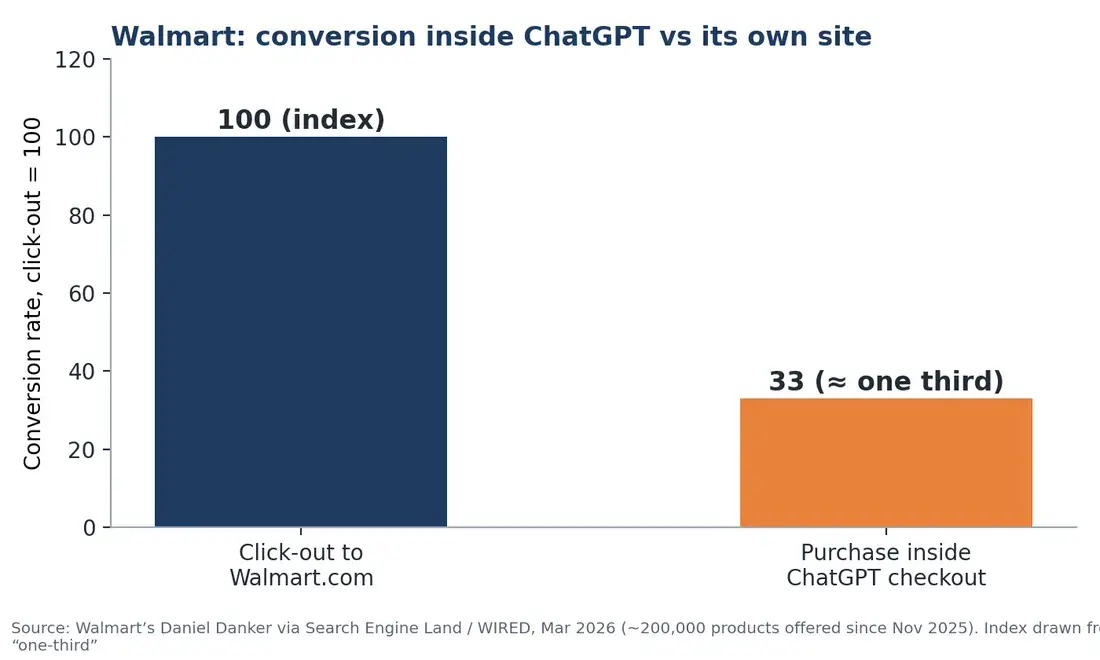
This changes where effort goes. The assistant is becoming a layer for discovery and comparison, and the sale is completed on the merchant’s own site or app. The work moves from “win the checkout in the chat” to “be in the answer, and make the click-through convert”, which is exactly what the data, pages and measurement in the next sections are about.
If you build a brand and not only traffic, GEO is familiar in essence. In my guide to brand marketing and the piece on brand strategy and positioning I look at how to become the one who is chosen and named. Generative search makes this testable: you can literally ask the system whom it names in your category.
4. How the system decides whom to name
Roughly, an answer is built from two sources: what the model “remembers” from training, and what it finds at the moment of the query. For a question about fresh prices and availability it searches; for “what is retinol” it may answer from memory. For its search, Google describes a mechanism called query fan-out: a complex query is split into several related sub-queries, and the answer is assembled from what each returns.
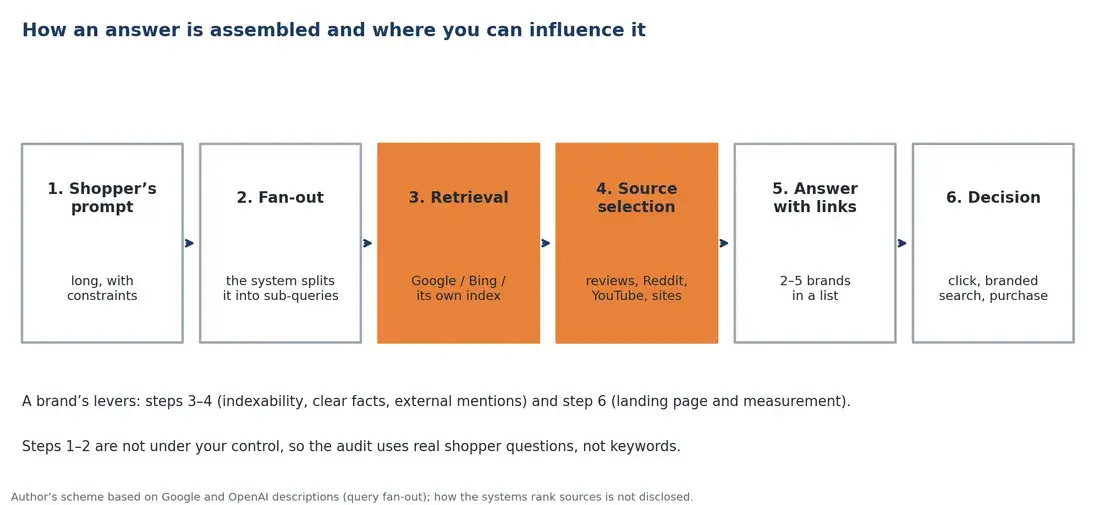
Neither OpenAI nor Google publishes the source-selection formula. So everything we know is observation. Three observations deserve trust, because they come from large samples.
Observation 1: they cite the environment around a brand, not only its site
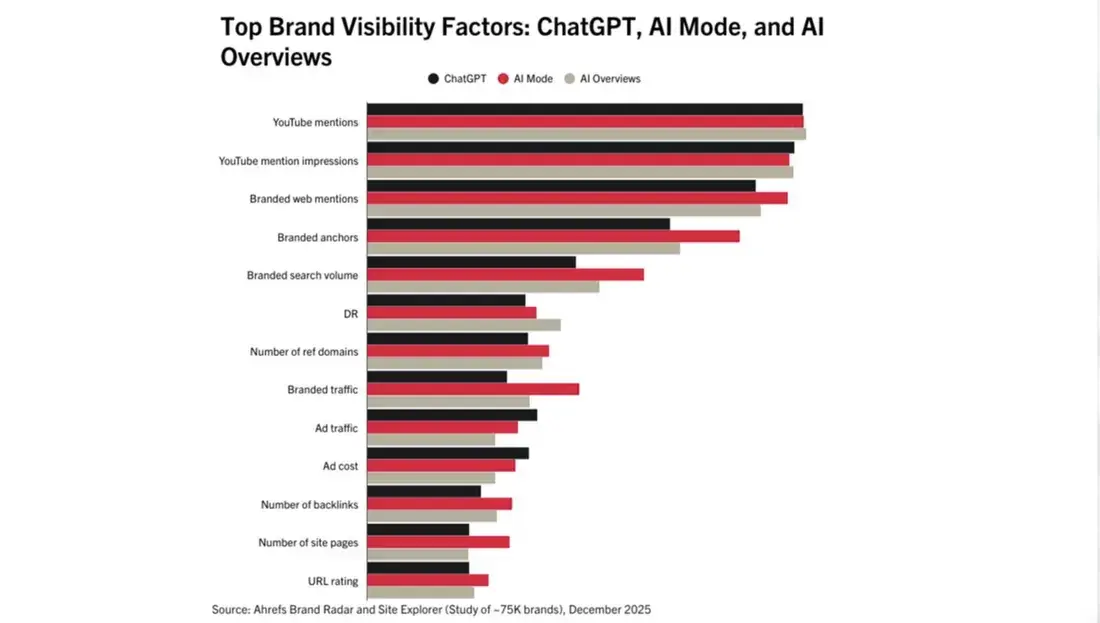
Ahrefs, on 75,000 brands (December 2025), compared how different factors correlate with brand mentions in ChatGPT, Google AI Mode and AI Overviews. YouTube mentions came first for all three, followed by branded web mentions and branded anchors; classic metrics such as number of backlinks and URL rating sit at the bottom. The pattern is nearly identical across the three systems (Ahrefs).
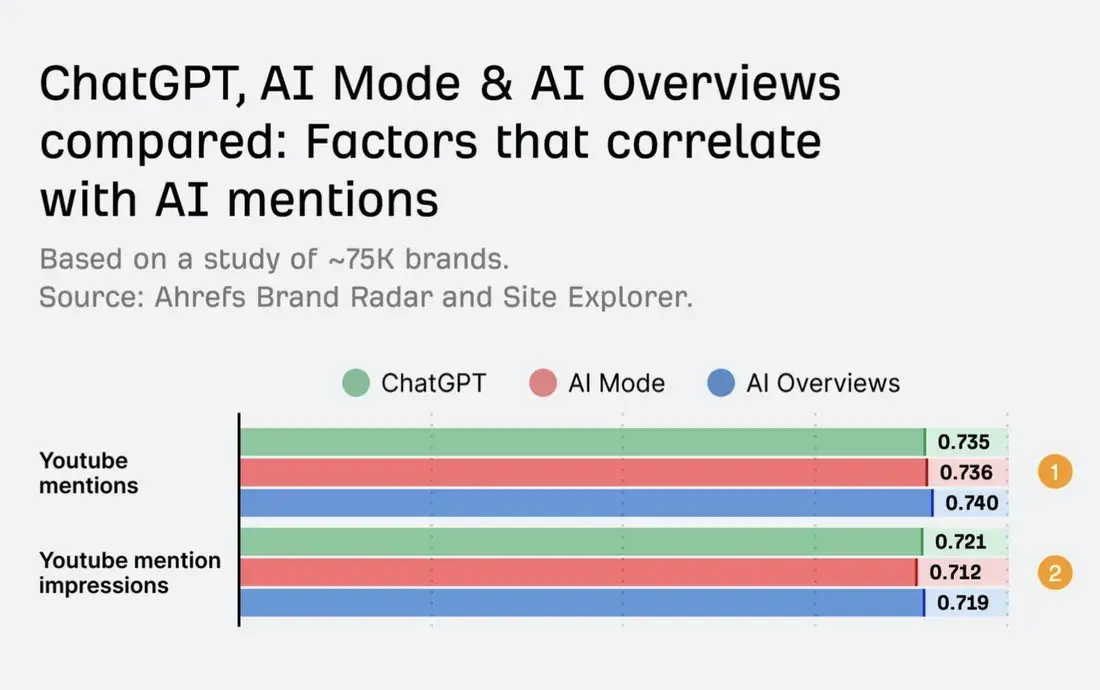
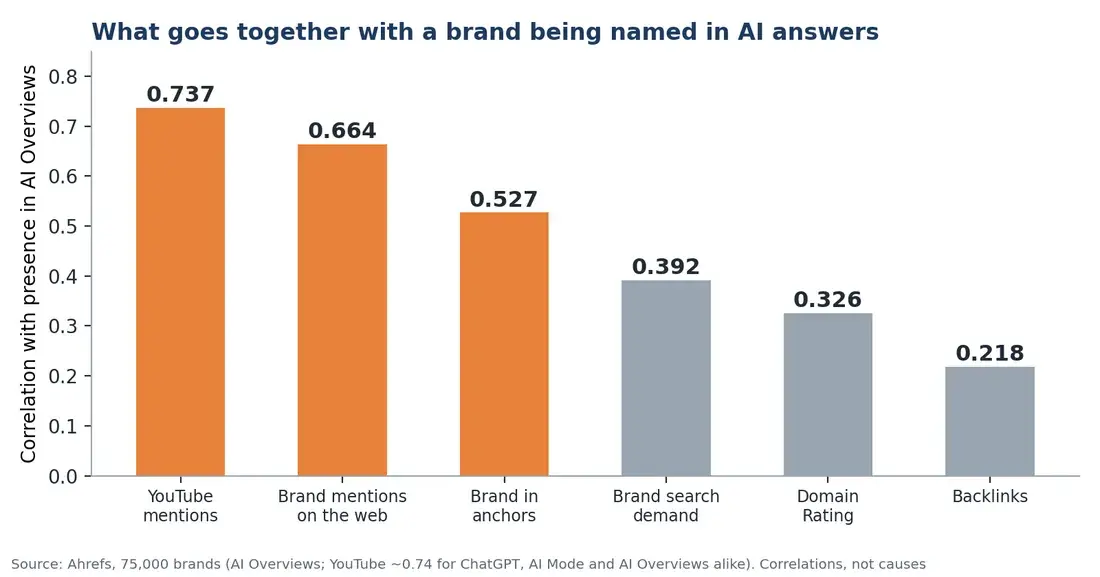
Numbers for AI Overviews: YouTube mentions 0.737, branded web mentions 0.664, branded anchors 0.527, branded search demand 0.392, Domain Rating 0.326, backlinks 0.218. About 26% of brands had no AI Overview mentions at all and were excluded from the analysis.
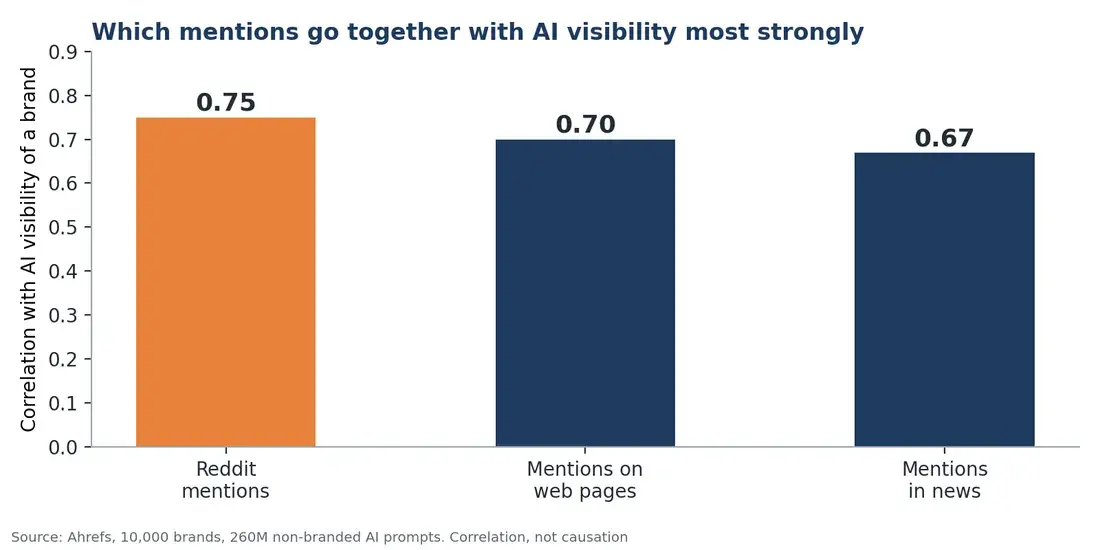
A second Ahrefs study, on 10,000 brands and 260 million non-branded AI prompts, looks at where mentions happen: Reddit mentions correlate at 0.75, mentions on web pages at 0.70, news mentions at 0.67. Brands with ten times more Reddit mentions had roughly 5.5 times more AI mentions (Ahrefs). These are correlations from one vendor’s data and I found no independent replication. The practical sense is still clear: what others say about you weighs more than what you say about yourself, and more than classic backlinks.
Observation 2: format decides
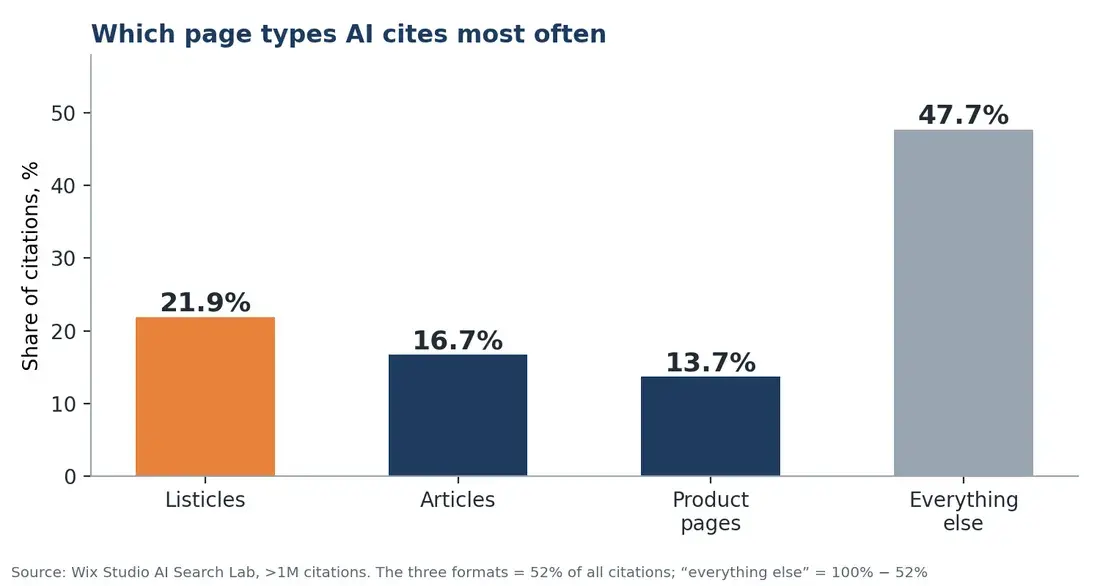
Wix AI Search Lab analysed more than a million citations. Listicles give 21.9%, articles 16.7%, product pages 13.7%; together 52% of all citations. “Alternatives” and head-to-head comparison pages give under 3% combined. For commercial queries listicles are cited in 40% of cases, almost double other intents (Wix Studio; summary: Search Engine Land). This is vendor data: it shows what is cited today, not what will be cited forever.
Observation 3: fresher pages are cited
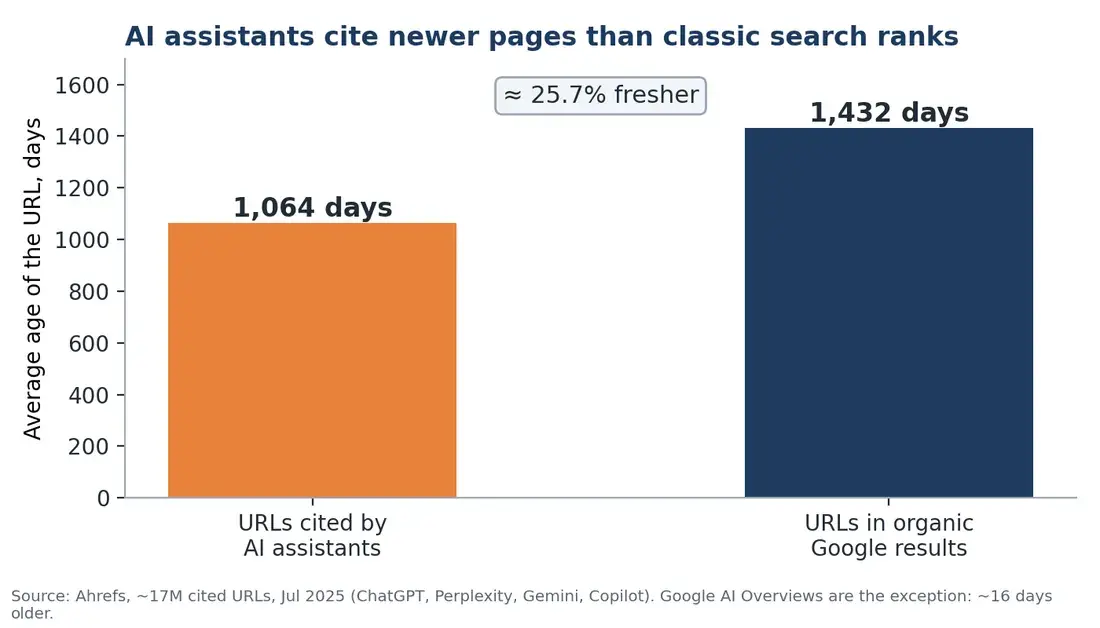
Ahrefs analysed about 17 million citations (Brand Radar data, July 2025). The average URL cited by AI assistants was 1,064 days old; the average URL in organic Google results was 1,432 days, so AI citations were 25.7% fresher. ChatGPT showed the strongest preference for fresh content; Google’s AI Overviews were the exception, citing pages about 16 days older than organic results. ChatGPT and Perplexity also list their in-text references from newest to oldest (Ahrefs). The sensible reading is not “change the date” but “keep the pages that answer buying questions current”; commentary on the study warns that cosmetic date changes are unlikely to help.
Observation 4: ChatGPT is neither the only system nor a stable one
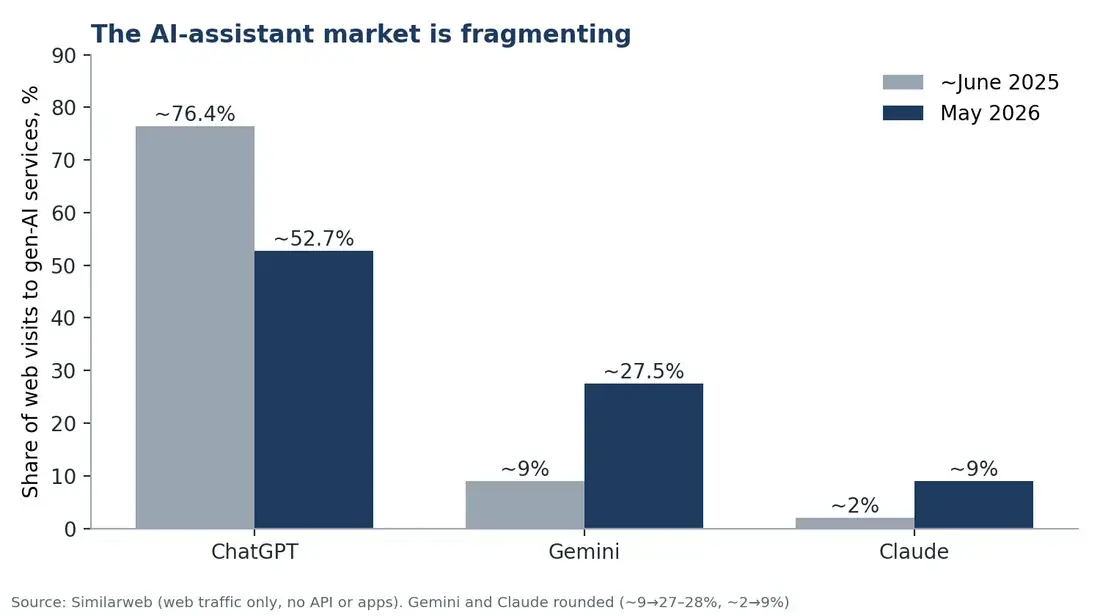
According to Similarweb, ChatGPT’s share of web visits to generative-AI services fell from about 76% in June 2025 to about 53% in May 2026; Gemini rose from about 9% to 27–28%, Claude from 2% to 9% (web only, no API or apps; Gemini and Claude figures are rounded) (Similarweb). Answers are also non-deterministic: the same question gives different recommendations run to run. One “we are not in the answer” measurement proves nothing.
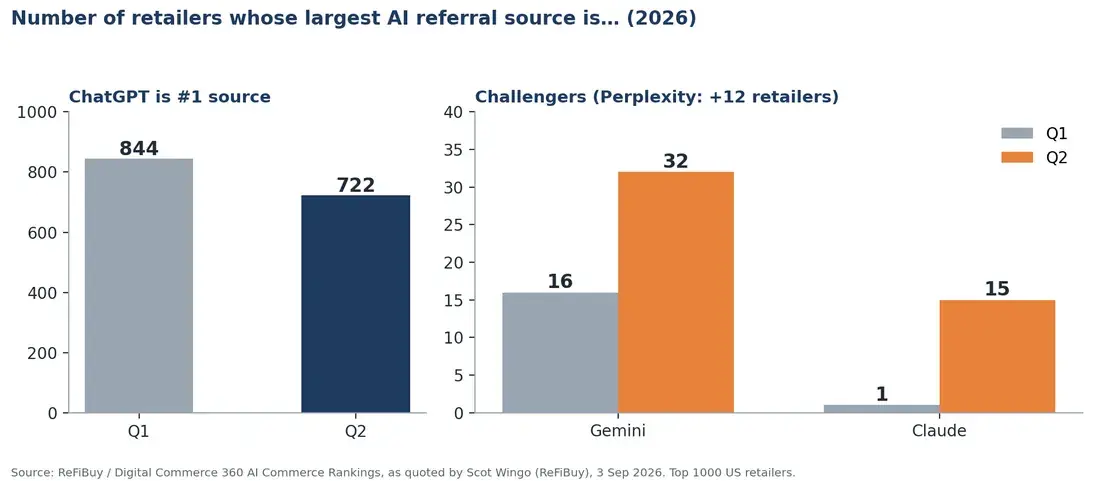
ReFiBuy’s AI Commerce Rankings, built with Digital Commerce 360 on the top 1,000 US retailers, show the same movement at the level of actual referrals. The number of retailers for which ChatGPT is the largest AI source fell from 844 in Q1 2026 to 722 in Q2; Gemini doubled from 16 to 32, Claude went from 1 to 15 and Perplexity gained 12 (Digital Commerce 360, 3 Sep 2026).
What follows
Three conclusions. The environment around the brand matters more than its own pages. You need factual, structured pages that can be quoted and kept current. You need presence in several systems, measured as a series, not once. That defines the next step: before any fixes you must know where you stand.
5. The audit: a one-day measurement
The aim of the audit is one starting number: in what percentage of runs were you mentioned and cited. Without it, two months from now you cannot tell effect from self-persuasion. My approach to experiments is the same as with creatives: an ad creative is a hypothesis you test. A page you rewrote for GEO is a hypothesis too, and the audit gives you the baseline.
Step 1. A list of 40–60 queries
Use shopper phrasing, not keywords. Where to get it: export questions from support and chats; take suggestions and the “People also ask” block; read Reddit threads (methods for finding primary data are in my piece on 48 free sources for market research and the consumer insight guide). Spread them over five types, 8–12 queries each.
| Type | Template | Where the real wording lives |
|---|---|---|
| Category | best [product] for [task] | On-site search log, “People also ask”, Reddit threads |
| With a constraint | [product] under [budget] for [person] | Support tickets, chat transcripts, product reviews |
| Comparison | [your brand] vs [competitor] for [task] | Competitor review pages, comparison threads |
| Brand | [brand]: reviews, downsides, worth it? | App-store and marketplace reviews, review sites |
| Action | where to buy [product], delivery, returns | Checkout and delivery FAQs, post-purchase survey |
The wording matters more than it seems. Edible Brands’ chief digital officer says its own on-site search data show customers moving from keywords to requests: instead of “chocolate-covered strawberries” they write something like “Get best gift for my uncle who loves X, Y and Z” (Digital Commerce 360, 17 Jun 2026). Your own search log and support inbox are the best free source of prompts, and they are already in your customers’ words.
Include prompts where your brand is not named. “What do you think of [your brand]?” only measures what the model already knows about you. “Best [product] for [task]” measures whether it names you unprompted, and that is visibility.
Step 2. Run it: 4–5 systems, 3 times each
ChatGPT with search, Google (AI Overviews and AI Mode), Gemini, Perplexity, Copilot. Each query three times, in a clean session, logged out, with your target country. For 50 queries in 4 systems at 3 runs that is 600 answers; by hand it is a day of work.
Step 3. The table and four numbers
| Prompt | Type | System | Run | Brand named? | Position | Link to your domain? | Tone | Who else is named |
|---|---|---|---|---|---|---|---|---|
| … | … | … | 1 / 2 / 3 | yes / no | … | yes / no | + / 0 / − | … |
| … | … | … | 1 / 2 / 3 | yes / no | … | yes / no | + / 0 / − | … |
This is an empty template: fill one row per prompt, per system, per run.
- Mention rate = runs that mention the brand ÷ all runs.
- Citation rate = runs with a link to your domain ÷ all runs.
- Share of voice = your mentions ÷ mentions of all brands on your competitor list.
- Tone and accuracy = share of neutral-or-positive mentions and share of answers without errors in price and specs.
Step 4. The sources
Write down which sites the systems link to for your queries. As a rule they are not your site but reviews, comparisons, Reddit, YouTube, marketplaces. That is your work map: you need to be present there. Open the page cited when a competitor is named and see how it is built.
What the tools look like (real examples)
You can run the audit by hand, and for a start you should. Once the list is fixed, monitoring platforms automate it. Here is what three of them show.
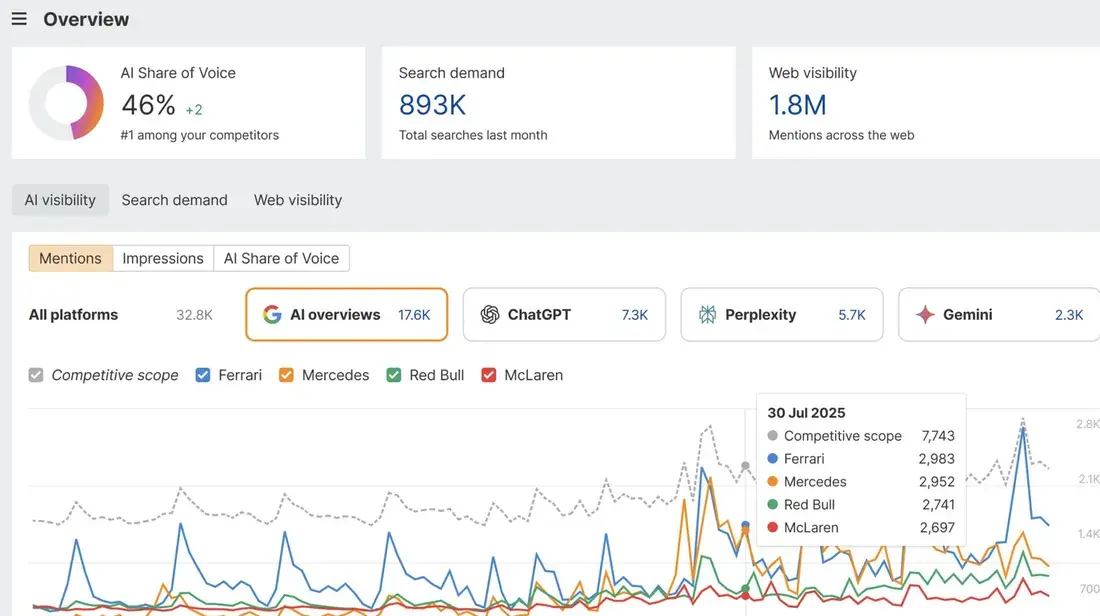
Ahrefs Brand Radar (demo set of four Formula 1 teams): AI share of voice 46%, search demand 893K searches a month, web visibility 1.8M mentions; all-platform mentions 32.8K, of which AI Overviews 17.6K, ChatGPT 7.3K, Perplexity 5.7K, Gemini 2.3K. The useful view is the line chart by platform, with the competitor set switchable.
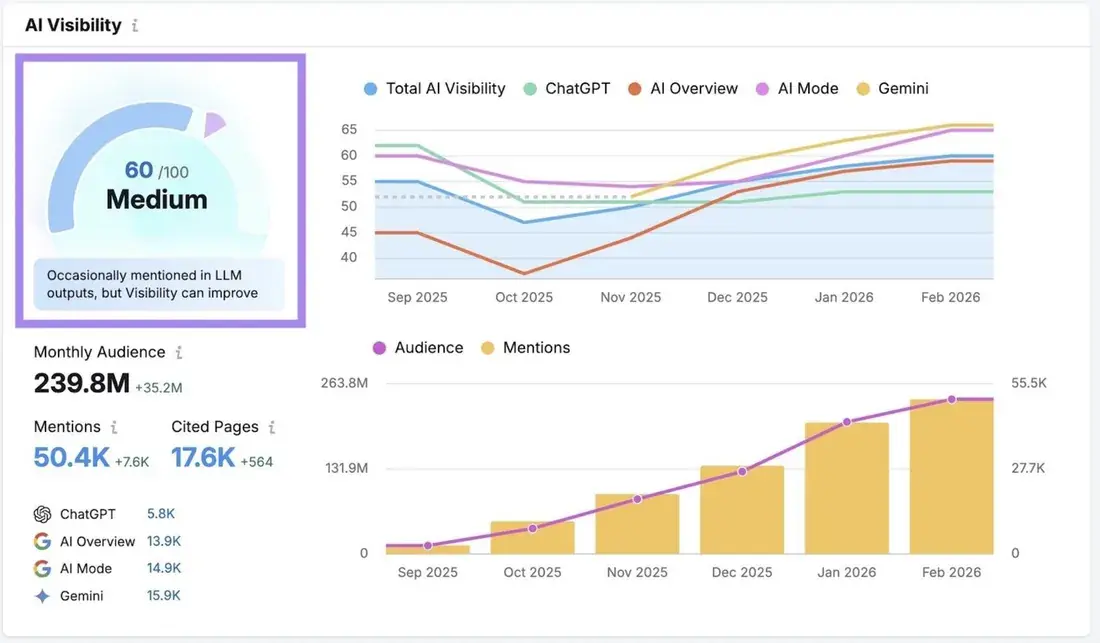
Semrush AI Visibility toolkit: a 0–100 visibility score (60, “Medium: occasionally mentioned in LLM outputs, but visibility can improve”), monthly audience 239.8M, 50.4K mentions and 17.6K cited pages; mentions split by ChatGPT, AI Overview, AI Mode and Gemini over September 2025 – February 2026.
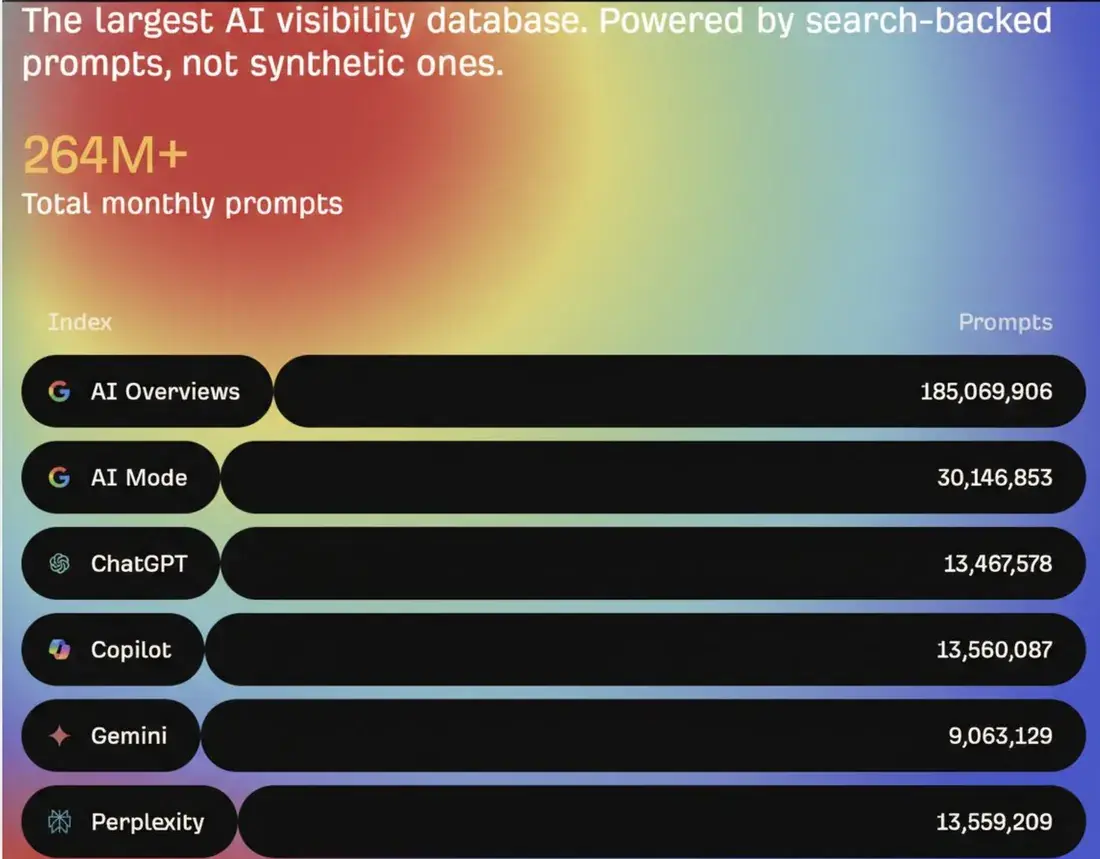
Profound describes itself as the largest AI-visibility database built on search-backed prompts rather than synthetic ones: 264M+ monthly prompts, of which AI Overviews 185.1M, AI Mode 30.1M, ChatGPT 13.5M, Copilot 13.6M, Gemini 9.1M and Perplexity 13.6M. These are the vendor’s own claims about the size of its panel, not independent numbers; useful mostly to see how the vendor distributes attention between platforms.
One more picture, and an important one. This is a daily AI share-of-voice series (Semrush, 20 June – 17 August 2025). Look at the noise: single days swing between roughly 5% and 40%, while the trend line climbs from about 10% to about 33%. This is the practical meaning of non-determinism: any single day or single run is almost useless; you read the trend over weeks.
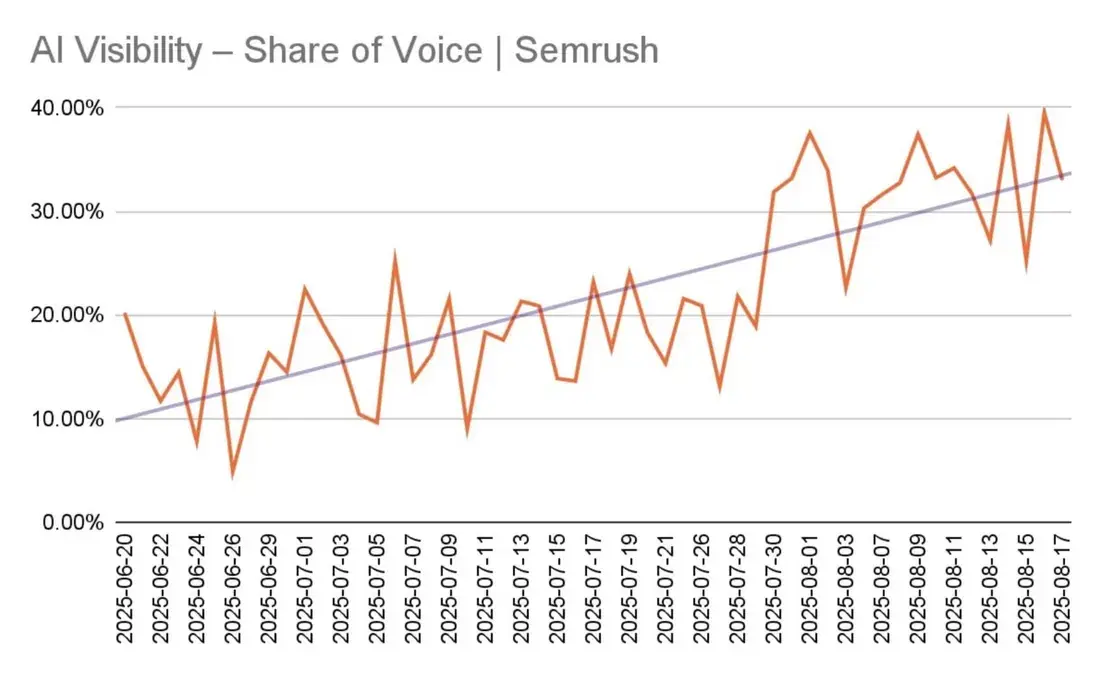
Independent data on the accuracy of these tools is thin, and their methodologies differ, so numbers from different tools are not comparable. Pick one, freeze your query list and compare only with yourself over time.
6. Diagnosis: why you are absent and what to do about it
A low mention rate is a symptom. The cause sits in one of four places, and each is treated differently. Do not optimise a subsystem until you have checked it is what limits the result.
| What you see in the audit | Likely cause | First action | § |
|---|---|---|---|
| Absent from answers, present in regular results | Few external mentions, or pages are not quotable | Source map from step 4, then reviews and page rewrites | 7, 9 |
| Mentioned, no link to your site | Model knows the brand but does not use your site as a source | Facts in HTML, tables, prices, comparisons | 7, 8, 10 |
| Errors in price and specs in the answer | Contradictions on old pages and in the feed | One source of truth, fresh feed, markup | 8, 10 |
| Negative tone | Sources say bad things (reviews, Reddit) | Fix the product and service, not the texts | 9 |
| Same competitors always named | They are entrenched in reviews | Find those reviews and get included | 9 |
| Results jump between runs | Normal non-determinism | Decide by rate, not by one run | 5 |
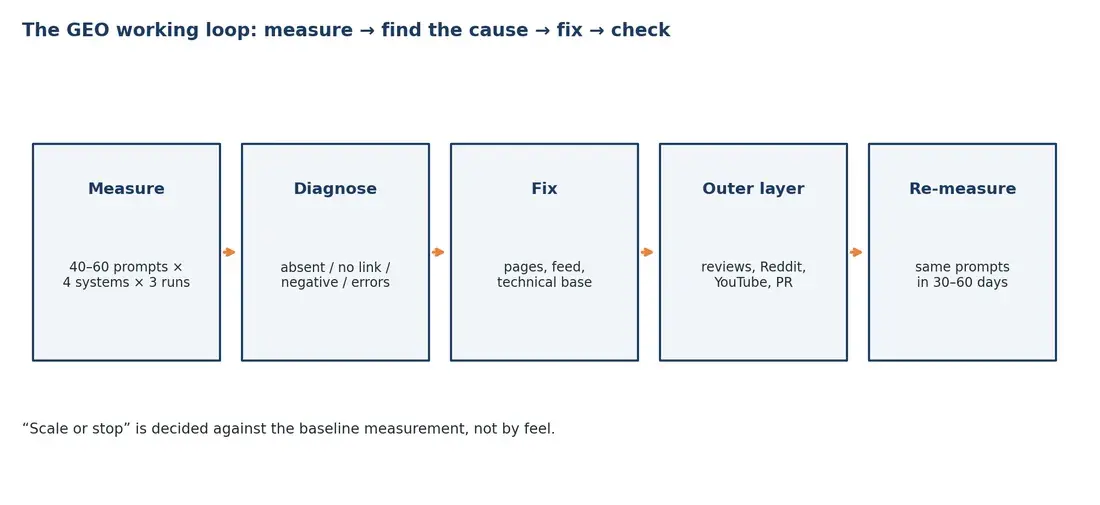
7. Pages: what to change and in what order
The idea is simple: a model cuts a fragment out of your page and pastes it into an answer. A page wins if the fragment is self-contained, accurate and tied to the product. Google’s guidance, as retold in the trade press, asks for no special markup, so write for people, but in such a way that a fact can be extracted.
What retailers say they changed
Three retailers describe the same shift in their own words (all Digital Commerce 360 interviews). Edible Brands’ chief digital officer Erica Randerson says shoppers now make requests instead of typing keywords, and the company sees it in its on-site search. Cotopaxi’s chief global officer Stephan Jacob describes moving product data from keyword discovery to contextual discovery, with use cases “explained in human language”, and notes that every marketplace and platform asks for slightly different attributes (Digital Commerce 360, 2 Jun 2026). Vessi’s director of D2C Ray Hua gives the example of a shopper planning a hiking trip who wants waterproof shoes and asks whether the brand has content ready for that scenario; the company keeps its catalogue clean so models can identify products, and focuses on benefits and use cases (Digital Commerce 360, 29 Apr 2026).
All three describe a process, not a result: none of the articles shows numbers proving that these changes raised AI visibility. I use them as a direction for what to write, not as proof of what works.
Answer first, facts in a table
Rules that follow:
- The first 2–3 sentences under a heading are the answer, not a run-up. Phrase the heading as the shopper’s question.
- One fact, one statement. Price, weight, dimensions, composition, delivery time, return terms: in text and in a table, not only in an image and not behind a tab.
- Honest downsides. “Fits everyone” convinces neither people nor models. Say who the product is not for.
- Date and author. Update date, name and role of the author, data source, test method. This is part of E-E-A-T (experience, expertise, authoritativeness, trust).
- Replace adjectives with numbers. “Reliable” is nothing; “5-year warranty, 700 km life in our test” is quotable.
A page template for a product or a roundup
H1: [Product] — who it is for and what for
[2–3 answer sentences: who it fits, who it does not, key difference, price]
H2: Specifications (table: size, weight, material, warranty, delivery time)
H2: Fits / does not fit (two lists)
H2: How it differs from [alternative 1] and [alternative 2] (table)
H2: FAQ (5–8 questions, 1–3 sentence answers)
H2: Delivery, returns, warranty (terms in numbers)
Trust block: dated reviews, rating with review count, certificates
Byline: author, role, “Updated: DD.MM.YYYY”
Which page types to build
Following the Wix data, the order is: product and category pages with full specs; then honest roundups “best X for Y” with selection criteria and a table (listicles are the most cited format); then buying guides and FAQs on delivery, returns and sizing; and last the “us vs alternatives” pages, which are rarely cited directly but are needed for comparison queries, so make them honest, not promotional. Build in clusters: a central roundup, pages for constraints around it (budget, age, size, season), comparisons and FAQ, interlinked. One cluster for one category is enough to test the hypothesis in 60 days.
A landing page for someone who has almost decided
The Draco Diamond case (section 12) shows an AI visitor often arrives mid-research: by the founder’s account, such visitors add to cart five times as often as Google Ads visitors. That person needs not promises but confirmations: return terms, delivery times, reviews, certificates. I wrote about the structure of such a page in the landing page in 8 seconds guide: the main thing on the first screen, the answer to an objection without a search.
Freshness
A hypothesis, not a fact: for queries about prices, availability and “best X of 2026” search-backed systems favour current pages. Practically: refresh the top-20 pages every quarter and change the content (prices, models, conclusions), not just the year in the title.
8. Product data and feeds: the page nobody sees
Sections 6 and 7 were about what a person and a model read on your pages. For shopping prompts there is a second channel: a structured catalogue that the assistant receives directly. It is also where the most concrete things happened in 2026, so it is worth being precise about what the two big ecosystems say they are building.
OpenAI: the Agentic Commerce Protocol for discovery
On 24 March 2026 OpenAI extended the Agentic Commerce Protocol to product discovery: merchants share product feeds and promotions so their catalogues are represented in ChatGPT, with delivery paths that include third-party providers such as Salesforce and Stripe. ChatGPT shows products side by side with key details such as price, reviews and features. Target, Sephora, Nordstrom, Lowe’s, Best Buy, The Home Depot and Wayfair are named as retailers already integrated for discovery. For merchants on Shopify, product data reaches ChatGPT through Shopify Catalog with no additional work from the individual merchant, and shoppers complete the purchase on the merchant’s own store through an in-app browser (OpenAI).
Google: the Universal Commerce Protocol and Merchant Center
Google’s UCP update of 19 March 2026 lists three optional capabilities: a cart that lets agents add several items from one store at once, a catalogue capability that returns real-time variants, inventory and pricing, and identity linking so shoppers get the same loyalty or member benefits they would on the retailer’s site. Google also says it is simplifying onboarding to UCP inside Merchant Center (Google). Trade press reports that native checkout in AI Mode and Gemini is limited to eligible US merchants and needs a specific product attribute; I have not found that in Google’s own text, so check Merchant Center help before relying on it (PPC Land).
What belongs in the feed
Neither platform’s exact field list is reproduced here: take it from the current specification. What follows is my checklist of what the retailers quoted in section 7 and the protocols above point to.
| Field group | What to put in | Why it matters |
|---|---|---|
| Identity | GTIN or SKU, brand, a plain title (brand + product type + key attribute) | Lets the system match your product across sources and avoid confusing variants |
| Offer | Price, sale price, availability, delivery, return terms | Must match the page; this is where assistants most easily show wrong data |
| Attributes | Size, colour, material, compatibility, capacity: whatever shoppers filter by | Prompts arrive as constraints; Cotopaxi and Vessi both say clean attributes are the priority |
| Use cases | A description in human language: who it is for, for what, when it is not suitable | Contextual discovery replaces keyword discovery (Cotopaxi, Edible) |
| Social proof | Rating and review count, dated reviews at product level | Comparison views show reviews next to price and features |
| Promotions | Active offers with dates | Feeds carry promotions, so stale ones become stale answers |
Readiness is not size
The AI Commerce Rankings by Digital Commerce 360 and ReFiBuy rate how ready retailers are for AI shopping. The Q2 2026 top five (Nixon, Online Labels, Everlane, Fashionphile, CustomInk) ranked from 133rd to 826th by online sales (Digital Commerce 360). Data discipline is not a function of budget, which is good news for a smaller brand.
9. The outer layer: what others write about you
This is the most underrated item for B2C teams, and the strongest by the data in section 4. If mentions on Reddit, in reviews, news and on YouTube correlate with AI visibility more strongly than backlinks do, then part of the budget you spend on links is better spent on presence.
Where to be present
- Independent reviews and roundups in niche media. Find them via step 4 of the audit: those the system links to for your category. Offer samples and honest facts, not an ad text.
- YouTube. The strongest correlation in Ahrefs’ 75,000-brand study (0.74, nearly identical across ChatGPT, AI Mode and AI Overviews). Reviews, tests and comparisons with timecodes and subtitles are quotable and point to your pages.
- Reddit and niche forums. Work under your own name, disclose your connection to the brand, answer on substance. The task is not to “plant mentions” but to be the one named when people discuss the category.
- News and research. Your own data (a customer survey, a benchmark, a calculator) brings links and quotes better than any promotional material.
The line you must not cross
Fake reviews, hidden promotion in discussions and bot farms violate platform rules and the law (in the US the FTC bans fake reviews), and both models and moderators learn to filter them. Systematic honest work is slower, but it is the only durable kind. For approaches that work on small budgets see my pieces on zero-budget marketing and 16 non-obvious content marketing tactics; for video, the guide to growing a blog on YouTube, RuTube and VK Video.
10. The technical base: so you can be read
The rule here is “do not break it”. Everything below is hygiene: it does not guarantee inclusion, but its absence guarantees problems.
1. Do not block AI crawlers by mistake
OpenAI runs several different bots: OAI-SearchBot (the index for ChatGPT search), GPTBot (model training), ChatGPT-User (fetches on a user’s request). If you want to be in ChatGPT answers, do not block OAI-SearchBot. Whether to block GPTBot is a separate business decision about training. Retailers split on the larger question: Digital Commerce 360 notes that apparel brand Carve Designs chose to block AI agents, while Vessi chose not to and works on answer-engine optimization instead. Google-Extended controls the use of content for Gemini and does not affect showing in Google Search and AI Overviews. Vendors change names and rules, so check the documentation (OpenAI). And do not forget Bing: ChatGPT Search and Copilot lean on its index, so registering in Bing Webmaster Tools is a must (my practical recommendation, not a quote from a study).
# robots.txt — example: open the search bots, decide on training separately
User-agent: OAI-SearchBot
Allow: /

User-agent: ChatGPT-User
Allow: /

User-agent: PerplexityBot
Allow: /

# Training is your business decision, not a technical one
User-agent: GPTBot
Disallow: /private/
2. Content is visible without JavaScript
According to Adobe, about 39% of the homepage content of US retailers is not fully machine-readable by LLMs (36% for furniture; apparel and electronics at least 70% readable) (Digital Commerce 360). Critical facts, such as prices, availability, specs and reviews, must be in the HTML the server returns, not loaded by a script after a click. One-minute check: open a product page, “View source”, and look for the price and the name as text.
3. Schema.org markup
Product, Offer, AggregateRating, Review, Organization, BreadcrumbList, FAQPage where it matches the real content. Google stresses that there is no special markup for AI features, so this is ordinary hygiene, needed above all for product listings. What exactly it adds to being cited in LLM answers has no independent data: treat it as an expert assumption.
{
  "@context": "https://schema.org",
  "@type": "Product",
  "name": "Product name",
  "sku": "ABC-123",
  "brand": {"@type": "Brand", "name": "Your brand"},
  "description": "One or two sentences: who it is for and what makes it different",
  "offers": {
    "@type": "Offer", "price": "129.00", "priceCurrency": "USD",
    "availability": "https://schema.org/InStock",
    "hasMerchantReturnPolicy": {"@type": "MerchantReturnPolicy"}
  },
  "aggregateRating": {"@type": "AggregateRating", "ratingValue": "4.6", "reviewCount": "812"}
}
4. The product feed
Covered in section 8. The technical rule is the same as for pages: price, availability and promotions in the feed must match the page, because assistants take them from either.
5. About llms.txt
Many recommend adding this file. According to Google, it is not needed for Google Search and is not used. If you want to maintain it for other systems, spend 15 minutes, but do not expect an effect and do not spend budget on it.
| Check | How | Expected |
|---|---|---|
| AI bots not blocked | robots.txt, CDN/WAF settings, logs by User-Agent | OAI-SearchBot gets 200 |
| Price and availability in HTML | Page source | Present without JavaScript |
| Markup is valid | Schema Markup Validator, Rich Results Test | No errors |
| Registered in Bing | Bing Webmaster Tools, sitemap | Pages in the index |
| Feed matches the site | Compare prices and availability | They match |
11. Measurement: tying it to money
Back to the constraint from section 2: direct AI traffic is small and undercounted. So measurement stands on four levels, and none of them alone proves anything.
| Level | What we count | Where from |
|---|---|---|
| 1. Presence | Mention and citation rate, share of voice | Series of runs (section 5) |
| 2. Impressions in Google | Impressions of pages in Google’s AI features | Generative AI performance report in Search Console |
| 3. Traffic and money | AI sessions, conversion, revenue per session | GA4, custom channel group |
| 4. Influence without a click | Branded search, direct, shopper answers | Search Console, post-purchase survey |
Search Console
Google launched generative-AI reports in Search Console on 3 June 2026: they show impressions of pages in AI features (AI Overviews and AI Mode together) by page, country and date. Clicks are not included and AI Overviews cannot be separated from AI Mode (Google Search Central). This is a free source for level 2.
GA4: the AI Search channel
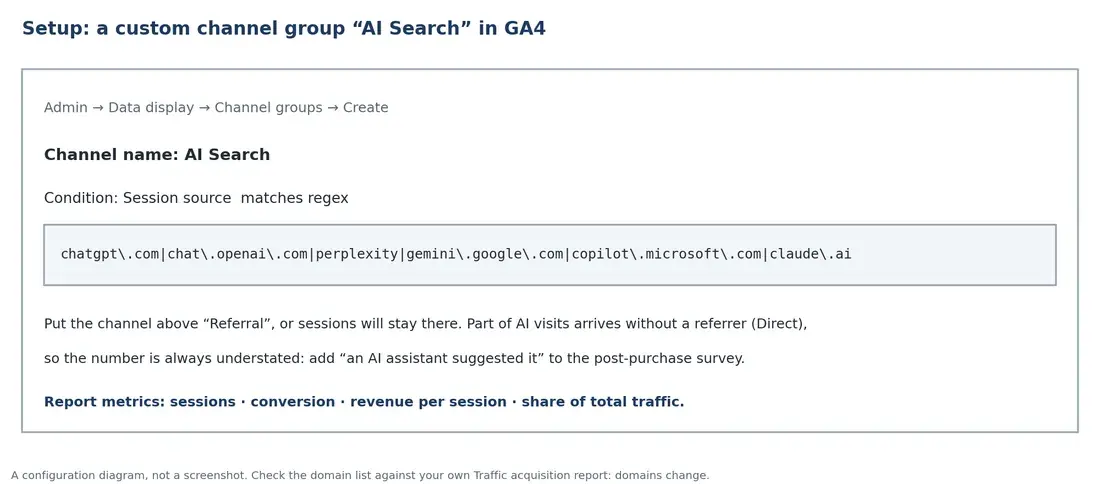
chatgpt\.com|chat\.openai\.com|perplexity|gemini\.google\.com|copilot\.microsoft\.com|claude\.aiPart of AI visits arrives without a referrer and lands in Direct, so the number is always understated. That is the main attribution problem.
Post-purchase survey and branded search
On the order confirmation page add one question, “How did you hear about us?”, with the option “An AI assistant suggested it (ChatGPT, Gemini, Perplexity, etc.)”. It is the cheapest way to see the part GA4 cannot. Also watch branded queries in Search Console and the dynamics of direct in the weeks when your mention rate grows: per Similarweb, a large share of visits after a recommendation arrives through branded search. Visibility Labs makes the same point from GA4 data: many people take a recommendation from ChatGPT and then search for the brand on Google, so the conversion is credited to branded organic, and it advises a post-purchase survey (Search Engine Land).
Money
Count not sessions but revenue per session and margin, as in any channel. I wrote about it in the piece on price and sales: revenue is not profit, and conversion without margin says nothing. For GEO add one criterion: compare with organic and paid search on the same landing page, not with the site average.
An honest anchor for the talk with management
At the retailers in the public cases (section 12), AI referrals give about 5% of traffic, and at one of them under 5%. Do not promise a “second organic”. Promise an experiment of 60–90 days with a baseline, success thresholds and comparison with yourself.
12. Cases: what is confirmed and how reliably
Public cases with checkable numbers are rare, and most are self-reported. Below are only those with a named source, and each states how reliable it is. Where a company reports no growth or a weaker result, I say so; that is also information.
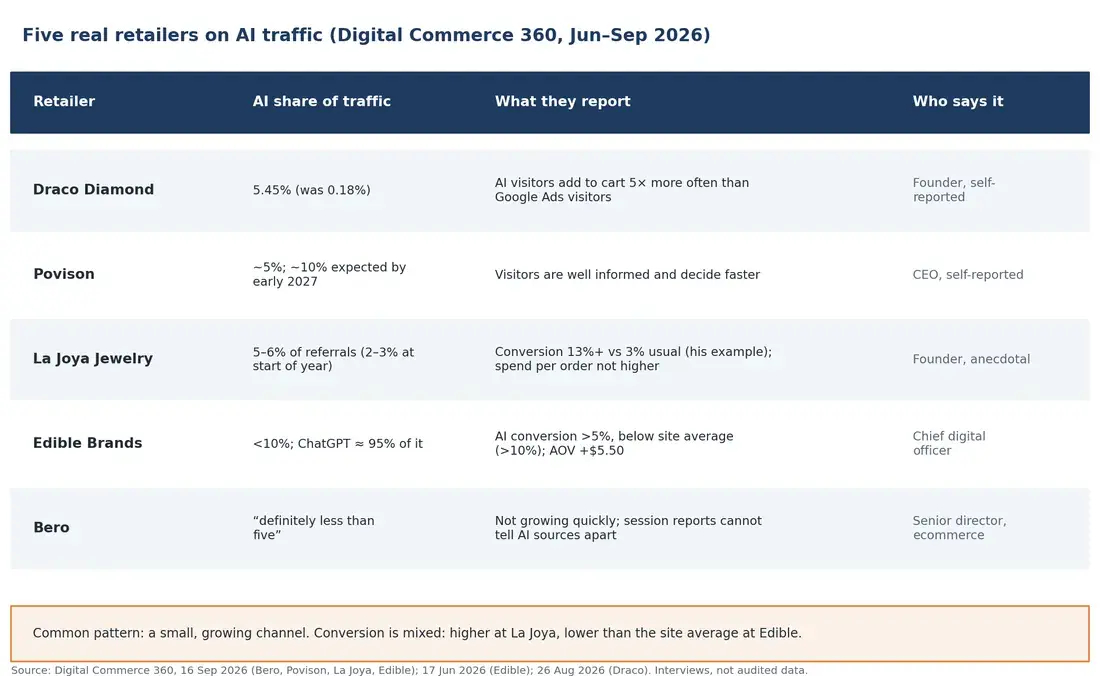
Case 1. Draco Diamond (Canada): AEO work and the share of AI in traffic
Situation. An online seller of made-to-order lab-grown diamonds. In spring 2026 founder Garrett McMartin focused on AEO. Result, as he reports it. The share of AI referrals in traffic rose from 0.18% to 5.45%; in May and July AI gave 7.3% and 6.6% of sessions. Visitors from AI added to cart five times as often as Google Ads visitors, and more than twice the site average. ChatGPT supplied 84% of all AI referrals. Revenue grew 78% and 195% year over year in June and July (5% and 10% in April and May). Takeaway. The founder expected AI visitors to arrive at the very end, for confirmation; the data showed they sit mid-research and return to buy later. Reliability: self-reported. The actions are not disclosed in the article; the revenue growth coincided with the AEO work, but causation is not proven (Digital Commerce 360).
Case 2. Povison (furniture, US): a bet on the ecosystem
Result, per CEO Ayden Lin. AI referrals give about 5% of site traffic; he expects about 10% by early 2027. He describes these visitors as “highly informed”: they look for detailed product information, compare options in a shorter time and expect accurate recommendations and fast service. What he does. Structured product data, brand storytelling, expert publications in industry media. The goal for the holiday season: when shoppers ask an assistant about furniture, Povison is in the answer. Takeaway. He says it needs a different kind of content investment from traditional search and paid media. Reliability: self-reported, no independent confirmation (Digital Commerce 360, 26 Aug and 16 Sep 2026).
Case 3. La Joya Jewelry (US): traffic that has already done its research
Situation. An online seller of lab-grown diamonds. Result, as the founder tells it. Nishit Mehta says AI sources were about 2% to 3% of referral traffic at the start of 2026 and had grown to about 5% or 6%. The traffic is “very focused” and converts better than organic or paid; as an example he says that a normal 3% conversion rate becomes more than 13% for visitors arriving from AI. They are not necessarily spending more: the main trend is that they have already done their research. In 2024 and 2025 the company had to explain what set lab-grown diamonds apart from natural ones; in 2026 that is a negligible part of its traffic. Takeaway. The landing page for this visitor confirms a decision; it does not teach the category. Reliability: a founder’s account, with an illustrative example rather than audited figures (Digital Commerce 360, 16 Sep 2026).
Case 4. Edible Brands (US): real traffic, conversion below the site average
Situation. A gift retailer, No. 182 in Digital Commerce 360’s Top 1000 database. Result, per chief digital officer Erica Randerson. Less than 10% of website traffic comes from AI referrals, and ChatGPT is about 95% of that; the traffic is growing “at an exponential rate”. Conversion from AI traffic is above 5%, but lower than the site average of more than 10%, which she explains by a gift-oriented, high-intent audience that arrives knowing whom it is shopping for. Average order value from AI traffic is $5.50 higher than the site average. What the company does. It is replatforming from a homegrown system to Shopify (not finished when interviewed in June), investing in technology and data infrastructure, and reading its own on-site search to learn how shoppers phrase requests. Takeaway. “AI converts better” is not universal: for a retailer whose own audience already converts above 10%, AI visitors are a smaller, growing and slightly lower-converting segment with higher baskets. Reliability: an executive interview (17 Jun and 16 Sep 2026).
Case 5. Bero (non-alcoholic beer, US): a null result
Result. Hyojin Park, senior director of ecommerce solutions and growth, says the share of traffic arriving through AI referrals is “definitely less than five” percent. When she goes deep into referral sources she sometimes sees ChatGPT, “but it’s nothing significant”, and the channel is not growing quickly, which surprised her. She adds that session reporting is not yet advanced enough to tell what comes from where in terms of AI. Takeaway. Not every brand sees the channel yet, and attribution is a limit in itself: what you cannot see you cannot manage, which is why section 11 builds measurement before scaling. Reliability: an interview (Digital Commerce 360, 16 Sep 2026).
Case 6. Vessi and Cotopaxi: preparing the data before there are results
Vessi (waterproof footwear, Canada) chose not to block AI agents. Director of D2C and lifecycle marketing Ray Hua says Vessi can separate human traffic from agent traffic and, in Shopify, see sessions originating in ChatGPT. The priority is clean product data and catalogue so that LLMs can identify the products; SEO still drives a lot of organic traffic, and AI does not replace strong products and brand storytelling (Digital Commerce 360, 29 Apr 2026). Cotopaxi (outdoor gear) has not plugged into any LLM directly and works through partners; it is moving its data from keyword to contextual discovery and says every marketplace has slightly different requirements (Digital Commerce 360, 2 Jun 2026). Takeaway. Both treat data quality as the first step and reserve judgement on results. Reliability: descriptions of practice, no numbers.
Case 7. Walmart: the checkout inside the chat did not convert
Covered in section 3: about 200,000 products offered through Instant Checkout from November, conversion at one third of click-outs, the format phased out in March 2026, and Walmart’s move to a ChatGPT app and to Gemini. Takeaway. The channel works for discovery and fails if the purchase is forced into a thinner experience than the retailer’s own. Reliability: a Walmart executive’s statement, relayed by trade press from a WIRED interview; OpenAI’s own statement about the format change is primary (Search Engine Land).
Case 8. Sephora, Ulta, Kayak, Capital One: a recommendation changes behaviour
This is not one company’s story but the Similarweb study from section 2: after Sephora was recommended, 7.9% of users visited Sephora and 3.3% Ulta; after Ulta was recommended, 7.6% visited Ulta and 4.6% Sephora; for Kayak, 12.0% against 3.4% for Skyscanner. Takeaway. A recommendation works like advertising that cannot be bought, and it must be measured through branded search, not only through the click. Reliability: US desktop panel, one vendor; causation cannot be excluded by this alone, but the size of the effect and its repetition across three categories are telling (Similarweb).
Case 9. Large samples that disagree: 973 sites, 94 sites, and the UK
973 sites. The peer-reviewed study by Kaiser and Schulze in Marketing Science: about $20 billion in revenue, more than 50,000 transactions from ChatGPT referrals. ChatGPT under 0.2% of traffic; conversion lower than every channel except paid social; conversion rising over the period (INFORMS). 94 sites. Visibility Labs, 2025 GA4 data: ChatGPT converted 31% better than non-branded organic but brought 1.48% of its revenue (section 2). The UK. According to Adobe, AI referrals to UK retail sites grew 1,439% between October 2024 and August 2026; in May 2026 conversion of AI visits first exceeded that of regular web search, and by August it was about 20% above non-AI traffic (Adobe UK). Takeaway. The periods, samples and definitions differ, so the three do not contradict each other as much as they seem to: the channel was weak in 2024–2025, improved through 2025, and in 2026 is above average in Adobe’s data and mixed in the retailers’ own. Reliability: the first is peer-reviewed; the others are vendor data with the limited definition of AI traffic (clicks only).
What the cases have in common
There is no “trick” in any of them. The same things everywhere: product data in order, facts on pages, presence beyond your own site, and measurement. The honest ones also show the limits: a retailer that sees nothing yet (Bero), one whose AI visitors convert below its own average (Edible), and a checkout that failed (Walmart). Most numbers are self-reported, relative or niche. That is why your main case is your own baseline measurement.
13. Eight mistakes
| Mistake | Why it hurts | What to do |
|---|---|---|
| One measurement, one conclusion | Answers are non-deterministic | A series of runs and a rate |
| Optimising only for ChatGPT | Its share of gen-AI web traffic fell from ~76% to ~53% in a year | Monitor 4–5 systems |
| Blocking all AI bots “just in case” | You drop out of ChatGPT’s search index | Separate search bots from training |
| Facts in images and behind JavaScript | The model will not read them | Price, availability, specs in HTML |
| “For everyone” copy with no downsides | No difference, no trust | Who it fits, who it does not |
| Only your own site, zero external mentions | Mentions correlate strongest | Reviews, roundups, YouTube, Reddit |
| Fake reviews and spam in discussions | Violates platform rules and the law | Honest reviews and disclosure |
| Betting on in-chat checkout | Walmart’s in-ChatGPT purchases converted at about a third of click-outs, and OpenAI rolled the format back | Feed the discovery layer; convert on your own site or app |
14. Checklist and a 90-day plan
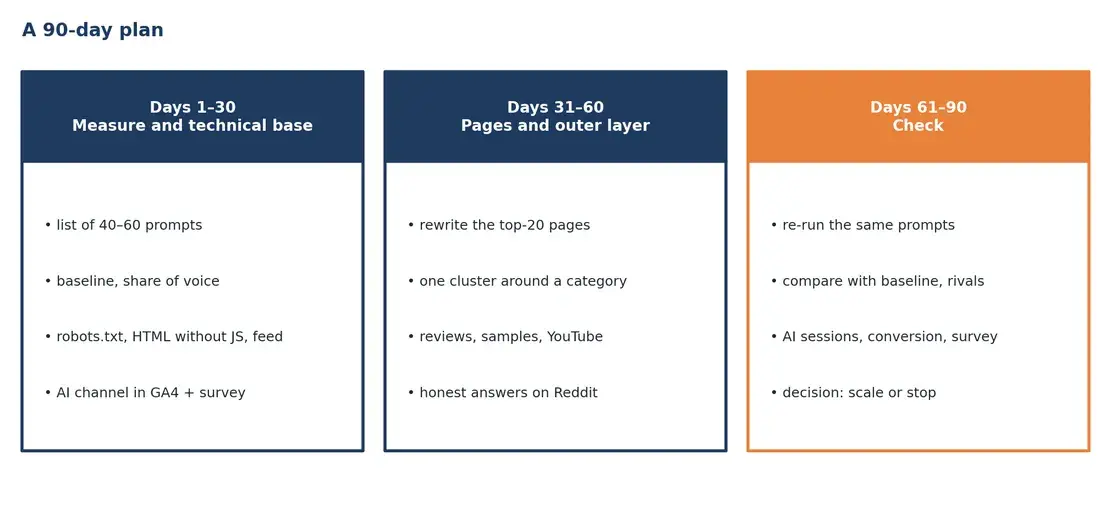
1. A list of 40–60 queries by 5 types, including queries without the brand name.
2. A baseline: 4–5 systems × 3 runs; mention rate, citation rate and share of voice calculated.
3. Five main competitors named; the sites AI links to for your queries written down.
4. robots.txt: search AI bots not blocked; training decision made deliberately; site registered in Bing Webmaster Tools.
5. Prices, availability, specs and reviews visible in HTML without JavaScript.
6. Top-20 pages answer in the first 2–3 sentences, with spec and comparison tables.
7. Pages carry an author, an update date, data sources and an honest “who it is not for” block.
8. Product, Offer, Rating and FAQ marked up and passing the validator.
9. The feed matches the site on prices and availability.
10. A plan for independent mentions: reviews, roundups, YouTube, Reddit under your own name.
11. The AI Search channel set up in GA4; the Generative AI performance report open in Search Console.
12. The post-purchase survey has the option “an AI assistant suggested it”.
13. An owner and a rhythm of measurement (at least monthly) assigned.
14. Success thresholds for 60 and 90 days set against the baseline.
15. The “scale or stop” decision is made by comparison with the baseline, not by feel.
What to do on Monday morning
- Assign one owner and one day for the audit.
- Collect 40 queries from the templates in section 5 and run them in three systems.
- Check robots.txt and logs for OAI-SearchBot and PerplexityBot.
- Open your three main pages and check whether price and availability are in the source.
- Add “an AI assistant suggested it” to the post-purchase survey.
15. What next (forecasts, not facts)
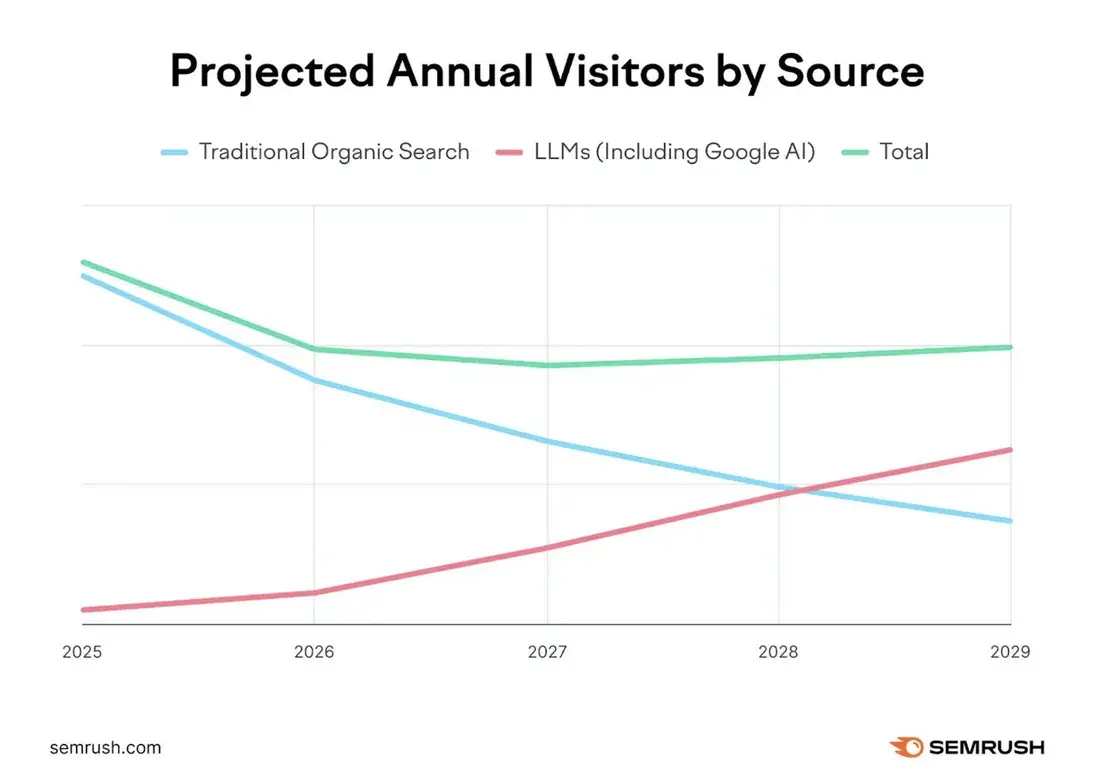
Semrush has published a projection of annual visitors by source for 2025–2029: traditional organic search declines, traffic from LLMs (including Google’s AI) rises, the total stays roughly flat, and the two lines cross around 2028. It is a scenario by one vendor, not a measurement; the chart has no values on the axis, so read it as a direction.
- Discovery moves into assistants; checkout stays with the merchant. After the Instant Checkout rollback OpenAI points merchants to their own checkout and to apps, and Google’s UCP adds cart, catalogue and identity linking. Whoever supplies clean data is eligible; whoever does not drops out of the shortlist.
- Fragmentation. ChatGPT’s share is falling, so monitoring has to span several systems.
- Paid slots in answers. Google’s own blog lists an update titled “Ads in AI Mode expand to new markets”, so paid placement inside AI answers is already a product, and organic presence will get relatively more expensive (Google).
- The value of reputation. If the environment around a brand weighs more than its pages, brands with real reputation win, not optimisers.
I would end with the constraint I started with. GEO is not about tricking ChatGPT; it is about making the brand findable, understandable, mentioned by others and readable by a machine. If you do that, you also do ordinary marketing better.
Sources
- Pew Research Center, Google users are less likely to click on links when an AI summary appears, 22 Jul 2025
- Ahrefs, Update: AI Overviews Reduce Clicks by 58%, 4 Feb 2026
- Ahrefs, An Analysis of AI Overview Brand Visibility Factors (75K brands)
- Ahrefs, Which Types of Mentions Correlate the Strongest With AI Visibility (260M prompts)
- Semrush, Traffic Channel Mix Study
- Digital Commerce 360, Adobe: AI-referral traffic spending, converting more than counterparts, 19 Aug 2026
- Adobe UK, Digital Insights Trends, August 2026
- Similarweb, AI Search Stats 2026
- Similarweb, The Downstream Impact of AI Visibility
- Kaiser, Schulze, ChatGPT Referrals to E-Commerce Websites, Marketing Science (INFORMS)
- Digiday, E-commerce sites see low sales from ChatGPT traffic
- Wix Studio AI Search Lab, Content types most cited by LLMs
- Aggarwal et al., GEO: Generative Engine Optimization, KDD 2024 (arXiv:2311.09735)
- Google Search Central, Search Generative AI performance reports, 3 Jun 2026
- Semrush, Google publishes generative AI search guide (retelling of Google’s May 2026 guide)
- Digital Commerce 360, Draco Diamond, 26 Aug 2026
- Digital Commerce 360, Povison, 26 Aug 2026
- Digital Commerce 360, Vessi, 29 Apr 2026
- Ahrefs, AI Overviews Currently Appear for 83% of Branded Searches, 2 Oct 2026
- Ahrefs, AI Assistants Prefer to Cite Fresher Content (17M citations)
- Search Engine Land, ChatGPT ecommerce traffic converts 31% higher than non-branded organic search (Visibility Labs)
- Search Engine Land, Walmart: ChatGPT checkout converted 3x worse than website
- OpenAI, Powering Product Discovery in ChatGPT, 24 Mar 2026
- Google, AI shopping gets simpler with Universal Commerce Protocol updates, 19 Mar 2026
- Digital Commerce 360, How AI referrals are impacting traffic at 4 online retailers, 16 Sep 2026
- Digital Commerce 360, Which AI sources are sending referral traffic to online retailers, 3 Sep 2026
- Digital Commerce 360, Edible Brands navigates AI traffic, 17 Jun 2026
- Digital Commerce 360, Cotopaxi prepares data for agentic AI discovery, 2 Jun 2026
- Digital Commerce 360 and ReFiBuy, AI Commerce Rankings, Q2 2026
- OpenAI, crawler documentation
What I did not verify directly and flagged in the text: the starting month of Adobe’s UK growth, the rounded Gemini and Claude shares at Similarweb, the details of Google’s May 2026 guide (retold by trade press), trade-press details of Google’s native checkout, the sample behind Seer Interactive’s chart, vendor-claimed panel sizes (Profound), and the Ahrefs comparison with the year-earlier branded-query study (different samples). For the GEO paper I read the abstract only. Charts credited to Adobe, Similarweb, Semrush, Seer Interactive, Ahrefs and Profound are the vendors’ own publications; the other charts are drawn by me from the published numbers and are labelled as such. There are no invented companies, cases or numbers in this guide.
Related on sabirov.club
- An ad creative is a hypothesis you test
- Zero-budget marketing: what you pay with when there is no budget
- Marketing and sales: managing one shared result
- Price and sales: set it, raise it, discount it
- How to research a market for free: 48 sources
- 8 seconds for a landing page
- Brand marketing: how to get chosen
- Principles of growth, part 1